| NOTE
15 - FINANCIAL RISK MANAGEMENT AND DERIVATIVES: |
| The purpose of the Company's foreign
currency hedging activities is to protect the Company from the risk
that the eventual dollar cash flows resulting from the sale and purchase
of products in foreign currencies will be adversely affected by changes
in exchange rates. In addition, the Company seeks to manage the impact
of foreign currency fluctuations related to the repayment of intercompany
borrowings. The Company does not hold or issue financial instruments
for trading purposes. It is the Company's policy to utilize derivative
financial instruments to reduce foreign exchange risks where internal
netting strategies cannot be effectively employed. Fluctuations in
the value of hedging instruments are offset by fluctuations in the
value of the underlying exposures being hedged.
The Company uses forward exchange contracts and purchased options
to hedge certain firm purchases and sales commitments and the related
receivables and payables including other third party or intercompany
foreign currency transactions. Purchased currency options are used
to hedge certain anticipated but not yet firmly committed transactions
expected to be recognized within one year. Cross-currency swaps
are used to hedge foreign currency denominated payments related
to intercompany loan agreements. Hedged transactions are denominated
primarily in European currencies, Japanese yen and Canadian dollars.
Premiums paid on purchased options and any realized gains are included
in prepaid expenses or accrued liabilities and recognized in earnings
when the underlying transaction is recognized. Deferred option premiums
paid, net of realized gains, were $21.7 million and $14.5 million
at May 31, 1998 and 1997, respectively. Gains and losses related
to hedges of firmly committed transactions and the related receivables
and payables are deferred and are recognized in income or as adjustments
of carrying amounts when the offsetting gains and losses are recognized
on the underlying transaction. Net realized and unrealized gains
on forward contracts deferred at May 31, 1998 and 1997 were $12.0
million and $28.0 million, respectively.
The estimated fair values of derivatives used to hedge the Company's
risks will fluctuate over time. The fair value of the forward exchange
contracts is estimated by obtaining quoted market prices. The fair
value of option contracts is estimated using option pricing models
widely used in the financial markets. These fair value amounts should
not be viewed in isolation, but rather in relation to the fair values
of the underlying hedged transactions and the overall reduction
in the Company's exposure to adverse fluctuations in foreign exchange
rates. The notional amounts of derivatives summarized below do not
necessarily represent amounts exchanged by the parties and, therefore,
are not a direct measure of the exposure to the Company through
its use of derivatives. The amounts exchanged are calculated on
the basis of the notional amounts and the other terms of the derivatives,
which relate to interest rates, exchange rates or other financial
indices.
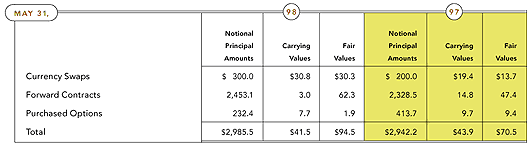
The following table presents the aggregate notional principal amounts,
carrying values and fair values of the Company's derivative financial
instruments outstanding at May 31, 1998 and 1997.
At May 31, 1998 and May 31, 1997, the Company had no contracts outstanding
with maturities beyond one year except the currency swaps which
have maturity dates consistent with the maturity dates of the related
debt. All realized gains/losses deferred at May 31, 1998 will be
recognized within one year.
The counterparties to derivative transactions are major financial
institutions with high investment grade credit ratings and, additionally,
counterparties to derivatives three years or greater are all AAA
rated. However, this does not eliminate the Company's exposure to
credit risk with these institutions. This credit risk is generally
limited to the unrealized gains in such contracts should any of
these counterparties fail to perform as contracted and is immaterial
to any one institution at May 31, 1998 and 1997. To manage this
risk, the Company has established strict counterparty credit guidelines
which are continually monitored and reported to Senior Management
according to prescribed guidelines. The Company utilizes a portfolio
of financial institutions either headquartered or operating in the
same countries the Company conducts its business. As a result, the
Company considers the risk of counterparty default to be minimal.
|
 |
 |
|