
Results of Operations
Introduction
Landstar System, Inc. and its subsidiary, Landstar System Holdings, Inc. (“Landstar” or the “Company”), provide transportation services to a variety of market niches throughout the United States and to a lesser extent in Canada and between the United States and Canada and Mexico through its operating subsidiaries. The Company has three reportable business segments. These are the carrier, multimodal and insurance segments.
The carrier segment consists of Landstar Ranger, Inc. (“Landstar Ranger”), Landstar Inway, Inc., Landstar Ligon, Inc. (“Landstar Ligon”) and Landstar Gemini, Inc. The carrier segment provides truckload transportation for a wide range of general commodities over irregular routes with its fleet of dry and specialty vans and unsided trailers, including flatbed, drop deck and specialty. It also provides short-to-long haul movement of containers by truck and dedicated power-only truck capacity. The carrier segment markets its services primarily through independent commission sales agents and utilizes tractors provided by independent contractors. The nature of the carrier segment’s business is such that a significant portion of its operating costs varies directly with revenue. The carrier segment historically has contributed approximately 80% of Landstar’s consolidated revenue.
The multimodal segment is comprised of Landstar Logistics, Inc. and Landstar Express America, Inc. (“Landstar Express America”). Transportation services provided by the multimodal segment include the arrangement of intermodal moves, contract logistics, truck brokerage and emergency and expedited air freight. The multimodal segment markets its services through independent commission sales agents and utilizes capacity provided by independent contractors, including railroads and air cargo carriers. The nature of the multimodal segment’s business is such that a significant portion of its operating costs also varies directly with revenue. The multimodal segment historically has contributed approximately 18% of Landstar’s consolidated revenue.
The insurance segment is comprised of Signature Insurance Company (“Signature”), a wholly-owned offshore insurance subsidiary, and Risk Management Claim Services, Inc. The insurance segment provides risk and claims management services to Landstar’s operating companies. In addition, it reinsures certain property, casualty and occupational accident risks of certain independent contractors who have contracted to haul freight for Landstar and provides certain property and casualty insurance directly to Landstar’s operating subsidiaries. The insurance segment historically has contributed approximately 2% of Landstar’s consolidated revenue.
On August 22, 1998, Landstar Poole, Inc. (“Landstar Poole”), a wholly-owned subsidiary of Landstar which comprised the entire company-owned tractor segment, completed the sale of all of its tractors and trailers, certain operating assets and the Landstar Poole business to Schneider National, Inc. for $40,435,000 in cash. Accordingly, the historical financial results of this segment have been reported as discontinued operations in the accompanying financial statements.
Purchased transportation represents the amount an independent contractor is paid to haul freight and is primarily based on a contractually agreed-upon percentage of revenue generated by the haul for truck capacity provided by independent contractors. Purchased transportation for the intermodal services operations and the air freight operations of the multimodal segment is based on a contractually agreed-upon fixed rate. Purchased transportation as a percentage of revenue for the intermodal services operations is normally higher than that of Landstar’s other transportation operations. Purchased transportation is the largest component of costs and expenses and, on a consolidated basis, increases or decreases in proportion to the revenue generated through independent contractors. Commissions to agents are primarily based on contractually agreed-upon percentages of revenue at the carrier segment and of gross profit at the multimodal segment. Commissions to agents as a percentage of consolidated revenue will vary directly with the percentage of consolidated revenue generated through independent commission sales agents. Both purchased transportation and commissions to agents generally will also increase or decrease as a percentage of the Company’s consolidated revenue if there is a change in the percentage of revenue contributed by Signature or by the intermodal services operations or the air freight operations of the multimodal segment.
Trailer rent and maintenance costs are the largest components of other operating costs.
Potential liability associated with accidents in the trucking industry is severe and occurrences are unpredictable. A material increase in the frequency or severity of accidents or workers’ compensation claims or the unfavorable development of existing claims can be expected to adversely affect Landstar’s operating income.
Employee compensation and benefits account for over half of the Company’s selling, general and administrative expense. Other significant components of selling, general and administrative expense are communications cost and rent expense.
Depreciation and amortization primarily relates to depreciation of trailers and management information services equipment.
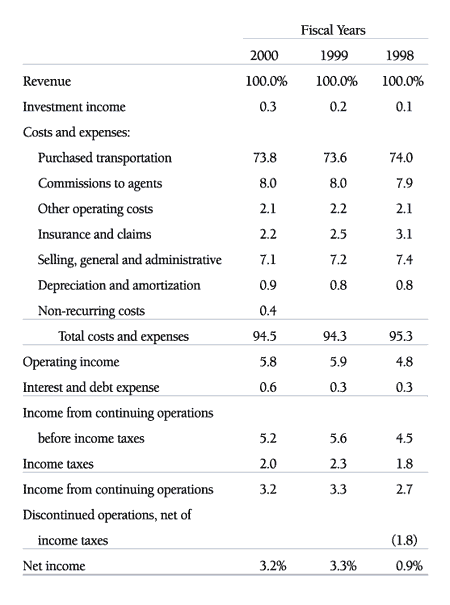
The following table sets forth the percentage relationships of expense items to revenue for the periods indicated:
Compared to Fiscal Year Ended December 25, 1999
Revenue for the fiscal year 2000 was $1,418,492,000, an increase of $30,409,000, or 2.2%, over revenue for the 1999 fiscal year. The increase was attributable to higher revenue at the carrier and multimodal segments of $5,130,000 and $26,692,000, respectively, partially offset by decreased revenue of $1,413,000 at the insurance segment. Overall, revenue per revenue mile (price) increased approximately 3%, partially offset by decreased revenue miles (volume) of approximately 1%. The decrease in revenue from the prior year at the insurance segment was primarily attributable to reduced independent contractor participation in the insurance programs reinsured by Signature. Investment income at the insurance segment was $4,317,000 and $2,502,000 for fiscal year 2000 and 1999, respectively.
Purchased transportation was 73.8% of revenue in 2000 compared with 73.6% in 1999. The increase in purchased transportation as a percentage of revenue was primarily attributable to increased revenue contributed by the multimodal segment which tends to have a higher cost of purchased transportation and decreased premium revenue at the insurance segment. In addition, purchased transportation costs at the multimodal segment were generally higher due to increased fuel costs incurred by its capacity providers. Commissions to agents were 8.0% of revenue in 2000 and 1999. Other operating costs were 2.1% of revenue in 2000 compared with 2.2% in 1999. The decrease in other operating costs as a percentage of revenue was primarily attributable to the increase in the percentage of revenue contributed by the multimodal segment which does not incur trailer rent or trailer maintenance costs. Insurance and claims were 2.2% of revenue in 2000 compared with 2.5% in 1999 primarily due to increased revenue at the multimodal segment, which has a lower claims risk profile, and lower overall accident frequency and severity in 2000. Selling, general and administrative costs were 7.1% of revenue in 2000 and 7.2% in 1999. The decrease in selling, general and administrative costs as a percentage of revenue was primarily due to a decrease in the provision for bonuses under the Company’s incentive compensation plan. Depreciation and amortization was 0.9% of revenue in 2000 and 0.8% of revenue in 1999. The increase in depreciation and amortization as a percent of revenue was due to an increase in company-owned trailing equipment.
Approximately 100 Landstar Ranger drivers are represented by the International Brotherhood of Teamsters (the “Teamsters”). The vast majority of these unionized drivers participate in the Teamsters’ Central States Southeast and Southwest Areas Pension Fund (the “Fund”). Under a prior collective bargaining agreement, Landstar Ranger was required to make contributions to various Teamster pension funds for 205 drivers regardless of the actual number of unionized drivers. Effective April 1, 2000, a new collective bargaining agreement required Landstar Ranger to make pension contributions for only the actual number of unionized drivers. As a result of the elimination of the requirement to make contributions for more than the actual number of unionized drivers, the Trustees of the Fund have terminated participation in the Fund by Landstar Ranger effective October 1, 2000. The Trustees of the Fund regard this action as a withdrawal by Landstar Ranger. Landstar Ranger recorded a charge in the amount of $2,230,000 for the estimated cost of withdrawal from the Fund. Management estimates the elimination of the requirement to make contributions for more than the actual number of unionized drivers will result in annual savings of approximately $800,000.
On March 28, 2000, the Company announced a plan to restructure the operations of Landstar Ligon and to relocate its headquarters from Madisonville, Kentucky to Jacksonville, Florida in June of 2000. As a result of the restructuring and relocation, a one-time charge in the amount of $3,040,000 was recorded during the second quarter of 2000 representing approximately $1,370,000 of employee and office relocation costs, $1,000,000 of severance costs and $670,000 of other costs. The restructuring and relocation were substantially completed by September 23, 2000. Management anticipates future savings of selling, general and administrative costs as a result of this restructuring to approximate $1,000,000 per annum.
Interest and debt expense was 0.6% of revenue in 2000 and 0.3% of revenue in 1999. This increase was primarily attributable to increased average borrowings on the senior credit facility, which were used to finance a portion of the Company’s stock repurchase program, increased capital lease obligations for trailing equipment and higher interest rates.
The provisions for income taxes for the 2000 and 1999 fiscal years were based on an effective income tax rate of 38.5% and 40.5%, respectively, which is higher than the statutory federal income tax rate primarily as a result of state income taxes, amortization of certain goodwill and the meals and entertainment exclusion. The decrease in the effective income tax rate was attributable to state income tax planning strategies. At December 30, 2000, the valuation allowance of $615,000 was attributable to deferred state income tax benefits, which primarily represented state operating loss carryforwards at one subsidiary. The valuation allowance and goodwill will be reduced by $587,000 when realization of deferred state income tax benefits becomes likely. The Company believes that deferred income tax benefits, net of the valuation allowance, are more likely than not to be realized because of the Company’s ability to generate future taxable earnings.
Net income was $45,194,000, or $5.15 per common share ($5.03 per diluted share), in 2000 compared with $45,937,000, or $4.60 per common share ($4.55 per diluted share), in 1999. After deducting related income tax benefits of $2,105,000, the non-recurring costs reduced net income by $3,165,000 in 2000. Excluding non-recurring costs, net income would have been $48,359,000, or $5.51 per common share ($5.38 per diluted share) in 2000.
Fiscal Year Ended December 25, 1999
Compared to Fiscal Year Ended December 26, 1998
Revenue for the fiscal year 1999 was $1,388,083,000, an increase of $104,476,000, or 8.1%, over revenue for the 1998 fiscal year. The increase was attributable to higher revenue at the carrier, multimodal and insurance segments of $82,480,000, $20,401,000 and $1,595,000, respectively. Overall, revenue per revenue mile (price) increased approximately 3%, which reflected improved freight quality, and revenue miles (volume) increased approximately 6%. The increase in revenue over the prior year at the insurance segment was attributable to increased independent contractor participation in the insurance programs reinsured by Signature.
Purchased transportation was 73.6% of revenue in 1999 compared with 74.0% in 1998. The decrease in purchased transportation as a percentage of revenue was primarily attributable to reduced intermodal and air freight revenue which tend to have a higher cost of purchased transportation and increased utilization of company-owned or leased trailers as opposed to those supplied by independent contractors. Commissions to agents were 8.0% of revenue in 1999 compared with 7.9% in 1998 primarily due to an increase in the percentage of revenue generated through independent commission sales agents which reflected the conversion of company-owned sales locations to independent commission sales agent locations. Other operating costs were 2.2% of revenue in 1999 compared with 2.1% in 1998. The increase in other operating costs as a percentage of revenue was primarily attributable to a higher provision for contractor bad debts, higher net trailer costs and increased contractor recruiting costs, partially offset by a one-time reduction in the cost of fuel taxes which resulted from a favorable fuel tax audit. Insurance and claims were 2.5% of revenue in 1999 compared with 3.1% in 1998 primarily due to the favorable development of prior year claims in 1999. Selling, general and administrative costs were 7.2% of revenue in 1999 and 7.4% in 1998. The decrease in selling, general and administrative costs as a percentage of revenue was due to the effect of the increase in revenue, a decrease in the provision for customer bad debts and one-time costs of $560,000 attributable to the relocation in 1998 of Landstar Express America from Charlotte, North Carolina to Jacksonville, Florida, partially offset by increased wages and benefits, increased information services costs and a higher provision for bonuses under the Company’s incentive compensation plan.
Interest and debt expense was 0.3% of revenue in 1999 and 1998.
The provisions for income taxes from continuing operations for the 1999 and 1998 fiscal years were based on an effective income tax rate of 40.5%, which is higher than the statutory federal income tax rate primarily as a result of state income taxes, amortization of certain goodwill and the meals and entertainment exclusion.
Net income was $45,937,000, or $4.60 per common share, in 1999 compared with income from continuing operations of $34,481,000, or $3.13 per common share, in 1998. Including the dilutive effect of the Company’s stock options, diluted earnings per share was $4.55 in 1999 and diluted earnings per share from continuing operations was $3.10 in 1998.
The loss from discontinued operations of $22,589,000, or $2.05 per common share ($2.03 diluted loss per share), in 1998 included a loss on sale of $21,489,000, net of income tax benefits of $2,511,000, and a loss from operations of $1,100,000, net of income tax benefits of $597,000.
Net income was $11,892,000, or $1.08 per common share, in 1998. Including the dilutive effect of the Company’s stock options, diluted earnings per share was $1.07 in 1998.
Capital Resources and Liquidity
On October 10, 1997, Landstar renegotiated its existing Credit Agreement with a syndicate of banks and The Chase Manhattan Bank, as administrative agent (the “Second Amended and Restated Credit Agreement”). The Second Amended and Restated Credit Agreement provides $200,000,000 of borrowing capacity, consisting of $150,000,000 of revolving credit (the “Working Capital Facility”) and $50,000,000 of revolving credit available to finance acquisitions (the “Acquisition Facility”). $50,000,000 of the total borrowing capacity under the Working Capital Facility may be utilized in the form of letter of credit guarantees. At December 30, 2000, Landstar had commitments for letters of credit outstanding in the amount of $20,452,000, primarily as collateral for estimated insurance claims, $10,080,000 of which were supported by the Second Amended and Restated Credit Agreement and $10,372,000 secured by assets deposited with a financial institution. The Second Amended and Restated Credit Agreement expires on October 10, 2002.
Borrowings under the Second Amended and Restated Credit Agreement bear interest at rates equal to, at the option of Landstar, either (i) the greatest of (a) the prime rate as publicly announced from time to time by The Chase Manhattan Bank, (b) the three month CD rate adjusted for statutory reserves and FDIC assessment costs plus 1% and (c) the federal funds effective rate plus 1/2%, or, (ii) the rate at the time offered to The Chase Manhattan Bank in the Eurodollar market for amounts and periods comparable to the relevant loan plus a margin that is determined based on the level of the Company’s Leverage Ratio, as defined in the Second Amended and Restated Credit Agreement. As of December 30, 2000, the margin was equal to 37.5/100 of 1%. The unused portion of the Second Amended and Restated Credit Agreement carries a commitment fee determined based on the level of the Leverage Ratio, as therein defined. As of December 30, 2000, the commitment fee for the unused portion of the Second Amended and Restated Credit Agreement was 0.125%. At December 30, 2000, the weighted average interest rate on borrowings outstanding under the Second Amended and Restated Credit Agreement was 7.06%.
The Second Amended and Restated Credit Agreement contains a number of covenants that limit, among other things, the incurrence of additional indebtedness, the incurrence of operating or capital lease obligations and the purchase of operating property. The Second Amended and Restated Credit Agreement also requires Landstar to meet certain financial tests. Landstar is required to, among other things, maintain minimum levels of Net Worth, as defined in the Second Amended and Restated Credit Agreement, and Interest and Fixed Charge Coverages, as therein defined. Under the most restrictive covenant, Landstar exceeded the required Interest Coverage level by $11,019,000 at December 30, 2000.
The Second Amended and Restated Credit Agreement provides a number of events of default related to a person or group acquiring 25% or more of the outstanding capital stock of the Company or obtaining the power to elect a majority of the Company’s directors.
Borrowings under the Second Amended and Restated Credit Agreement are unsecured, however, the Company and all but one of Landstar System Holdings, Inc.’s (“LSHI”) subsidiaries guarantee LSHI’s obligations under the Second Amended and Restated Credit Agreement.
Shareholders’ equity was $107,859,000, or 53% of total capitalization, at December 30, 2000, compared with $106,884,000, or 61% of total capitalization, at December 25, 1999. The reduction in shareholders’ equity as a percentage of a total capitalization was primarily a result of the purchase of 864,000 shares of the Company’s common stock at a total cost of $46,185,000, partially offset by fiscal year’s 2000 net income. As of December 30, 2000, the Company may purchase an additional 500,000 shares of its common stock under its authorized stock repurchase program. Long-term debt including current maturities was $94,643,000 at December 30, 2000, $27,345,000 higher than at December 25, 1999, primarily as a result of financing a portion of the stock repurchase program with borrowings under the Second Amended and Restated Credit Agreement. Working capital and the ratio of current assets to current liabilities were $94,718,000 and 1.61 to 1, respectively, at December 30, 2000, compared with $81,589,000 and 1.48 to 1, respectively, at December 25, 1999. Landstar has historically operated with current ratios approximating 1.5 to 1. Cash provided by operating activities was $54,047,000 in 2000 compared with $43,582,000 in 1999. The increase in cash provided by operating activities was attributable to the timing of collection of accounts receivable. During the 2000 fiscal year, Landstar purchased $7,305,000 of operating property and acquired $18,448,000 of revenue equipment by entering into capital leases. Landstar anticipates it will acquire approximately $12,000,000 of operating property during fiscal year 2001 either by purchase or by lease financing.
Landstar is involved in certain claims and pending litigation arising from the normal conduct of business. Based on the knowledge of the facts and, in certain cases, opinions of outside counsel, management believes that adequate provisions have been made for probable losses with respect to the resolution of all claims and pending litigation and that the ultimate outcome, after provisions thereof, will not have a material adverse effect on the financial condition of Landstar, but could have a material effect on the results of operations in a given quarter or year.
Management believes that cash flow from operations combined with its borrowing capacity under the Second Amended and Restated Credit Agreement will be adequate to meet Landstar’s debt service requirements, fund continued growth, both internal and through acquisitions, complete its announced stock repurchase program and meet working capital needs.
Management does not believe inflation has had a material impact on the results of operations or financial condition of Landstar in the past five years. However, inflation higher than that experienced in the past five years might have an adverse effect on the Company’s results of operations.
In June 1998, the Financial Accounting Standards Board issued SFAS No. 133, “Accounting for Derivative Investments and Hedging Activities.” This Statement, effective for fiscal years beginning after June 15, 2000, establishes standards for reporting and display of derivative investments and for hedging activities. Management believes that upon adoption of this Statement, Landstar’s financial statements will not be affected, considering the nature of the transactions the Company routinely enters into.
Forward-looking Statements
The following is a “safe harbor” statement under the Private Securities Litigation Reform Act of 1995. Statements contained in this document that are not based on historical facts are “forward-looking statements.” This Management’s Discussion and Analysis of Financial Condition and Results of Operations and other sections of this Annual Report contain forward-looking statements, such as statements which relate to Landstar’s business objectives, plans, strategies and expectations. Terms such as “anticipates,” “believes,” “estimates,” “plans,” “predicts,” “may,” “should,” “will,” the negative thereof and similar expressions are intended to identify forward-looking statements. Such statements are subject to uncertainties and risks, including but not limited to; an increase in the frequency or severity of accidents or workers’ compensation claims; unfavorable development of existing accident claims; a downturn in domestic economic growth or growth in the transportation sector; and other operational, financial or legal risks or uncertainties detailed in Landstar’s Securities and Exchange Commission filings from time to time. These risks and uncertainties could cause actual results or events to differ materially from historical results or those anticipated. Investors should not place undue reliance on such forward-looking statements, and the Company undertakes no obligation to publicly update or revise any forward-looking statements.
Seasonality
Landstar’s operations are subject to seasonal trends common to the trucking industry. Results of operations for the quarter ending in March are typically lower than the quarters ending June, September and December due to reduced shipments and higher operating costs in the winter months.