
Consolidation
The consolidated financial statements include the accounts of Landstar System, Inc. and its subsidiary Landstar System Holdings, Inc. (“LSHI”). Landstar System, Inc. and its subsidiary are herein referred to as “Landstar” or the “Company.” Significant inter-company accounts have been eliminated in consolidation. The preparation of the consolidated financial statements requires the use of management’s estimates. Actual results could differ from those estimates.
Fiscal Year
Landstar’s fiscal year is the 52 or 53 week period ending the last Saturday in December.
Revenue Recognition
Revenue and the related direct freight expenses are recognized upon completion of freight delivery.
Insurance Claim Costs
Landstar provides, on an actuarially determined basis, for the estimated costs of cargo, property, casualty, general liability and workers’ compensation claims both reported and for claims incurred but not reported. Landstar retains liability up to $1,000,000 for each individual property, casualty and general liability claim, $250,000 for each workers’ compensation claim and $100,000 for each cargo claim.
Tires
Tires purchased as part of trailers are capitalized as part of the cost of the equipment. Replacement tires are charged to expense when placed in service.
Investments
Investments, all of which are intended to be held to maturity, consist of investment grade bonds having maturities of up to three years and are carried at amortized cost, which approximates fair value. Short-term investments represent the current portion of these bonds. There are $3,877,000 and $4,002,000 of these bonds included in other assets at December 30, 2000 and December 25, 1999, respectively.
Operating Property
Operating property is recorded at cost. Depreciation is provided on a straight-line basis over the estimated useful lives of the related assets. Trailers are being depreciated over 7 years.
Goodwill
Goodwill represents the excess of purchase cost over the estimated fair value of net assets acquired. It is being amortized on a straight-line basis over periods of twenty and forty years. The Company assesses the recoverability of goodwill by determining whether the amortization of the goodwill balance over its remaining useful life can be recovered through projected undiscounted future operating cash flows. The amount of goodwill impairment, if any, is measured based on projected discounted future operating cash flows using a discount rate reflecting the Company’s current average cost of funds.
Income Taxes
Income tax expense is equal to the current year’s liability for income taxes and a provision for deferred income taxes. Deferred tax assets and liabilities are recorded for the future tax effects attributable to temporary differences between the financial statement carrying amounts of existing assets and liabilities and their respective tax bases. Deferred tax assets and liabilities are measured using the enacted tax rates expected to be applied to taxable income in the years in which those temporary differences are expected to be recovered or settled.
Stock-based Compensation
Compensation cost for the Company’s stock options is measured as the excess, if any, of the quoted market price of the Company’s stock at the date of grant over the exercise price of the stock option.
Earnings Per Share
Earnings per common share amounts are based on the weighted average number of common shares outstanding and diluted earnings per share amounts are based on the weighted average number of common shares outstanding plus the incremental shares that would have been outstanding upon the assumed exercise of all dilutive stock options.
(2) Non-recurring Costs
Approximately 100 Landstar Ranger, Inc. (“Landstar Ranger”) drivers are represented by the International Brotherhood of Teamsters (the “Teamsters”). The vast majority of these unionized drivers participate in the Teamsters’ Central States Southeast and Southwest Areas Pension Fund (the “Fund”). Under a prior collective bargaining agreement, Landstar Ranger was required to make contributions to various Teamster pension funds for 205 drivers regardless of the actual number of unionized drivers. Effective April 1, 2000, a new collective bargaining agreement required Landstar Ranger to make pension contributions for only the actual number of unionized drivers. As a result of the elimination of the requirement to make contributions for more than the actual number of unionized drivers, the Trustees of the Fund have terminated participation in the Fund by Landstar Ranger effective October 1, 2000. The Trustees of the Fund regard this action as a withdrawal by Landstar Ranger. In the third quarter of 2000, the Company recorded a charge in the amount of $2,230,000 for its estimated cost of withdrawal from the Fund. After deducting related income tax benefits of $880,000, this charge reduced fiscal year 2000 net income by $1,350,000, or $0.15 per common share ($0.15 per diluted share).
On March 28, 2000, the Company announced a plan to restructure the operations of Landstar Ligon, Inc. and to relocate its headquarters from Madisonville, Kentucky to Jacksonville, Florida in June of 2000. As a result of this restructuring and relocation, a one-time charge in the amount of $3,040,000 was recorded during the second quarter of 2000 representing approximately $1,370,000 of employee and office relocation costs, $1,000,000 of severance costs and $670,000 of other costs. The restructuring and relocation were substantially completed by September 23, 2000. After deducting related income tax benefits of $1,225,000, this one-time restructuring charge reduced fiscal year 2000 net income by $1,815,000, or $0.21 per common share ($0.20 per diluted share).
(3) Discontinued Operations
On August 22, 1998, Landstar Poole, Inc. (“Landstar Poole”), a wholly-owned subsidiary of Landstar which comprised the entire company-owned tractor segment, completed the sale of all of its tractors and trailers, certain operating assets and the Landstar Poole business to Schneider National, Inc. for $40,435,000 in cash. Accordingly, the financial results of this segment have been reported as discontinued operations in the accompanying financial statements.
The loss from discontinued operations of $22,589,000 in 1998 included a loss on sale of $21,489,000, net of related income tax benefits of $2,511,000, and a loss from operations of $1,100,000, net of related income tax benefits of $597,000. Certain liabilities of the company-owned tractor segment were retained by Landstar, primarily insurance claims, capital lease obligations and accounts payable.
The company-owned tractor segment had revenue of $58,715,000 in 1998.
(4) Income Taxes
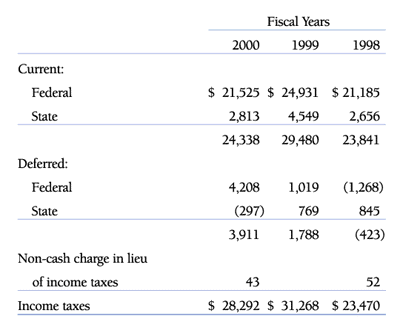
The provisions for income taxes from continuing operations consisted of the following (in thousands):
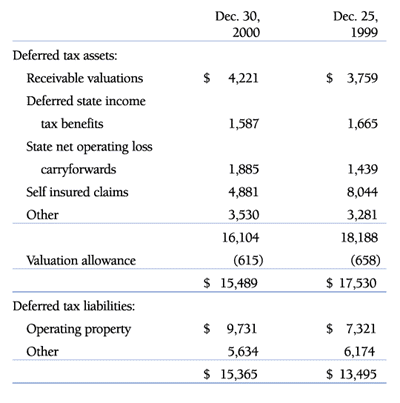
Temporary differences and carryforwards which gave rise to deferred tax assets and liabilities consisted of the following (in thousands):
The loss from discontinued operations included a deferred tax benefit of $7,604,000 in 1998.
At December 30, 2000, the valuation allowance of $615,000 was attributable to deferred state income tax benefits, which primarily represented state operating loss carryforwards at one subsidiary. The valuation allowance and goodwill will be reduced by $587,000 when realization of deferred state income tax benefits becomes likely.
The following table summarizes the differences between income taxes calculated at the federal income tax rate of 35% on income from continuing operations before income taxes and the provisions for income taxes (in thousands):
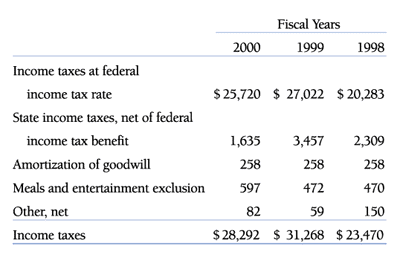
Landstar paid income taxes of $25,089,000 in 2000, $28,659,000 in 1999 and $26,110,000 in 1998.
(5) Operating Property
Operating property is summarized as follows (in thousands):
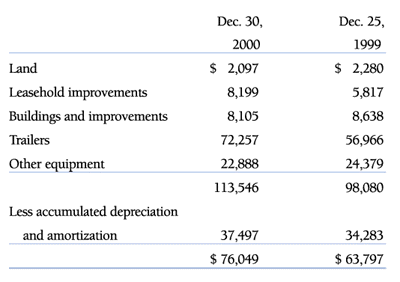
Included above is $60,811,000 in 2000 and $50,899,000 in 1999 of operating property under capital leases, $44,458,000 and $35,153,000, respectively, net of accumulated amortization. Landstar acquired operating property by entering into capital leases in the amount of $18,448,000 in 2000, $17,445,000 in 1999 and $12,902,000 in 1998.
(6) Pension Plans
Landstar sponsors an Internal Revenue Code section 401(k) defined contribution plan for the benefit of full-time employees who have completed one year of service. Eligible employees make voluntary contributions up to 16% of their base salary, subject to certain limitations. Landstar contributes an amount equal to 100% of the first 3% and 50% of the next 2% of such contributions, subject to certain limitations.
Prior to the October 1, 2000 withdrawal (see note 2), Landstar Ranger made contributions in accordance with a negotiated labor contract (generally based on the number of weeks worked) to union sponsored multi-employer pension plans.
The expense from continuing operations for the Company sponsored defined contribution plan and for union sponsored plans, excluding the estimated cost of withdrawal (see note 2), was $1,105,000 and $935,000 in 2000, respectively, $1,082,000 and $1,351,000 in 1999, respectively, and $624,000 and $1,265,000 in 1998, respectively.
(7) Debt
Long-term debt is summarized as follows (in thousands):
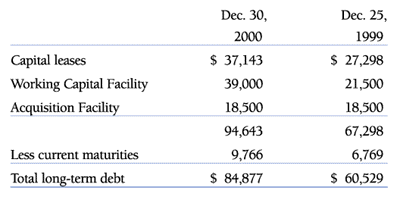
On October 10, 1997, Landstar renegotiated its existing Credit Agreement with a syndicate of banks and The Chase Manhattan Bank, as administrative agent (the “Second Amended and Restated Credit Agreement”). The Second Amended and Restated Credit Agreement provides $200,000,000 of borrowing capacity, consisting of $150,000,000 of revolving credit (the “Working Capital Facility”) and $50,000,000 of revolving credit available to finance acquisitions (the “Acquisition Facility”). $50,000,000 of the total borrowing capacity under the Working Capital Facility may be utilized in the form of letter of credit guarantees. The Second Amended and Restated Credit Agreement expires on October 10, 2002.
Borrowings under the Second Amended and Restated Credit Agreement bear interest at rates equal to, at the option of Landstar, either (i) the greatest of (a) the prime rate as publicly announced from time to time by The Chase Manhattan Bank, (b) the three month CD rate adjusted for statutory reserves and FDIC assessment costs plus 1% and (c) the federal funds effective rate plus 1/2%, or, (ii) the rate at the time offered to The Chase Manhattan Bank in the Eurodollar market for amounts and periods comparable to the relevant loan plus a margin that is determined based on the level of the Company’s Leverage Ratio, as defined in the Second Amended and Restated Credit Agreement. As of December 30, 2000, the margin was equal to 37.5/100 of 1%. The unused portion of the Second Amended and Restated Credit Agreement carries a commitment fee determined based on the level of the Company’s Leverage Ratio, as therein defined. As of December 30, 2000, the commitment fee for the unused portion of the Second Amended and Restated Credit Agreement was 0.125%. At December 30, 2000, the weighted average interest rate on borrowings outstanding under the Second Amended and Restated Credit Agreement was 7.06%. Based on the borrowing rates in the Second Amended and Restated Credit Agreement and the repayment terms, the fair value of the outstanding borrowings under the Second Amended and Restated Credit Agreement was estimated to approximate carrying value.
The Second Amended and Restated Credit Agreement contains a number of covenants that limit, among other things, the incurrence of additional indebtedness, the incurrence of operating or capital lease obligations and the purchase of operating property. The Second Amended and Restated Credit Agreement also requires Landstar to meet certain financial tests. Landstar is required to, among other things, maintain minimum levels of Net Worth, as defined in the Second Amended and Restated Credit Agreement, and Interest and Fixed Charge Coverages, as therein defined. Under the most restrictive covenant, Landstar exceeded the required Interest Coverage level by approximately $11,019,000 at December 30, 2000.
The Second Amended and Restated Credit Agreement provides a number of events of default related to a person or group acquiring 25% or more of the outstanding capital stock of the Company or obtaining the power to elect a majority of the Company’s directors.
Borrowings under the Second Amended and Restated Credit Agreement are unsecured, however, the Company and all but one of LSHI’s subsidiaries guarantee LSHI’s obligations under the Second Amended and Restated Credit Agreement.
The amounts outstanding on both the Working Capital Facility and the Acquisition Facility are payable upon the expiration of the Second Amended and Restated Credit Agreement. There are no other installments of long-term debt, excluding capital lease obligations, maturing in the next five years.
Landstar paid interest of $9,658,000 in 2000, $4,484,000 in 1999 and $4,159,000 in 1998. Included in interest paid in 1998 was $695,000 related to discontinued operations.
(8) Leases
The future minimum lease payments under all noncancelable leases at December 30, 2000, principally for trailers and the Company’s headquarters facility in Jacksonville, Florida, are shown in the following table (in thousands):
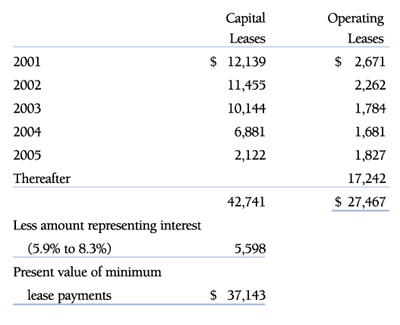
Total rent expense from continuing operations, net of sublease income, was $19,620,000 in 2000, $19,322,000 in 1999 and $20,548,000 in 1998.
(9) Stock Option Plans
The Company maintains two stock option plans. Under the 1993 Stock Option Plan, as amended, (the “Plan”), the Compensation Committee of the Board of Directors may grant options to Company employees for up to 1,115,000 shares of common stock. Under the 1994 Directors Stock Option Plan, as amended, (the “DSOP”), outside members of the Board of Directors will be granted up to an aggregate of 210,000 options to purchase common stock. Under the DSOP, each outside Director will be granted 9,000 options to purchase common stock upon election or re-election to the Board of Directors.
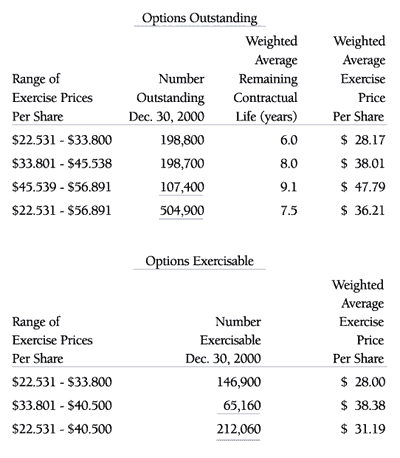
Options granted become exercisable in five equal annual installments under the Plan and three equal annual installments under the DSOP, commencing on the first anniversary of the date of grant, subject to acceleration in certain circumstances, and expire on the tenth anniversary of the date of grant. Under the plans, the exercise price of each option equals the market price of the Company’s stock on the date of grant. At December 30, 2000, there were 962,800 shares of the Company’s stock reserved for issuance upon exercise of options granted under the plans.
Information regarding the Company’s stock option plans is as follows:
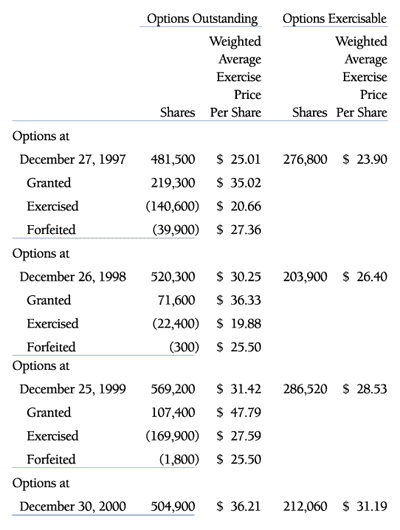
The fair value of each option grant on its grant date was calculated using the Black-Scholes option pricing model with the following assumptions for grants made in 2000, 1999 and 1998: risk free interest rate of 6.0% in 2000 and 1999 and 5.0% in 1998, expected lives of 5 years and no dividend yield. The expected volatility used in calculating the fair market value of stock options granted was 41% in 2000, 38% in 1999 and 40% in 1998. The weighted average grant date fair value of stock options granted was $21.61, $15.71 and $15.02 per share in 2000, 1999 and 1998, respectively.
The following table summarizes stock options outstanding at December 30, 2000:
The Company accounts for its stock option plans using the intrinsic value method as prescribed in Accounting Principal Board Opinion No. 25, “Accounting for Stock Issued to Employees.” Had compensation cost for the Company’s stock option plans been determined using the fair value at grant date method as prescribed by Statement of Financial Accounting Standards (“SFAS”) No. 123, “Accounting for Stock-Based Compensation,” the effect on net income and earnings per common share for the fiscal year would have been $1,145,000, or $0.13 per common share, in 2000, $966,000, or $0.10 per common share, in 1999 and $484,000, or $0.04 per common share, in 1998.
(10) Shareholders’ Equity
During 2000, Landstar purchased 864,000 shares of its common stock at a total cost of $46,185,000 pursuant to previously announced stock repurchase programs. As of December 30, 2000, Landstar may purchase an additional 500,000 shares of its common stock under its authorized stock repurchase program.
During 1998, the Company established an employee stock option loan program. Under the terms of the program, the Company will provide employees financing in order for them to exercise fully vested stock options. The loans are full recourse with the principal repayable in lump sum on the fifth anniversary of the loan. During 2000, 1999 and 1998, $4,596,000, $384,000 and $1,541,000 of such loans were issued, respectively.
The Company has 2,000,000 shares of preferred stock authorized and unissued. Under the terms of a Shareholder Rights Agreement (the “Agreement”), as amended, a preferred stock purchase right (the “Right”) accompanies each outstanding share of common stock. Each Right entitles the holder to purchase from the Company one one-hundredth of a share of preferred stock at an exercise price of $60. Within the time limits and under the circumstances specified in the Agreement, the Rights entitle the holder to acquire shares of common stock in the Company, or the surviving Company in a business combination, having a value of two times the exercise price. The Rights may be redeemed prior to becoming exercisable by action of the Board of Directors at a redemption price of $.01 per Right. The Rights expire February 10, 2003. Until a Right is exercised, it has no rights including, without limitation, the right to vote or to receive dividends.
(11) Segment Information
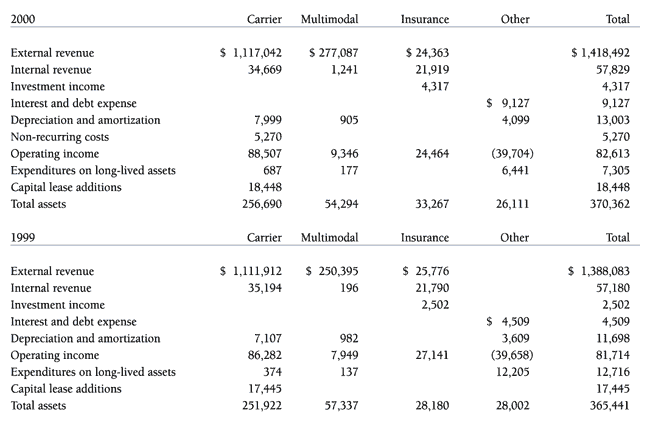
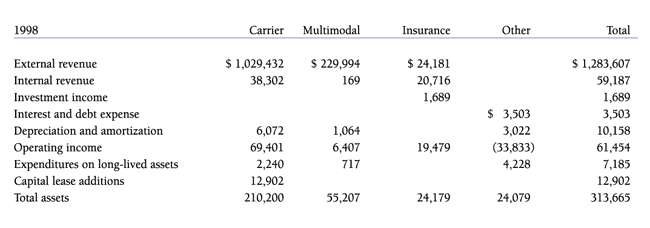
The Company has three reportable business segments. These are the carrier, multimodal and insurance segments. The carrier segment provides truckload transportation for a wide range of general commodities over irregular routes with its fleet of dry and specialty vans and unsided trailers, including flatbed, drop deck and specialty. It also provides short-to-long haul movement of containers by truck and dedicated power-only truck capacity. The carrier segment markets its services primarily through independent commission sales agents and utilizes tractors provided by independent contractors. Transportation services provided by the multimodal segment include the arrangement of intermodal moves, contract logistics, truck brokerage and emergency and expedited air freight. The multimodal segment markets its services through independent commission sales agents and utilizes capacity provided by independent contractors, including railroads and air cargo carriers. The nature of the carrier and multimodal segments’ business is such that a significant portion of their operating costs varies directly with revenue. The insurance segment provides risk and claims management services to Landstar’s operating companies. In addition, it reinsures certain property, casualty and occupational accident risks of certain independent contractors who have contracted to haul freight for Landstar and provides certain property and casualty insurance directly to Landstar’s operating subsidiaries.
The accounting policies of the segments are the same as those described in the summary of significant accounting policies. The Company evaluates a segment’s performance based on operating income.
Inter-segment revenue for transactions between the carrier and multimodal segments is based on quoted rates which are believed to approximate the cost that would have been incurred had similar services been obtained from an unrelated third party. Inter-segment revenue between the insurance segment and the carrier and multimodal segments is calculated at the beginning of each fiscal period based on an actuarial calculation of historical loss experience and is believed to approximate the cost that would have been incurred had similar insurance been obtained from an unrelated third party.
No single customer accounts for more than 10% of consolidated revenue. However, during 2000 approximately 16% of the Company’s revenue was attributable to the automotive industry. Substantially all of the Company’s revenue is generated in the United States.
The following tables summarize information about the Company’s reportable business segments as of and for the fiscal years ending December 30, 2000, December 25, 1999 and December 26, 1998 (in thousands):
(12) Commitments and Contingencies
At December 30, 2000, Landstar had commitments for letters of credit outstanding in the amount of $20,452,000, primarily as collateral for estimated insurance claims, $10,080,000 of which were supported by the Second Amended and Restated Credit Agreement and $10,372,000 secured by assets deposited with a financial institution.
Landstar is involved in certain claims and pending litigation arising from the normal conduct of business. Based on knowledge of the facts and, in certain cases, opinions of outside counsel, management believes that adequate provisions have been made for probable losses with respect to the resolution of all claims and pending litigation and that the ultimate outcome, after provisions thereof, will not have a material adverse effect on the financial condition of Landstar, but could have a material effect on the results of operations in a given quarter or year.