|
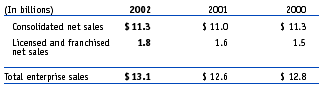
We reported consolidated net sales
of $11.3 billion for the 52-week fiscal year ended February 1, 2003
versus $11.0 billion for the 52-week fiscal year ended February 2, 2002,
or a 3% increase in consolidated net sales. Our consolidated net sales
were $11.2 billion for 2002, after excluding the impact of foreign currency
translation, representing a 1% increase over 2001 net sales.
Total enterprise sales consist of all Toys"R"Us branded net sales from
all of our stores and from our internet businesses, and the net sales
from international licensed and franchised stores. We believe that enterprise
sales are useful in analyzing the worldwide strength of our family of
brands:
Our consolidated comparable store sales, in local currencies, were flat
for the fourth quarter and the fiscal year. Comparable store sales for
our U.S. toy store division declined 1% for both the fourth quarter
and the full year. Video game sales, which include sales of video hardware,
software and accessories, were the primary factor contributing to these
decreases. The video game category posted an 18% decline for the fourth
quarter and a 13% decline for the year. The introduction of three video
platforms (X-Box, Gamecube and Gameboy Advance) drove strong video sales
in 2001. The performance of the video game category was also negatively
impacted by significant reductions in the retail prices of video game
platforms this year, such as the reduction in retail price from $299
to $199 for X-Box and PlayStation 2, and a reduction in retail price
from $199 to $149 for Gamecube. Video game sales accounted for approximately
19% of our total U.S. toy store sales, excluding apparel sales, in the
fourth quarter of 2002, down from 22% in 2001. Juvenile product sales
in our U.S. toy stores declined 8% for the full year, mainly due to
a shift of some sales to Babies"R"Us stores in the same markets. However,
our core toy sales, which include boys and girls, learning and preschool
toy categories, increased 3% in 2002.
Our International division reported comparable toy store sales increases,
in local currencies, of 5% for the fourth quarter and 6% for the full
year. These increases were primarily driven by the strong performance
of our toy stores in the United Kingdom and Spain. We continued to expand
the presence of in-store shops, such as Universe of Imagination (learning
and educational products), Animal Alley (plush), Teentronics (electronic
entertainment products) and Babies"R"Us (newborn and infant products).
In addition, the penetration of exclusive products in the International
division continues to grow, and, as a result, contributed to the improvement
of our gross margin in this division.
|
|
Our Babies"R"Us division reported
12% net sales growth for the full year, primarily driven by the opening
of 19 new Babies"R"Us stores in the United States this year. This division
reported a 2% increase in comparable store sales for the fourth quarter
and a 3% increase for the full year. A variety of initiatives helped
to drive sales and guest traffic, including the rollout of extended
apparel sizing to all stores and the addition of in-store photo studios
in 21 Babies"R"Us stores.
Toysrus.com reported a net sales increase of 11% for the fourth quarter
and 23% for the full year. Growth in the on-line toy business and the
Babiesrus.com (baby products), Imaginarium.com (learning products) and
the new Giftsrus.com (personalized gifts) on-line stores were factors
in the sales performance of Toysrus.com.
We record the costs associated with operating our distribution network
as a part of selling, general and administrative expenses (SG&A), including
those costs that primarily relate to moving merchandise from distribution
centers to stores. Therefore, our consolidated gross margin may not
be comparable to some other retailers which include similar costs in
their cost of sales. Our consolidated gross margin, as a percentage
of sales, increased by 0.4% for the fourth quarter and was flat at 31.0%
for the full year. Our consolidated gross margin for the fourth quarter
of 2001 included $27 million of store closing markdowns, which were
recorded as part of the restructuring and other charges announced in
January 2002. Credits and allowances from vendors, which are netted
against our cost of sales, have a positive impact on our consolidated
gross margin. These credits and allowances increased our consolidated
gross margin by 0.4% for the year, primarily in support of our increased
promotional activities. Our U.S. toy store division reported a 0.7%
decline in gross margin for the fourth quarter and a 0.8% decline for
the full year. These declines were primarily attributed to the impact
of increased promotional activity, such as our "Low Price Super Stars"
pricing campaign, as well as the impact of higher markdowns recorded
to keep our inventories fresh. Our International toy store division
reported a 0.3% increase in gross margin to 32.2% for the year, primarily
due to our continued emphasis on exclusive products which carry higher
margins. Our Babies"R"Us division reported a 1.0% improvement in gross
margin to 36.0%, primarily due to a shift in sales mix to higher margin
import product. Gross margin for Toysrus.com improved 2.7% to 24.8%,
reflecting an ongoing mix shift toward higher margin juvenile and learning
products, as well as lower markdowns due to decreased inventory levels
this year.
Our consolidated SG&A, as a percentage of net sales, increased 0.3%
to 18.3% for the fourth quarter of 2002. This increase was primarily
due to an increase in net advertising expense as a result of our decision
to defer certain of our advertising activities to this year's fourth
quarter. Our consolidated SG&A, as a percentage of sales, decreased
0.7% to 24.0% for the full year, primarily as a result of our continued
focus on expense control. During 2002, we implemented shared services
in a variety of functional groups, which, along with other efforts,
helped us to achieve the overall reduction in SG&A as a percentage of
sales. Advertising allowances, which are netted against
|
|