|
Cash requirements for operating and investing activities will be
met primarily through use of our exisiting cash and cash equivalents,
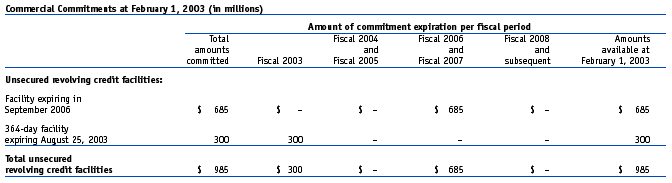
cash flows from operating activities, and utilization of our unsecured committed revolving credit facilities. At February 1, 2003, we had
in place stand-by letters of credit of $360 million, primarily as a guarantee for a debt obligation and $75 million of outstanding letters of credit related to import merchandise.
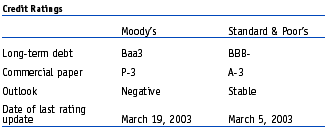
Our debt instruments do not contain provisions requiring acceleration of payment upon a debt rating downgrade. We continue to be confident in our ability to refinance maturing debt. Other credit ratings for our debt are available; however we disclosed above only ratings of the two largest nationally recognized statistical rating organizations because we believe these are the most relevant to our business.
The seasonal nature of our business typically causes cash balances to decline from the beginning of the year through October as inventory increases for the holiday selling season and funds are used for
construction of new stores, remodeling and other initiatives that
normally occur in this period. The fourth quarter, including the
holiday season, accounts for more than 40% of our net sales and
substantially all of our operating earnings.
Our net cash inflows from operating activities increased to $574 million in 2002 from net cash inflows of $504 million in 2001 and net cash
outflows of $151 in 2000. Net earnings, as adjusted for non-cash items, of $600 million in 2002 and $425 million in 2001 were the primary
drivers of the net cash inflows from operations in those years. The net cash outflows from operations in 2000 were primarily driven by an increase in merchandise inventories of $486 million, and a net decrease in accounts payable, accrued expenses and other liabilities of
$178 million, and was partially offset by net earnings, as adjusted
for non-cash items, of $444 million for that year.
|
|
Capital expenditures, net of dispositions, were $398 million in 2002, $705 million in 2001 and $402 million in 2000. Capital expenditures during these periods include investments to: open 55 new Babies"R"Us stores in the United States; open 18 new Toys"R"Us stores internationally; reformat our existing Toys"R"Us store base in the United States to our Mission Possible format and remodel 41 existing Kids"R"Us stores to our R-Generation store format; convert 286 existing Toys"R"Us stores into Toys"R"Us/Kids"R"Us combo stores; improve and enhance our management information systems.
During 2003, we plan to reduce our capital expenditures for our
business to less than $350 million. We plan to open approximately 20 new Babies"R"Us stores in the United States and approximately five new international Toys"R"Us stores, and we also plan to continue to improve and enhance our management information systems in 2003.
Net cash inflows from financing activities were $613 million in 2002, primarily driven by net long-term borrowings of $407 million, as well
as proceeds received from the issuance of our common stock and
contracts to purchase common stock totaling $266 million. In May 2002, we issued 14,950,000 shares of our common stock at a price
of $17.65 per share and received net proceeds of $253 million.
On the same date, we issued 8,050,000 equity security units with
a stated amount of $50 per unit and received net proceeds of $390
million. Each security unit consists of a contract to purchase, for $50, a specified number of shares of Toys"R"Us common stock in August 2005, and a senior note due in 2007 with a principal amount of $50. The fair value of the contract to purchase shares of Toys"R"Us common stock was estimated at $1.77 per equity security unit. The fair value of the senior note was estimated at $48.23 per equity security unit. Interest on the senior notes is payable quarterly at an initial rate of 6.25%. We are obligated to remarket the notes in May 2005 at the then prevailing interest rate for similar notes. If the remarketing were not to be
successful, we would be entitled to take possession of the senior notes, and the holder's obligation under the contracts to purchase shares of
our common stock would be deemed to have been satisfied. The net proceeds from these public offerings were used to refinance short-term borrowings and for other general corporate purposes.
|
|