|
agreements. As a result of the interest rate swap agreements, interest on the $500 notes will accrue at the rate of LIBOR plus 1.5120%
per annum and interest on the $250 notes accrues at the rate of LIBOR plus 1.1515% per annum. Interest is payable on both notes semi-annually on February 1 and August 1, commencing on
February 1, 2002. In October 2002, the company terminated a
portion of the interest rate swap agreements and received a payment of $27, which is being amortized over the lives of the related notes. Concurrently, the company entered into new interest rate swap
agreements. Of the $500 notes, $200 accrues interest at the rate
of LIBOR plus 3.06%, and $125 of the $250 notes accrues interest
at the rate of LIBOR plus 3.54%.
As of February 1, 2003, the company had $985 in unsecured committed revolving credit facilities from a syndicate of financial institutions. These credit facilities consist of a $685 facility expiring September 2006 and a $300 facility expiring on August 25, 2003. The facilities are used for seasonal borrowings and to support the company's domestic commercial paper borrowings. As of February 1, 2003, all of the $685 facility expiring September 2006 and all of the $300 facility expiring on August 25, 2003 were available.
The annual maturities of long-term debt at February 1, 2003 are
as follows:
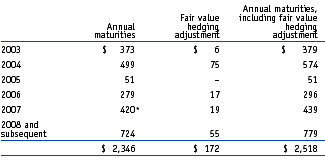
Long-term debt balances as of February 1, 2003 have been impacted by certain interest rate and currency swaps that have
been designated as fair value and cash flow hedges, as discussed in the note entitled,
"DERIVATIVE INSTRUMENTS AND HEDGING ACTIVITIES."
*Includes $390 of equity security units, due 2007, which the company is
obligated to remarket in 2005. See the note entitled "ISSUANCE OF COMMON STOCK AND EQUITY SECURTIY UNITS."
The company is exposed to market risk from potential changes in interest rates and foreign exchange rates. The company continues
to regularly evaluate these risks and continues to take measures to mitigate these risks, including, among other measures, entering into derivative financial instruments to hedge a variety of risk exposures including interest rate and currency risks. The company enters into forward exchange contracts to minimize and manage the currency risks related to its import merchandise purchase program. The company enters into interest rate swaps to manage interest rate risk and strives to achieve what it believes is an acceptable balance between fixed and variable rate debt.
|
|
The company purchases forward exchange contracts to minimize and manage the foreign currency risks related to its import merchandise purchase program. The counter-parties to these contracts are highly rated financial institutions and the company does not have significant exposure to any one counter-party. These forward exchange contracts are designated as cash flow hedges, as defined by SFAS No. 133, and are effective as hedges. Accordingly, changes in the effective portion of the fair value of these forward exchange contracts are included in other comprehensive income. Once the hedged transactions are
completed, or when merchandise is sold, the unrealized gains and losses on the forward contracts are reclassified from accumulated other comprehensive income and recognized in earnings. The
unrealized losses related to the import merchandise purchase program contracts, that were recorded in other comprehensive income, were not material at February 1, 2003 or February 2, 2002.
The company is faced with interest rate risks resulting from interest rate fluctuations. The company has a variety of fixed and variable
rate debt instruments. In an effort to manage interest rate exposures,
the company strives to achieve an acceptable balance between fixed and variable rate debt and has entered into interest rate swaps to maintain that balance.
On May 28, 2002, the company entered into an interest rate swap agreement on its Equity-Linked Securities. Under the agreement, the company will pay interest at a variable rate in exchange for fixed rate payments, effectively transforming these debentures to floating rate obligations. This swap is designated as a highly effective fair value hedge, as defined by SFAS No. 133. Changes in the fair value
of the interest rate swap offset changes in the fair value of the
fixed rate debt due to changes in market interest rates with some ineffectiveness present. The amount of ineffectiveness did not have
a material effect on earnings.
On March 19, 2002, the company refinanced a note payable originally due in 2005 and increased the amount outstanding to $160 from $100. This borrowing is repayable in semi-annual installments of
principal and interest, with the final installment due on February 20, 2008. The effective cost of this borrowing is 2.23% and is secured by expected future cash flows from license fees due from Toys - Japan. The company also entered into a contract to swap yen to U.S. dollars, within exact terms of the loan. This cross currency swap has been designated as a foreign currency cash flow hedge, as defined by SFAS No. 133, and is effective as a hedge.
In July 2001, the company entered into interest rate swap agreements on its 7.625% $500 notes, due August 1, 2011, and its 6.875% $250 notes, due August 1, 2006. Under these agreements, the company will pay interest at a variable rate in exchange for fixed rate payments, effectively transforming the debentures to floating rate obligations. These swaps are designated as highly effective fair value hedges, as defined by SFAS No. 133. Changes in the fair value of the interest rate swaps perfectly offset changes in the fair value of the fixed rate debt due to changes in market interest rates. As such, there were no ineffective hedge portions recognized in earnings during 2001.
|
|