| |
|
|
|
|
|
|
|
|
| |
|
|
|
|
|
|
|
|
|
|
|
|
|
|
|
|
|
|
|
|
|
|
|
|
|
|
Today, American Commercial Lines is more than 3,000 employees strong and growing. A
leading barge transportation provider and manufacturer, ACL has been operating since
1915 on the United States Inland Waterways System, which consists of the Mississippi
River System, its connecting waterways and the Gulf Intracoastal Waterways. Our two
primary businesses are Transportation and Manufacturing.
|
|
|
|
|
|
|
|
|
|
|
|
|
|
|
|
|
|
Our mission |
|
|
|
|
|
|
|
|
|
|
|
|
|
|
|
|
|
ACL will deliver premium transportation services, solutions and equipment to accommodate
the evolving needs of its customers. We will do so with integrity and superior service,
exceeding industry standards and customer expectations. |
|
|
|
|
|
|
|
|
|
|
|
|
|
|
|
|
|
Our value proposition |
|
|
|
|
|
|
|
|
|
|
|
|
|
|
|
|
|
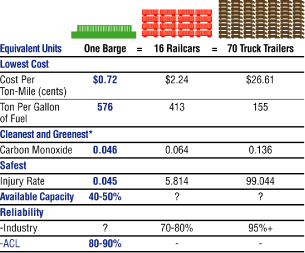
ACL is a customer-focused company that delivers the safest, cleanest, most
cost-effective and innovative transportation solutions, resulting in improved
business for our customers. |
|
|
|
|
|
|
|
|
|
|
|
|
|
|
|
|
|
Our core values |
|
|
|
|
|
|
|
|
At ACL, our core values speak to what the company stands for: safety, customer focus,
innovation, integrity and value for everyone involved. ACL has made a long-term
commitment to these values and makes them part of everything the Company does. We
believe this is to the benefit of our customers, employees, shareholders and the
communities in which we work. |
|
|
|
|
|
|
|
|
|
|
|
|
|
|
|
|
|
Safety – Never compromise the safety of people, the environment, property or equipment. |
|
|
|
|
|
|
|
|
|
|
|
|
|
|
|
|
|
Customer Focus – Provide superior customer service. |
|
|
|
|
|
|
|
|
|
|
|
|
|
|
|
|
Innovation – Set the standard in transportation and manufacturing solutions. |
|
|
|
|
|
|
|
|
|
|
|
|
|
|
|
|
|
Integrity – Always do the right thing. |
|
|
|
|
|
|
|
|
|
|
|
|
|
|
|
|
|
Value – Let the creation of value drive all we do for our shareholders and employees. |
|
|
|
|
|
|
|
|
|
|
|
|
|
|
|
|
|
Our leadership in safety |
|
|
|
|
|
|
|
|
|
|
|
|
|
|
|
|
|
Safety is foremost in everything we do. As the first of our core values, it is an
overarching Company tenet. Our employees live by the principle that all accidents and
injuries can be prevented, and by the motto that no job is so important and no service
so urgent, that we cannot take the time to perform all work safely. |
|
|
|
|
|
|
|
|
|
|
|
|
|
|
|
|
|
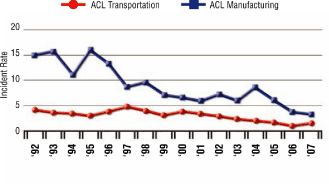
We take great pride in the fact that committing ourselves to continuous improvement in
safety processes has once again led to our having one of the best safety records in the
industry. Within ACL’s Transportation Division, the personal injury incident rate,
already the industry’s lowest, continued to improve throughout 2007 and is significantly
better than the industry average. The same is true in our Manufacturing Division, where,
even as volume grew throughout 2007, our incident rate continued to improve. |
|
|
|
|
|
|
|
|
|
|
|
|
|
| |
|
This report includes certain “forward-looking statements” within the meaning of the Private
Securities Litigation Report Act of 1995 including without limitation the EBITDA margin potential.
These forward-looking statements are based on management’s present expectations and beliefs about
future events. As with any projection or forecast, these statements are inherently susceptible to
risks, uncertainty and changes in circumstance. Important factors could cause actual results to
differ materially from those expressed or implied by the forward-looking statements and should be
considered in evaluating the outlook of American Commercial Lines Inc. Risks and uncertainties are
detailed from time to time in American Commercial Lines Inc’s and its subsidiaries’ filings with
the SEC, including the Form 10-K for the year ended December 31, 2007. American Commercial Lines Inc
is under no obligation to, and expressly disclaims any obligation to, update or alter its forward-looking
statements, whether as a result of changes, new information, subsequent events or otherwise. |
|
|
|
|
|
|
|
|
|
|
|
| |
|
Management considers EBITDA to be a meaningful indicator of operating performance and uses it as a
measure to assess the operating performance of the Company’s business segments. EBITDA provides us
with an understanding of the Company’s revenues before the impact of investing and financing
transactions and income taxes. EBITDA should not be construed as a substitute for net loss or as a
better measure of liquidity than cash flow from operating activities, which is determined in
accordance with generally accepted accounting principles (GAAP). EBITDA excludes components that
are significant in understanding and assessing our results of operations and cash flows. In
addition, EBITDA is not a term defined by GAAP and, as a result, our measure of EBITDA might not be
comparable to similarly titled measures used by other companies. |
|
|
|
|
|
|
|
|
|
|
|
| |
|
However, the Company believes that EBITDA is relevant and useful information, which is often
reported and widely used by analysts, investors and other interested parties in our industry.
Accordingly, the Company is disclosing this information to permit a more comprehensive analysis of
its operating performance. |
|
|
|
|
|
|
|
|
|
|
|
| |
|
|
|
|
| |
|
|
|
|
F I N A N C I A L O V E R V I E W
| |
|
|
|
|
|
|
|
|
|
|
|
|
|
|
|
|
|
|
|
|
|
|
|
|
Fiscal Year |
|
|
|
|
|
|
|
|
|
|
|
|
|
|
|
|
|
|
|
| (in
thousands except per share data) |
|
2003 |
|
|
2004 |
|
|
2005 |
|
|
2006 |
|
|
2007 |
|
|
|
|
|
|
|
|
|
|
|
|
|
|
|
|
|
|
|
|
|
|
|
|
|
|
|
|
|
|
| |
|
|
|
|
|
|
|
|
|
|
|
|
|
|
|
|
|
|
|
|
|
|
|
|
|
Income Statement Data |
|
|
|
|
|
|
|
|
|
|
|
|
|
|
|
|
|
|
|
|
|
|
|
|
Revenue |
|
|
$594,086 |
|
|
|
$604,956 |
|
|
|
$714,941 |
|
|
|
$942,552 |
|
|
|
$1,050,360 |
|
|
|
|
|
Operating Income |
|
|
($2,957) |
|
|
|
$20,152 |
|
|
|
$55,669 |
|
|
|
$152,412 |
|
|
|
$108,206 |
|
|
|
|
|
Net Income |
|
|
($61,576) |
|
|
|
$4,394 |
|
|
|
$11,813 |
|
|
|
$92,252 |
|
|
|
$44,361 |
|
|
|
|
|
Diluted Income Per Share |
|
NA |
|
|
NA |
|
|
|
$0.24 |
|
|
|
$1.47 |
|
|
|
$0.77 |
|
|
|
|
|
|
|
|
|
|
|
|
|
|
|
|
|
|
|
|
|
|
|
|
|
|
|
|
|
|
| |
|
|
|
|
|
|
|
|
|
|
|
|
|
|
|
|
|
|
|
|
|
|
|
|
|
Balance Sheet Data |
|
|
|
|
|
|
|
|
|
|
|
|
|
|
|
|
|
|
|
|
|
|
|
|
Total Assets |
|
|
$812,196 |
|
|
|
$667,677 |
|
|
|
$623,284 |
|
|
|
$671,003 |
|
|
|
$760,811 |
|
|
|
|
|
Long-Term
Debt (including current portion) |
|
|
$613,445 |
|
|
|
$406,433 |
|
|
|
$200,000 |
|
|
|
$119,500 |
|
|
|
$439,760 |
|
|
|
|
|
Stockholders’Equity |
|
|
($19,674) |
|
|
|
$100,098 |
|
|
|
$253,701 |
|
|
|
$358,653 |
|
|
|
$125,391 |
|
|
|
|
|
Net Income
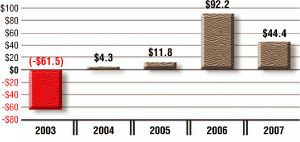
Debt-to-Capital
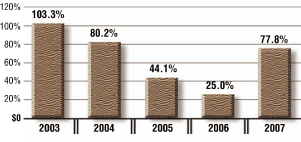
EBITDA *
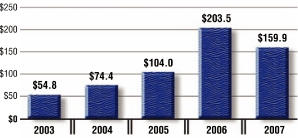
Debt-to-EBITDA
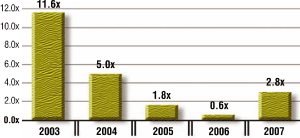
|
|
|
| * Excludes discontinued ops and cost-of-debt refinancing |
1
T O O U R S H A R E H O L D E R S
| |
|
|
|
|
|
|

|
|
Michael P. Ryan
President & CEO |
ACL continued its industry leading record in
safety in 2007. Safety is foremost in everything
we do. As one of our core values, our employees
live by the principle that all accidents and
injuries can be prevented. We take great pride in
our record of continuous improvement in safety and
proudly maintain one of the best safety records in
the transportation industry.
2007 was a successful year for ACL, in spite of the
many challenges we faced in the global and domestic
economy. Our revenues for the full year 2007 were
over $1.0 billion, with EBITDA of $160 million.
This was the second highest EBITDA level ever
achieved by ACL. We felt the impact of shifting
markets in 2007 which challenged our expectations
and forecasting models following an unusually strong year in 2006.
In order to better understand our results in 2007,
it is important to start our review with a brief
look back at 2006.
With tight barge capacity, significant export grain
demand, strong imports and strong domestic coal,
ACL enjoyed record setting revenue and earnings
increases in 2006. While this year over year
earnings growth was impressive, it was not
sustainable in 2007. A primary driver in 2006
growth was the 2005 rollover of export grain after
Hurricane Katrina. As we moved into 2007, the
export grain market for barges became even more
competitive. The weakening U.S. dollar in 2007
significantly decreased import flows through New
Orleans. Barge companies lost their import product
volumes and dispatched their empty hopper barges
north to inland origins to load with export grain.
The excess dry cargo barge capacity in the first
half of 2007, resulting from the reduced import
volumes, drove down barge freight prices for grain
and reduced ACL’s share of this market at the same
time. This variable left us with unrealistic grain
volume and pricing expectations in a business
segment which comprised approximately
25% of our
2007 revenue portfolio. Late in 2007, we also faced
compounding pressure on our margins from fuel price
increases as they started their meteoric climb to
$2.52 per gallon, up 34% from prior year fourth
quarter levels.
Even with the reduced grain demands, our
transportation revenues increased $21.3 million,
year over year, to just under $809 million in 2007.
We increased revenues in our liquids business,
experienced strong bulk pricing, and witnessed the
beginning of new higher export coal volumes driven
by the weakened U.S. dollar. These were all
positives for our company, though these gains were
offset by a 20% reduction in grain volume. This
further validated our longer term objective and
strategy of reducing our dependence on grain in our
portfolio, and complementing it with more
diversified non-grain demand, building a more
ratable book of business.
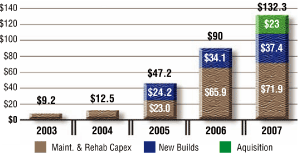
Capital Expenditures (in
millions)
To accelerate our liquids growth we opened our new
Liquids Division Headquarters in Houston, Texas in
August. We also expanded our industry presence in
2007 with strategic investment in
Summit Environmental, an environmental consulting
company and acquisition of Elliot Bay Design Group,
a naval engineering and marine architectural
services company. Subsequent to year end we
acquired the remaining ownership interest in
Summit. Summit’s engineering expertise will
actually position us to work with customers on the
design and development of new barge shipping site
locations. This represents a page from my past with
class one railroads when we created a new
industrial development shipping infrastructure with
rail customers. With Summit, we are now in a
position to do the same for new barge customers.
We continued to drive pricing and contract term
discipline into our contracts, selling the value of
our transportation services and manufactured
products. In 2007, we repriced
2
approximately one third of our transportation
contract business with an average fuel neutral
increase of approximately 15% and continued to add
inflationary protection terms as well. Our
commercial objective continues to be to identify
and capture new demand. We will continue to compete
for existing inland waterway tons, though our
primary organic growth targets remain modal
conversion of distressed rail volumes for barge
movement. We signed up over $60 million in annual
organic growth (increased and new volume) during
2007.
To more effectively compete for higher margin, land
based tonnage we must present a scheduled service
option to shippers. In February 2007, we initiated
a scheduled service program in our highest freight
density lane between Cairo, Illinois and Baton
Rouge, Louisiana. Much like the railroads did in
the late 1980’s and early 1990’s, we started to
move our power and barges on a schedule, selling
our corridor service to fill those barge tows. We
believe bringing new, higher margin business to the
water is a key long term solution for achieving
ratable, profitable growth for all barge companies.
A new scheduled service alternative is a value to
our customers, one which will position us for
sustainable organic growth.
For the year, total manufacturing revenue was
$290.1 million and our EBITDA was $21.4
million. Total manufacturing production volume
increased 28% in 2007 versus 2006, with deliveries
of 361 dry hopper barges, 41 tank barges and 2
special vessels for a total of 404 units. In 2007,
we built 50 dry hopper barges and 13 tank barges
for ACL use.
We continued to invest in our business at an
aggressive pace. During 2007 we invested $110
million to improve the quality of our barge fleet,
shipyards, facilities and work force. As a result
of our investment over the last several years, the
age of ACL liquid and dry fleet compares favorably
to the industry average.
Outlook for 2008
We ended 2007 with a Transportation revenue
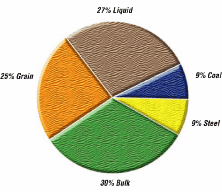
portfolio of 25% grain, 27% liquids, 30% bulk, 9%
coal and 9% steel. This compares favorably to our
2006 mix of 32% grain, 24% liquids, 28% bulk, 8%
coal and 8% steel. In 2008, we will continue
increasing our liquid revenue and decreasing our
dependence on grain by introducing more dry volume
in coal and other non-grain volumes.
Much like 2007, we expect continued grain
volatility, weak imports and inflation.
In manufacturing, we are planning for modest
growth as we continue to improve our efficiency in
the shipyard while working through our legacy
contracts. If all the outstanding legacy contract
options are exercised, we would expect
approximately 50-55% of our volume in 2008 to be
for legacy agreements. As we move into a greater
non-legacy portfolio period, we expect to sell new
higher margin agreements. This new business,
combined with productivity improvements, will
continue to improve margins at our Jeffboat
facility.
In 2008, we will continue to spend capital to
again upgrade vessels, barges, and facilities, and
look to increase our fleet of ACL liquid tank
barges.
To keep stakeholders updated, we will provide
quarterly updates on reliable metrics. These
metrics will include data on contract renewals,
pricing strength and portfolio conversion. In
manufacturing, we will track our progress in
productivity improvement, profitability
improvement and portfolio enhancement.
The keys to our success remain in building barges,
moving barges, capturing a premium for our services
and products, and reinvesting in our assets and
work force. Our growth engine will be fueled by our
new sales, marketing, and customer service
programs. A measure of our success will include a
recap of our wins where we capture ratable and
highly profitable new business contracts. We will
continue to focus on our further development of our
scheduled service offering and maximizing profits
in all of our business lines. We will not stray
from our industry leading focus on safety and
environmental stewardship. We have a great
foundation on which to continue to build. We will
continue our aggressive pursuit of developing the
best portfolio of transportation business, while at
the same time developing stronger processes and
producing greater margins on the manufacturing side
of our business.
Michael P. Ryan
President & CEO
3
F O C U S O N T R A N S P O R T A T I O N
| |
|
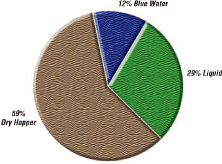
2007 Transportation Cargo Mix |
Moving cargo safely and efficiently is the
foundation upon which American Commercial Lines
is built. With transportation as a focal point,
we have become the second largest provider of
total dry and liquid cargo barge transportation
on America’s inland waterway system.
Custom-tailored transportation solutions
ACL operates an extensive and versatile fleet of
dry cargo barges, tank barges and towboats. Our
barge operations are complemented by fleet
management, marine repair and maintenance,
cleaning and port services. We also provide
logistics services in partnership with our
customers to supplement our transportation
network.
With our fleet and range of support services,
we are uniquely positioned to provide
custom-tailored transportation solutions for a
wide variety of shippers.
A diversified mix of commodities
ACL’s primary barging customers include many of
the major industrial and agricultural companies
in the United States. Our dry cargo barges
transport a variety of bulk and non-bulk
commodities including coal, steel and grain.
Through our fleet of tank barges, we transport
chemicals, petroleum, ethanol and biodiesel
fuel, edible oils and other liquid commodities.
4
F O C U S O N T R A N S P O R T A T I O N
Long-term customer relationships and ACL Trac
ACL continually pursues innovative ways to
improve the services we make available to our
customers. Our sales and customer services teams
draw on all our resources to provide outstanding
service and innovative solutions. We are proud
of the fact that we have maintained strong
relationships with our customers, many of which
have been in place for decades.
Innovation in shipment tracking
ACL has once again brought innovation to
shipment tracking with our proprietary ACLTrac.
It is a state-of-the-art system that provides an
online medium for customers and dock managers to
pinpoint their barges anywhere on the Inland
Waterway System. This enhances our customers’
ability to plan for shipments and enables them
to manage their supply chain more effectively.
The best safety record in the business
ACL is committed to doing our jobs without
compromising the safety of people, the
environment, property or equipment. Every member
of our corporate-wide team receives an in-depth
safety education. That, combined with our
continuous improvement in safety processes, has
once again led to our achieving the best safety
record in the industry.
Barge - The Green Alternative
* Environmentally superior: Barges consume less fuel
per ton mile and emit less nitrogen oxide, carbon
monoxide and particulate matter into the atmosphere
than do trucks or trains.
Best Industry safety Record
5
| |
|
|
| |
|
|
F O C U S O N M A N U F A C T U R I N G
|
|
|
| |
|
2007 Manufacturing Revenue |
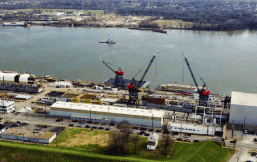
ACL has directed tremendous resources toward
manufacturing barges and remains the largest
single-site inland shipbuilding and repair
facility in the United States.
Industry overview
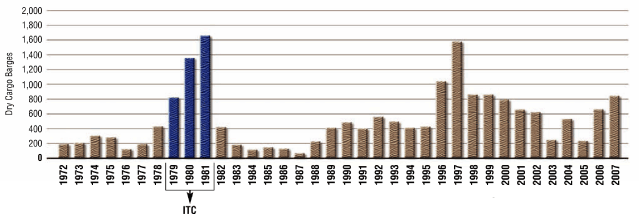
The demand for barge production is in direct
correlation to the industry fleet size and age.
Dry cargo barges have a useful life of 25 to 30
years. Approximately 20 percent of the current
industry fleet was built prior to 1981, and many
of these barges are now being retired.
The useful life for liquid tank barges is 30 to
35 years. Until the last few years, the pace of
new liquid barge construction was slowed by
relatively unfavorable freight rates and excess
capacity. However, a federal law will take
approximately 360 single hull barges, none of
which belong to ACL, out of action by 2015. A
reduction in liquid fleet capacity and an aging
fleet have resulted in vastly improved demand
for all types of inland tank barges.
Barge replacement trends
The replacement demand created by the aging
barge fleet and general shortage of capacity is
immediate and projected to be ongoing for the
next several years. New construction orders are
placing most inland shipyards at capacity. This
provides an excellent opportunity for Jeffboat,
which now has barge manufacturing contracts
scheduled well into 2010.
6
| |
|
|
|
|
|
|
|
F O C U S O N M A N U F A C T U R I N G |
Dry
Cargo Barges in Operation by Year of Construction
Source:
Informa Economics, Inc.
Investment in equipment, facilities and training
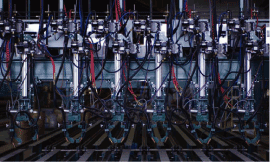
In the last few years, Jeffboat has made a
significant investment in equipment, facilities
and employee training that yield safer, more
efficient production. New buildings and
production lines, including a hopper assembly
building, side box lines and a tanker panel
line, are examples of enhancements that have
further improved efficiency in the shipyard. We
also employ lean manufacturing initiatives to
drive efficiency and productivity.
Long-time leadership in marine design
and construction
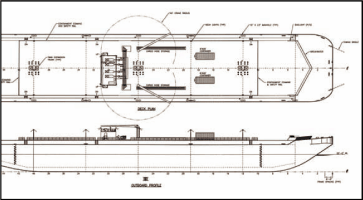
Jeffboat has a long history of building inland
and blue water vessels of exceptional quality. In
addition to building tanker and dry cargo barges,
Jeffboat also constructs specialty vessels for
third party customers.
7
| |
|
|
| |
|
|
P R O F E S S I O N A L S E R V I C E S
|
|
|
One highlight of 2007 was the creation of our
Professional Services arm through strategic
acquisitions in environmental consulting, naval
engineering and marine architectural services. ACL
now has best-in-class environmental and marine
engineering and architectural services as part of
our portfolio.
Professional Services: Elliott Bay Design Group
LLC and Summit Contracting LLC.
Elliott Bay Design

Based in Seattle, Washington, Elliott Bay Design Group is a leading naval architecture and marine
engineering firm. The firm offers state-of-the-art engineering services backed by extensive
experience in vessel design, shipyard level engineering, production planning and
quality control. Elliott Bay performs all aspects of vessel engineering, including concept,
preliminary, contract and functional design, vessel modification and stability analysis.
Elliot Bay Design Group will significantly enhance
the design of equipment we build and operate and
will provide a valuable resource to help our
customers solve their transportation issues through
new vessel design and engineering.
Summit Contracting

A top environmental services contractor, Summit Contracting is based in Evansville, Indiana and
provides emergency response, environmental remediation, and industrial and civil construction
services. With the addition of Summit, ACL is again raising the environmental and safety standard
for barge transportation, which is already the safest mode of transportation in the United States.
Strong synergies exist between Summit and ACL,
offering the opportunity to enhance and expand
our service offerings to all customers. This
includes areas such as tank barge cleaning, dock
and rail construction, site selection and
best-in-class environmental services.
A new opportunity channel
One example of the advantage Professional
Services brings to ACL is that the combination
of our commercial sales team and Summit’s
engineering expertise has opened a new
opportunity channel for us to work with
customers on the design and development of new
shipping site locations.
8
E N V I R O N M E N T A L A N D R E G U L A T O R Y L E A D E R S H I P
ACL is committed to operating beyond regulatory
compliance and leading our industry in
environmental, health, safety and security
management. Our first operating priority is
stated plainly, communicated throughout our
organization, and posted on our vessels:
ACL will never compromise the safety of personnel or
the environment.
We make public commitments to operate beyond
compliance by joining such voluntary programs
as these:
| |
• |
|
American Chemistry Council’s
Responsible Care®Program |
| |
| |
• |
|
Responsible Carrier Program of the
American Waterways Operators |
| |
| |
• |
|
Indiana’s Environmental Stewardship
Program (charter member) |
| |
| |
• |
|
Kentucky’s Project Excel (charter member) |
Commitment measured by performance
Participation in these programs is based on
commitment measured by performance and subject to
periodic independent third-party assessment. We
do not simply write a check and claim to be
members of these programs. Applications are
competitive and based, in part, on a demonstrated
history of superior regulatory compliance. If ACL
exhibits excellent management systems and makes
the required commitments to perform beyond
compliance, admission is granted. Upon joining,
we
must advance the cause of excellent environmental,
health, safety and security management. As members
of these organizations, if we do not meet
performance expectations and commitments, membership
will be revoked. We are members in good standing of
these and other environmental organizations and
demonstrated leaders in our industry.
Environmental leadership
ACL is an industry leader in environmental
management, providing customers with reliable
transportation that puts a priority on health and
safety and minimizes environmental impact.
Regulatory compliance
ACL’s philosophy is to operate beyond compliance. We
are an active member of the American Waterways
Operators Responsible Carrier Program, which is
committed to maintaining the highest standards in the
health and safety issues of waterways carriers.
Vendor vetting
ACL maintains a list of preferred vendors that have
been certified via our stringent vetting process. To
be a preferred vendor, a company must meet our
criteria for selection and/or acquire and maintain
certification through American Waterways Operators.
ACL performs due diligence with suppliers to ensure
that they meet regulatory, industry, ACL and customer
requirements.
9
UNITED STATES SECURITIES AND EXCHANGE COMMISSION
Washington, D.C. 20549
Form 10-K
| |
|
|
| þ |
|
ANNUAL REPORT PURSUANT TO SECTION 13 OR 15(d)
OF THE SECURITIES EXCHANGE ACT OF
1933 |
For the fiscal year ended December 31, 2007
OR
| |
|
|
| o |
|
TRANSITION REPORT PURSUANT TO SECTION 13 OR 15(d)
OF THE SECURITIES EXCHANGE ACT OF
1934 |
For
the transition period from to
Commission file number: 000-51562
AMERICAN COMMERCIAL LINES INC.
(Exact name of registrant as specified in its charter)
| |
|
|
| Delaware
|
|
75-3177794 |
| (State or other jurisdiction of
|
|
(I.R.S. Employer |
| incorporation or organization)
|
|
Identification No.) |
| |
| 1701 East Market Street
|
|
47130 |
| Jeffersonville, Indiana
|
|
(Zip Code) |
| (Address of principal executive offices) |
|
|
(812) 288-0100
(Registrant’s telephone number, including area code)
Not applicable
(Former name, former address and former fiscal year, if changed since last report)
Securities registered pursuant to Section 12(b) of the Act:
Common Stock, $.01 par value per share Securities
registered pursuant to Section 12(g) of the Act:
None
Indicate by check mark if the registrant is a well-known seasoned issuer, as defined in Rule
405 of the Securities Act. Yes þ No o
Indicate by check mark if the registrant is not required to file reports pursuant to Section
13 or Section 15(d) of the Exchange Act.
Yes o No þ
Indicate by check mark whether the registrant (1) has filed all reports required to be filed
by Section 13 or 15(d) of the Securities Exchange Act of 1934 during the preceding 12 months (or
for such shorter period that the registrant was required to file such reports), and (2) has been
subject to such filing requirements for the past 90 days. Yes þ No o
Indicate by check mark if disclosure of delinquent filers pursuant to Item 405 of Regulation
S-K is not contained herein, and will not be contained, to the best of registrant’s knowledge, in
definitive proxy or information statements incorporated by reference in Part III of this Form 10-K
or any amendment to this Form 10-K. þ
Aggregate market value of common stock held by non-affiliates at June 30, 2007 $1,473,743,634
Indicate by check mark whether the registrant is a large accelerated filer, an accelerated filer,
a non-accelerated filer, or a smaller reporting company.
See the definitions of “large
accelerated filer,” “accelerated filer” and “smaller reporting company” in Rule 12b-2 of the Exchange Act. (Check one):
| |
|
|
|
|
|
|
| Large accelerated filer þ |
|
Accelerated filer o |
|
Non-accelerated filer o
(Do not check if a smaller reporting company) |
|
Smaller reporting company o |
Indicate by check mark whether the registrant is a shell company (as defined in Rule 12b-2 of
the Exchange Act). Yes o No þ
Indicate the number of shares outstanding of each of the issuer’s classes of common stock, as of
the latest practicable date.
| |
|
|
| Class
|
|
Outstanding at February 21, 2008 |
| Common Stock, $.01 par value per share
|
|
50,163,755 shares |
DOCUMENTS INCORPORATED BY REFERENCE
| |
|
|
| Document
|
|
Parts Into Which
Incorporated |
Proxy Statement for the Annual Meeting of Stockholders to be
held in 2008
|
|
Part III |
APPLICABLE ONLY TO ISSUERS INVOLVED IN
BANKRUPTCY PROCEEDINGS DURING THE PRECEDING FIVE YEARS
Indicate by check mark whether the registrant has filed all documents and reports required to
be filed by Sections 12, 13 or 15(d) of the Securities Exchange Act of 1934 subsequent to the
distribution of securities under a plan confirmed by a court. Yes þ No o
Table of Contents
| |
|
|
|
|
|
|
|
|
| |
|
|
|
|
|
Page |
|
| |
|
|
|
|
|
|
|
|
| Item 1. |
|
Business |
|
|
4 |
|
| Item 1A. |
|
Risk Factors |
|
|
18 |
|
| Item 1B. |
|
Unresolved Staff Comments |
|
|
25 |
|
| Item 2. |
|
Properties |
|
|
25 |
|
| Item 3 |
|
Legal Proceedings |
|
|
27 |
|
| Item 4. |
|
Submission of Matters to a Vote of Security Holders |
|
|
28 |
|
| |
|
|
|
|
|
|
|
|
| |
|
|
|
|
|
|
|
|
| |
| Item 5. |
|
Market for the Registrant’s Common Equity, Related Stockholder Matters and Issuer
Purchases of Equity Securities |
|
|
28 |
|
| Item 6. |
|
Selected Financial Data |
|
|
30 |
|
| Item 7. |
|
Management’s Discussion and Analysis of Financial Condition and of Operation |
|
|
34 |
|
| Item 7A. |
|
Quantitative and Qualitative Disclosures About Market Risk. |
|
|
60 |
|
| Item 8. |
|
Financial Statements and Supplementary Data |
|
|
61 |
|
| Item 9. |
|
Changes in and Disagreements with Accountants on Accounting and Financial Disclosure |
|
|
94 |
|
| Item 9A. |
|
Controls and Procedures |
|
|
94 |
|
| Item 9B. |
|
Other Information |
|
|
94 |
|
| |
|
|
|
|
|
|
|
|
| |
|
|
|
|
|
|
|
|
| |
| Item 10. |
|
Directors and Executive Officers of the Registrant |
|
|
94 |
|
| Item 11. |
|
Executive Compensation |
|
|
95 |
|
| Item 12. |
|
Security Ownership of Certain Beneficial Owners and Management |
|
|
95 |
|
| Item 13. |
|
Certain Relationships and Related Transactions |
|
|
95 |
|
| Item 14. |
|
Principal Accountant Fees and Services |
|
|
95 |
|
| |
|
|
|
|
|
|
|
|
| |
|
|
|
|
|
|
|
|
| |
| Item 15. |
|
Exhibits and Financial Statement Schedules |
|
|
95 |
|
| |
|
|
|
|
|
|
96 |
|
2
CAUTIONARY STATEMENT REGARDING FORWARD-LOOKING STATEMENTS
This annual report on Form 10-K includes certain “forward-looking statements” that involve
many risks and uncertainties. When used, words such as “anticipate,” “expect,” “believe,” “intend,”
“may be,” “will be” and similar words or phrases, or the negative thereof, unless the context
requires otherwise, are intended to identify forward-looking statements. These forward-looking
statements are based on management’s present expectations and beliefs about future events. As with
any projection or forecast, these statements are inherently susceptible to uncertainty and changes
in circumstances. The Company is under no obligation to, and expressly disclaims any obligation to,
update or alter our forward-looking statements whether as a result of such changes, new
information, subsequent events or otherwise.
Important factors that could cause actual results to differ materially from those reflected
in such forward-looking statements and that should be considered in evaluating our outlook
include, but are not limited to, the following.
| |
• |
|
Freight transportation rates for the Inland Waterways fluctuate from time to time and
may decrease. |
| |
| |
• |
|
An increase in barging capacity may lead to reductions in freight rates. |
| |
| |
• |
|
North American crop yields, export quantities and relative freight differentials from
available ports as well as the size and usage of worldwide grain harvests could materially
affect demand for our barging services. |
| |
| |
• |
|
Higher fuel prices, if not recouped from our customers, could increase operating
expenses and adversely affect profitability. |
| |
| |
• |
|
We are subject to adverse weather and river conditions, including ice, fog and
hurricanes. |
| |
| |
• |
|
The inland barge transportation industry is highly competitive; increased competition
could adversely affect us. |
| |
| |
• |
|
A significant portion of our barge fleet is nearing retirement, which, if not
replaced, could adversely affect our revenue, earnings and cash flows. |
| |
| |
• |
|
A partial failure of the aging infrastructure on the Inland Waterway could lead to
increases in our costs and disruption of our operations. |
| |
| |
• |
|
Our transportation business’ capital investment and organic growth plans are
predicated on efficiency improvements which we expect to achieve through a variety of
initiatives, including reduction in stationary days, better power utilization and improved
fleeting, among others. We may not ultimately be able to drive efficiency to the level to
achieve our current forecast of tonnage without investing additional capital or incurring
additional costs. |
| |
| |
• |
|
We may not be successful in our plans to upgrade our production lines in our shipyard
and realize increased levels of capacity and efficiency. |
| |
| |
• |
|
As part of the Company’s growth strategy, we may continue to make selective
acquisitions, the integration and consolidation of which may disrupt operations and could
negatively impact our business, including our margins. |
| |
| |
• |
|
Our cash flows and borrowing facilities may not be adequate for our additional
capital needs and, if we incur additional borrowings, our future cash flow and capital
resources may not be sufficient for payments of interest and principal of our
indebtedness. |
| |
| |
• |
|
Increases in prevailing interest rates would increase our interest payment
obligations on our floating rate debt. |
| |
| |
• |
|
The loss of one or more key customers, or material nonpayment or nonperformance by
one or more of our key customers, could have a material adverse effect on our revenue and
profitability. |
| |
| |
• |
|
The loss of key personnel, including highly skilled and licensed vessel personnel,
could adversely affect our business. |
See Item 1A “Risk Factors” of this annual report on Form 10-K for a more detailed discussion
of the foregoing and certain other factors that could cause actual results to differ materially
from those reflected in such forward-looking statements and that should be considered in evaluating
our outlook.
3
PART I
ITEM 1. THE BUSINESS
The Company
American Commercial Lines Inc. (“ACL” or the “Company”), a Delaware corporation, is one of the
largest and most diversified marine transportation and service companies in the United States. ACL
provides barge transportation and related services under the provisions of the Jones Act and
manufactures barges, towboats and other vessels, including ocean-going liquid tank barges. During
the fourth quarter of 2007, ACL acquired a naval architecture and marine engineering firm which
will continue to provide architecture, engineering and production support to its many customers in
the commercial marine industry, while providing ACL with expertise in support of its transportation
and manufacturing businesses.
Our principal executive offices are located at 1701 East Market Street in Jeffersonville,
Indiana. Our mailing address is P.O. Box 610, Jeffersonville, Indiana 47130.
Information Available on our Website
Our
website address is www.aclines.com. All of our filings with the Securities and Exchange
Commission, including our annual report on Form 10-K, quarterly reports on Form 10-Q, current
reports on Form 8-K and amendments to those reports and our recent registration statements can be
accessed through the Investor Relations link on the website.
In addition, the following information is also available on the website.
Committee Charters:
| |
• |
|
Audit Committee |
| |
| |
• |
|
Compensation Committee |
| |
| |
• |
|
Nominating and Governance Committee
|
Governance
Documents:
| |
• |
|
Code of Ethics |
| |
| |
• |
|
Corporate Governance Guidelines |
| |
| |
• |
|
Director Stock Ownership Guidelines |
| |
| |
• |
|
Majority Voting Policy |
| |
| |
• |
|
Related Party Transaction Policy |
Operating Segments
We currently operate in two primary business segments, transportation and manufacturing. We
are the second largest provider of dry cargo barge transportation and liquid cargo barge
transportation on the United States Inland Waterways consisting of the Mississippi River System,
its connecting waterways and the Gulf Intracoastal Waterway (the “Inland Waterways”), accounting
for 14.8% of the total inland dry cargo barge fleet and 13.2% of the total inland liquid cargo
barge fleet as of December 31, 2006. We do not believe that these percentages have varied
significantly during 2007, but competitive surveys are normally not available until March of each
year. Our manufacturing subsidiary, Jeffboat LLC (“Jeffboat”), is the second largest manufacturer
of dry cargo and tank barges in the United States. The Company also owns a naval architecture
company which provides services to third-party customers and to the Company’s transportation and
manufacturing businesses. Comparative financial information regarding our transportation,
manufacturing and other business segments is included in both the notes to our consolidated
financial statements and in Management’s Discussion and Analysis of Financial Conditions and
Results of Operations.
4
During 2006, in separate transactions, we sold our interests in our Venezuelan operations and
the assets of our Dominican Republic operations, both for net gains. In 2007 we had no remaining
continuing operations outside of the United States. The disposed international operations
contributed 2.3% and 6.1%, respectively, of our combined revenues and consolidated net income in
2006 and 3.6% and 15.3%, respectively, of combined revenues and consolidated net income in 2005.
Collectively, these operations are treated as discontinued in all income statements presented
herein and, unless expressly stated, are excluded from the discussion, analyses and comparisons,
herein.
For the year ended December 31, 2007, we generated revenue of $1.05 billion and net income of
$44.4 million. We generated EBITDA of $159.8 million (See “Selected Consolidated Financial Data”
for the definition of EBITDA and a reconciliation of net income to EBITDA).
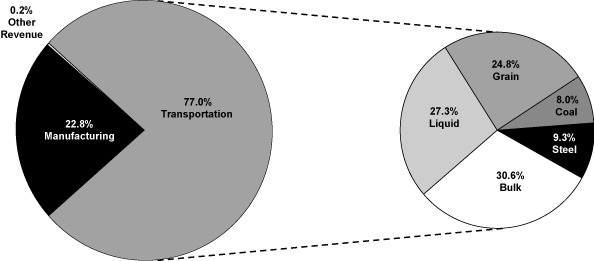
2007 Revenues by Source and Commodity
Our transportation segment’s revenues in 2007 were $808.6 million or 77% of consolidated
revenue. In 2007, our transportation segment transported approximately 39.3 billion ton-miles of
cargo under affreightment contracts and an additional 4.3 billion ton-miles under towing and day
rate contracts for a total of 43.6 billion ton-miles. This was a decrease of 1.5 billion ton-miles
or 3.4% compared to 2006. The decreased ton-miles were produced with a fleet that was 5.6% smaller
than the prior year. We believe that ton-miles, which is computed by the extension of tons by the
number of miles transported, is the best available volume measurement for the transportation
business and is a key part of how we measure our performance.
Our operations are tailored to service a wide variety of shippers and freight types. As of
December 31, 2007, the 2,828 barges in our fleet included 2,074 covered dry cargo barges, 366 open
dry cargo barges and 388 liquid tank barges. We provide additional value-added services to our
customers, including third-party logistics through our BargeLink LLC joint venture, and limited
container transportation services between Chicago and New Orleans. Our operations incorporate
advanced fleet management practices and information technology systems, including our proprietary
ACLTrac real-time GPS barge tracking system, which allows us to effectively manage our fleet. Our
barging operations are complemented by our marine repair, maintenance and port services (e.g.
fleeting, shifting, repairing and cleaning of barges and towboats) located strategically throughout
the Inland Waterways.
Our freight contracts are typically matched to the individual requirements of the shipper
depending on the shipper’s need for capacity, specialized equipment, timing and geographic
coverage. As a result of the supply and demand imbalance for barge capacity, average freight rates
for commodities moved under term contracts have increased significantly during the past three
years. We expect this trend to continue under new term
5
contracts due to the expected retirement of aged barge capacity over the next several years,
although we can make no assurance that they will do so. Spot rates obtained over the same period,
primarily grain and to a lesser extent coal, though generally higher as well, have been and are
expected to continue to be more volatile within and across years. This volatility is based not only
on the supply and demand for barges but additionally weather, crop size, export demand, ocean port
freight differentials and producer market timing.
Our dry cargo barges transport a variety of bulk and non-bulk commodities. In 2007, bulk
commodities were our largest class of cargo transported, accounting for 30.6% of our transportation
revenue, followed by grain, steel and coal. The bulk commodities classification contains a variety
of cargo segments including salt, alumina, fertilizers, cement, ferro alloys, ore and gypsum.
We also transport chemicals, petroleum, ethanol, edible oils and other liquid commodities with
our fleet of tank barges, accounting for approximately 27.3% of our 2007 transportation revenue.
Jeffboat, our manufacturing segment, generated almost 23% or $239.9 million of our
consolidated revenue in 2007. Located in Jeffersonville, Indiana, Jeffboat is a large inland
single-site shipyard and repair facility, occupying approximately 68 acres of land and
approximately 5,600 feet of frontage on the Ohio River, which we believe to be the largest inland
shipyard in the United States. Jeffboat designs and manufactures barges and other vessels for
inland river service for third-party customers and our transportation business. It also
manufactures equipment for coastal and offshore markets and has long employed advanced inland
marine technology. In addition, it also provides complete dry-docking capabilities and full machine
shop facilities for repair and storage of towboat propellers, rudders and shafts. Jeffboat also
offers technically advanced marine design and manufacturing capabilities for both inland and ocean
service vessels. Jeffboat utilizes sophisticated computer-aided design and manufacturing systems to
develop, calculate and analyze all manufacturing and repair plans.
Historically, our transportation business has been one of Jeffboat’s most significant
customers. We believe the synergy created by our transportation operations and Jeffboat’s
manufacturing and repair capabilities is a competitive advantage. Our vertical integration permits
optimization of manufacturing schedules and asset utilization between internal requirements and
sales to third-party customers. Additionally, Jeffboat’s engineers have the opportunity to
collaborate both with our barge operations and with our naval architects on innovations that
enhance towboat performance and barge life.
CUSTOMERS AND CONTRACTS
Transportation. Our primary customers include many of the major industrial and agricultural
companies in the United States. Our relationships with our top ten customers have been in existence
for between five and 30 years. We enter into a wide variety of contracts with these customers,
ranging from single spot movements to renewable one-year contracts and multi-year extended
contracts. In many cases, these relationships have resulted in multi-year contracts that feature
predictable tonnage requirements or exclusivity, allowing us to plan our logistics more
effectively.
In 2007, our largest ten customers accounted for approximately 28% of our revenue with no
individual customer exceeding 10%. We have many long-standing customer relationships, including
Cargill, Inc., North American Salt Company, the David J. Joseph Company, Consolidated Grain and
Barge Company, Bunge North America, Inc., United States Steel Corporation, Nucor Steel, Alcoa,
Inc., Lyondell Chemical Company, Shell Chemical Company, Koch Industries, DuPont and Nova
Chemicals, Inc. We also have a long-standing contractual relationship, extended during the
emergence from bankruptcy of our predecessor company in 2005, until 2015, with Louisiana Generating
LLC, a subsidiary of NRG Energy, Inc. (“LaGen”) and Burlington Northern Santa Fe Railway (“BNSF”).
In 2008, we anticipate that approximately 65% of our barging revenue will be derived from
customer contracts that vary in duration but generally are one year to three years in length. The
average contract maturity is approximately two years. Our multi-year contracts are set at a fixed
price, although we do have some multi-year contracts which contain positively stated rate increases
along with compounding adjustment provisions as well for fuel, and, in most cases, labor cost and
general inflation, which increases stability of the contract margins. Generally, contracts that are
less than one year are priced at the time of execution, which we
6
refer to as the spot market. Grain freight is almost entirely priced in the spot market. All of our
grain freight was priced in this manner during 2007 and 2006. In 2007, the transportation segment
generated approximately 74% of its revenues under term contracts and spot market arrangements with
customers to transport cargoes on a per ton basis from an origin point to a destination point along
the Inland Waterways on the Company’s barges, pushed primarily by the Company’s towboats. These
contracts are referred to as affreightment contracts. The Company is responsible for tracking and
reporting the tonnages moved under such contracts. Due to the pricing attractiveness of dedicated
service contracts, the Company continued to deploy more of its liquid tank fleet to that service in
2007 decreasing by approximately 6% the portion of the transportation segment’s total revenues
generated from affreightment contracts.
The remaining revenues of the transportation segment (collectively “non-affreightment
revenues”) are generated either by demurrage charges for customers’ delays, beyond contractually
allowed days, of our equipment under affreightment contracts or by one of three other distinct
contractual arrangements with customers: dedicated service contracts, outside towing contracts, or
other marine services contracts. Transportation services revenue for each contract type is
summarized in the key operating statistics table contained in Management’s Discussion and Analysis
of Financial Condition and Results of Operations.
Our dedicated service contracts typically provide for dedicated equipment specially configured
to meet the customer’s requirements for scheduling, parcel size and product integrity. The contract
may take the form of a “consecutive voyages” affreightment agreement, under which the customer
commits to loading the barges on consecutive arrivals. Alternatively, the contract may be a “day
rate plus towing” agreement under which the customer essentially charters a barge or set of barges
for a fixed daily rate and pays a towing charge for the movement of the tow to its destination. A
“unit tow” contract provides the customer with a set of barges and a boat for a fixed daily rate,
with the customer paying the cost of fuel. Chemical shippers typically use dedicated service
contracts to ensure reliable supplies of specialized feedstocks to their plants. Petroleum
distillates and fuel oils generally move under “unit tow” contracts. Many dedicated service
customers also seek capacity in the spot market for peaking requirements. Outside towing revenue is
earned by moving barges for other affreightment carriers at a specific rate per barge move.
Transportation services revenue is earned for fleeting, shifting and cleaning services provided to
third parties. Under charter/day rate contracts, the Company’s boats and barges are leased to third
parties who control the use (loading, unloading, and movement) of the vessels. During 2007 and 2006
we deployed additional barges to serve customers under charter/day rate contracts due to strong
demand and attractive, available pricing for such service. On average, an additional 33 and 26
liquid tank barges in 2007 and 2006, respectively, were devoted to these non-affreightment
contracts when compared to the immediately preceding years. This represented redeployment of an
additional 9% and 7%, respectively, of our average liquid tank fleet in those years to this type of
service (for an average total of 131 and 98 tank barges or 35% and 26% of our average liquid tanker
fleet in the two years). The pricing attained for this type of service and the increased number of
barges deployed drove charter and day rate revenue up 52% in 2007 and 82%in 2006, respectively, in
comparison to the immediately preceding years.
Certain contracts that provide for a minimum level of service are generally referred to as
fixed volume, “take or pay.” A take or pay contract requires the shipper to tender a minimum
tonnage over a defined period, suffering a “dead freight” penalty for failure to meet the minimum
volume level. Under take or pay contracts, we typically provide a fixed amount of equipment and
dedicate it to providing the required level of service. Electric utility companies sometimes use
take or pay agreements to ensure an adequate supply of inventory. These contracts usually run for
many years and typically have adjustment clauses for fuel, labor and inflation.
7
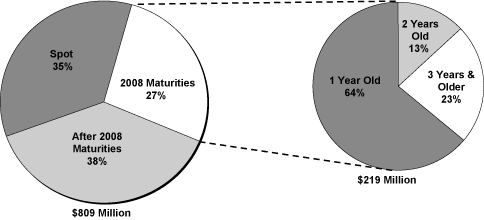
The following chart depicts total transportation revenues, both affreightment and
non-affreightment, and indicates the approximate renewal dates of the term contracts. The chart
also displays expected 2008 term renewals by relative age.
| |
|
|
|
|
|
|
Transportation Portfolio
|
|
2008 Renewals |
|
|
|
|
|
|
2007
Revenues by Contract Type
Manufacturing. The primary third-party customers of our barge and other vessel manufacturing
subsidiary, Jeffboat, are other operators within the inland barging industry. Because barge and
other vessel manufacturing requirements for any one customer are dependent upon the customer’s
specific replacement and growth strategy, and due to the long-lived nature of the equipment
manufactured, Jeffboat’s customer base varies from year-to-year. Our transportation business is a
significant customer of Jeffboat. In 2007, our transportation segment accounted for 17% of
Jeffboat’s revenue before intercompany eliminations.
At December 31, 2007, the manufacturing segment’s approximate vessel backlog for external
customers was $429 million compared to $407 million at December 31, 2006. The backlog consists of
vessels to be constructed under signed customer contracts or exercised contract options that have
not yet been recognized as revenue. The backlog excludes our planned construction of internal
replacement barges. Approximately 54% of the backlog is under contract for delivery in 2008. The
backlog extends into 2010. In January 2008 a new contract was signed for approximately $100 million
in new barge construction including options. Contract options are not included in the computation
of the approximate vessel backlog until signed. The new contract increased the backlog by
approximately $25 million from the year end level.
Steel is the largest component of our raw materials, representing 70% to 90% of the raw
material cost, depending on barge type. We have established relationships with our steel vendors
and have not had an issue with obtaining the quantity or quality of steel required to meet our
commitments. The price of steel, however, varies significantly with changes in supply and demand.
All of the contracts in our backlog contain steel price adjustments. Because of the volatile nature
of steel prices, we pass on the cost of steel used in the production of our customers’ barges back
to our customers. Therefore, at the time of construction, the actual price of steel may result in
contract prices that are greater than or less than those used to calculate the backlog at the end
of 2007. In addition, many of our contracts signed in 2006 and 2007 also contain labor and general
inflation clauses which may also impact the revenue ultimately realized on the construction of the
vessels.
We believe demand for dry and liquid tank barges remains strong. A continuing significant
driver in this market is the demand to replace all single-hull tank barges with double-hull tank
barges. By federal law, single-hull tank barges will not be allowed to operate after 2015. All of
the Company’s tank barges have
8
double hulls. In addition to barge demand, we expect that the boat replacement cycle will drive
demand for new boat construction in 2009 and beyond. We have signed contracts to produce five
towboats for delivery in 2009 and 2010.
The price we have been able to charge for manufacturing production has fluctuated historically
based on a variety of factors including the cost of raw materials, the cost of labor and the demand
for new barge builds compared to the barge manufacturing capacity within the industry at the time.
During 2007, we continued to increase the pricing on our barges, net of steel costs, in response to
increased demand for new barge construction. We plan to continue increasing the pricing on our
barges, net of steel, in conjunction with the expected additional demand for new barge
construction. If demand for new barge construction diminishes going forward, we may not be able to
increase pricing over our current levels or maintain pricing at current levels. Additionally, at
the end of 2007, we have over $200 million related to more than 375 vessels in our backlog that
were priced under contracts or options negotiated at lower estimated margins and with more
aggressive labor estimates than in contracts signed during 2006 and 2007. These will result in
sub-optimal margins as they enter production. Unsigned options in these contracts on nearly 200
additional vessels or more than $100 million of revenues are expected to extend the margin impact
into 2010 and 2011 if the options are exercised. As a percent of total production, we expect that
these vessels will decline in 2008 and beyond as the underlying vessels are completed.
TRANSPORTATION FLEET
Barges. As of December 31, 2007, our total transportation fleet was 2,828 barges, consisting
of 2,074 covered dry cargo barges, 366 open dry cargo barges and 388 tank barges. We operate 531 of
these dry cargo barges and 37 of these tank barges pursuant to charter agreements. The charter
agreements have terms ranging from one to fifteen years. Generally, we expect to be able to renew
or replace our charter agreements as they expire. Our entire existing tank barge fleet is
double-hulled. As of December 31, 2007, the average age of our covered dry cargo barges was 20
years, and the average age of our tank barges was 23 years, which we believe is consistent with the
industry age profile.
Towboats. As of December 31, 2007, our barge fleet was powered by 137 Company-owned towboats
and 25 additional towboats operated exclusively for us by third parties. The size and diversity of
our towboat fleet allows us to deploy our towboats to areas of the Inland Waterways where they can
operate most effectively. For example, our towboats with 9,000 horsepower or greater typically
operate with tow sizes of as many as 40 barges along the Lower Mississippi River, where the river
channels are wider and there are no restricting locks and dams. Our 5,600 horsepower towboats
predominantly operate along the Ohio, Upper Mississippi and Illinois Rivers, where the river
channels are narrower and restricting locks and dams are more prevalent. We also deploy smaller
horsepower towboats for shuttle and harbor services. In early 2007 we acquired 20 towboats that had
previously serviced both the Company and other third parties. This acquisition significantly
increased our capacity for Gulf fleeting and canal service.
PORT SERVICES ASSETS
To support our barging fleet, we operate port service facilities. ACL Transportation Services
LLC (“ACLT”) operates facilities throughout the Inland Waterways that provide fleeting, shifting,
cleaning and repair services for both barges and towboats, primarily for ACL, but also for
third-party customers. Effective January 1, 2007 all of our port service assets were controlled by
ACLT which we believe enhances the branded value of the American Commercial Lines brand. ACLT has
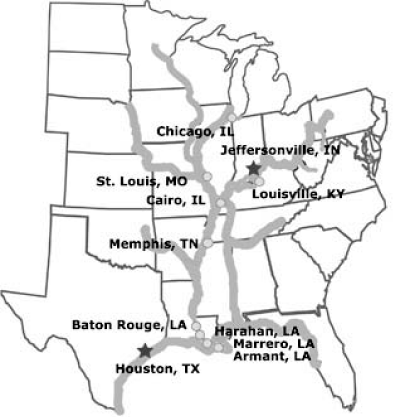
port service facilities in the following locations: Lemont, Illinois; St. Louis, Missouri; Cairo,
Illinois; Louisville, Kentucky; Baton Rouge, Louisiana; Vacherie, Louisiana (Armant fleet);
Harahan, Louisiana; Marrero, Louisiana; and Houston, Texas. Its operations consist of fleets,
towboat repair shops, dry docks, scrapping facilities and cleaning operations.
ACLT also operates a coal receiving, storage and transfer facility in St. Louis, Missouri.
Together with BNSF, we also transport coal from mines in the Powder River Basin of Wyoming and
Montana to the LaGen power plant in Louisiana under an agreement with LaGen. Currently these
activities account for less than 10% of our revenue. Our St. Louis terminal also receives and
stores coal from third-party shippers who source coal
9
on the BNSF and ship to inland utilities on our barges. ACLT’s liquid terminal in Memphis,
Tennessee provides liquid tank storage for third parties and processes oily bilge water from
towboats. The oil recovered from this process is blended for fuel used by ACL’s towboats or is sold
to third parties.
THIRD-PARTY LOGISTICS, INTERMODAL SERVICES
Our fleet size, diversity of cargo transported and experience enables us to provide
transportation logistics services for our customers. We own 50% of BargeLink LLC, a joint venture
with MBLX, Inc. (“BargeLink”), based in New Orleans. BargeLink provides third-party logistics
services to international and domestic shippers who distribute goods primarily throughout the
inland rivers. BargeLink provides and arranges for ocean freight, customs clearance, stevedoring
(loading and unloading cargo), trucking, storage and barge freight for its customers. BargeLink
tracks customers’ shipments across multiple carriers using proprietary tracking software developed
by BargeLink.
Additionally, we also initiated container transport in our barging operations in 2004. We are
evaluating other river gateway opportunities going forward. We also provide “stack to stack”
service, which includes local truckers for cargo transport and terminals for container handling.
This service makes use of our existing fleet of open dry cargo barges and is within the principal
operating corridors of our dry and liquid barging service. This pattern density creates the
frequency of service that is valued by intermodal shippers. We expect to continue to market this
kind of service as well as other services that, to date, have been predominantly served by
“off-river” modes of transportation.
At our Lemont Terminal, located approximately 25 miles Southwest of downtown Chicago, we have
direct access to Highways 55, 355 and 294 and a truck delivery radius including Iowa, Michigan,
Indiana, Illinois, Wisconsin, and Ohio. From this location we distribute truck-to-barge and
barge-to-truck multi-modal shipments of both northbound and southbound freight from inland river
system origins and destinations in Mexico, Texas, New Orleans, Alabama, Florida, Pennsylvania and
points between. We also have 48,000 square feet of indoor temperature controlled space for product
storage in Lemont, as well as 35 acres for outside storage.
COMPETITION
Transportation. Competition within the barging industry for major commodity contracts is
intense, with a number of companies offering transportation services on the Inland Waterways. We
compete with other carriers primarily on the basis of commodity shipping rates, but also with
respect to customer service, available routes, value-added services (including scheduling
convenience and flexibility), information timeliness, quality of equipment, accessorial terms,
freight payment terms, free days and demurrage days.
We believe our vertical integration provides us with a competitive advantage. By using our
ACLT and Jeffboat barge and towboat repair facilities, ACLT vessel fleeting facilities and
Jeffboat’s shipbuilding capabilities, we are able to support our core barging business and offer a
combination of competitive pricing and high quality service to our customers. We believe that the
size and diversity of our fleet allow us to optimize the use of our equipment and offer our
customers a broad service area, at competitive rates, with a high frequency of arrivals and
departures from key ports.
According to Informa Inc., a private forecasting service (“Informa”), we had the largest
covered dry cargo barge fleet in the industry with almost 21% of the industry capacity. Informa
updates annual industry data in March of each year for the prior calendar year end. We do not
expect the 2007 data to be significantly different. We expect that our concentration in 2008 on
expansion of our liquid tank fleet may result in a reduction of the percentage of industry dry
cargo fleet capacity owned by the Company. We believe our large covered dry cargo fleet gives us a
unique position in the marketplace that allows us to service the transportation needs of customers
requiring covered barges to ship their products. It also provides us with the flexibility to shift
covered dry cargo fleet capacity to compete in the open dry cargo barge market simply by storing
the barge covers. This adaptability allows us to operate the barges in open barge trades for a
short or long term period of time to take advantage of market opportunities. Carriers that have
barges designed for
10
open dry cargo barge service only cannot easily retrofit their open dry cargo barges with covers
without significant expense, time and effort.
Since 1980, the industry has experienced consolidation as the acquiring companies have moved
toward attaining the widespread geographic reach necessary to support major national customers.
TOP 5 CARRIERS BY FLEET SIZE
(as of December 31, 2006*)
| |
|
|
|
|
|
|
|
|
|
|
|
|
| |
|
|
|
|
| |
% of |
| | |
Average | |
| |
|
Units |
| |
Barges |
| | |
Age (Yrs) |
|
Dry Cargo Barges ** |
|
|
|
|
|
|
|
|
|
|
|
|
Ingram Barge Company |
|
|
3,633 |
|
|
|
20.3 |
% |
|
|
16.4 |
|
American Commercial Lines |
|
|
2,639 |
|
|
|
14.8 |
% |
|
|
20.4 |
|
AEP/MEMCO
Barge Line, Inc. |
|
|
2,628 |
|
|
|
14.7 |
% |
|
|
10.9 |
|
American River Transportation Company |
|
|
2,061 |
|
|
|
11.5 |
% |
|
|
25.7 |
|
Cargo Carriers |
|
|
958 |
|
|
|
5.4 |
% |
|
|
14.8 |
|
|
|
|
|
|
|
|
|
|
|
|
|
|
Top 5 Dry Carriers |
|
|
11,919 |
|
|
|
66.6 |
% |
|
|
17.6 |
|
|
|
|
|
|
|
|
|
|
|
|
|
|
Total Industry |
|
|
17,885 |
|
|
|
100.0 |
% |
|
|
16.2 |
|
|
|
|
|
|
|
|
|
|
|
|
|
|
|
|
|
|
|
|
|
|
|
|
|
|
|
Liquid Cargo Barges |
|
|
|
|
|
|
|
|
|
|
|
|
Kirby Corporation |
|
|
912 |
|
|
|
32.5 |
% |
|
|
24.1 |
|
American Commercial Lines |
|
|
371 |
|
|
|
13.2 |
% |
|
|
22.6 |
|
Marathon Ashland Petroleum LLC |
|
|
180 |
|
|
|
6.4 |
% |
|
|
19.1 |
|
Canal Barge Company, Inc. |
|
|
170 |
|
|
|
6.1 |
% |
|
|
12.3 |
|
Ingram Barge Company |
|
|
165 |
|
|
|
5.9 |
% |
|
|
28.5 |
|
|
|
|
|
|
|
|
|
|
|
|
|
|
Top 5 Liquid Carriers |
|
|
1,798 |
|
|
|
64.0 |
% |
|
|
22.6 |
|
|
|
|
|
|
|
|
|
|
|
|
|
|
Total Industry |
|
|
2,809 |
|
|
|
100.0 |
% |
|
|
21.8 |
|
|
|
|
|
|
|
|
|
|
|
|
|
|
|
|
|
| * |
|
Source: Informa and Company. Note that annual data is normally not available until March of
the following year. |
| |
| ** |
|
Dry Cargo Barges include covered and open dry barges. |
Manufacturing. The inland barge and towboat manufacturing industry competes primarily on
quality of manufacture, delivery schedule, design capabilities and price. We consider Trinity
Industries, Inc. to be Jeffboat’s most significant competitor for the large-scale manufacture of
inland barges, although other firms have barge building capability on a smaller scale. We believe
there are a number of shipyards located on the Gulf Coast that compete with Jeffboat for the
manufacture of towboats. In addition, certain other shipyards may be able to reconfigure to
manufacture inland barges and related equipment.
SEASONALITY
Our historical revenue stream within any year reflects the variance in seasonal demand, with
revenues earned in the first half of the year historically lower than those earned in the second
half of the year. Additionally, we have generally experienced higher expenses in the winter months,
because winter conditions historically result in higher costs of operation and reduced equipment
demand, which permits scheduling major boat maintenance. Similarly, our manufacturing costs
increase in our shipyard with seasonal precipitation, as extra shifts and lower productivity
overtime are required to maintain production schedules.
The transportation of grain in the spot market represented almost 25% of our annual revenues
for 2007. Historically, we have experienced the greatest degree of seasonality in our grain
transportation business
11
compared to all other commodity segments, with demand generally following the timing of the annual
harvest. The demand for grain movement generally begins in the Gulf Coast and Texas regions and the
southern portions of the Lower Mississippi River, or the Delta area, in late summer of each year.
The demand for freight spreads north and east as the grain matures and harvest progresses through
the Ohio Valley, the Mid-Mississippi River area, and the Illinois River and Upper Mississippi River
areas. System-wide demand generally peaks in the mid-fourth quarter. Demand normally tapers off
through the mid-first quarter, when traffic is generally limited to the Ohio River as the Upper
Mississippi River normally closes from approximately mid-December to mid-March, and ice conditions
can hamper navigation on the upper reaches of the Illinois River. Fertilizer movements are timed
for delivery prior to annual planting, generally moving from late August through April. Salt
movements are heaviest in the winter, when the need for road salt in cold weather regions drives
demand, and are more ratable throughout the balance of the year as stockpiles are replaced. Overall
demand for other bulk and liquid products delivered by barge is more ratable throughout the year.
Spot grain movement is generally priced at or near the quoted tariff rate for the particular
river section on which the move occurred. These tariff rates move independently based on weather,
harvest timing and other factors related specifically to that location in addition to the overall
supply and demand relationship of available barges. The differential between peak and trough rates
has averaged 123% over the last five years.
Since the beginning of 2006, we have not negotiated term contracts for grain movements and
have, therefore accepted the potentially greater volatility in tariff rates. The average annual
rates for the mid-Mississippi River, which we believe is a fair indicator of the total market,
increased over 60% in 2005 over 2004. Rates in 2006 rose an incremental 20% over 2005 levels. Rates
in 2007 declined approximately 6% from the 2006 levels, but remained 15% above 2005 levels. While
we believe our decision to move all of our grain business to spot market pricing favorably impacted
2006 and 2007 when compared to prior years’ pricing levels, it has also exposed us to greater
volatility.
The chart below depicts the seasonal movements in what we believe to be a representative
tariff rate over time for a river segment we track as part of the mid-Mississippi River. We do not
track January and February for this segment due to significantly reduced volumes on the segment
during that time frame.
ACL Mid-Mississippi Tariff Rates By Month By Year
12
EXECUTIVE OFFICERS AND KEY EMPLOYEES
The following is a list of our executive officers and key employees as of February 29, 2008
and their ages as of such date and their positions and offices.
| |
|
|
|
|
|
|
| Name |
|
Age |
|
Position |
Mark R. Holden
|
|
|
48 |
|
|
Director, President and Chief Executive Officer(1) |
Michael P. Ryan
|
|
|
48 |
|
|
Senior Vice President, Sales and Marketing(2) |
W. Norbert Whitlock
|
|
|
66 |
|
|
Executive Vice President, Governmental Affairs |
Christopher A. Black
|
|
|
45 |
|
|
Senior Vice President, Chief Financial Officer(3) |
Nick C. Fletcher
|
|
|
47 |
|
|
Senior Vice President, Human Resources |
Jerry R. Linzey
|
|
|
44 |
|
|
Senior Vice President, Chief Operating Officer |
Richard A. Mitchell Jr.
|
|
|
42 |
|
|
Senior Vice President, Corporate Strategy |
Michael J. Monahan
|
|
|
49 |
|
|
Senior Vice President, Transportation Services |
Kevin S. Boyle
|
|
|
34 |
|
|
Vice President, Treasurer |
Karl D. Kintzele
|
|
|
57 |
|
|
Vice President, Internal Audit |
Tamra L. Koshewa
|
|
|
39 |
|
|
Vice President, Finance and Corporate Controller |
David T. Parker
|
|
|
44 |
|
|
Vice President, Investor Relations and Corporate Communications |
Douglas C. Ruschman
|
|
|
56 |
|
|
Interim General Counsel and Vice President Legal |
William L. Schmidt
|
|
|
46 |
|
|
Vice President, Information Technology |
Jacques J. Vanier
|
|
|
46 |
|
|
Vice President, Manufacturing |
|
|
|
| (1) |
|
On February 18, 2008, Mr. Holden announced his resignation from all executive positions and
from the Board of Directors effective on March 1, 2008. |
| |
| (2) |
|
On February 18, 2008, Mr. Ryan was named President, Chief Executive Officer and a director
effective March 1, 2008. |
| |
| (3) |
|
On September 5, 2007 Mr. Black informed the Company of his plan to leave the Company upon
expiration of his employment agreement on February 22, 2008. In January 2008 the Company entered
into an agreement with Mr. Black to extend his employment through March 1, 2008 and thereafter to
serve as a consultant to the Company until April 30, 2008. |
Mark R. Holden was named President and Chief Executive Officer of ACL in January 2005 and has
also served as a director of ACL since that date. Mr. Holden has announced his resignation from all
executive positions and from the Board of Directors effective on March 1, 2008. Prior to joining us
in 2005, Mr. Holden served in the Office of the Chief Executive Officer and as Chief Financial
Officer, since May 1995, of Wabash National Corporation, a large manufacturer of truck trailers.
Mr. Holden also served on the board of directors of Wabash from 1995 to 2003 and on the Executive
Committee of the Board. Prior to that, Mr. Holden held a variety of positions of increasing
responsibility with Wabash beginning in 1992. Before joining Wabash, Mr. Holden spent 12 years at
an international accounting firm.
Michael P. Ryan was named President and Chief Executive Officer effective March 1, 2008. In
addition, Mr. Ryan was elected to the Board of Directors effective March 1, 2008. He previously
served as Senior Vice President, Sales and Marketing of ACL since November 2005. Mr. Ryan has more
than 24 years of combined experience in logistics, sales, marketing and customer service. He spent
approximately 20 years in sales and marketing positions of increasing responsibility while at
Canadian National Railway Company and CSX Corporation, Inc. and was most recently Senior Vice
President and General Manager of McCollister’s Transportation Systems.
W. Norbert Whitlock was named Executive Vice President, Governmental Affairs of ACL in August
2006. From January 2005 Mr. Whitlock was Senior Vice President, Chief Operating Officer of ACL.
Since April 2004 Mr. Whitlock served as our Chief Operating Officer and served as our President
from April 2004 through January 17, 2005. Previously, Mr. Whitlock served as Senior Vice President,
Transportation Services of American Commercial Lines LLC from July 2003 to April 2004, as Senior
Vice President, Logistics
13
Services for American Commercial Barge Line LLC and LDC from March 2000 to June 2003 and as Senior
Vice President, Transportation Services of American Commercial Barge Line and LDC from 1982 through
March 2000.
Christopher A. Black was named Senior Vice President, Chief Financial Officer of ACL in
February 2005. Prior to joining us, Mr. Black served as Vice President and Treasurer of Wabash
National Corporation from October 2001 to July 2004. Prior to that, from September 2000 to October
2001, Mr. Black served as Senior Vice President — Corporate Banking of US Bancorp. From August 1995
to September 2000, he held various positions at SunTrust Bank, most recently as Director —
Corporate & Investment Banking. Prior to that, he was employed by PNC Bank and Bank One (now JP
Morgan Chase). Mr. Black has resigned from the Company effective March 1, 2008, but will continue
as a consultant to the Company until April 30, 2008.
Nick C. Fletcher was named Senior Vice President, Human Resources of ACL in March 2005. From
February 2004 until joining us, Mr. Fletcher was Vice President of Human Resources for Continental
Tire North America, Inc., a global manufacturer of automotive tires and products, since February
2004. Prior to that, he provided human resources consulting services from May 2003 to February
2004. From June 1999 until May 2003, he was employed by Wabash National Corporation as Director of
Human Resources and as Vice President, Human Resources. Throughout his career he has held various
human resources positions with increasing responsibility at TRW Inc., Pilkington Libbey-Owens-Ford
Co., Landis & Gyr Inc. and Siemens Corporation.
Jerry R. Linzey was named Senior Vice President, Chief Operating Officer of ACL in August 2006
after having served as Senior Vice President, Manufacturing from May 2005 until then. Prior to
joining us, Mr. Linzey served as Vice President and Senior Vice President, Manufacturing of Wabash
National Corporation from 2002 to May 2005. Prior to that, from 2000 to 2002, Mr. Linzey served as
Director, North American Operations of The Stanley Works, a large manufacturer of tools and
fasteners. From 1985 to 2000, he held various positions at Delphi Automotive Systems, most recently
as Plant Manager — Radiator and Oil Cooler Product Lines.
Richard A. Mitchell Jr. was named Senior Vice President, Corporate Strategy of ACL in October
2005. Prior to joining us, Mr. Mitchell spent over 20 years in various capacities for United Parcel
Service, Inc., one of the world’s largest integrated transportation companies. Most recently, Mr.
Mitchell served as Vice President and Group Head of the UPS Mergers & Acquisitions Group until June
2004, and subsequently served as Vice President of Corporate Strategy until his departure in
October 2005.
Michael J. Monahan was named Senior Vice President, Transportation Services of ACL in
September 2004. Prior to joining ACL, Mr. Monahan served as Vice President of TECO Barge Line, a
barge transportation company, from August 2002 until August 2004, where he was responsible for the
management and operation of its river transportation assets. Before joining TECO, Mr. Monahan was
Vice President of Operations Support for Midland Enterprises, Inc., a barge transportation and
related service company, from April 2000 until August 2002.
Kevin S. Boyle was named Vice President, Treasurer of ACL in December 2005. Prior to joining
the Company, Mr. Boyle was Director of Planning and Development for Great Lakes Transportation,
which was sold to Canadian National Railway Company. From 1998 to 2001, Mr. Boyle was employed by
Seabulk International, where he rose to the position of Treasurer.
Karl D. Kintzele was named Vice President, Internal Audit of ACL in March 2005. From October
2001 until joining us, Mr. Kintzele served as Vice President, Internal Audit of Wabash National
Corporation since October 2001, having been promoted from the position of Director, Internal Audit,
which he assumed in September 1999 upon joining the company. Before joining Wabash, Mr. Kintzele
spent 18 years with Teledyne, Inc., a conglomerate of aerospace, electronics, consumer and
specialty metals components, holding positions of increasing senior management responsibilities
within the financial and internal audit functions.
Tamra L. Koshewa was named Vice President, Finance and Corporate Controller of ACL in July
2006. Prior to joining the Company, Ms. Koshewa worked for ten years at General Electric (“GE”) in
several progressive financial leadership roles, most recently as Manager, Finance — Integration and
Quality for GE’s
14
Consumer and Industrial division in Louisville, Kentucky. She is also a Certified Public
Accountant and worked for KPMG prior to joining GE.
David T. Parker was named Vice President Investor Relations and Corporate Communications in
December 2007. From November 2006 until joining the Company Mr. Parker was Senior Counsel for
Peyron & Associates from November 2006. From March 2005 to November 2006 Mr. Parker was Vice
President, Investor Relations and Governmental Affairs for Albertsons, Inc. From March 2003 to
March 2005, Mr. Parker had been Director of Strategic Communication and Investor Relations for
Micron Technology.
Douglas C. Ruschman was named Vice President Legal in October 2006 and interim General Counsel
and Secretary in January 2008. He had earlier served as Vice President Law and Administration for
ACL, responsible for risk management, insurance and tort litigation. At ACL Mr. Ruschman has also
been responsible for the Human Resources and Benefits Departments. Prior to joining ACL in 1995 Mr.
Ruschman spent twenty years with CSX Transportation, a Class I Railroad and fully integrated
Transportation company. He held a number of positions there, the last as the General Manager of
Litigation.
William L. Schmidt was named Vice President, Information Technology of ACL in April 2005. Mr.
Schmidt served as our Vice President, Corporate Support from October 2003 to April 2005; Vice
President, Purchasing from June 2002 to October 2003; and Assistant Vice President, Logistics from
April 2000 to June 2002. Mr. Schmidt joined us in 1995 as a Manager of Liquid Sales before being
named Assistant Vice President, Gulf Fleet Services in 1997. Prior to joining us, Mr. Schmidt
served as Director — Projects & Business Development of The Great Lakes Towing Company from 1990 to
1995.
Jacques J. Vanier was named Vice President, Manufacturing of ACL in January 2007. Prior to
joining us, Mr. Vanier served as Vice President of Global Manufacturing and Operations with Alcoa
Automotive and Truck Systems. Mr. Vanier held a variety of positions in operations and management,
manufacturing, logistics, production control and sales throughout a twenty-one year career with
Alcoa.
EMPLOYEE MATTERS
EMPLOYEE COUNT
| |
|
|
|
|
|
|
|
|
| |
|
December 31, |
|
December 31, |
| Function |
|
2007 |
|
2006 |
Administration (including Jeffboat) |
|
|
319 |
|
|
|
288 |
|
Transportation services |
|
|
1,704 |
|
|
|
1,446 |
|
Manufacturing |
|
|
1,320 |
|
|
|
1,055 |
|
Other |
|
|
59 |
|
|
|
6 |
|
|
|
|
|
|
|
|
|
|
|
|
|
3,402 |
|
|
|
2,795 |
|
|
|
|
|
|
|
|
|
|
Collective bargaining agreements. As of December 31, 2007, approximately 1,207, or 35.5%, of
our employees were represented by unions. Approximately 1,188 of these unionized employees are
represented by General Drivers, Warehousemen and Helpers, Local Union No. 89, which is affiliated
with the International Brotherhood of Teamsters, Chauffeurs, Warehousemen and Helpers of America,
at our Jeffboat shipyard facility under a collective bargaining agreement that is set to expire in
April 2010. The remainder of our unionized employees, approximately 20 positions at ACL
Transportation Services LLC’s terminal operations in St. Louis, Missouri, are represented by the
International Union of United Mine Workers of America, District 12-Local 2452 (“UMW”), under a
collective bargaining agreement that expired in November 2007. We have been in negotiations with
UMW since October 26, 2007 for a successor agreement covering terms and conditions of employment
for production and maintenance workers at the facility. We expect to continue negotiations in late
February, 2008. We currently cannot predict when or if a new agreement will be reached with UMW.
INSURANCE AND RISK MANAGEMENT
The Company procures and manages insurance policies and provides claims management services
for our subsidiaries internally through our risk management department. The company is exposed to
traditional
15
hazards associated with its manufacturing and marine transportation operations on the Inland
Waterways. A program of insurance is maintained to mitigate risk of loss to the Company’s property,
vessels and barges, loss and contamination of cargo and as protection against personal injury to
third parties and company employees. Our general marine liability policy insures against all
operational risks for our marine activities. Pollution liability coverage is maintained as well.
The Company has provided for adequate excess liability coverage above the noted casualty risks. All
costs of defense, negotiation and costs incurred in liquidating a claim, such as surveys and damage
estimates, are considered insured costs. Our personnel costs involved in managing insured claims
are not reimbursed. We evaluate our insurance coverage regularly. The company believes that our
insurance coverage is adequate.
GOVERNMENT REGULATION
General. Our business is subject to extensive government regulation in the form of
international treaties, conventions, national, state and local laws and regulations, as well as
laws relating to the discharge of materials into the environment. Because such treaties,
conventions, laws and regulations are regularly reviewed and revised by issuing governments, we are
unable to predict the ultimate cost or impact of future compliance. In addition, we are required by
various governmental and quasi-governmental agencies to obtain certain permits, licenses and
certificates with respect to our business operations. The types of permits, licenses and
certificates required depend upon such factors as the commodity transported, the waters in which
the vessel operates, the nationality of the vessel’s crew, the age of the vessel and our status as
owner, operator or charterer. As of December 31, 2007, we had obtained all material permits,
licenses and certificates necessary for operations.
Our transportation operations are subject to regulation by the U.S. Coast Guard, federal laws,
state laws and certain international conventions.
The majority of our inland tank barges carry regulated cargoes. All of our inland tank barges
that carry regulated cargoes are inspected by the U.S. Coast Guard and carry certificates of
inspection. Towboats will soon become subject to U.S. Coast Guard inspection and will be required
to carry certificates of inspection. Our dry cargo barges are not subject to U.S. Coast Guard
inspection requirements.
Additional regulations relating to homeland security, the environment or additional vessel
inspection requirements may be imposed on the barging industry.
Jones Act. The Jones Act is a federal cabotage law that restricts domestic non-proprietary
cargo marine transportation in the United States to vessels built and registered in the United
States. Furthermore, the Jones Act requires that the vessels be manned by U.S. citizens and owned
by U.S. citizens. For a limited liability company to qualify as a U.S. citizen for the purposes of
domestic trade, 75% of the company’s beneficial equity holders must be U.S. citizens. We currently
meet all of the requirements of the Jones Act for our owned vessels.
Compliance with U.S. ownership requirements of the Jones Act is very important to our
operations, and the loss of Jones Act status could have a significant negative effect on our
business, financial condition and results of operations. We monitor the citizenship requirements
under the Jones Act of our employees, boards of directors and managers and beneficial equity
holders and will take action as necessary to ensure compliance with the Jones Act.
User Fees and Fuel Tax. Federal legislation requires that inland marine transportation
companies pay a user fee in the form of a tax assessed upon propulsion fuel used by vessels engaged
in trade along the Inland Waterways. These user fees are designed to help defray the costs
associated with replacing major components of the waterway system, including dams and locks, and to
build new projects. Significant portions of the Inland Waterways on which our vessels operate are
maintained by the U.S. Army Corps of Engineers.
We presently pay a federal fuel tax of 20.1 cents per gallon of propulsion fuel consumed by
our towboats in some geographic regions. In the future, user fees may be increased or additional
user fees may be imposed to defray the costs of Inland Waterways infrastructure and navigation
support. Increases in these taxes are normally passed through to our customers by contract.
16
Homeland Security Requirements. The Maritime Transportation Security Act of 2002 requires,
among other things, submission to and approval by the U.S. Coast Guard of vessel and waterfront
facility security plans (“VSP” and “FSP,” respectively). The regulations required maritime
transporters to submit VSP and FSP for approval no later than December 31, 2003 and to comply with
their VSP and FSP by June 30, 2004. Our VSP and our FSP have been approved. As a result, we are
subject to continuing requirements to engage in training and participate in exercises and drills.
ENVIRONMENTAL REGULATION
Our operations, facilities, properties and vessels are subject to extensive and evolving laws
and regulations pertaining to air emissions, wastewater discharges, the handling and disposal of
solid and hazardous materials, hazardous substances and wastes, the investigation and remediation
of contamination, and other laws and regulations related to health, safety and the protection of
the environment and natural resources. As a result, we are involved from time to time in
administrative and legal proceedings related to environmental, health and safety matters and have
incurred and will continue to incur capital costs and other expenditures relating to such matters.
In addition to environmental laws that regulate our ongoing operations, we are also subject to
environmental remediation liability under the Comprehensive Environmental Response Compensation and
Liability Act (“CERCLA”) and analogous state laws, and the Oil Pollution Act of 1990 (“OPA 90”). We
may be liable as a result of the release or threatened release of hazardous substances or wastes or
other pollutants into the environment at or by our facilities, properties or vessels, or as a
result of our current or past operations. These laws typically impose liability and cleanup
responsibility without regard to whether the owner or operator knew of or caused the release or
threatened release. Even if more than one person may be liable for the release or threatened
release, each person covered by these environmental laws may be held responsible for all of the
investigation and cleanup costs incurred. In addition, third parties may sue the owner or operator
of a site for damages based on personal injury, property damage or other costs, including
investigation and cleanup costs resulting from environmental contamination.
A release or threatened release of hazardous substances or wastes, or other pollutants into
the environment at or by our facilities, properties or vessels, as the result of our current or
past operations, or at a facility to which we have shipped wastes, or the existence of historical
contamination at any of our properties, could result in material liability to us. We conduct
loading and unloading of dry commodities, liquids and scrap materials on and near waterways. These
operations present a potential that some such material might be spilled or otherwise released into
the environment, thereby exposing us to potential liability.
As of December 31, 2007, we had no reserves for these environmental matters. Any cash
expenditures required to comply with applicable environmental laws or to pay for any remediation
efforts will therefore result in charges to earnings. We may incur future costs related to the
sites associated with the environmental reserves. The discovery of additional sites, the
modification of existing or the promulgation of new laws or regulations, more vigorous enforcement
by regulators, the imposition of joint and several liability under CERCLA or analogous state laws
or OPA 90 and other unanticipated events could also result in additional environmental costs. For
more information, see “Legal Proceedings — Environmental Litigation.”
OCCUPATIONAL HEALTH AND SAFETY MATTERS
Our vessel operations are primarily regulated by the U.S. Coast Guard for navigation safety
standards. Our shore operations are subject to the U.S. Occupational Safety and Health
Administration regulations. As of December 31, 2007, we were in material compliance with these
regulations. However, we may experience claims against us for work-related illness or injury as
well as further adoption of occupational health and safety regulations.
We endeavor to reduce employee exposure to hazards incident to our business through safety
programs, training and preventive maintenance efforts. We emphasize safety performance in all of
our operating subsidiaries. We believe that our safety performance consistently places us among the
industry leaders as evidenced by what we believe are lower injury frequency levels than those of
many of our competitors. We
17
have been certified in the American Waterway Operators Responsible Carrier Program, which is
oriented to enhancing safety in vessel operations.
INTELLECTUAL PROPERTY
We register our material trademarks and trade names. We believe we have current intellectual
property rights sufficient to conduct our business.
BANKRUPTCY FILING & EMERGENCE
We were formed in 1953 as the holding company for a family of barge transportation and marine
service companies, the oldest of which has an operating history dating back to 1915. In 1984, we
were acquired by CSX Corporation. For several years thereafter we achieved significant growth
through acquisitions, including: SCNO Barge Lines, Inc. in 1988, Hines Incorporated in 1991, The
Valley Line Company in 1992, and Continental Grain Company’s barging operations in 1996. In June
1998, we completed a leveraged recapitalization in a series of transactions in which the barge
businesses of Vectura Group, Inc. and its subsidiaries were combined with ours. In 2000 we acquired
the assets of Peavey Barge Line, which included the assets of the inland marine transport divisions
of ConAgra, Inc. Late in 2000 we began to experience difficulties in meeting certain financial
covenants set forth in our recapitalized credit facilities. In May 2002 we refinanced our existing
debt obligations with Danielson Holding Corporation (“DHC”). This second recapitalization resulted
in our acquisition by DHC and they remained our parent company until our emergence from bankruptcy
on January 11, 2005, when their ownership interest was extinguished.
During 2002 and through the beginning of 2003 we experienced a decline in barging rates,
reduced shipping volumes and excess barging capacity during a period of slow economic growth and a
global economic recession. Due to these factors our revenue and earnings did not meet expectations
and our liquidity was significantly impaired. We determined that our debt burden was too high and
that a restructuring under Chapter 11 of the Bankruptcy Code offered us the most viable opportunity
to reduce our debts while continuing operations. We therefore filed voluntary petitions seeking
relief from our creditors pursuant to Chapter 11 of the Bankruptcy Code on January 31, 2003. On
December 30, 2004, the Bankruptcy Court entered an order confirming a Plan of Reorganization (“Plan
of Reorganization”). We emerged from Chapter 11 protection in January 2005 with a significantly
less leveraged consolidated balance sheet. On February 2, 2007 the Bankruptcy Court issued a Final
Decree and Order that the estate has been fully administered and the Chapter 11 case is closed.
References herein to the Company or ACL include the Company’s predecessor.
ITEM 1A. RISK FACTORS
Set forth below is a detailed discussion of risks related to our industry and our business. In
addition to the other information in this document, you should consider carefully the following
risk factors. Any of these risks or the occurrence of any one or more of the uncertainties
described below could have a material adverse effect on our financial condition and the performance
of our business.
RISKS RELATED TO OUR INDUSTRY
Freight transportation rates for the Inland Waterways fluctuate from time to time and may
decrease.
Freight transportation rates fluctuate from season-to-season and year-to-year. Levels of dry
and liquid cargo being transported on the Inland Waterways vary based on several factors including
global economic conditions and business cycles, domestic agricultural production and demand,
international agricultural production and demand, and foreign exchange rates. Additionally,
fluctuation of ocean freight rate spreads between the Gulf of Mexico and the Pacific Northwest
affects demand for barging on the Inland Waterways, especially in grain movements. Grain,
particularly corn for export, has been a significant part of our business. Since the beginning of
2006, all grain transported by us has been under spot market contracts.
Spot grain contracts are normally priced at, or near, the quoted tariff rates in effect for
the river segment of the move. Spot rates can vary widely from quarter-to-quarter and year-to-year.
A decline in spot rates could
18
negatively impact our business. The number of barges and towboats available to transport dry and
liquid cargo on the Inland Waterways also varies from year-to-year as older vessels are retired and
new vessels are placed into service. The resulting relationship between levels of cargoes and
vessels available for transport affects the freight transportation rates that we are able to
charge.
An oversupply of barging capacity may lead to reductions in freight rates.
Our industry has previously suffered from an oversupply of barges relative to demand for
barging services. Such oversupply may recur due to a variety of factors, including a drop in
demand, overbuilding and delay in scrapping of barges approaching the end of their useful economic
lives. Calendar year 2006 was the first year in eight years that more barges were built than
scrapped. We believe that approximately 25% of the industry’s existing dry cargo barge fleet will
need to be retired due to age over the next five years. If that occurs it will continue to
constrain barge capacity. If an oversupply of barges were to occur, it could take several years
before supply growth matches demand due to the variable nature of the barging industry and the
freight transportation industry in general, and the relatively long life of marine equipment. Such
oversupply could lead to reductions in the freight rates that we are able to charge.
Yields from North American and worldwide grain harvests could materially affect demand for our
barging services.
Demand for dry cargo barging in North America is affected significantly by the volume of grain
exports flowing through ports on the Gulf of Mexico. The volume of grain exports can vary due to,
among other things, crop harvest yield levels in the United States and abroad. Overseas grain
shortages increase demand for U.S. grain, while worldwide over-production decreases demand for U.S.
grain. Other factors, such as domestic ethanol demand and overseas markets acceptance of
genetically altered products, may also affect demand for U.S. grain. Fluctuations in demand for
U.S. grain exports can lead to temporary barge oversupply, which in turn leads to reduced freight
rates. We cannot assure that historical levels of U.S. grain exports will be maintained in the
future.
Diminishing demand for new barge construction may lead to a reduction in sales prices for new
barges.
The prices we have been able to charge for Jeffboat production have fluctuated historically
based on a variety of factors including the cost of raw materials, the cost of labor and the demand
for new barge builds compared to the barge manufacturing capacity within the industry at the time.
During 2005 we began to increase the pricing on our barges, net of steel costs, in response to
increased demand for new barge construction. Some of the contracts signed prior to that time (the
“legacy contracts”), including any options exercised for additional barges, will negatively impact
manufacturing segment margins due to their lower overall pricing structure. We plan to continue
increasing the pricing on our barges, net of steel, in conjunction with the expected additional
demand for new barge construction as well as inflation of our costs. As a percent of total
production legacy contracts will decline in 2008 and beyond. If demand for new barge construction
diminishes we may not be able to increase pricing over our current levels or maintain pricing at
current levels.
Higher fuel prices, if not recouped from our customers, could dramatically increase operating
expenses and adversely affect profitability.
For the years ended December 31, 2007 and 2006, fuel expenses and related fuel usage taxes
represented 23% and 22% of transportation revenues, respectively. For the quarters ended December
31, 2007 and 2006, fuel expenses and related fuel usage taxes represented 24% and 20% of
transportation revenues, respectively. Fuel prices are subject to fluctuation as a result of
domestic and international events. Generally, our term contracts contain provisions that allow us
to pass through (usually on a one month or one quarter delay) a significant portion of any fuel
expense increase to our customers, thereby reducing, but not eliminating, our fuel price risk. Fuel
price is a key, but not the only variable in spot market pricing. Therefore, fuel price and the
timing of contractual rate adjustments can be a significant source of quarter-over-quarter and
year-over-year volatility. Negotiated spot rates may not fully recover fuel price increases.
19
Our operating margins are impacted by certain low margin “legacy” contracts and by spot rate
market volatility for grain volume and pricing.
Our predecessor company emerged from bankruptcy in January, 2005. Our largest term contract
for the movement of coal predates the emergence and was negotiated at a low margin. Though it
contains a fuel adjustment mechanism, the mechanism may not fully recover increases in fuel cost.
The majority of our coal moves since bankruptcy and through the 2015 expiration of this contract
may be at a low margin. Additionally, contracts for barge manufacturing by our shipyard negotiated
prior to 2006 also commit us to lower margins and more aggressive labor hour forecasts than we have
recently achieved. Additionally, though the contracts contain steel price escalation clauses, only
a portion adjust for increases in wage rates, which we have experienced since they were signed. If
we are unable to improve our performance against the labor hour forecasts these contracts may
reduce margins or inhibit margin improvements from our manufacturing division. These two
concentrations of low margin business were approximately $155 million, $192 million and $185
million of our total revenues in 2005, 2006 and 2007, respectively. The combined legacy contract
amounts in 2008 are expected to be slightly lower than 2007.
All of our grain shipments since the beginning of 2006 were under spot market contracts. Spot
rates can vary widely from quarter-to-quarter and year-to-year. The available pricing and the
volume under such contracts is impacted by many factors including global economic conditions and
business cycles, domestic agricultural production and demand, international agricultural production
and demand, foreign exchange rates and fluctuation of ocean freight rate spreads between the Gulf
of Mexico and the Pacific Northwest. The revenues generated under such contracts, therefore,
ultimately may not cover inflation, particularly for wages and fuel, in any given period. The most
current forecasts for 2008 grain spot rates indicate that they may be flat to down from the rates
obtained during 2007. We expect higher costs for wages and fuel. These circumstances may reduce the
margins we are able to produce on the grain movements which we are able to contract during 2008.
Grain movements were 27%, 32% and 25% of our transportation revenues in 2005, 2006 and 2007,
respectively. We expect grain to continue to decline as a percent of revenue in 2008.
The legacy contracts combined with the potential impact of the grain spot market may lead to
declines in our operating margins which could reduce our profitability.
We are subject to adverse weather and river conditions.
Our barging operations are affected by weather and river conditions. Varying weather patterns
can affect river levels, contribute to fog delays and cause ice to form in certain river areas of
the United States. For example, the Upper Mississippi River closes annually from approximately
mid-December to mid-March, and ice conditions can hamper navigation on the upper reaches of the
Illinois River during the winter months. During hurricane season in the summer and early fall, we
may be subject to revenue loss, business interruptions and equipment and facilities damage,
particularly in the Gulf region. In addition, adverse river conditions can affect towboat speed,
tow size and loading drafts and can delay barge movements. Terminals may also experience
operational interruptions as a result of weather or river conditions.
Jeffboat’s waterfront facility is subject to occasional flooding. Jeffboat’s manufacturing
operation, much of which is conducted outdoors, is also subject to weather conditions. As a result,
these operations are subject to production schedule delays or added costs to maintain production
schedules caused by weather.
Seasonal fluctuations in industry demand could adversely affect our operating results, cash flow
and working capital requirements.
Segments of the inland barging business are seasonal. Historically, our revenue and profits
have been lower during the first six months of the year and higher during the last six months of
the year. This seasonality is due primarily to the timing of the North American grain harvest and
seasonal weather patterns. Our working capital requirements typically track the rise and fall of
our revenue and profits throughout the year. As a result, adverse market or operating conditions
during the last six months of a calendar year could disproportionately adversely affect our
operating results, cash flow and working capital requirements for the year.
20
The aging infrastructure on the Inland Waterways may lead to increased costs and disruptions in
our operations.
Many of the dams and locks on the Inland Waterways were built early in the last century, and
their age makes them costly to maintain and susceptible to unscheduled maintenance outages. Much of
this infrastructure needs to be replaced, but federal government funding of the 50% share not
funded through fuel user taxes on barge operators for new projects has historically been limited.
In addition, though the current annual government funding levels are near the average anticipated
annual need for the foreseeable future, there can be no guarantee that these levels will be
sustained and that a larger portion of infrastructure maintenance costs will not be imposed on
operators. The delays caused by malfunctioning dams and locks may increase our operating costs and
delay the delivery of our cargoes. Moreover, increased diesel fuel user taxes could be imposed in
the future to fund necessary infrastructure improvements, increasing our expenses. We may not be
able to recover increased fuel user taxes through pricing increases that may occur.
The inland barge transportation industry is highly competitive; increased competition could
adversely affect us.
The inland barge transportation industry is highly competitive. Increased competition in the
future could result in a significant increase in available shipping capacity on the Inland
Waterways, which could create downward rate pressure for us or result in our loss of business.
Global trade agreements, tariffs and subsidies could decrease the demand for imported and
exported goods, adversely affecting the flow of import and export tonnage through the Port of New
Orleans and the demand for barging services.
The volume of goods imported through the Port of New Orleans is affected by subsidies or
tariffs imposed by U.S. or foreign governments. Demand for U.S. grain exports may be affected by
the actions of foreign governments and global or regional economic developments. Foreign subsidies
and tariffs on agricultural products affect the pricing of and the demand for U.S. agricultural
exports. U.S. and foreign trade agreements can also affect demand for U.S. agricultural exports as
well as goods imported into the United States. Similarly, national and international embargoes of
the agricultural products of the United States or other countries may affect demand for U.S.
agricultural exports. Additionally, the strength or weakness of the U.S. dollar against foreign
currencies can impact import and export demand. These events, all of which are beyond our control,
could reduce the demand for our services.
Our failure to comply with government regulations affecting the barging industry, or changes in
these regulations, may cause us to incur significant expenses or affect our ability to operate.
The barging industry is subject to various laws and regulations, including international
treaties, conventions, national, state and local laws and regulations and the laws and regulations
of the flag nations of vessels, all of which are subject to amendment or changes in interpretation.
In addition, various governmental and quasi-governmental agencies require barge operators to obtain
and maintain permits, licenses and certificates respecting their operations. Any significant
changes in laws or regulations affecting the inland barge industry, or in the interpretation
thereof, could cause us to incur significant expenses. Recently enacted regulations call for
increased inspection of towboats. Interpretation of the new regulations could result in boat delay
and significantly increased maintenance and upgrade costs for our boat fleet. Furthermore, failure
to comply with current or future laws and regulations may result in the imposition of fines and/or
restrictions or prohibitions on our ability to operate.
Though we work actively with regulators at all levels to avoid inordinate impairment of our
continued operations, regulations and their interpretations may ultimately have a negative impact
on the industry. Regulation such as the Transportation Worker Identification Credential provisions
of the Homeland Security legislation could have an impact on the ability of domestic ports to
efficiently move cargoes. This could ultimately slow operations and increase costs.
21
The Jones Act restricts foreign ownership of our stock, and the repeal, suspension or substantial
amendment of the Jones Act could increase competition on the Inland Waterways and have a material
adverse effect on our business.
The Jones Act requires that, to be eligible to operate a vessel transporting non-proprietary
cargo on the Inland Waterways, the company that owns the vessel must be at least 75% owned by U.S.
citizens at each tier of its ownership. The Jones Act therefore restricts, directly or indirectly,
foreign ownership interests in the entities that directly or indirectly own the vessels which we
operate on the Inland Waterways. If we at any point cease to be 75% owned by U.S. citizens, we may
become subject to penalties and risk forfeiture of our Inland Waterways operations. As of December
31, 2007, we are in compliance with the ownership requirements.
The Jones Act continues to be in effect and supported by the U.S. Congress and the current
administration. We cannot assure that the Jones Act will not be repealed, further suspended or
amended in the future. If the Jones Act was to be repealed, suspended or substantially amended and,
as a consequence, competitors with lower operating costs were to enter the Inland Waterways market,
our business likely would be materially adversely affected. In addition, our advantages as a
U.S.-citizen operator of Jones Act vessels could be eroded over time as there continue to be
periodic efforts and attempts by foreign investors to circumvent certain aspects of the Jones Act.
RISKS RELATED TO OUR BUSINESS
Our aging fleet of dry cargo barges may lead to increased costs and disruptions in our
operations.
The average life expectancy of a dry cargo barge is 25 to 30 years. We anticipate that without
further investment and repairs by the end of 2010 approximately half of our current dry cargo
barges will have reached the end of their economic useful lives. Once barges begin to reach 25
years of age the cost to maintain and operate them may be so high that it is more economical for
the barges to be scrapped. If such barges are not scrapped, additional operating costs to repair
and maintain them would likely reduce cash flows and earnings. If such barges are scrapped and not
replaced, revenue, earnings and cash flows may decline. Though we anticipate future capital
investment in dry cargo barges, we may choose not to replace all barges that we may scrap with new
barges based on uncertainties related to financing, timing and shipyard availability. If such
barges are replaced, significant capital outlays would be required. If the number of barges
declines over time, our ability to maintain our hauling capacity will be decreased unless we can
improve the utilization of the fleet. If these improvements in utilization are not achieved,
revenue, earnings and cash flow could decline.
We may not be successful in our plans to upgrade our production lines in our shipyard and
realize increased levels of capacity and efficiency.
In 2006 and 2007 we invested significant capital in upgrading and retooling our shipyard. The
upgrades and retooling may not ultimately work as planned. These projects, though designed to
increase our efficiency and reduce our exposure to weather delays and expedite production capacity,
may not generate the level of cost savings that we estimate and may not expedite our capacity.
Significant additional capital may be required to maintain existing production capacity and may
delay our ability to modify or augment our current upgrade plans. These delays and additional
expenditures may adversely affect our ability to meet production schedules for external and
internal builds and our results of operations.
Our plans for our transportation business capital investment and organic growth are predicated on
efficiency improvements which we expect to achieve through a variety of initiatives, including
reduction in stationary days, better power utilization and improved fleeting, among others. We
may not ultimately be able to drive efficiency to the level to achieve our current forecast of
tonnage without investing additional capital or incurring additional costs.
We believe that our initiatives will result in improvements in efficiency allowing us to move
more tonnage per barge. If we do not fully achieve these efficiencies, or do not achieve them as
quickly as we plan,
22
we will need to incur higher repair expenses to maintain fleet size by maintaining older barges or
invest new capital as we replace retiring capacity. Either of these options would adversely affect
our results of operations.
Our cash flows and borrowing facilities may not be adequate for our additional capital needs and,
if we incur additional borrowings, our future cash flow and capital resources may not be
sufficient for payments of interest and principal of our substantial indebtedness.
Our operations are capital intensive and require significant capital investment. We intend to
fund substantially all of our needs to operate the business and make capital expenditures,
including adequate investment in our aging boat and barge fleet, through operating cash flows and
borrowings. We may need more capital than may be available under the revolving credit facility and
therefore we would be required either to (a) seek to increase the availability under the revolving
credit facility or (b) obtain other sources of financing. If we incur additional indebtedness, the
risk that our future cash flow and capital resources may not be sufficient for payments of interest
on and principal of our substantial indebtedness would increase. We may not be able to increase the
availability under the revolving credit facility or to obtain other sources of financing on
commercially reasonable terms, or at all. If we are unable to obtain additional capital, we may be
required to curtail our capital expenditures and we may not be able to invest in our aging barge
fleet and to meet our obligations, including our obligations to pay the principal and interest
under our indebtedness.
Our substantial borrowings are currently all tied to floating interest rates which may expose us
to higher interest payments should LIBOR or the prime rate increase substantially.
At December 31, 2007, we had $439.0 million of floating rate debt outstanding, which
represented the outstanding balance of the revolving credit facility. Each 100 basis point increase
in interest rates, at our existing debt level, would increase our cash interest expense by
approximately $4.4 million annually.
We face the risk of breaching financial covenants in our credit agreement.
Our credit agreement contains financial covenants, including a limit on the ratio of debt to
earnings before interest, taxes, depreciation, and amortization. Although we believe none of our
covenants are considered restrictive to our operations, our ability to meet the financial covenants
can be affected by events beyond our control, and we cannot provide assurance that we will meet
those tests. A breach of any of these covenants could result in a default under our credit
agreement. Upon the occurrence of an event of default under our credit agreement, the lenders could
elect to declare all amounts outstanding to be immediately due and payable and terminate all
commitments to extend further credit. If the lenders accelerate the repayment of borrowings, we
cannot provide assurance that we will have sufficient assets to repay our credit.
As part of our growth strategy, we may continue to make selective acquisitions, the integration
and consolidation of which may disrupt operations and could negatively impact our business,
including our margins.
Growing the business through acquisitions involves risks of maintaining the continuity of the
acquired business, including its personnel and customer base; achievement of expected synergies,
economies of scale and cost reduction; adequacy of returns from the acquired business to fund
incremental debt or capital costs arising from its acquisition; and possible assumption of
unanticipated costs or liabilities related to the acquired business. Integrating and consolidating
the operations and personnel of acquired businesses into our existing operations may result in
difficulties and expense, disrupt our business and divert management’s time and attention. As a
result of these risks, there can be no assurance that any future acquisition will be successful or
that it will not have a material adverse effect on our business, financial condition and results of
operations.
The loss of one or more key customers, or material nonpayment or nonperformance by one or more of
our key customers, would have a material adverse effect on our revenue and profitability.
In 2007, our largest customer, Cargill, accounted for approximately 6% of our revenue, and our
largest ten customers accounted for approximately 28% of our revenue. If we were to lose one or
more of our large customers, or if one or more of our large customers were to significantly reduce
the amount of barging
23
services they purchased from us and we were unable to redeploy that equipment on similar terms, or
if one or more of our key customers failed to pay or perform, we could experience a significant
loss of revenue.
A major accident or casualty loss at any of our facilities could significantly reduce production
One or more of our facilities may experience a major accident and may be subject to unplanned
events such as explosions, fires, inclement weather, acts of God and transportation interruptions.
Any shutdown or interruption of a facility could reduce the production from that facility and could
prevent us from conducting our business for an indefinite period of time at that facility, which
could substantially impair our business. For example, such an occurrence at our Jeffboat facility
could disrupt or shut down our manufacturing activities. Our insurance may not be adequate to cover
our resulting losses.
Our transportation division employees are covered by federal maritime laws that may subject us to
job-related claims in addition to those provided by state laws.
Many of our employees are covered by federal maritime laws, including provisions of the Jones
Act, the Longshore and Harbor Workers Act and the Seaman’s Wage Act. These laws typically operate
to make liability limits established by state workers’ compensation laws inapplicable to these
employees and to permit these employees and their representatives to pursue actions against
employers for job-related injuries in federal court. Because we are not generally protected by the
limits imposed by state workers’ compensation statutes for these employees, we may have greater
exposure for any claims made by these employees than is customary in the individual states.
We have experienced work stoppages by union employees in the past, and future work stoppages may
disrupt our services and adversely affect our operations.
As of December 31, 2007, approximately 1,207 employees were represented by unions. Most of
these unionized employees (approximately 1,188 individuals) are represented by General Drivers,
Warehousemen and Helpers, Local Union No. 89, affiliated with the International Brotherhood of
Teamsters, Chauffeurs, Warehousemen and Helpers of America (“Teamsters”), at our Jeffboat shipyard
facility under a three-year collective bargaining agreement that expires in April 2010. Our
remaining unionized employees (approximately 20 positions) are represented by the International
Union of United Mine Workers of America, District 12-Local 2452 at ACL Transportation Services LLC
in St. Louis, Missouri under a collective bargaining agreement that expired in November 2007. We
are continuing to negotiate with UMW for a successor agreement but cannot predict when or if a new
agreement will be reached. Although we believe that our relations with our employees and with the
recognized labor unions are generally good, we cannot assure that we will not be subject to work
stoppages or other labor disruption in the future.
The loss of key personnel, including highly skilled and licensed vessel personnel, could
adversely affect our business.
We believe that our ability to successfully implement our business strategy and to operate
profitably depends on the continued employment of our senior management team and other key
personnel, including highly skilled and licensed vessel personnel. Specifically, experienced vessel
operators, including captains, are not quickly replaceable and the loss of high-level vessel
employees over a short period of time could impair our ability to fully man all of our vessels. If
key employees depart, we may have to incur significant costs to replace them. Our ability to
execute our business model could be impaired if we cannot replace them in a timely manner.
Therefore, any loss or reduction in the number of such key personnel could adversely affect our
future operating results.
Failure to comply with environmental, health and safety regulations could result in substantial
penalties and changes to our operations.
Our operations, facilities, properties and vessels are subject to extensive and evolving laws
and regulations. These laws pertain to air emissions; water discharges; the handling and disposal
of solid and
24
hazardous materials and oil and oil-related products, hazardous substances and wastes; the
investigation and remediation of contamination; and health, safety and the protection of the
environment and natural resources. As a result, we are involved from time to time in administrative
and legal proceedings related to environmental, health and safety matters and have in the past and
will continue to incur costs and other expenditures relating to such matters.
In addition to environmental laws that regulate our ongoing operations, we are also subject to
environmental remediation liability. Under federal and state laws, we may be liable as a result of
the release or threatened release of hazardous substances or wastes or other pollutants into the
environment at or by our facilities, properties or vessels, or as a result of our current or past
operations, including facilities to which we have shipped wastes. These laws, such as CERCLA, RCRA
and OPA 90, typically impose liability and cleanup responsibility without regard to whether the
owner or operator knew of or caused the release or threatened release. Even if more than one person
may be liable for the investigation and release or threatened release, each person covered by the
environmental laws may be held wholly responsible for all of the investigation and cleanup costs.
In addition, third parties may sue the owner or operator of a site for damage based on personal
injury, property damage or other costs, including investigation and cleanup costs, resulting from
environmental contamination.
As of December 31, 2007 we were involved in the several matters relating to the investigation
or remediation of locations where hazardous materials have or might have been released or where we
or our vendors have arranged for the disposal of wastes. These matters include situations in which
we have been named or are believed to be a potentially responsible party under applicable federal
and state laws. As of December 31, 2007, we had no reserves for these environmental matters.
Any cash expenditures required to comply with applicable environmental laws or to pay for any
remediation efforts will therefore result in charges to earnings. We may incur future costs related
to the sites associated with the environmental issues, and any significant additional costs could
adversely affect our financial condition. The discovery of additional sites, the modification of
existing laws or regulations or the promulgation of new laws or regulations, more vigorous
enforcement by regulators, the imposition of joint and several liability under CERCLA or analogous
state laws or OPA 90 and other unanticipated events could also result in a material adverse effect.
We are subject to, and may in the future be subject to disputes, or legal or other proceedings
that could involve significant expenditures by us.
The nature of our business exposes us to the potential for disputes or legal or other
proceedings from time to time relating to labor and employment matters, personal injury and
property damage, product liability matters, environmental matters, tax matters and other matters.
Specifically, we are subject to claims on cargo damage from our customers and injury claims from
our vessel personnel. These disputes, individually or collectively, could affect our business by
distracting our management from the operation of our business. If these disputes develop into
proceedings, these proceedings, individually or collectively, could involve significant
expenditures. We are currently involved in several environmental matters. See “Legal Proceedings —
Environmental Litigation.”
ITEM 1B. UNRESOLVED STAFF COMMENTS.
Not applicable.
ITEM 2. PROPERTIES.
We operate numerous land-based facilities in support of our marine operations. These
facilities include a major manufacturing shipyard in Jeffersonville, Indiana; terminal facilities
for cargo transfer and handling at St. Louis, Missouri and Memphis, Tennessee; port service
facilities at Lemont, Illinois, St. Louis, Missouri, Cairo, Illinois, Louisville, Kentucky, Baton
Rouge, Louisiana, Vacherie, Louisiana, Harahan, Louisiana, Marrero, Louisiana and Houston, Texas;
boat repair facilities at Louisville, Kentucky, St. Louis, Missouri, Harahan, Louisiana and Cairo,
Illinois; and a corporate office complex in Jeffersonville, Indiana. In 2007 we opened a liquids
division headquarters facility in Houston, Texas. For the properties that we lease, the majority of
leases are long term agreements.
25
The map below shows the locations of our primary transportation and manufacturing facilities,
along with our Inland Waterway routes.
The most significant of our facilities among these properties, all of which we own, except as
otherwise noted, are as follows.
| |
• |
|
Our manufacturing segment’s shipbuilding facility in Jeffersonville, Indiana is a
large single-site shipyard facility on the Inland Waterways, occupying approximately 64
acres of owned land and approximately 5,600 feet of frontage on the Ohio River. There are
32 buildings on the property comprising approximately 318,020 square feet under roof. In
addition, we lease an additional four acres of land under leases expiring in 2015. |
| |
| |
• |
|
ACLT’s coal transfer terminal in St. Louis, Missouri occupies approximately 69 acres.
There are six buildings on the property comprising approximately 21,000 square feet. In
addition, we lease 2,400 feet of river frontage from the City of St. Louis under a lease
expiring in 2010. The lease may be terminated with one-year advance notice by ACLT.
Additional parcels in use include property of BNSF under leases that either party can
terminate with 30 days prior written notice. |
| |
| |
• |
|
ACLT operates a terminal in Memphis, Tennessee that processes boat and barge waste
water. There are three buildings occupying approximately 7,000 square feet on almost three
acres. ACLT leases an easement to this facility that expires in 2018. Either party may
cancel the lease with 90 days prior written notice. |
| |
| |
• |
|
ACLT’s fleet facility in Cairo, Illinois occupies approximately 37 acres, including
approximately 900 feet of owned river frontage. In addition, we lease approximately 22,400
feet of additional river frontage under various leases expiring between 2008 and 2013.
This facility provides the base of operations for our barge fleeting and shifting, barge
cleaning and repair and topside-towboat repair. |
26
| |
• |
|
ACLT’s fleet facilities in Lemont, Illinois occupy approximately 81 acres, including
approximately 10,000 feet of river frontage, under various leases expiring between 2011 and
2044. This facility provides the base of operations for our barge fleeting and shifting,
barge cleaning and repairs on the Illinois River. |
| |
| |
• |
|
Our corporate offices in Jeffersonville, Indiana occupy approximately 22 acres,
comprising approximately 165,000 square feet of office space. |
| |
| |
• |
|
The liquids division of our transportation segment is headquartered in approximately 26,800
square feet of leased space in Houston, Texas under a lease expiring in August 2015. |
| |
| |
• |
|
In addition to the above properties, our wholly-owned naval architecture subsidiary operates
in leased facilities consisting of approximately 10,000 square feet in Seattle, Washington and
2,200 square feet in New Orleans, Louisiana. The lease of the Seattle facility expires in
September 2015. The lease of the New Orleans facility is a month-to-month commitment. |
We believe that our facilities are suitable and adequate for our current needs.
|
|
|
| ITEM 3. |
|
LEGAL PROCEEDINGS. |
The nature of our business exposes us to the potential for legal proceedings relating to labor
and employment, personal injury, property damage and environmental matters. Although the ultimate
outcome of any legal matter cannot be predicted with certainty, based on present information,
including our assessment of the merits of each particular claim, as well as our current reserves
and insurance coverage, we do not expect that any known legal proceeding will in the foreseeable
future have a material adverse impact on our financial condition or the results of our operations.
Environmental Litigation. As of December 31, 2007 we were involved in the following matters
relating to the investigation or remediation of locations where hazardous materials have or might
have been released or where we or our vendors have arranged for the disposal of wastes. These
matters include situations in which we have been named or are believed to be a potentially
responsible party (“PRP”) under applicable federal and state laws.
Barge Cleaning Facilities, Port Arthur, Texas. American Commercial Barge Line LLC received
notices from the U.S. EPA in 1999 and 2004 that it is a potentially responsible party at the State
Marine of Port Arthur and the Palmer Barge Line Superfund Sites in Port Arthur, Texas with respect
to waste from barge cleaning at the two sites in the early 1980s. With regard to the Palmer Barge
Line Superfund Site, we have entered into an agreement in principle with the PRP group for all PRP
cleanup costs.
PHI/Harahan Site, Harahan, Louisiana. We were contacted in July 2005 by the State of Louisiana
Department of Environmental Quality (“DEQ”) in connection with the investigation and cleanup of
diesel and/or jet fuel in soil at this site. We believe the contamination was caused by a tenant on
the property and have so notified DEQ. We completed a site investigation and a summary report has
been submitted to the state. Based upon reported levels, it is unknown whether cleanup will be
required. In January 2008, we requested and received from DEQ a No Further Action At This Time
letter. We, therefore have no reserve for further costs in connection with this site.
SEC Inquiry
The Company reported to and discussed with the Securities and Exchange Commission (the “SEC”)
circumstances surrounding an e-mail sent by the Company’s Chief Financial Officer on June 16, 2007
and the Company’s filing of a Form 8-K on June 18, 2007. On February 20, 2008, the SEC requested
certain documents and other information from the Company in connection with these events. The
Company is continuing to cooperate fully with the SEC. The Company does not believe that any
inquiry by the SEC into these events will have a material impact on the Company. However, there can
be no assurance that the SEC will not take any action against the Company or any of its current or
former employees.
27
|
|
|
| ITEM 4. |
|
SUBMISSION OF MATTERS TO A VOTE OF SECURITY HOLDERS. |
No matters were submitted to a vote of security holders during the fourth quarter of fiscal
year 2007.
PART II
|
|
|
| ITEM 5. |
|
MARKET FOR REGISTRANT’S COMMON EQUITY, RELATED STOCKHOLDER MATTERS
AND ISSUER PURCHASES OF EQUITY SECURITIES. |
Market Information and Holders
Since October 7, 2005, our common stock has traded on the NASDAQ National Market under the
symbol “ACLI.” Prior to trading on the NASDAQ National Market, our common stock was not listed or
quoted on any national exchange or market system.
The following table sets forth, for the periods indicated, the high and low closing sale
prices for our common stock as reported on the NASDAQ National Market. These prices have been
adjusted for the February 20, 2007 two-for-one stock split. See Note 2 to the accompanying
consolidated financial statements.
| |
|
|
|
|
|
|
|
|
| 2005 |
|
High |
|
Low |
Fourth Quarter |
|
$ |
15.53 |
|
|
$ |
13.17 |
|
2006 |
|
|
|
|
|
|
|
|
First Quarter |
|
$ |
23.60 |
|
|
$ |
14.92 |
|
Second Quarter |
|
|
31.38 |
|
|
|
22.85 |
|
Third Quarter |
|
|
30.92 |
|
|
|
24.72 |
|
Fourth Quarter |
|
|
37.70 |
|
|
|
29.47 |
|
2007 |
|
|
|
|
|
|
|
|
First Quarter |
|
$ |
39.14 |
|
|
$ |
29.66 |
|
Second Quarter |
|
|
33.05 |
|
|
|
23.16 |
|
Third Quarter |
|
|
27.06 |
|
|
|
19.97 |
|
Fourth Quarter |
|
|
23.99 |
|
|
|
13.16 |
|
On February 21, 2008, the last sale price reported on the NASDAQ National Market for our
common stock was $17.82 per share. As of February 21, 2008, there were approximately 55 holders of
record of our common stock.
Dividends
ACL has not declared or paid any cash dividends in the past and does not anticipate declaring
or paying any cash dividends on its common shares in the foreseeable future. The timing and amount
of future cash dividends, if any, would be determined by ACL’s board of directors and would depend
upon a number of factors, including our future earnings, capital requirements, financial condition,
obligations to lenders and other factors that the board of directors may deem relevant. The
revolving credit facility, of which ACL is a guarantor, currently restricts our ability to pay
dividends.
28
Issuer Purchases of Equity Securities
All of the shares of Common Stock repurchased by the Company in the three months ended
December 31, 2007 resulted from elections by holders of share-based compensation grants to execute
the “cashless” exercise or vesting options of applicable awards and the withholding of shares to
pay taxes due upon the vesting or exercise of applicable awards. During the quarter ended December
31, 2007, the Company redeemed such shares as presented in the table below.
| |
|
|
|
|
|
|
|
|
|
|
|
|
|
|
|
|
| |
|
Total Number of Shares |
|
Weighted- |
|
|
|
|
| |
|
Redeemed to Satisfy |
|
Average Fair |
|
Total Number of Shares |
|
Maximum Number of |
| |
|
Employee Tax |
|
Market Value |
|
Purchased as Part of |
|
Shares that may yet be |
| |
|
Withholding |
|
Per Share |
|
Publicly Announced |
|
Purchased Under the |
| Period |
|
Requirements |
|
Redeemed |
|
Plans or Programs |
|
Plans or Programs |
October 2007 |
|
|
N/A |
|
|
|
N/A |
|
|
|
N/A |
|
|
|
N/A |
|
November 2007 |
|
|
2,213 |
|
|
$ |
13.35 |
|
|
|
N/A |
|
|
|
N/A |
|
December 2007 |
|
|
N/A |
|
|
$ |
N/A |
|
|
|
N/A |
|
|
|
N/A |
|
|
|
|
|
|
|
|
|
|
|
|
|
|
|
|
|
|
Total |
|
|
2,213 |
|
|
$ |
13.35 |
|
|
|
N/A |
|
|
|
N/A |
|
As further discussed in Note 14 to the accompanying financial statements and disclosed in the
Company’s 2007 filings on Form 10Q, during the year ended December 31, 2007 the Company acquired
12.1 million shares of its common stock under June 7, 2007 and August 13, 2007 Board of Directors’
authorizations to repurchase up to $200 million and $150 million, respectively, of ACL common stock
in the open market. During 2007 the Company repurchased $300 million of its common stock. At
December 31, 2007, $50 million of the authorized repurchase amount had not yet been purchased.
Cumulative Total Stockholders Return (October 2005 — December 2007)
Set forth below is a line graph comparing the monthly percentage change in the cumulative
shareholder return on the Company’s Common Stock against the cumulative total return of the NASDAQ
Stock Market Index and the Dow Jones U.S. Marine Transportation Index. The graph presents monthly
data from October 7, 2005, the date of the Company’s initial public offering, until December 31,
2007. The foregoing graph shall not be deemed to be filed as part of the Form 10-K and does not
constitute soliciting material and should not be deemed filed or incorporated by reference into any
other filing of the Company under the Securities Act of 1933, as amended, or the Securities
Exchange Act of 1934, as amended, except to the extent the Company specifically incorporates the
graph by reference.
Stock Performance
29
|
|
|
| ITEM 6. |
|
SELECTED FINANCIAL DATA. |
SELECTED CONSOLIDATED FINANCIAL DATA
Set forth below is American Commercial Lines Inc. and its predecessor company’s selected
consolidated financial data for each of the five fiscal years ended December 31, 2007. This
selected consolidated financial data is derived from American Commercial Lines Inc.’s and its
predecessor company’s audited financial statements. The selected consolidated financial data should
be read in conjunction with American Commercial Lines Inc.’s consolidated financial statements and
with “Management’s Discussion and Analysis of Financial Condition and Results of Operations.” The
selected financial data has been adjusted for the impact of the February 20, 2007 two-for-one stock
split. The Company has been publicly traded since its initial public offering in October 2005.
| |
|
|
|
|
|
|
|
|
|
|
|
|
|
|
|
|
|
|
|
|
| |
|
Predecessor Company |
|
|
|
|
|
|
|
| |
|
Dec. 26, |
|
|
Dec. 31, |
|
|
Dec. 31, |
|
|
Dec. 31, |
|
|
Dec. 31, |
|
| |
|
2003 |
|
|
2004 |
|
|
2005 |
|
|
2006 |
|
|
2007 |
|
| |
|
(In thousands, except per share data) |
|
Statement of Operating Data: |
|
|
|
|
|
|
|
|
|
|
|
|
|
|
|
|
|
|
|
|
Transportation revenue |
|
$ |
523,877 |
|
|
$ |
506,968 |
|
|
$ |
594,200 |
|
|
$ |
787,348 |
|
|
$ |
810,443 |
|
Manufacturing revenue |
|
|
70,209 |
|
|
|
97,988 |
|
|
|
120,741 |
|
|
|
155,204 |
|
|
|
239,917 |
|
|
|
|
|
|
|
|
|
|
|
|
|
|
|
|
|
Total revenue |
|
|
594,086 |
|
|
|
604,956 |
|
|
|
714,941 |
|
|
|
942,552 |
|
|
|
1,050,360 |
|
Operating expenses: |
|
|
|
|
|
|
|
|
|
|
|
|
|
|
|
|
|
|
|
|
Materials, supplies and other |
|
|
210,982 |
|
|
|
200,843 |
|
|
|
212,532 |
|
|
|
249,500 |
|
|
|
279,867 |
|
Rent |
|
|
35,528 |
|
|
|
21,621 |
|
|
|
19,910 |
|
|
|
22,445 |
|
|
|
24,595 |
|
Labor and fringe benefits |
|
|
90,938 |
|
|
|
79,504 |
|
|
|
82,541 |
|
|
|
90,294 |
|
|
|
111,617 |
|
Fuel |
|
|
82,829 |
|
|
|
89,341 |
|
|
|
126,893 |
|
|
|
157,070 |
|
|
|
169,178 |
|
Depreciation and amortization(a) |
|
|
48,634 |
|
|
|
48,100 |
|
|
|
45,255 |
|
|
|
45,489 |
|
|
|
46,776 |
|
Taxes, other than income taxes |
|
|
21,107 |
|
|
|
19,096 |
|
|
|
16,793 |
|
|
|
17,667 |
|
|
|
16,594 |
|
(Gain) loss on property dispositions |
|
|
(274 |
) |
|
|
247 |
|
|
|
(4,523 |
) |
|
|
(194 |
) |
|
|
(3,390 |
) |
Cost of goods sold — manufacturing |
|
|
70,935 |
|
|
|
94,343 |
|
|
|
112,217 |
|
|
|
141,589 |
|
|
|
228,190 |
|
|
|
|
|
|
|
|
|
|
|
|
|
|
|
|
|
Cost of sales |
|
|
560,679 |
|
|
|
553,095 |
|
|
|
611,618 |
|
|
|
723,860 |
|
|
|
873,427 |
|
Selling, general and administrative expenses |
|
|
36,364 |
|
|
|
31,709 |
|
|
|
47,654 |
|
|
|
66,280 |
|
|
|
68,727 |
|
|
|
|
|
|
|
|
|
|
|
|
|
|
|
|
|
Total operating expenses |
|
|
597,043 |
|
|
|
584,804 |
|
|
|
659,272 |
|
|
|
790,140 |
|
|
|
942,154 |
|
|
|
|
|
|
|
|
|
|
|
|
|
|
|
|
|
Operating income (loss) |
|
|
(2,957 |
) |
|
|
20,152 |
|
|
|
55,669 |
|
|
|
152,412 |
|
|
|
108,206 |
|
Other income |
|
|
3,757 |
|
|
|
3,179 |
|
|
|
1,801 |
|
|
|
3,799 |
|
|
|
2,532 |
|
Interest expense |
|
|
40,624 |
|
|
|
39,023 |
|
|
|
31,590 |
|
|
|
18,354 |
|
|
|
20,578 |
|
Debt retirement expenses |
|
|
— |
|
|
|
— |
|
|
|
11,732 |
|
|
|
1,437 |
|
|
|
23,938 |
|
|
|
|
|
|
|
|
|
|
|
|
|
|
|
|
|
Income (loss) before reorganization items, fresh-start
adjustments, income taxes, discontinued operations and
extraordinary items |
|
|
(39,824 |
) |
|
|
(15,692 |
) |
|
|
14,148 |
|
|
|
136,420 |
|
|
|
66,222 |
|
Reorganization items and fresh-start adjustments(b) |
|
|
24,344 |
|
|
|
142,108 |
|
|
|
— |
|
|
|
— |
|
|
|
— |
|
Income taxes |
|
|
32 |
|
|
|
— |
|
|
|
4,144 |
|
|
|
49,822 |
|
|
|
21,855 |
|
|
|
|
|
|
|
|
|
|
|
|
|
|
|
|
|
Net income (loss) before discontinued operations and
extraordinary items |
|
|
(64,200 |
) |
|
|
(157,800 |
) |
|
|
10,004 |
|
|
|
86,598 |
|
|
|
44,367 |
|
|
|
|
|
|
|
|
|
|
|
|
|
|
|
|
|
Discontinued operations, net of tax(c) |
|
|
2,624 |
|
|
|
11,045 |
|
|
|
1,809 |
|
|
|
5,654 |
|
|
|
(6 |
) |
Extraordinary item(d) |
|
|
— |
|
|
|
(151,149 |
) |
|
|
— |
|
|
|
— |
|
|
|
— |
|
|
|
|
|
|
|
|
|
|
|
|
|
|
|
|
|
Net income (loss) |
|
$ |
(61,576 |
) |
|
$ |
4,394 |
|
|
$ |
11,813 |
|
|
$ |
92,252 |
|
|
$ |
44,361 |
|
|
|
|
|
|
|
|
|
|
|
|
|
|
|
|
|
Net income per common share — basic |
|
|
|
|
|
|
|
|
|
$ |
0.25 |
|
|
$ |
1.52 |
|
|
$ |
0.79 |
|
Net income per common share from continuing
operations — basic |
|
|
|
|
|
|
|
|
|
$ |
0.21 |
|
|
$ |
1.43 |
|
|
$ |
0.79 |
|
Net income per common share from discontinued
operations — basic |
|
|
|
|
|
|
|
|
|
$ |
0.04 |
|
|
$ |
0.09 |
|
|
$ |
— |
|
Net income per common share — diluted |
|
|
|
|
|
|
|
|
|
$ |
0.24 |
|
|
$ |
1.47 |
|
|
$ |
0.77 |
|
Net income per common share from continuing
operations — diluted |
|
|
|
|
|
|
|
|
|
$ |
0.20 |
|
|
$ |
1.38 |
|
|
$ |
0.77 |
|
Net income per common share from discontinued
operations — diluted |
|
|
|
|
|
|
|
|
|
$ |
0.04 |
|
|
$ |
0.09 |
|
|
$ |
— |
|
Shares used in computing basic net income per common
share |
|
|
|
|
|
|
|
|
|
|
47,594 |
|
|
|
60,743 |
|
|
|
56,245 |
|
Shares used in computing diluted net income per
common share |
|
|
|
|
|
|
|
|
|
|
49,248 |
|
|
|
62,801 |
|
|
|
57,679 |
|
30
| |
|
|
|
|
|
|
|
|
|
|
|
|
|
|
|
|
|
|
|
|
| |
|
Fiscal Years Ended |
| |
|
Dec. 26, |
|
Dec. 31, |
|
Dec. 31, |
|
Dec. 31, |
|
Dec. 31, |
| |
|
2003 |
|
2004 |
|
2005 |
|
2006 |
|
2007 |
Statement of Financial Position Data: |
|
|
|
|
|
|
|
|
|
|
|
|
|
|
|
|
|
|
|
|
Cash, restricted cash and cash equivalents(e) |
|
$ |
43,029 |
|
|
$ |
55,827 |
|
|
$ |
13,959 |
|
|
$ |
5,113 |
|
|
$ |
5,021 |
|
Working capital(f) |
|
|
(619,974 |
) |
|
|
91,890 |
|
|
|
46,204 |
|
|
|
44,251 |
|
|
|
70,434 |
|
Total assets |
|
|
812,196 |
|
|
|
667,677 |
|
|
|
623,284 |
|
|
|
671,003 |
|
|
|
760,811 |
|
Long term debt, including current portion |
|
|
613,445 |
|
|
|
406,433 |
|
|
|
200,000 |
|
|
|
119,500 |
|
|
|
439,760 |
|
Stockholders’ equity |
|
|
(19,674 |
) |
|
|
100,098 |
|
|
|
253,701 |
|
|
|
358,653 |
|
|
|
125,391 |
|
| |
|
|
|
|
|
|
|
|
|
|
|
|
|
|
|
|
|
|
|
|
| |
|
Fiscal Years Ended |
| |
|
Dec. 26, |
|
Dec. 31, |
|
Dec. 31, |
|
Dec. 31, |
|
Dec. 31, |
| |
|
2003 |
|
2004 |
|
2005 |
|
2006 |
|
2007 |
Other Data: |
|
|
|
|
|
|
|
|
|
|
|
|
|
|
|
|
|
|
|
|
Net cash provided by (used in)
operating activities |
|
$ |
(16,066 |
) |
|
$ |
36,197 |
|
|
$ |
63,338 |
|
|
$ |
135,786 |
|
|
$ |
115,766 |
|
Net cash provided by (used in)
investing activities |
|
$ |
(11,817 |
) |
|
$ |
27,228 |
|
|
$ |
(27,493 |
) |
|
$ |
(63,899 |
) |
|
$ |
(115,386 |
) |
Net cash provided by (used in)
financing activities |
|
$ |
48,662 |
|
|
$ |
(52,055 |
) |
|
$ |
(68,531 |
) |
|
$ |
(80,733 |
) |
|
$ |
(472 |
) |
Adjusted EBITDA(g)(h) |
|
$ |
61,189 |
|
|
$ |
82,028 |
|
|
$ |
110,949 |
|
|
$ |
211,811 |
|
|
$ |
159,758 |
|
Capital expenditures |
|
$ |
9,209 |
|
|
$ |
12,520 |
|
|
$ |
47,279 |
|
|
$ |
90,042 |
|
|
$ |
109,315 |
|
Towboats (at period end)(i) |
|
|
166 |
|
|
|
165 |
|
|
|
155 |
|
|
|
148 |
|
|
|
162 |
|
Barges (at period end)(i) |
|
|
3,670 |
|
|
|
3,369 |
|
|
|
3,300 |
|
|
|
3,010 |
|
|
|
2,828 |
|
Ton-miles from continuing
operations affreightment(j) |
|
|
|
|
|
|
43,140,000 |
|
|
|
40,038,964 |
|
|
|
41,797,859 |
|
|
|
39,271,112 |
|
Ton-miles from continuing
operations non-affreightment(k) |
|
|
|
|
|
|
|
|
|
|
2,705,200 |
|
|
|
3,317,000 |
|
|
|
4,326,404 |
|
|
|
|
| (a) |
|
Fresh-start accounting was adopted on emergence from bankruptcy on January 1, 2005 and is
reflected in the basis of our properties and related depreciation since that date. |
| |
| (b) |
|
We filed a petition for reorganization under Chapter 11 of the U.S. Bankruptcy Court on January
31, 2003. Items related to the reorganization are presented separately in accordance with the
American Institute of Certified Public Accountants (AICPA) Statement of Position 90-7, “Financial
Reporting by Entities in Reorganization under the Bankruptcy Code.” In 2004, we recorded a loss of
$35,206 from the sale of Argentina assets and other reorganization items of $21,715. In the fourth
quarter 2004, we recorded $85,187 in fresh-start accounting adjustments due to the emergence from
bankruptcy. |
| |
| (c) |
|
In all periods presented the operations of the Dominican Republic and Venezuela businesses, on
a net of tax basis, have been presented as discontinued operations. Included in 2006 is the $4.8
million, net of tax, gain on the sale of Venezuela business. Included in 2004 is a gain on the
discharge of debt related to the discontinued operations of $2.2 million. |
| |
| (d) |
|
In the fourth quarter 2004 we recorded a gain on discharge of debt of our continuing
operations of $151,149 due to our emergence from bankruptcy. |
| |
| (e) |
|
Includes $7,754 and $9,182 at December 26, 2003 and December 31, 2004, respectively, in
restricted cash held in escrow to repay the bonds guaranteed by MARAD. |
| |
| (f) |
|
We define working capital as total current assets minus total current liabilities. |
| |
| (g) |
|
Adjusted EBITDA represents net income before interest, income taxes, depreciation and
amortization, adjusted as described below. Adjusted EBITDA provides useful information to investors
about us and our financial condition and results of operations for the following reasons: (i) it is
one of the measures used by our board of directors and management team to evaluate our operating
performance, (ii) it is one of |
31
|
|
|
| |
|
the measures used by our management team to make day-to-day operating decisions, (iii) certain
management compensation is based upon performance metrics which use Adjusted EBITDA as a
component and (iv) it is used by securities analysts, investors and other interested parties as
common performance measure to compare results across companies in our industry. For these
reasons we believe Adjusted EBITDA is a useful measure to present to our investors. |
| |
| (h) |
|
For the year ended December 31, 2004, Adjusted EBITDA excludes an extraordinary gain of
$155,358 from the discharge of debt according to the Plan of Reorganization and a nonrecurring
expense of $139,951 for reorganization items and fresh-start adjustments. For the year ended
December 26, 2003, Adjusted EBITDA excludes reorganization items as indicated in the table below. |
| |
| (i) |
|
Includes equipment operated by foreign subsidiaries through date of
disposal. |
| |
| (j) |
|
Unavailable for 2003. |
| |
| (k) |
|
Unavailable prior to 2005. |
The following table reconciles net (loss) income to Adjusted EBITDA on an historical basis:
| |
|
|
|
|
|
|
|
|
|
|
|
|
|
|
|
|
|
|
|
|
| |
|
Fiscal Years Ended |
|
| |
|
Dec. 26, |
|
|
Dec. 31, |
|
|
Dec. 31, |
|
|
Dec. 31, |
|
|
Dec. 31, |
|
| |
|
2003 |
|
|
2004 |
|
|
2005 |
|
|
2006 |
|
|
2007 |
|
Net (loss) income |
|
$ |
(61,576 |
) |
|
$ |
4,394 |
|
|
$ |
11,813 |
|
|
$ |
92,252 |
|
|
$ |
44,361 |
|
Interest income |
|
|
(112 |
) |
|
|
(944 |
) |
|
|
(1,037 |
) |
|
|
(697 |
) |
|
|
(295 |
) |
Interest expense |
|
|
41,514 |
|
|
|
39,023 |
|
|
|
43,322 |
|
|
|
21,219 |
|
|
|
44,516 |
|
Depreciation and amortization |
|
|
54,918 |
|
|
|
53,175 |
|
|
|
49,121 |
|
|
|
49,215 |
|
|
|
49,371 |
|
Income taxes |
|
|
2,101 |
|
|
|
1,787 |
|
|
|
7,730 |
|
|
|
49,822 |
|
|
|
21,805 |
|
Adjustments: |
|
|
|
|
|
|
|
|
|
|
|
|
|
|
|
|
|
|
|
|
Reorganization items |
|
|
24,344 |
|
|
|
56,921 |
|
|
|
— |
|
|
|
— |
|
|
|
— |
|
Fresh start accounting |
|
|
— |
|
|
|
83,030 |
|
|
|
— |
|
|
|
— |
|
|
|
— |
|
Gain on discharge of debt |
|
|
— |
|
|
|
(155,358 |
) |
|
|
— |
|
|
|
— |
|
|
|
— |
|
|
|
|
|
|
|
|
|
|
|
|
|
|
|
|
|
Adjusted EBITDA |
|
$ |
61,189 |
|
|
$ |
82,028 |
|
|
$ |
110,949 |
|
|
$ |
211,811 |
|
|
$ |
159,758 |
|
|
|
|
|
|
|
|
|
|
|
|
|
|
|
|
|
Adjusted EBITDA has limitations as an analytical tool and should not be considered in
isolation or as a substitute for analysis of our results as reported under U.S. generally accepted
accounting principles. Some of these limitations are:
| |
• |
|
Adjusted EBITDA does not reflect our current or future cash requirements for capital
expenditures; |
| |
| |
• |
|
Adjusted EBITDA does not reflect changes in, or cash requirements for, our working
capital needs; |
| |
| |
• |
|
Adjusted EBITDA does not reflect the significant interest expense, or the cash
requirements necessary to service interest or principal payments, on our debts; |
| |
| |
• |
|
Although depreciation and amortization are non-cash charges, the assets being
depreciated and amortized will often have to be replaced in the future, and Adjusted
EBITDA does not reflect any cash requirements for such replacements; and |
| |
| |
• |
|
Other companies in our industry may calculate Adjusted EBITDA differently than we do,
limiting its usefulness as a comparative measure. |
Adjusted EBITDA is not a measurement of our financial performance under GAAP and should not be
considered as an alternative to net income, operating income or any other performance measures
derived in accordance with GAAP or as a measure of our liquidity. Because of these limitations,
Adjusted EBITDA should not be considered as a measure of discretionary cash available to us to
invest in the growth of our business. We compensate for these limitations by relying primarily on
our GAAP results and using Adjusted EBITDA only as a supplement to those GAAP results. See the
statements of cash flow included in our consolidated financial statements.
32
|
|
|
| ITEM 7. |
|
MANAGEMENT’S DISCUSSION AND ANALYSIS OF FINANCIAL CONDITION AND
RESULTS OF OPERATIONS. |
This management’s discussion and analysis of financial condition and results of operations
(“MD&A”) includes certain “forward-looking statements” that involve many risks and uncertainties.
When used, words such as “anticipate,” “expect,” “believe,” “intend,” “may be,” “will be” and
similar words or phrases, or the negative thereof, unless the context requires otherwise, are
intended to identify forward-looking statements. These forward-looking statements are based on
management’s present expectations and beliefs about future events. As with any projection or
forecast, these statements are inherently susceptible to uncertainty and changes in circumstances.
The Company is under no obligation to, and expressly disclaims any obligation to, update or alter
its forward-looking statements whether as a result of such changes, new information, subsequent
events or otherwise.
See the risk factors included in Item 1A of this annual report on Form 10-K for a detailed
discussion of important factors that could cause actual results to differ materially from those
reflected in such forward-looking statements. The potential for actual results to differ materially
from such forward-looking statements should be considered in evaluating our outlook.
INTRODUCTION
This MD&A is provided as a supplement to the accompanying consolidated financial statements
and footnotes to help provide an understanding of the financial condition, changes in financial
condition and results of operations of American Commercial Lines Inc. MD&A should be read in
conjunction with, and is qualified in its entirety by reference to, the accompanying consolidated
financial statements and footnotes. MD&A is organized as follows.
| |
• |
|
Overview. This section provides a general description of the Company and its
business, as well as developments the Company believes are important in understanding the
results of operations and financial condition or in understanding anticipated future
trends. |
| |
| |
• |
|
Results of Operations. This section provides an analysis of the Company’s results of
operations for the year ended December 31, 2007 compared to the results of operations for
the year ended December 31, 2006 and an analysis of the Company’s results of operations
for the year ended December 31, 2006 compared to the results of operations for the year
ended December 31, 2005. |
| |
| |
• |
|
Liquidity and Capital Resources. This section provides an overview of the Company’s
sources of liquidity, a discussion of the Company’s debt that existed as of December 31,
2007 and an analysis of the Company’s cash flows for the years ended December 31, 2007,
December 31, 2006 and December 31, 2005. This section also provides information regarding
certain contractual obligations. |
| |
| |
• |
|
Seasonality. This section describes the seasonality of our business. |
| |
| |
• |
|
Changes in Accounting Standards. This section describes certain changes in accounting
and reporting standards applicable to the Company. |
| |
| |
• |
|
Critical Accounting Policies. This section describes accounting policies that are
considered important to the Company’s financial condition and results of operations,
require significant judgment and require estimates on the part of management in
application. The Company’s significant accounting policies, including those considered to
be critical accounting policies, are also summarized in Note 1 to the accompanying
consolidated financial statements. |
| |
| |
• |
|
Quantitative and Qualitative Disclosures about Market Risk. This section describes
our exposure to potential loss arising from adverse changes in fuel prices, interest rates
and foreign currency exchange rates. |
| |
| |
• |
|
Risk Factors and Caution Concerning Forward-Looking Statements. This section
references important factors that could adversely affect the operations, business or
financial results of the Company or its business segments and the use of forward-looking
information appearing in this annual report on Form 10-K, including in MD&A and the
consolidated financial statements. Such information is based on management’s current
expectations about future events, which are inherently susceptible to uncertainty and
changes in circumstances. |
33
OVERVIEW
Our Business
We are one of the largest and most diversified marine transportation and services companies in
the United States, providing barge transportation and related services under the provisions of the
Jones Act, as well as the manufacturing of barges, towboats and other vessels, including
ocean-going liquid tank barges. We are the second largest provider of dry cargo barge
transportation and liquid tank barge transportation on the United States Inland Waterways,
consisting of the Mississippi River System, its connecting waterways and the Gulf Intracoastal
Waterway (the “Inland Waterways”), accounting for 14.8% of the total inland dry cargo barge fleet
and 13.2% of the total inland liquid cargo barge fleet as of December 31, 2006, according to
Informa Economics, Inc., a private forecasting service (“Informa”). We do not believe that these
percentages have varied significantly during 2007, but competitive surveys are normally not
available until March of each year.
Our manufacturing subsidiary, Jeffboat LLC (“Jeffboat”), was the second largest manufacturer
of dry cargo barges in the United States in 2006 according to Criton Corporation, publisher of
River Transport News. We believe this also approximates our ranking in terms of construction of
liquid tank barges (including both inland and ocean-going liquid tank barges).
We provide additional value-added services to our customers, including warehousing and
third-party logistics through our BargeLink LLC joint venture. Our operations incorporate advanced
fleet management practices and information technology systems, including our proprietary ACLTrac
real-time GPS barge tracking system, which allows us to effectively manage our fleet.
During the fourth quarter of 2007, we acquired a naval architecture and marine engineering
firm which will continue to provide architecture, engineering and production support to its many
customers in the commercial marine industry, while providing ACL with expertise in support of its
transportation and manufacturing businesses.
Certain of the Company’s international operations have been recorded as discontinued
operations in all periods presented due to the sale of all remaining international operations in
2006. Operations ceased in the Dominican Republic in the third quarter of 2006 and operations
ceased in Venezuela in the fourth quarter 2006 See Note 16 — Discontinued Operations.
The Industry
Transportation Industry. Barge market behavior is driven by the fundamental forces of supply
and demand, influenced by a variety of factors including the size of the Inland Waterways barge
fleet, local weather patterns, navigation circumstances, domestic and international consumption of
agricultural and industrial products, crop production, trade policies foreign exchange rates and
the price of steel. According to Informa, from 1998 to 2006, the Inland Waterways fleet size was
reduced by 2,395 dry cargo barges and 99 liquid tank barges, for a total reduction of 2,494 barges,
or 10.8%. The 2006 year-end Inland Waterways fleet consisted of 17,885 dry cargo barges and 2,809
liquid tank barges or a combined total of 20,694 barges. Industry data for 2006 indicates that 2006
was the first year in eight years that more barges were built than scrapped, with nominal net
additions of 15 liquid tank barges and 12 dry cargo barges or an increase of 0.1%. This overall
level, therefore, represents the second lowest number of barges in operation within our industry
since 1992. Competition is intense for barge freight transportation. Industry data for 2007 should
become available in March 2008 but is not expected to significantly impact this trend. The top five
carriers (by fleet size) of dry and liquid barges comprised over 60% of the industry fleet in each
sector as of December 31, 2006. The average economic useful life of a dry cargo barge is generally
estimated to be between 25 and 30 years and between 30 and 35 years for liquid tank barges.
The demand for dry cargo freight on the Inland Waterways is driven by the production volumes
of dry bulk commodities transported by barge as well as the attractiveness of barging as a means of
freight transportation. Historically, the major drivers of demand for dry cargo freight are coal
for utility companies, industrial and coke producers, and export markets; construction commodities
such as cement and limestone;
34
and coarse grain, such as corn and soybeans, for export markets. Other commodity drivers include
products used in the manufacturing of steel, finished and partially-finished steel products, ores,
salt, gypsum, fertilizer and forest products. The demand for our liquid freight is driven by the
demand for bulk chemicals used in domestic production, including styrene, methanol, ethylene
glycol, propylene oxide, caustic soda and other products. It is also affected by the demand for
clean petroleum products and agricultural-related products such as ethanol, vegetable oil,
bio-diesel and molasses. Additionally, the volume of goods imported through the port of New Orleans
impacts freight demand.
Freight rates in both the dry and liquid freight markets are a function of the relationship
between the amount of freight demand for these commodities and the number of available barges.
Certain spot rate contracts, particularly for grain, are subject to significant seasonal
fluctuations and also react to weather, crop size, producer market timing and export estimates
through the Port of New Orleans. We believe that the supply and demand relationship for bulk and
liquid freight will remain steady with freight rates steady to moderately higher.
For purposes of industry analysis the commodities transported in the Inland Waterways can be
broadly divided into four categories: grain, bulk, coal, and liquids. Using these broad cargo
categories the following graph depicts the total millions of tons shipped through the United States
Inland Waterways for 2007, 2006 and 2005 by all carriers according to data from the US Army Corps
of Engineers Waterborne Commerce Statistics Center (the “Corps”) . The Corps does not estimate
ton-miles, which we believe is a more accurate volume metric. Note that the most recent periods are
typically estimated for the Corps’ purposes by lockmasters and retroactively adjusted as shipper
data is received.
Source: U.S. Army Corps of Engineers Waterborne Commerce Statistics Center
The Manufacturing Industry. Our manufacturing segment competes with companies also engaged in
building equipment for use on both the Inland Waterways and in ocean-going trade. Based on
available industry data, we believe our manufacturing segment is the second largest manufacturer of
dry cargo and liquid tank barges for Inland Waterways use in the United States. Due to the
relatively long life of the vessels produced by inland shipyards and the relative oversupply of
barges built in the late 1970’s and early 1980’s there has only recently been a resurgence in the
demand for new barges as older barges are retired or liquid tank barges are made obsolete by U.S.
Coast Guard requirements. This heightened demand may ultimately increase the competition within the
segment.
35
Consolidated Financial Overview
Year ended December 31, 2007 compared to December 31, 2006
In 2007 the Company’s net income decreased by $47.9 million or 51.9% to $44.4 million.
In 2007, after-tax debt retirement expenses of $16.0 million were incurred on both the
retirement of the asset-based revolver in the second quarter and on the retirement of the Company’s
91/2% Senior Notes in the first quarter. In 2006 after tax debt retirement
expenses of $0.9 million were incurred. The retirement of the asset-based revolver and the Senior
Notes is also discussed in Note 3 to the consolidated financial statements and in the “Liquidity
and Capital Resources” section.
During the year ended December 31, 2006, the Company’s former international operations
(including the after tax gain of approximately $4.8 million on the sale of its Venezuelan
operations) contributed $5.7 million, net of tax to net income in that year. This contribution to
net income is recorded in discontinued operations in the consolidated income statement.
Exclusive of these significant items, income decreased $27.1 million or 31.0% for the year
ended December 31, 2007 compared to 2006. Operating income for the transportation segment declined
by $44.1 million and the manufacturing segment operating income was essentially flat. Interest
costs increased $2.2 million and other income declined by $1.3 million. Income tax expense,
exclusive of the tax benefit related to debt retirement expenses declined by $20.6 million on the
lower income base.
In 2007 EBITDA was $159.8 million, a decrease of 24.6% over 2006. EBITDA as a percent of
combined revenue (inclusive of revenue from discontinued operations) declined to 15.2% for the year
compared to 22.0% in 2006. See the table at the end of this Consolidated Financial Overview and
Selected Financial Data for a definition of EBITDA and a reconciliation of EBITDA to consolidated
net income.
The decline in operating results in 2007 was driven by a decline in operating margin, higher
interest costs and lower other income, partially offset by lower income tax expense. Lower
transportation margins resulted from cost inflation in excess of revenue growth. Margins were
impacted by grain ton-mile rates and grain volumes which declined 7% and 18% respectively,
year-over-year. Cost inflation related to increases in the number of vessel employees; fuel costs,
particularly during the fourth quarter during which cost per gallon were 34% higher than the prior
year; vessel repair costs; and selling, general and administrative expenses. These costs were
partially offset by higher scrapping income and gains from the disposal of assets and improved
barging productivity. Transportation margins were also impacted by the expense associated with the
withdrawal from the multi-employer pension plan pertaining to certain represented terminal
employees. Lower manufacturing margins resulted primarily from inefficiency associated with the 28%
increase in the number of barges produced and overall 11% higher labor rates associated with the
new contract for the 1,188 represented employees.
During the second and third quarters of 2007 the Company substantially increased its leverage
by purchasing $300 million of its common stock in the open market. This represented almost 20% of
the previously outstanding shares of our common stock. The acquisition was funded with proceeds
from borrowing under the Company’s $600 million revolving credit facility and increased our debt to
prior-four-quarter EBITDA ratio to 2.74 to 1.0 at December 31, 2007.
In 2007 the Company invested $37.4 million in new barges built by the manufacturing segment,
$36.0 million in improvements to the existing boat and barge fleet, $7.2 million in improvements to
our shipyard, $24.1 million in improvements to our facilities including our marine services
facilities along the Inland Waterways, $15.6 million for 20 boats and other assets acquired in the
McKinney acquisition, $6.2 million for a minority investment in Summit Contracting, LLC (“Summit”),
$4.3 million for the acquisition of Elliott Bay Design Group, Ltd. (“EBDG”) and $4.5 million in the
buy out of an existing operating lease covering 35 hopper barges.
36
Year ended December 31, 2006 compared to December 31, 2005
In 2006 the Company’s income from continuing operations increased $76.6 million to $86.6
million over the year ended December 31, 2005. In 2006, EBITDA from continuing operations was
$203.5 million, an improvement of 95.7% over 2005. EBITDA from continuing operations as a percent
of consolidated revenue improved to 21.6% for the year compared to 14.5% in 2005.
The improved operating results in 2006 were driven primarily by increased transportation and
manufacturing revenues, a 10.8% improvement in transportation operating margins, lower interest and
debt retirement expenses and selling, general and administrative expenses that were essentially
flat year over year as a percent of revenue. The increased revenues resulted primarily from pricing
leverage and tonnage growth in our transportation business and greater external volume and pricing
in our manufacturing business. The lower interest expense was driven primarily by lower outstanding
average debt balances in 2006, compared to 2005 and lower debt retirement expenses in 2006.
Consolidated operating margin improved to 16.1% in 2006 from 7.2% for 2005.
In 2006 the Company invested $34.1 million in new Jeffboat-built barges, $22.7 million in
improvements to the existing boat and barge fleet, $17.3 million in improvements to our shipyard
and $15.9 million in improvements to our facilities including our marine services facilities along
the Inland Waterways.
As discussed in Item 1, Part 1, under “Bankruptcy Filing and Emergence” and in earlier
filings, we emerged from Chapter 11 protection in January 2005 with a significantly less leveraged
consolidated balance sheet. We also generated net cash proceeds of $144.9 million from our initial
public offering in 2005. In 2005, capital expenditures were $47.3 million. Capital expenditures in
2005 included $15.3 million for the construction of 16 tank barges and $8.9 million of
construction-in-progress expenditures for tank barges that were delivered in 2006. Other capital
expenditures of $23.1 million in 2005 were primarily for marine equipment maintenance and
maintenance for the Jeffboat manufacturing facility. In 2005, we purchased for $2.5 million the
remaining 50% interest of an equity investment in Vessel Leasing LLC, which was merged into ACL.
Additionally, proceeds from property dispositions provided $14.9 million in cash in 2005.
Segment overview
We operate in two predominant business segments: transportation and manufacturing.
Transportation
In recent years the attractive nature of non-affreightment charter and day rate contracts have
absorbed more of our available tank barge fleet, resulting in a reduction in the ratio of our
affreightment revenues to total transportation segment revenues.
Affreightment contracts for the year ended December 31, 2007 comprised approximately 74% or
$595 million of the Company’s transportation segment’s total revenues compared to, for the years
ended December 31, 2006 and 2005 respectively, $635 million and $482 million or approximately 81%
in each year. Under such contracts our customers hire us to move cargo for a per ton rate from an
origin point to a destination point along the Inland Waterways on the Company’s barges, pushed
primarily by the Company’s towboats. Affreightment contracts include both term and spot market
arrangements. The Company is responsible for tracking and reporting the tonnage moved under such
contracts.
The remaining segment revenues (“non-affreightment revenues”) were generated either by
demurrage charges related to affreightment contracts or by other contractual arrangements with
customers: charter/day rate contracts; outside towing contracts; or other marine services
contracts. Transportation revenue for each contract type is summarized in the key operating
statistics table below.
Outside towing revenue is earned by moving barges for other affreightment carriers at a
specific rate per barge move. Marine services revenue is earned for fleeting, shifting and cleaning
services provided to third parties or from the sale of barges tolled for scrap.
37
During 2007 and 2006, we deployed additional barges to serve customers under charter/day rate
contracts due to strong demand and attractive, available pricing for such service. On average, an
additional 33 and 26 liquid tank barges in 2007 and 2006 respectively were devoted to these
non-affreightment contracts. This represented redeployment of an additional 9% and 7% respectively
of our average liquid tank fleet in those years to this type of service (for an average total of
131 and 98 tank barges or 35% and 26% of our average liquid tanker fleet in those two years). This
also caused gross ton-miles reported under affreightment contracts to be lower than if there had
been no shift in barge deployment.
Key operating statistics regarding our transportation segment are summarized in the following
table.
Key operating statistics
| |
|
|
|
|
|
|
|
|
|
|
|
|
|
|
|
|
|
|
|
|
| |
|
Year Ended |
|
|
% |
|
|
Year Ended |
|
|
% |
|
|
Year Ended |
|
| |
|
December 31, |
|
|
Change to |
|
|
December 31, |
|
|
Change to |
|
|
December 31, |
|
| |
|
2007 |
|
|
2006 |
|
|
2006 |
|
|
2005 |
|
|
2005 |
|
Ton-miles (000’s) and rates per mile: |
|
|
|
|
|
|
|
|
|
|
|
|
|
|
|
|
|
|
|
|
Affreightment Ton Miles (in thousands): |
|
|
|
|
|
|
|
|
|
|
|
|
|
|
|
|
|
|
|
|
Total Dry |
|
|
36,022,374 |
|
|
|
(5.3 |
)% |
|
|
38,020,770 |
|
|
|
5.9 |
% |
|
|
35,913,148 |
|
Ton-miles per average dry affreightment barge |
|
|
14,486 |
|
|
|
6.0 |
% |
|
|
13,665 |
|
|
|
7.3 |
% |
|
|
12,740 |
|
Total Liquid |
|
|
3,248,738 |
|
|
|
(14.0 |
)% |
|
|
3,777,089 |
|
|
|
(8.5 |
)% |
|
|
4,125,816 |
|
Ton-miles per average liquid affreightment
barge |
|
|
13,211 |
|
|
|
(3.0 |
)% |
|
|
13,623 |
|
|
|
(0.1 |
)% |
|
|
13,635 |
|
Total affreightment ton miles |
|
|
39,271,112 |
|
|
|
(6.0 |
)% |
|
|
41,797,859 |
|
|
|
4.4 |
% |
|
|
40,038,964 |
|
Total ton miles non-affreightment |
|
|
4,326,404 |
|
|
|
30.4 |
% |
|
|
3,317,000 |
|
|
|
22.6 |
% |
|
|
2,705,200 |
|
Total ton miles |
|
|
43,597,516 |
|
|
|
(3.4 |
)% |
|
|
45,114,859 |
|
|
|
5.5 |
% |
|
|
42,744,164 |
|
Ton-miles per average affreightment barge |
|
|
14,371 |
|
|
|
5.2 |
% |
|
|
13,661 |
|
|
|
6.5 |
% |
|
|
12,827 |
|
Rates per ton mile/Revenues per average
barge: |
|
|
|
|
|
|
|
|
|
|
|
|
|
|
|
|
|
|
|
|
Increase in dry rate per ton mile |
|
|
|
|
|
|
(1.6 |
)% |
|
|
|
|
|
|
28.6 |
% |
|
|
|
|
Increase in fuel neutral dry rate per ton mile |
|
|
|
|
|
|
(1.2 |
)% |
|
|
|
|
|
|
23.7 |
% |
|
|
|
|
Increase in liquid rate per ton mile |
|
|
|
|
|
|
13.1 |
% |
|
|
|
|
|
|
20.9 |
% |
|
|
|
|
Increase in fuel neutral liquid rate per ton mile |
|
|
|
|
|
|
13.4 |
% |
|
|
|
|
|
|
11.7 |
% |
|
|
|
|
Overall rate per ton mile |
|
|
15.19 |
|
|
|
(0.2 |
)% |
|
|
15.22 |
|
|
|
26.1 |
% |
|
|
12.07 |
|
Overall fuel neutral rate per ton mile |
|
|
15.26 |
|
|
|
4.6 |
% |
|
|
14.59 |
|
|
|
31.3 |
% |
|
|
11.11 |
|
Revenue per average barge operated |
|
|
277,018 |
|
|
|
8.8 |
% |
|
|
254,640 |
|
|
|
37.4 |
% |
|
|
185,282 |
|
Fuel Price and Volume Data: |
|
|
|
|
|
|
|
|
|
|
|
|
|
|
|
|
|
|
|
|
Fuel Price |
|
|
2.13 |
|
|
|
8.7 |
% |
|
|
1.96 |
|
|
|
18.1 |
% |
|
|
1.66 |
|
Fuel Gallons |
|
|
79,502 |
|
|
|
(0.8 |
)% |
|
|
80,158 |
|
|
|
5.0 |
% |
|
|
76,330 |
|
Revenue data (in thousands): |
|
|
|
|
|
|
|
|
|
|
|
|
|
|
|
|
|
|
|
|
Affreightment revenue |
|
$ |
595,438 |
|
|
|
(6.2 |
)% |
|
$ |
635,065 |
|
|
|
31.7 |
% |
|
$ |
482,375 |
|
|
|
|
|
|
|
|
|
|
|
|
|
|
|
|
|
Towing |
|
|
64,660 |
|
|
|
41.3 |
% |
|
|
47,900 |
|
|
|
41.3 |
% |
|
|
33,889 |
|
Charter and day rate |
|
|
65,793 |
|
|
|
82.0 |
% |
|
|
43,310 |
|
|
|
82.0 |
% |
|
|
23,792 |
|
Demurrage |
|
|
44,426 |
|
|
|
25.4 |
% |
|
|
40,763 |
|
|
|
25.4 |
% |
|
|
32,512 |
|
Other |
|
|
38,300 |
|
|
|
88.6 |
% |
|
|
20,310 |
|
|
|
(6.1 |
)% |
|
|
21,632 |
|
|
|
|
|
|
|
|
|
|
|
|
|
|
|
|
|
Total non-affreightment |
|
|
213,179 |
|
|
|
38.3 |
% |
|
|
152,283 |
|
|
|
38.3 |
% |
|
|
111,825 |
|
|
|
|
|
|
|
|
|
|
|
|
|
|
|
|
|
Total transportation segment |
|
$ |
808,617 |
|
|
|
2.7 |
% |
|
$ |
787,348 |
|
|
|
32.5 |
% |
|
$ |
594,200 |
|
38
Data regarding changes in our barge fleet for the fourth quarter of 2007 and the past three
years ended December 31, 2007 are summarized in the following table.
Barge Fleet Changes
| |
|
|
|
|
|
|
|
|
|
|
|
|
| Domestic Barges — Fourth Quarter |
|
Dry |
|
Tankers |
|
Total |
Barges operated as of the end of the 3rd quarter 2007 |
|
|
2,473 |
|
|
|
386 |
|
|
|
2,859 |
|
Retired |
|
|
(62 |
) |
|
|
2 |
|
|
|
(60 |
) |
New builds |
|
|
9 |
|
|
|
— |
|
|
|
9 |
|
Purchased |
|
|
2 |
|
|
|
— |
|
|
|
2 |
|
Change in number of barges leased |
|
|
18 |
|
|
|
— |
|
|
|
18 |
|
|
|
|
|
|
|
|
|
|
|
|
|
|
Barges operated as of the end of 2007 |
|
|
2,440 |
|
|
|
388 |
|
|
|
2,828 |
|
|
|
|
|
|
|
|
|
|
|
|
|
|
| |
|
|
|
|
|
|
|
|
|
|
|
|
| Barges — Last Three Years |
|
Dry |
|
Tankers |
|
Total |
Barges operated as of the end of 2004 |
|
|
2,861 |
|
|
|
379 |
|
|
|
3,240 |
|
Retired |
|
|
(51 |
) |
|
|
(16 |
) |
|
|
(67 |
) |
Active barges sold |
|
|
— |
|
|
|
(7 |
) |
|
|
(7 |
) |
New builds |
|
|
— |
|
|
|
16 |
|
|
|
16 |
|
Change in number of barges leased |
|
|
(7 |
) |
|
|
(1 |
) |
|
|
(8 |
) |
|
|
|
|
|
|
|
|
|
|
|
|
|
Barges operated as of the end of 2005 |
|
|
2,803 |
|
|
|
371 |
|
|
|
3,174 |
|
|
|
|
|
|
|
|
|
|
|
|
|
|
Retired |
|
|
(228 |
) |
|
|
(18 |
) |
|
|
(246 |
) |
New builds |
|
|
70 |
|
|
|
16 |
|
|
|
86 |
|
Change in number of barges leased |
|
|
(6 |
) |
|
|
2 |
|
|
|
(4 |
) |
|
|
|
|
|
|
|
|
|
|
|
|
|
Barges operated as of the end of 2006 |
|
|
2,639 |
|
|
|
371 |
|
|
|
3,010 |
|
|
|
|
|
|
|
|
|
|
|
|
|
|
Retired |
|
|
(258 |
) |
|
|
3 |
|
|
|
(255 |
) |
New builds |
|
|
50 |
|
|
|
13 |
|
|
|
63 |
|
Purchased |
|
|
37 |
|
|
|
— |
|
|
|
37 |
|
Change in number of barges leased |
|
|
(28 |
) |
|
|
1 |
|
|
|
(27 |
) |
|
|
|
|
|
|
|
|
|
|
|
|
|
Barges operated as of the end of 2007 |
|
|
2,440 |
|
|
|
388 |
|
|
|
2,828 |
|
|
|
|
|
|
|
|
|
|
|
|
|
|
Data regarding our boat fleet at December 31, 2007 is contained in the following table.
Owned Boat Counts and Average Age by Horsepower Class
| |
|
|
|
|
|
|
|
|
| |
|
|
|
|
|
Average |
| Horsepower Class |
|
Number |
|
Age |
1,950 or less |
|
|
57 |
|
|
|
31.0 |
|
Less than 4,300 |
|
|
22 |
|
|
|
33.5 |
|
Less than 6,200 |
|
|
43 |
|
|
|
33.0 |
|
7,000 or over |
|
|
15 |
|
|
|
30.5 |
|
|
|
|
|
|
|
|
|
|
Total/overall age |
|
|
137 |
|
|
|
32.0 |
|
|
|
|
|
|
|
|
|
|
In addition to the 137 boats detailed above, the Company had 25 chartered boats in service at
December 31, 2007. The average life of a boat (with refurbishment) exceeds 50 years. One owned boat
is included in assets held for sale at December 31, 2007. During the first quarter of 2007 the
Company entered into an agreement to purchase twenty towboats (and related equipment and supplies)
from McKinney for $15.6 million in cash. The transaction doubled the size of ACL’s Gulf-region
fleet.
39
Transportation segment revenue increased $21.3 million or 2.7% to $808.6 million in the year
ended December 31, 2007 compared with 2006. Higher scrapping revenue and higher charter revenue, a
result of the acquisition of the McKinney boats early in the year, drove the transportation revenue
increase. Strength in our total liquid business portfolio and the rate gains we have seen in bulk
pricing were almost completely offset by lower grain volume and pricing and, to a lesser extent, by
lower bulk volume. Coal volumes increased significantly, though largely offset by lower pricing.
Our dry business for the year ended December 31, 2007 was impacted by significant weakness in
both grain volume and pricing compared to the prior year. Grain pricing improved in the second half
of the year as the harvest season progressed. However, for the full year ended December 31, 2007 it
remained down 7.4% from the prior year’s level. Our grain ton-mile volume declined 18.1% in the
year ended December 31, 2007 compared to 2006. We believe that several factors have driven the
decline in grain volume. First, the absence in 2007 of the significant carryover grain demand
experienced in the first half of 2006 as a result of the 2005 hurricanes. Second, we believe that
the market dynamics related to the current crop year have resulted in delays in movement to market
of what is estimated to be a record export crop, as farm interests try to maximize their return.
This resulted in a high number of loaded barges held in demurrage status at unloading points in the
Gulf that were not able to be redeployed. Consistent with our objective to increase our asset
utilization, during the third quarter of 2007 we announced certain increases in demurrage rates on
our dry fleet. These increases, unlike those implemented in the prior year, were not followed by
other dry cargo haulers. In the fourth quarter, of 2007 due to the highly competitive nature of the
grain market, we eased the increased rates, though still maintained our position at the high end of
the market.
The average annual grain rates for the mid-Mississippi River, which we believe are the most
representative of the total market, increased over 60% in 2005 and by over 20% in 2006. Though
grain rates declined in 2007 by approximately 6% from their 2006 level, they remained 15% above the
2005 rates. The annual differential between peak and trough rates has averaged 123% for the last
five years. Though quoted tariff rates are a general indicator of the market, the year-over-year
change in quoted tariff rates will not match our change in grain rates per ton-mile due to timing
of shipment volume and river segment mix. The average mid-Mississippi tariff rates for both the
years ended December 31, 2007 and 2006 respectively were approximately 419% and 444%. 2007
year-to-date average mid-Mississippi tariff rates are second only to the same period of 2006, and
substantially higher than the trailing five year average.
Excluding the year-over-year impact of grain, average dry rates per ton-mile increased 4.2% in
the year ended December 31, 2007 compared to 2006. Stronger term contract pricing on bulk cargoes
was substantially offset by a smaller portion of the 2007 coal tonnage moving in the higher margin
spot market than the portion moved in the spot market in the prior year. Our coal volume increased
18.0% during 2007 compared to 2006. Bulk cargo volume was up in the fourth quarter of 2007 compared
to the prior year, but ended 2007 down 4.6% compared to the year ended December 31, 2006. We
believe the bulk volume decreases are attributable to the weakness of the U.S. dollar and the
housing market, particularly for commodities such as cement. For the year ended December 31, 2007,
one-third of the impact of higher bulk pricing was offset by the decline in bulk volume in
comparison to 2006.
The overall positive performance of the dry portfolio excluding grain offset almost half of
the combined price and volume weakness in grain for the year ended December 31, 2007 compared to
2006.
Another contributing factor to lower year-over-year volume for the year ended December 31,
2007 was Inland Waterways’ weather conditions for the year were much more seasonally normal than
the exceptionally good conditions experienced in 2006. In 2007 the upper river systems closed for
20 to 25 days early in the year due to icing compared to no icing in 2006. Also significant Gulf
fog conditions were more severe in 2007 compared to the prior year.
Non-affreightment revenues, particularly liquid charter and day rate contracts and fleeting,
shifting and towing revenues, increased 40.0% over the prior year, more than offsetting declines in
revenue from affreightment contracts during the same period. Revenues per average barge increased
8.8% in the year ended December 31, 2007 over their full year 2006 level. During the year ended
December 31, 2007 we operated 5.6% fewer barges on average than in 2006.
40
Manufacturing
Labor inefficiencies in the shipyard driven by the production ramp-up, and higher average
labor rates resulted in 3.9% lower gross margins on external sales in the manufacturing segment in
the year ended December 31, 2007 compared to 2006. The lower gross margins were partially offset by
a 1.9% improvement in selling, general and administrative expenses as a percent of manufacturing
revenue. The improvement in selling, general and administrative costs resulted from lower incentive
and employee related expenses. In total, 89 more barges were completed in 2007 than in 2006. During
2007, 23 fewer barges were produced for internal use than in the prior year, three fewer tank
barges and 20 fewer dry barges. In 2007, external production increased by 112 barges. Three more
liquid tank barges and 109 more dry cargo barges were sold than in the prior year. We continue to
believe there is no sign of over-production in the industry and that most of the production is for
replacement demand. We have seen continued labor inefficiencies in the manufacturing business where
we have added over 25.1% to our workforce in 2007 to support the increases in production levels.
Additionally we have not yet fully received the benefits of several major capital projects
undertaken over the past two years.
Manufacturing segment units produced for sale or internal use:
| |
|
|
|
|
|
|
|
|
|
|
|
|
| |
|
Years Ended |
| |
|
December 31, |
| |
|
2007 |
|
2006 |
|
2005 |
External sales: |
|
|
|
|
|
|
|
|
|
|
|
|
Liquid tank barges |
|
|
28 |
|
|
|
25 |
|
|
|
64 |
|
Ocean tank barges |
|
|
2 |
|
|
|
2 |
|
|
|
2 |
|
Dry cargo barges |
|
|
311 |
|
|
|
202 |
|
|
|
45 |
|
|
|
|
|
|
|
|
|
|
|
|
|
|
Total external units sold |
|
|
341 |
|
|
|
229 |
|
|
|
111 |
|
|
|
|
|
|
|
|
|
|
|
|
|
|
Internal sales: |
|
|
|
|
|
|
|
|
|
|
|
|
Liquid tank barges |
|
|
13 |
|
|
|
16 |
|
|
|
16 |
|
Dry cargo barges |
|
|
50 |
|
|
|
70 |
|
|
|
— |
|
|
|
|
|
|
|
|
|
|
|
|
|
|
Total units into production |
|
|
63 |
|
|
|
86 |
|
|
|
16 |
|
|
|
|
|
|
|
|
|
|
|
|
|
|
Total units produced |
|
|
404 |
|
|
|
315 |
|
|
|
127 |
|
|
|
|
|
|
|
|
|
|
|
|
|
|
41
Consolidated Financial Overview — Non-GAAP Financial Measure Reconciliation
AMERICAN COMMERCIAL LINES INC. NET INCOME TO
EBITDA RECONCILIATION
| |
|
|
|
|
|
|
|
|
|
|
|
|
| |
|
Year Ended Dec. 31, |
|
| |
|
2007 |
|
|
2006 |
|
|
2005 |
|
| |
|
(Dollars in thousands) |
|
| |
|
(Unaudited) |
|
Income (loss) from continuing operations(1) |
|
$ |
44,367 |
|
|
$ |
86,598 |
|
|
$ |
10,004 |
|
Discontinued operations, net of income taxes |
|
|
(6 |
) |
|
|
5,654 |
|
|
|
1,809 |
|
|
|
|
|
|
|
|
|
|
|
Consolidated Net Income |
|
$ |
44,361 |
|
|
$ |
92,252 |
|
|
$ |
11,813 |
|
|
|
|
|
|
|
|
|
|
|
Adjustments from continuing operations: |
|
|
|
|
|
|
|
|
|
|
|
|
Interest income |
|
|
(161 |
) |
|
|
(46 |
) |
|
|
(545 |
) |
Interest expense |
|
|
20,578 |
|
|
|
18,354 |
|
|
|
31,590 |
|
Debt retirement expenses |
|
|
23,938 |
|
|
|
1,437 |
|
|
|
11,732 |
|
Depreciation and amortization |
|
|
49,371 |
|
|
|
47,378 |
|
|
|
47,061 |
|
Taxes |
|
|
21,855 |
|
|
|
49,822 |
|
|
|
4,144 |
|
Adjustments from discontinued operations: |
|
|
|
|
|
|
|
|
|
|
|
|
Interest income |
|
|
(134 |
) |
|
|
(651 |
) |
|
|
(492 |
) |
Depreciation and amortization |
|
|
— |
|
|
|
1,428 |
|
|
|
2,060 |
|
Taxes |
|
|
(50 |
) |
|
|
1,837 |
|
|
|
3,586 |
|
Adjusted EBITDA from continuing operations(1) |
|
|
159,948 |
|
|
|
203,543 |
|
|
|
103,986 |
|
Adjusted EBITDA from discontinued operations(1) |
|
|
(190 |
) |
|
|
8,268 |
|
|
|
6,963 |
|
|
|
|
|
|
|
|
|
|
|
Adjusted consolidated EBITDA(1) |
|
$ |
159,758 |
|
|
$ |
211,811 |
|
|
$ |
110,949 |
|
|
|
|
|
|
|
|
|
|
|
|
|
|
|
|
|
|
|
|
|
|
|
|
Selected segment EBITDA calculations: |
|
|
|
|
|
|
|
|
|
|
|
|
Transportation net income |
|
$ |
36,389 |
|
|
$ |
78,364 |
|
|
$ |
4,285 |
|
Interest income |
|
|
(160 |
) |
|
|
(46 |
) |
|
|
(545 |
) |
Interest expense |
|
|
20,578 |
|
|
|
18,354 |
|
|
|
31,590 |
|
Debt retirement expenses |
|
|
23,938 |
|
|
|
1,437 |
|
|
|
11,732 |
|
Depreciation and amortization |
|
|
46,694 |
|
|
|
45,489 |
|
|
|
45,255 |
|
Taxes |
|
|
21,855 |
|
|
|
49,822 |
|
|
|
4,144 |
|
|
|
|
|
|
|
|
|
|
|
Transportation EBITDA |
|
$ |
149,294 |
|
|
$ |
193,420 |
|
|
$ |
96,461 |
|
|
|
|
|
|
|
|
|
|
|
Manufacturing net income |
|
$ |
18,850 |
|
|
$ |
19,116 |
|
|
$ |
7,165 |
|
Depreciation and amortization |
|
|
2,595 |
|
|
|
1,889 |
|
|
|
1,806 |
|
Total Manufacturing EBITDA |
|
|
21,445 |
|
|
|
21,005 |
|
|
|
8,971 |
|
Intersegment profit |
|
|
(11,057 |
) |
|
|
(10,882 |
) |
|
|
(1,446 |
) |
|
|
|
|
|
|
|
|
|
|
External Manufacturing EBITDA |
|
$ |
10,388 |
|
|
$ |
10,123 |
|
|
$ |
7,525 |
|
|
|
|
|
|
|
|
|
|
|
Management considers EBITDA to be a meaningful indicator of operating performance and uses it
as a measure to assess the operating performance of the Company’s business segments. EBITDA
provides us with an understanding of one aspect of earnings before the impact of investing and
financing transactions and income taxes. EBITDA should not be construed as a substitute for net
income or as a better measure of liquidity than cash flow from operating activities, which is
determined in accordance with generally accepted accounting principles (“GAAP”). EBITDA excludes
components that are significant in understanding and assessing our results of operations and cash
flows. In addition, EBITDA is not a term defined by GAAP and
42
as a result our measure of EBITDA might not be comparable to similarly titled measures used by
other companies.
The Company believes that EBITDA is relevant and useful information, which is often reported
and widely used by analysts, investors and other interested parties in our industry. Accordingly,
the Company is disclosing this information to allow a more comprehensive analysis of its operating
performance.
Outlook
Transportation: We believe that our value proposition is to deliver the safest, cleanest, most
cost effective and innovative transportation solutions to our customers. Barge transportation is
widely recognized as the lowest cost, cleanest, safest and most fuel efficient mode of
transportation in the U.S. and is estimated to be operating at only 50% of infrastructure capacity.
We expect over the next few years to significantly change our portfolio mix of commodities and
increase the capacity of our liquid fleet. During 2007 our transportation revenues were comprised
of 31% bulk, 27% liquids, 25% grain, 9% steel and 8% coal. During 2006, our transportation revenues
were comprised of 32% grain, 28% bulk, 24% liquids, 8% coal and 8% steel. We intend to pursue a
comprehensive sales and marketing program involving freight that has traditionally been moved by
barge as well as freight that is currently “off-river” to convert the Company’s portfolio mix of
business to 40% liquids, 20% coal, 20% bulk, 10% grain, 5% steel and 5% emerging markets.
Consistent with our strategic vision, we plan to continue growing our liquids business, and
reshaping its dry business by pursuing the following strategies.
| |
• |
|
Dry cargo barge retirements in 2007 totaled 258 barges, bringing the total number of
retirements in 2006 through 2007 to 486 units, or 17% of the Company’s previously existing
dry cargo fleet. We expect further retirements in 2008 which will represent over 20%
retirement of our previously existing dry cargo fleet. |
| |
| |
• |
|
We have significantly reduced production of new dry cargo barges to be built during
2008 for our transportation division at our shipyard and expect that increasing the
efficiency of the existing fleet should compensate for the scrapping of older barges. |
| |
| |
• |
|
We have increased the number of liquid tank barges to be built at our shipyard in
2008, in order to add approximately 15% to our existing liquid tank barge barrel capacity
to accommodate accelerated growth in our liquids division. |
| |
| |
• |
|
In August 2007 we established a headquarters location in Houston, Texas for our
liquids division to more directly service the majority of our primary liquids customers
and prospects. |
| |
| |
• |
|
We continue replacing certain seasonal dry cargo spot business with more ratable
long-term contract business. |
Though the re-balancing of the transportation portfolio is expected to take some time, we have
begun to make tangible progress. Our stationary days per barge loading improved by almost one full
day in the year ended December 31, 2007 compared with 2006.
In 2006, the Company established a new pricing and equipment allocation program in its liquids
business. All new contracts featured market-based pricing and terms designed to allow us to
optimize asset utilization. We believe that the liquids business remains our fastest growing, most
ratable profit opportunity. Our review of historical industry data for waterborne movement
indicates that liquid commodity barge movement is a very steady growth and demand market with less
volatility than certain dry commodities such as grain. Management believes its liquid tank barge
fleet is comparable to the industry in both condition and age.
In addition, we introduced to the market limited scheduled barge service which provides
shippers the ability to measure “on-time” service. In 2007 we achieved an 86% on time record for
this service.
Year-to-date, through the addition of new barges and barge refurbishment, the barrel capacity
of our liquid fleet has increased 4.8%. All of the barges built by our manufacturing division for
the transportation division in 2008 are expected to be liquid cargo barges, further expanding our
liquids capacity.
43
Our objectives are similar in the dry markets, pursuing growth that fits within our scheduled
service model while retaining existing business that fits in this model. Management believes the
key to our success in the dry markets will again be driven by producing a more valuable
transportation service product to compete for more new, ratable business against other
transportation modes. This is also a key to increased dry fleet efficiency. We are focused on
improving asset turn rates through reduction of average stationary days per barge loading. We
expect to continue to focus our efforts on moving more ratable coal and capturing distressed rail
movements. New coal business is expected to be market-priced. The majority of our existing coal
volume moves under a legacy contract. Although the contract contains fuel and general cost
escalation clauses, it is only marginally profitable. Pet coke, alumina and outbound steel have
offered some early progress in our dry portfolio rebalancing. As we move to replace a portion of
the grain moved by barge, we continue to seek expansion in large, ratable dry shipments with
existing and new customers in the Company’s primary service lanes. Many of the cargoes we are
testing are conversions from other modes of transportation, primarily rail. The Company expects to
continue to offer these modal alternatives in chemicals as well as in new target markets such as
forest products/lumber, coal/scrubber stone, energy products, and in emerging markets like
municipal solid waste. We believe that there is significant opportunity to move by barge certain
cargoes that currently move via truck and rail.
Over the past few years, there has been increasing utilization of existing coal-fired power
generating capacity. Continued volatility in the price of natural gas, and increasing demand for
coke (used in the production of steel), have resulted in increased demand for both steam coal and
metallurgical coal. According to Criton Corporation, the high spot and forward prices of natural
gas and oil, increased utilization and expansion of existing coal-fired power plants, new
construction of coal-fired power plants, retrofitting of existing plants for flue-gas
desulphurization (FGD), strong steel demand and the weak dollar are expected to contribute to
continued growth in demand for coal tonnage. Distribution patterns may be affected by FGD
retrofitting and may negatively impact miles per trip. In addition, due to clean air laws that are
resulting in the use of limestone to reduce sulfur emissions from coal-fired electricity
generation, we expect to see increases in limestone and, to a lesser extent, gypsum movements by
barge.
A combination of growth in coal demand and continued constrained rail capacity is expected to
result in an increasing commitment of existing barging capacity to dedicated transport of coal, as
coal-fired power plants move to ensure uninterrupted delivery of their fuel supplies. This is
expected to have a secondary benefit of diverting existing barging capacity from other dry trades,
particularly grain and other spot market transactions, which in turn may have a further positive
effect on freight rates, in an environment of level to declining barge capacity over the next
several years.
We believe terminaling and transloading will become a more prominent part of the strategy
going forward as we begin to expand our dock-to-dock offerings, to include dock-to-door and
door-to-door options. With ACL facilities in St. Louis, Memphis, New Orleans and Chicago, we
believe we have a strong, strategically located core of base locations to begin to offer one-stop
transportation services. In fact, several of the cargo expansions in 2007 included multi-modal
solutions through our terminal locations. Our new Lemont, Illinois facility, located just outside
of Chicago, provides terminaling and warehousing services for clients shipping and receiving their
products by barge. Through Lemont, we are transloading products to be routed to or through Chicago.
The Lemont facility also handles products manufactured in the greater Chicago area which are
destined to the southern United States and to export markets.
At December 31, 2007, 73% of our fleet consisted of covered hopper barges. The demand for
coarse grain freight, particularly transport demand for corn, has been an important driver of our
revenue. We expect grain to still be a component of our future business mix. However, the grain
flows we expect to pursue going forward are the ratable, predictable flows. Smaller, more targeted,
export grain programs that run ratably throughout the year are likewise attractive as they are not
as susceptible to volatile price swings and seasonal harvest cycles. The complex interrelationships
of agricultural supply/demand, the weather, ocean going freight rates and other factors lead to a
high degree of unattractive volatility in both demand and pricing. Our service commitment is to
build and maintain a covered barge fleet that handles ratable, profitable commodities. We expect
that the introduction of new demand will over time drive our grain position down to approximately
10% of our revenue base.
44
Although we expect to significantly reduce our exposure to seasonal grain moves, grain is
still expected to be both an important commodity for us and, as circumstances allow, a tactical
opportunity. The United States Department of Agriculture (the “USDA”) forecasted, as of the January
11, 2008, corn exports of 2.13 billion bushels for the 2006/2007 crop year equal to the 2.13
billion bushels for the 2005/2006 crop year. Crop years are measured from September 1 through
August 31 of the next calendar year. The total 2006/2007 corn harvest was estimated to be
approximately 10.5 billion bushels, below the prior two year’s 11.1 billion and 11.8 billion bushel
estimates. We believe that the estimated corn harvest size and export demand will result in a
significant opportunity for barge transportation service for export grain through the port of New
Orleans.
According to Informa, from 1998 to 2006 the Inland Waterways fleet size was reduced by 2,395
dry cargo barges and 99 liquid tank barges, for a total reduction of 2,494 barges, or 10.8%. The
2006 year-end Inland Waterways fleet consisted of 17,885 dry cargo barges and 2,809 liquid tank
barges or a combined total of 20,694 barges. Industry data for 2006 indicates that 2006 was the
first year in eight years that more barges were built than scrapped, with net additions of 15
liquid tank barges and 12 dry cargo barges. This overall level represents the second lowest number
of barges in operation within our industry since 1992. We believe capacity will continue to be
taken out of the industry as older barges reach the end of their useful lives. From an overall
barge supply standpoint, we believe that approximately 25% of the industry’s existing dry cargo
barges will be retired in the next four to eight years. We also believe that a like number of
barges will be built during this period, although the exact number of additions or reductions in
any given year is difficult to estimate. The average economic useful life of a dry cargo barge is
generally estimated to be between 25 and 30 years and between 30 and 35 years for liquid tank
barges. Our fleet of dry cargo barges will see over half of the 2,440 barges in service reach 30
years of age by the end of 2010. We may replace lost capacity through new builds, acquisitions,
barge refurbishments and increased asset utilization.
Freight rates in both the dry and liquid freight markets are a function of the relationship
between the amount of freight demand and the number of barges available to load freight.
Notwithstanding the decline in grain freight rates for the year ended December 31, 2007 compared
with 2006, we believe the current supply/ demand relationship for dry cargo freight indicates that
recent improvements in contract market freight rates will stabilize in the near term with the
possibility of further moderate increases in freight rates in the future if capacity continues to
decline. If the fuel price increases experienced in the fourth quarter of 2007 are sustained,
contractual fuel rate adjustment clauses will also drive increases in rates. We believe the supply/
demand relationship for liquid freight will also continue to benefit from tightened supply/demand
dynamics in the industry.
We may continue to shift a larger portion of our liquid fleet business to day rate contracts,
rather than affreightment contracts. Such a shift may result in a reduction in tonnage but an
increase in revenues per barge as we would be paid a per diem rate regardless of the tonnage moved.
We anticipate approximately $220 million in contract renewals in 2008, primarily in the fourth
quarter. We expect that we will be able to continue to achieve meaningful increases in contract
rates on a fuel neutral basis. Of the expected renewals, 64%, 13% and 23% of the renewable
contracts, are one, two and three years or older, respectively.
From an expense standpoint, fuel price increases may reduce profitability in three primary
ways. First, contractual protection in the Company’s newest term contracts operate on a one month
lag thereby exposing us to a one month delay in recovering higher prices. Some older term contracts
are adjusted quarterly thus lengthening our exposure. We have been changing the frequency of rate
adjustments for fuel price from quarterly to monthly as we renew our contracts. Second, fuel rates
may move ahead of booked-forward spot market pricing. Third, fuel expense is a significant
component of the cost structure of other fleeting, shifting and towing vendors that we use. These
costs are passed through to us in higher rates for such services and we are generally unable to
pass these increases through to our customers. In the year ended December 31, 2007, we believe we
recovered approximately 90% of our direct fuel cost through the fuel rate adjustment clauses in our
contracts and through spot rate pricing. The decline in our recovery rate that occurred in the
fourth quarter of 2007 was primarily the result of the rapid escalation of fuel costs in that
quarter. The 34% increase in fuel rates lowered our quarterly recovery percentage to 76% in the
stand-alone quarter, resulting in approximately $12 million in exposure to fuel increases. In
anticipation of further instability in fuel pricing, as of
45
December 31, 2007, we entered into fuel swap contracts fixing the price on 200,000 gallons per
month at $2.605 per gallon for each of the first six months of 2008. The value of the swaps at year
end was insignificant.
Increases in wages and other costs, if they are not recoverable under contract adjustment
clauses or through rates we are able to obtain in the market, would also create margin pressure. We
would also expect to experience continued pressure on labor rates, which we expect to defray
through labor escalators in certain of our contracts and through pricing. Competition for
experienced vessel personnel is strong, and increases in experienced vessel personnel wage rates
has been exceeding the general inflation level for several years. We expect this trend to continue
and may not be able to recover such increases over time.
Manufacturing. At December 31, 2007, our manufacturing segment’s vessel manufacturing backlog
for external customers was approximately $429 million of contracted revenue with expected
deliveries extending into the second half of 2010, an increase of approximately $22 million from
the end of 2006. In January 2008 a new contract for approximately $100 million of additional
barges, including options, was signed. Contract options are not included in the computation of the
approximate vessel backlog until signed. The new contract increased the backlog by approximately
$25 million from the year end level. All of the contracts in the backlog contain steel price
adjustments. The actual price of steel at the time of construction may result in contract prices
that are greater than or less than those used to calculate the backlog at the end of 2007. All of
the contracts booked during 2006 and 2007 are expected to exceed our minimum acceptable operating
margin when they enter production. This backlog excludes option units in booked contracts and our
planned construction of internal replacement barges. We are focused on reducing labor costs
relative to our bid specifications. Additionally, at the end of 2007 we have over $200 million
related to more than 375 vessels in our backlog that were priced under contracts or options
negotiated at lower estimated margins and with more aggressive labor estimates than in contracts
signed during 2006 and 2007, which will result in margin pressure as they enter production.
Approximately 60 to 65% of this $200 million lower margin business is expected to be produced in
2008. Unsigned options in these contracts on nearly 200 additional vessels or more than $100
million of revenues are expected to extend the margin impact into 2010 and 2011 if the options are
exercised. We expect that these pressures will decline as a percent of total production in 2008 and
beyond as the underlying vessels are completed. All legacy contracts contain steel price escalation
clauses, however, some option barges are not covered by labor or other cost escalation clauses. We
expect that 2008 revenues in our manufacturing segment will exceed 2007 revenues, though the number
of barges produced is expected to decline. The increase is due to an expected sales mix shift to
more higher priced liquid cargo barges.
During 2006 we sought and were granted certain job creation, job training and investment tax
incentives from the state of Indiana that could result in a maximum of $11.3 million of capital in
the form of tax credits and tax abatements to enhance our ability to expand and improve our
existing shipyard capability both through investment in the physical plant and in our employees
depending on the expansion of the number of jobs, capital investment and other factors. If the
aggressive annual job creation and other targets are not met, any credit achieved could be
significantly less than the maximum available. At December 31, 2007 we were not at targeted
employment levels.
46
AMERICAN COMMERCIAL LINES INC. OPERATING RESULTS by BUSINESS SEGMENT
Year Ended December 31, 2007 as compared with Year Ended December 31, 2006
(Dollars in thousands except where noted) (Unaudited)
| |
|
|
|
|
|
|
|
|
|
|
|
|
|
|
|
|
|
|
|
|
| |
|
|
|
|
|
|
|
|
|
|
|
|
|
% of |
|
| |
|
|
|
|
|
|
|
|
|
|
|
|
|
Consolidated |
|
| |
|
|
|
|
|
|
|
|
|
|
|
|
|
Revenue |
|
| |
|
Year Ended Dec. 31, |
|
|
Year |
|
| |
|
2007 |
|
|
2006 |
|
|
Variance |
|
|
2007 |
|
|
2006 |
|
REVENUE |
|
|
|
|
|
|
|
|
|
|
|
|
|
|
|
|
|
|
|
|
Transportation and services |
|
$ |
810,443 |
|
|
$ |
787,348 |
|
|
$ |
23,095 |
|
|
|
77.2 |
% |
|
|
83.5 |
% |
Manufacturing (external and internal) |
|
|
290,053 |
|
|
|
211,367 |
|
|
|
78,686 |
|
|
|
27.6 |
% |
|
|
22.4 |
% |
Intersegment manufacturing elimination |
|
|
(50,136 |
) |
|
|
(56,163 |
) |
|
|
6,027 |
|
|
|
(4.8 |
)% |
|
|
(6.0 |
)% |
|
|
|
|
|
|
|
|
|
|
|
|
|
|
|
|
Consolidated Revenue |
|
|
1,050,360 |
|
|
|
942,552 |
|
|
|
107,808 |
|
|
|
100.0 |
% |
|
|
100.0 |
% |
OPERATING EXPENSE |
|
|
|
|
|
|
|
|
|
|
|
|
|
|
|
|
|
|
|
|
Transportation and services |
|
|
709,906 |
|
|
|
642,904 |
|
|
|
67,002 |
|
|
|
|
|
|
|
|
|
Manufacturing (external and internal) |
|
|
271,327 |
|
|
|
192,517 |
|
|
|
78,810 |
|
|
|
|
|
|
|
|
|
Intersegment manufacturing elimination |
|
|
(39,079 |
) |
|
|
(45,281 |
) |
|
|
6,202 |
|
|
|
|
|
|
|
|
|
|
|
|
|
|
|
|
|
|
|
|
|
|
|
|
|
Consolidated Operating Expense |
|
|
942,154 |
|
|
|
790,140 |
|
|
|
152,014 |
|
|
|
89.7 |
% |
|
|
83.8 |
% |
OPERATING INCOME |
|
|
|
|
|
|
|
|
|
|
|
|
|
|
|
|
|
|
|
|
Transportation and services |
|
|
100,537 |
|
|
|
144,444 |
|
|
|
(43,907 |
) |
|
|
|
|
|
|
|
|
Manufacturing (external and internal) |
|
|
18,726 |
|
|
|
18,850 |
|
|
|
(124 |
) |
|
|
|
|
|
|
|
|
Intersegment manufacturing elimination |
|
|
(11,057 |
) |
|
|
(10,882 |
) |
|
|
(175 |
) |
|
|
|
|
|
|
|
|
|
|
|
|
|
|
|
|
|
|
|
|
|
|
|
|
Consolidated Operating Income |
|
|
108,206 |
|
|
|
152,412 |
|
|
|
(44,206 |
) |
|
|
10.3 |
% |
|
|
16.2 |
% |
Interest Expense |
|
|
20,578 |
|
|
|
18,354 |
|
|
|
2,224 |
|
|
|
|
|
|
|
|
|
Debt Retirement Expenses |
|
|
23,938 |
|
|
|
1,437 |
|
|
|
22,501 |
|
|
|
|
|
|
|
|
|
Other Income |
|
|
(2,532 |
) |
|
|
(3,799 |
) |
|
|
1,267 |
|
|
|
|
|
|
|
|
|
|
|
|
|
|
|
|
|
|
|
|
|
|
|
|
|
|
|
Income before Income Taxes |
|
|
66,222 |
|
|
|
136,420 |
|
|
|
(70,198 |
) |
|
|
|
|
|
|
|
|
Income Taxes |
|
|
21,855 |
|
|
|
49,822 |
|
|
|
(27,967 |
) |
|
|
|
|
|
|
|
|
Discontinued Operations |
|
|
(6 |
) |
|
|
5,654 |
|
|
|
(5,660 |
) |
|
|
|
|
|
|
|
|
|
|
|
|
|
|
|
|
|
|
|
|
|
|
|
|
|
|
|
|
|
|
|
|
|
|
|
|
|
|
|
|
|
|
|
|
|
|
|
Net Income |
|
$ |
44,361 |
|
|
$ |
92,252 |
|
|
$ |
(47,891 |
) |
|
|
|
|
|
|
|
|
|
|
|
|
|
|
|
|
|
|
|
|
|
|
|
|
|
|
Domestic Barges Operated (average of period
beginning and end) |
|
|
2,919 |
|
|
|
3,092 |
|
|
|
(173 |
) |
|
|
|
|
|
|
|
|
Revenue per Barge Operated (Actual) |
|
$ |
277,018 |
|
|
$ |
254,640 |
|
|
$ |
22,378 |
|
|
|
|
|
|
|
|
|
RESULTS OF OPERATIONS
Year ended December 31, 2007 compared to Year ended December 31, 2006
Revenue. Consolidated revenue increased by $107.8 million or 11.4% to $1.05 billion.
The increase in consolidated revenue was driven by higher levels of manufacturing segment
external sales during the year ended December 31, 2007 compared to 2006. Three more liquid tank
barges and 109 more dry cargo barges were delivered during 2007 than in 2006, driving $84.7 million
of the increase in revenues. Transportation revenues increased $21.3 million, primarily due to
higher barge scrapping revenue and, to a lesser extent the increased revenues from the total liquid
portfolio of business, strong bulk pricing, and higher coal volume which was almost offset by lower
grain rate and volume and coal rate declines. Charter revenue from contracts acquired with the
McKinney vessels in early 2007 also contributed to the revenue increase.
47
Revenue per average barge operated for 2007 increased 8.8% to $277,018 from $254,640 in 2006.
Average fuel neutral rates per ton-mile for dry cargo freight and liquid cargo freight decreased
1.2% and increased 13.4%, respectively, for 2007 as compared to 2006. On a blended basis, average
fuel neutral rates per ton-mile were flat year over year. Liquid volume under affreightment
contracts was down 14%. This decline was attributable to the impact of the redeployment of on
average, 33 more liquid tank barges to day
rate contracts during 2007 as compared to 2006. This higher level of deployment and higher
rates for this type of service drove charter and day rate revenue up 52% or $22.5 million
year-over-year. Liquid demand continues to be strong, led by petro-chemical and refined product
markets. Overall volume increases in the market included increased volumes of ethanol and
bio-diesel, which has led to customers entering day rate contracts to ensure that their logistics
requirements are met. Dry volume was down year over year primarily attributable to lower grain
volume and weaker bulk imports. Grain volume loss was attributable to the absence of the prior
year’s carryover grain demand as a result of the 2005 hurricanes, and due to the current year
timing of the grain export market. Bulk volume loss was attributable to the impact of the weak U.S.
dollar on imports and the slowdown in the U.S. economy, particularly housing. Additionally, our
naval architecture firm, acquired in the fourth quarter of 2007 had revenues of $1.8 million.
Operating Expense. Consolidated operating expense increased by 19.2% to $942.2 million or
89.7% of consolidated revenue.
Transportation expenses increased 10.4%, or $67.0 million, over 2006 due to the following
factors.
| |
• |
|
Labor, training and fringe benefits costs. The increase of almost 300 in the number
of vessel employees during the year ended December 31, 2007 compared to 2006, combined
with inflation in labor rates and lower incentive earnings drove an increase of $25.8
million year over year. In addition, the Company made a decision during its fourth quarter
of 2007 to buy out of the multi-employer plan for certain of its represented employees and
accrued $2.1 million in additional costs during that quarter. |
| |
| |
• |
|
Fuel costs. Per gallon costs escalated 34% to $2.52 per gallon in the fourth quarter
of 2007 driving direct fuel expenses to a $12.1 million year over year variance (or a 7.7%
full year increase) from essentially flat at the end of three quarters. Taxes on fuel
usage declined $1.1 million due to lower consumption. |
| |
| |
• |
|
Vessel repairs, claims and barge preparation. These expenses increased $11.1 million
year over year due to the aging of the barge and boat fleets and expenses to upgrade
certain of the McKinney vessels. |
| |
| |
• |
|
External towing, fleeting and shifting costs. The rate of increase year over year of
these expenses escalated in the fourth quarter of 2007 from $3.2 million after three
quarters to $7.9 million for the full year. We believe this to have resulted primarily
from pass through by providers of the dramatic fuel increases in the fourth quarter of
2007 and to a lesser degree to higher volume. |
| |
| |
• |
|
Depreciation and amortization. These costs increased by $1.2 million due to the
higher asset base. |
| |
| |
• |
|
Scrapping costs. Costs related to our scrapping operations, mostly the remaining book
value of scrapped barges increased $5.8 million in the year ended December 31, 2007
compared to 2006. Gains on sales of whole barges to third parties for scrap and the gain
on the sale of one boat drove an increase of $3.2 million in total gains on dispositions
for the year ended December 31, 2007 compared to 2006. |
| |
| |
• |
|
Selling, general and administrative expenses. Increased employee related costs
increases (though largely offset by lower incentive compensation accruals), higher bad
debt expense, higher marketing expenses and expenses related to bond retirement drove a
$3.0 million increase in the year ended December 31, 2007 when compared to 2006. Due to
the higher revenue level in 2007 selling, general and administrative expense was
essentially flat as a percent of transportation segment revenues. In addition, our naval
architecture business incurred $1.0 million in selling, general and administrative
expenses. |
Manufacturing operating expenses increased 57.7% or $85.0 million in 2007 over 2006 due
primarily
to a 112 barge increase in the number of barges sold externally year over year. Labor
inefficiencies in the shipyard
48
driven by the production ramp-up and higher average labor rates, resulted in 3.9% lower gross
margins on external sales in the manufacturing segment in 2007 compared to 2006. The lower gross
margins were partially offset by a 1.9% improvement as a percent of manufacturing revenue in
selling, general and administrative expenses. The improvement in selling, general and
administrative costs resulted from lower incentive and employee related expenses. In total, 89 more
barges were completed in 2007 than in 2006. During 2007, 23 fewer barges were produced for internal
use than in the prior year, three fewer tank barges and 20 fewer dry cargo barges. During 2007 the
external production increase of 112 barges consisted of three additional liquid tank barges and 109
additional dry cargo barges than produced in the prior year.
Operating Income. Operating income declined $44.2 million to $108.2 million. Operating income
as a percent of consolidated revenue fell to 10.3% compared to 16.2% in 2006. The decrease was
primarily the
result of the decline in the operating ratio in transportation to 87.6% from 81.7%. In the
transportation segment labor and fringe benefits along with material, supplies and other were 48.4%
of segment revenue compared to 43.2% for 2006, increasing $51.2 million in dollar terms. Fuel and
fuel usage tax expenses increased from 22.2% for 2006 to 23.0% in 2007, primarily due to a 34%
increase in per gallon costs in the fourth quarter of 2007. Selling, general and administrative
expenses declined by 0.5% as a percent of consolidated revenue in 2007 compared to 2006, though
increasing $2.4 million in dollar terms.
Interest Expense. Interest expense increased $2.2 million to $20.6 million. This increase was
driven by the higher average outstanding debt balance. The debt balance was increased to fund the
repurchase of $300 million of the Company’s common stock under two separate Board of Directors
authorizations. The shares were repurchased in the second and third quarters of 2007. The average
interest rate for 2007 was 6.7% compared to 6.3% in 2006.
Debt Retirement Expenses. Debt retirement expenses increased due to the retirement of $119.5
million of the Company’s 91/2% Senior Notes in the first quarter of 2007 and
the replacement of the asset based revolver with the Company’s new revolving credit facility.
Other Income. Other income was lower in 2007 by $1.3 million compared to 2006 primarily due to
the $1.0 million reversal of a litigation accrual in the first quarter of 2006 related to the
bankruptcy of our predecessor company. The litigation was settled in 2006.
Income Tax Expense. The effective rate for income tax is equal to the federal and state
statutory rates after considering the deductibility of state income taxes for federal income taxes.
The effective tax rate for 2007 was 33.0% as compared to 36.5% in 2006. The lower rate in the
current year was due to the recognition of a previously unrecognized deferred tax asset for which
realization is believed to be probable.
Discontinued Operations, Net of Income Tax. Net income from discontinued operations decreased
$5.7 million due primarily to the prior year gain on the sale of our Venezuelan business ($4.8
million, net of income tax) and the 2006 partial year of operations of businesses sold in 2006.
Net Income. Net income decreased $47.9 million in 2007 over 2006 to $44.4 million due to the
reasons noted above.
49
AMERICAN COMMERCIAL LINES INC. OPERATING RESULTS by BUSINESS SEGMENT
Year Ended December 31, 2006 as compared with Year Ended December 31, 2005
(Dollars in thousands except where noted) (Unaudited)
| |
|
|
|
|
|
|
|
|
|
|
|
|
|
|
|
|
|
|
|
|
| |
|
|
|
|
|
|
|
|
|
|
|
|
|
% of |
|
| |
|
|
|
|
|
|
|
|
|
|
|
|
|
Consolidated |
|
| |
|
|
|
|
|
|
|
|
|
|
|
|
|
Revenue |
|
| |
|
|
|
|
|
|
|
|
|
|
|
|
|
Year Ended |
|
| |
|
Year Ended Dec. 31, |
|
|
Dec. 31, |
|
| |
|
2006 |
|
|
2005 |
|
|
Variance |
|
|
2006 |
|
|
2005 |
|
REVENUE |
|
|
|
|
|
|
|
|
|
|
|
|
|
|
|
|
|
|
|
|
Transportation |
|
$ |
787,348 |
|
|
$ |
594,200 |
|
|
$ |
193,148 |
|
|
|
83.6 |
% |
|
|
83.2 |
% |
Manufacturing (external and internal) |
|
|
211,367 |
|
|
|
138,985 |
|
|
|
72,382 |
|
|
|
22.4 |
% |
|
|
19.4 |
% |
Intersegment manufacturing elimination |
|
|
(56,163 |
) |
|
|
(18,244 |
) |
|
|
(37,919 |
) |
|
|
(6.0 |
)% |
|
|
(2.6 |
)% |
|
|
|
|
|
|
|
|
|
|
|
|
|
|
|
|
Consolidated Revenue |
|
|
942,552 |
|
|
|
714,941 |
|
|
|
227,611 |
|
|
|
100.0 |
% |
|
|
100.0 |
% |
OPERATING EXPENSE |
|
|
|
|
|
|
|
|
|
|
|
|
|
|
|
|
|
|
|
|
Transportation |
|
|
642,904 |
|
|
|
544,273 |
|
|
|
98,631 |
|
|
|
|
|
|
|
|
|
Manufacturing (external and internal) |
|
|
192,517 |
|
|
|
131,797 |
|
|
|
60,720 |
|
|
|
|
|
|
|
|
|
Intersegment manufacturing elimination |
|
|
(45,281 |
) |
|
|
(16,798 |
) |
|
|
(28,483 |
) |
|
|
|
|
|
|
|
|
|
|
|
|
|
|
|
|
|
|
|
|
|
|
|
|
Consolidated Operating Expense |
|
|
790,140 |
|
|
|
659,272 |
|
|
|
130,868 |
|
|
|
83.9 |
% |
|
|
92.9 |
% |
OPERATING INCOME |
|
|
|
|
|
|
|
|
|
|
|
|
|
|
|
|
|
|
|
|
Transportation |
|
|
144,444 |
|
|
|
49,927 |
|
|
|
94,517 |
|
|
|
|
|
|
|
|
|
Manufacturing (external and internal) |
|
|
18,850 |
|
|
|
7,188 |
|
|
|
11,662 |
|
|
|
|
|
|
|
|
|
Intersegment manufacturing elimination |
|
|
(10,882 |
) |
|
|
(1,446 |
) |
|
|
(9,436 |
) |
|
|
|
|
|
|
|
|
|
|
|
|
|
|
|
|
|
|
|
|
|
|
|
|
Consolidated Operating Income |
|
|
152,412 |
|
|
|
55,669 |
|
|
|
96,743 |
|
|
|
16.2 |
% |
|
|
7.2 |
% |
Interest Expense |
|
|
18,354 |
|
|
|
31,590 |
|
|
|
(13,236 |
) |
|
|
|
|
|
|
|
|
Debt Retirement Expenses |
|
|
1,437 |
|
|
|
11,732 |
|
|
|
(10,295 |
) |
|
|
|
|
|
|
|
|
Other Income |
|
|
(3,799 |
) |
|
|
(1,801 |
) |
|
|
(1,998 |
) |
|
|
|
|
|
|
|
|
|
|
|
|
|
|
|
|
|
|
|
|
|
|
|
|
|
|
Income before Income Taxes |
|
|
136,420 |
|
|
|
14,148 |
|
|
|
111,977 |
|
|
|
|
|
|
|
|
|
Income Taxes |
|
|
49,822 |
|
|
|
4,144 |
|
|
|
45,678 |
|
|
|
|
|
|
|
|
|
|
|
|
|
|
|
|
|
|
|
|
|
|
|
|
|
|
|
Income from Continuing Operations |
|
|
86,598 |
|
|
|
10,004 |
|
|
|
76,594 |
|
|
|
|
|
|
|
|
|
Discontinued Operations, Net of Income Taxes |
|
|
5,654 |
|
|
|
1,809 |
|
|
|
3,845 |
|
|
|
|
|
|
|
|
|
|
|
|
|
|
|
|
|
|
|
|
|
|
|
|
|
|
|
Net Income |
|
$ |
92,252 |
|
|
$ |
11,813 |
|
|
$ |
80,439 |
|
|
|
|
|
|
|
|
|
|
|
|
|
|
|
|
|
|
|
|
|
|
|
|
|
|
|
|
|
|
|
|
|
|
|
|
|
|
|
|
|
|
|
|
|
|
|
|
Domestic Barges Operated (average of period
beginning and end) |
|
|
3,092 |
|
|
|
3,207 |
|
|
|
(115 |
) |
|
|
|
|
|
|
|
|
Revenue per Domestic Barge Operated (Actual) |
|
$ |
254,640 |
|
|
$ |
185,282 |
|
|
$ |
69,358 |
|
|
|
|
|
|
|
|
|
Year ended December 31, 2006 compared to Year ended December 31, 2005
Revenue. Consolidated revenue increased by $227.6 million or 31.8% to $942.6 million.
Improving industry fundamentals drove significant increases in revenue rates during 2006
compared to 2005. Affreightment contracts comprised approximately 81% or $635 million of the
Company’s transportation segment’s total revenues for 2006 compared to $483 million or 82% of the
transportation segment’s 2005 total revenues. Transportation segment revenue increased $193.1
million primarily due to higher contract and spot rates on affreightment contracts. These higher
rates drove a $141.7 million increase in revenue. Higher affreightment ton-mile volumes resulted in
an $11.2 million increase in revenue. Total ton-miles increased 5.5% over 2005. As previously
discussed, gross liquid affreightment ton-miles were offset by the higher revenue from the
deployment of a higher proportion of our liquid tank barge fleet to day rate contracts. Dry
50
affreightment ton-miles increased 5.9% due to strong demand, particularly grain freight demand
which
resulted from the rollover of the hurricanes in 2005. Outside towing, charter and day rate,
demurrage, fleeting, shifting and cleaning increased $40.5 million.
Revenue per barge operated for 2006 increased 37.4% to $252,640 from $185,282 in 2005. Average
fuel neutral rates per ton-mile for dry cargo freight and liquid cargo freight increased 23.7% and
11.7% respectively for 2006 as compared to 2005. On a blended basis average fuel neutral rates per
ton-mile increased 20.9% for the year. Liquid volume under affreightment contracts was down 8.5%.
This decline was attributable to the impact of the redeployment of, on average, 26 more liquid tank
barges to day rate contracts during 2006 as compared to 2005. This redeployment drove charter and
day rate revenue up $19.5 million year-over-year. Liquid demand continues to be strong, led by
petro-chemical and refined product markets. Increased volumes of ethanol and bio-diesel have led to
customers entering day rate contracts to ensure that their logistics requirements are met. Dry
volume was led by corn exports, which benefited from the ocean freight spread favoring corn
exportation from the central Gulf over the Pacific Northwest and an anticipated reduction of corn
exports by China.
Manufacturing segment revenue from sales to third parties increased $34.5 million in 2006 over
2005. Barges sold included 157 more dry cargo barges and 39 fewer liquid tank barges than in 2005.
Operating Expense. Consolidated operating expense increased by 19.9% to $790.1 million.
Transportation expenses increased 18.1%, or $98.6 million, over 2005 primarily due to $37.0
million higher materials, supplies and other expense, $30.2 million in higher fuel expense, $15.7
million higher selling, general and administrative expenses and $7.8 million higher labor and
fringe benefits. The increase in fuel expense was driven by a 29 cent per gallon increase in price
in addition to 3.9 million more gallons consumed. The increase in materials, supplies and other
expense was driven by higher expenses for boat and barge repairs ($13.9 million), boats and crews
chartered ($11.4 million), and outside shifting and towing ($8.2 million as a result of higher
prices for such services and higher volume). The increase in selling, general and administrative
expenses was due to higher incentive and share-based compensation costs and other employee
expenses, increased consulting expenses regarding compliance with Section 404 of the Sarbanes-Oxley
Act, higher legal costs, and higher marketing expenses.
Manufacturing operating expenses related to external sales increased 28.0% or $32.2 million
over 2005, due primarily to the higher volume of external barges sold. In 2006, 229 barges were
sold to external customers compared to 111 in 2005. Gross margins improved from 7.1% in 2005 to
8.8% in 2006. The improvement was due primarily to the higher external sales volume, offset
partially by labor inefficiencies associated with the start-up of our covered dry hopper barge line
in the third quarter and the change in the mix of external barges sold with 39 fewer liquid tank
barges in 2006.
Operating Income. Operating income of $152.4 million rose $96.7 million. Operating income, as
a percent of consolidated revenue rose to 16.2% compared to 7.8% in 2005. The increase was
primarily the result of improvement in the operating ratio in transportation to 81.7% from 91.6%.
In the transportation segment labor and fringe benefits, along with material, supplies and other,
were 43.2% of segment revenue compared to 49.7% for 2005, despite increasing $44.7 million in
dollar terms. Depreciation and amortization, which were relatively unchanged in dollars,
represented 5.8% of revenues compared to 7.6% for 2005. Fuel costs decreased from 21.4% for 2005 to
20.0% in 2006. Selling, general and administrative expenses increased slightly as a percentage of
revenue to 7.0% from 6.7% in 2005.
Interest Expense. Interest expenses decreased by $13.2 million to $18.4 million. The decrease
was due to lower outstanding debt balances. Additionally, an increase in interest due to a higher
LIBOR base interest rate was partially offset by lower rate margins. LIBOR is the primary base rate
for borrowings under our asset based revolver.
Debt Retirement Expenses. The decline of $10.3 million was attributable to expenses incurred
in 2005 that were not repeated in 2006. These included $7.9 million in prepayment penalties and
$3.8 million in
accelerated amortization of debt issuance and debt discount cost from the early retirement of
$70.0 million of our 2015 Senior Notes and 100% of the principal of our former MARAD guaranteed
bonds. We did incur
51
$1.4 million of debt retirement expenses related to the retirement during 2006 of $10.5 million in
face value of our 9.5% Senior Notes at a premium.
Other Income. Other income increased by $2.0 million to $3.8 million in 2006. The reversal of
$1.0 million of legal reserves related to our bankruptcy and $1.0 million in insurance recoveries
related to costs of environmental matters that were incurred by the Company or its predecessor
recorded in 2006 drove the increase. These items were partially offset by lower interest income
from improved cash management.
Income Tax Expense. The effective rate for income tax is equal to the federal and state
statutory rates after considering the deductibility of state income taxes for federal income taxes.
The effective tax rate was
36.5% for 2006 as compared to 29.3% for 2005. The lower rate in the prior year was primarily
due to the significance of permanent differences to income from continuing operations in 2005.
Discontinued Operations, Net of Income Tax. Net income from discontinued operations increased
by $3.8 million due primarily to the gain on the sale of our Venezuelan business ($4.8 million, net
of income tax) offset by the losses from the partial year operation of that business when compared
to the full year of operations in 2005. The third and fourth quarters were seasonally the strongest
operating quarters for the business sold in October 2006.
Net Income. Net income increased $80.4 million in 2006 over 2005 to $92.3 million due to the
reasons noted above.
LIQUIDITY AND CAPITAL RESOURCES
Based on past performance and current expectations, we believe that cash generated from
operations and our ability to access capital markets will satisfy the working capital needs,
capital expenditures, stock repurchases and other liquidity requirements associated with our
operations in the near term. Our funding requirements include capital expenditures (including new
barge purchases), vessel and barge fleet maintenance, interest payments and other working capital
requirements. Our primary sources of liquidity are cash generated from operations, borrowings under
our revolving credit facility, sale and leaseback transactions for productive assets and, to a
lesser extent, barge scrapping activity and cash proceeds from the sale of non-core assets.
Our cash operating costs consist primarily of purchased services, materials and repairs, fuel,
labor and fringe benefits and taxes (collectively presented as Cost of Sales on the consolidated
statements of operations) and selling, general and administrative costs.
Capital expenditures are a significant use of cash in our operations totaling $109.3 million
in the year ended December 31, 2007 for property additions and capital expenditures (which included
$4.5 million for the acquisition of certain dry hopper barges on which a pre-existing operating
lease had expired). We also expended $15.6 million for towboats and certain inventoried assets in
the McKinney acquisition, $6.2 million for the investment in Summit and $4.3 million for the
acquisition of EBDG. Capital is expended primarily to fund the building of new barges to replace
retiring barges, to increase the useful life or enhance the value of towboats and barges, and to
replace or improve equipment used in manufacturing or other lines of business. Other capital
expenditures are made for vessel and facility improvements and maintenance that extend the useful
life or enhance the function of our assets. Sources of funding for these capital expenditures and
other investments include cash flow from operations, borrowings under the bank revolving credit
facility and, to a lesser extent, proceeds from barge scrapping activities.
Our Indebtedness
On April 27, 2007, the Company entered into an agreement which provided for a five-year
$400,000 revolving credit facility with a $200,000 expansion option. The new revolving credit
facility replaced the previous $250,000 asset-based revolver that was entered into on February 11,
2005. On August 17, 2007, the Company elected to utilize the $200,000 expansion option under its
revolving credit facility and obtained lender commitments for the additional $200,000 which
increased the total facility size to $600,000. As of December 31, 2007, we had total indebtedness
of $439.8 million. During 2007, the Board of Directors authorized the repurchase of up to $350
million of our common stock. Advances of $300 million on the
52
revolving credit facility were used to fund stock repurchased in the open market. At December 31,
2007 the Company had $50 million authorized but unpurchased under the stock repurchase program.
The revolving credit facility contains certain covenants including a total leverage ratio,
fixed charge
coverage ratio and minimum net worth as defined in the facility loan agreement. Through March
31, 2008 the Company’s total leverage ratio as defined in the revolving credit facility cannot be
greater than 3.25 to 1.0. However, beginning April 1, 2008 the total leverage ratio is reduced per
the amended agreement to 3.0 to 1.0. This reduction in the maximum total leverage ratio may limit
the company’s ability to borrow the full amount of the revolving credit facility if the sum of
adjusted EBITDA for each of the prior-four-quarters is not sufficient. If the Company does not
remain in compliance with these covenants or if the Company does not obtain an applicable waiver
from such noncompliance, the Company may not be able to borrow additional funds when and if it
becomes necessary, it may incur higher borrowing costs and face more restrictive covenants, and the
lenders could accelerate all amounts outstanding to be immediately due and payable. For further
discussion on these covenants, see “Item 1A — Risk Factors.” The revolving credit facility is
secured by the tangible and intangible assets of the Company.
Under the April 27, 2007 credit agreement, interest rates vary based on a quarterly
determination of the Company’s consolidated leverage ratio, as defined by the agreement. Based on
the calculation the LIBOR margin that the Company is obligated to pay on borrowings under the
agreement is currently 150 basis points, consistent with the prior quarter’s computation.
Net Cash, Capital Expenditures and Cash Flow
Net cash provided by operating activities was $115.8 million in the year ended December 31,
2007, as compared to $135.8 million in the year ended December 31, 2006. The year-over-year
decrease in net cash provided by operating activities in 2007 as compared to 2006 was due primarily
to the $47.9 million decline in net income, offset by debt retirement expenses of $23.9 million
which are a financing cash flow.
Net cash provided by operating activities during the year ended December 31, 2007 was used
primarily to fund capital expenditures and the investments in McKinney, Summit and EBDG. Net cash
used in investing activities was $131.3 million in the year ended December 31, 2007 and $63.9
million in the year ended December 31, 2006. Capital expenditures were $109.3 million and $90.0
million in the years ended December 31, 2007 and 2006, respectively. In addition, net cash used in
investing activities included $15.6 million for the acquisition of towboats and certain assets in
the McKinney acquisition, $6.2 million for the investment in Summit Contracting and $4.3 million
for the investment in EBDG.
Proceeds from property dispositions were $7.4 million in the year ended December 31, 2007. A
gain on property dispositions in 2007 of $3.4 million has been recorded as a reduction of operating
expense in the consolidated income statements.
Net cash provided by financing activities was $15.4 million in the year ended December 31,
2007, compared to net cash used in financing activities of $80.7 million in the year ended December
31, 2006. Significant financing activities in 2007 consisted of borrowing on the revolving credit
facility of $439.0 million for repayment of $119.5 million in Senior Notes and the related tender
premium and debt costs of $21.0 million. Additionally, $300.1 million of cash was used to purchase the Company’s common
stock under the Stock Repurchase Program. Net other financing activities in 2007, a provision of
$1.2 million, resulted from the excess of the tax benefit of share based compensation and the
exercise of stock options over uses associated with the acquisition of treasury shares from
“cashless exercises” under the share based compensation program, change in outstanding checks and
other financing activities. Cash provided by financing activities in 2007 also included the $15.9
million in proceeds of a sale and leaseback transaction involving 28 barges. The gain on the sale
leaseback transaction was deferred and will be recognized as a reduction of lease expense over the
ten-year term of the lease. Cash used by financing activities in 2006 of $81.9 million resulted
primarily from $70.0 million of repayments of the credit facility and $10.5 million of the Senior
Notes.
53
Contractual Obligations and Commercial Commitment Summary
A summary of the Company’s known contractual commitments under debt and lease agreements as of
December 31, 2007, appears below.
| |
|
|
|
|
|
|
|
|
|
|
|
|
|
|
|
|
|
|
|
|
|
|
|
|
|
|
| |
|
|
|
|
|
|
Less Than |
|
One to |
|
Three to |
|
After |
| Contractual Obligations |
|
Total |
|
One Year |
|
Two Years |
|
Five Years |
|
Five Years |
Long term debt obligations(1) |
|
|
|
|
|
|
|
|
|
|
|
|
|
|
|
|
|
|
|
|
|
|
|
|
|
Elliott Bay acquisition note(2) |
|
|
$ |
0.8 |
|
|
|
$ |
— |
|
|
|
$ |
0.8 |
|
|
|
$ |
— |
|
|
|
$ |
— |
|
Bank revolver |
|
|
|
439.0 |
|
|
|
|
— |
|
|
|
|
— |
|
|
|
|
439.0 |
|
|
|
|
— |
|
Operating lease obligations(3) |
|
|
|
170.4 |
|
|
|
|
26.1 |
|
|
|
|
20.6 |
|
|
|
|
51.9 |
|
|
|
|
71.8 |
|
|
|
|
|
|
|
|
|
|
|
|
|
|
|
|
|
|
|
|
|
|
Total contractual cash obligations |
|
|
$ |
610.2 |
|
|
|
$ |
26.1 |
|
|
|
$ |
21.4 |
|
|
|
$ |
490.9 |
|
|
|
$ |
71.8 |
|
|
|
|
|
|
|
|
|
|
|
|
|
|
|
|
|
|
|
|
|
|
Estimated interest on contactual debt
obligations(4) |
|
|
$ |
127.2 |
|
|
|
$ |
29.5 |
|
|
|
$ |
29.4 |
|
|
|
$ |
68.3 |
|
|
|
$ |
— |
|
|
|
|
|
|
|
|
|
|
|
|
|
|
|
|
|
|
|
|
|
|
|
|
|
| (1) |
|
Represents the principal amounts due on outstanding debt obligations, current and long term as
of December 31, 2007. Amounts do not include interest. |
| |
| (2) |
|
This note represents consideration paid for the acquisition of Elliott Bay Design Corporation
in October 2007. |
| |
| (3) |
|
Represents the minimum lease rental payments under non-cancelable leases, primarily for vessels
and land. |
| |
| (4) |
|
Interest expense calculation begins on January 1, 2008 and ends on the respective maturity
dates. |
The interest rate and term assumptions used in these calculations are contained in the
following table.
| |
|
|
|
|
|
|
|
|
|
|
|
|
|
|
|
|
| |
|
Principal at |
|
|
|
|
| |
|
December 31, |
|
Period |
|
Interest |
| Obligation |
|
2007 |
|
From |
|
To |
|
Rate |
Elliott Bay acquisition note |
|
$ |
0.8 |
|
|
|
1/1/2008 |
|
|
|
1/2/2009 |
|
|
|
5.50 |
% |
Bank revolvers |
|
$ |
439.0 |
|
|
|
1/1/2008 |
|
|
|
4/27/2012 |
|
|
|
6.70 |
% |
For additional disclosures regarding these obligations and commitments, see Note 3 to the
accompanying consolidated financial statements.
SEASONALITY
The seasonality of our business is discussed in Item 1, Part I, under “Seasonality”.
CHANGES IN ACCOUNTING STANDARDS
As of the beginning of 2007 we adopted Financial Accounting Standards Board (“FASB”)
Interpretation No. 48, “Accounting for Uncertainty in Income Taxes — an interpretation of FASB
Statement No. 109” (“FIN 48”). FIN 48 requires that we recognize in our financial statements the
impact of tax positions if those positions are more likely than not of being sustained on audit,
based on the technical merits of the positions. There was no cumulative effect of the change in
accounting principle recorded as an adjustment to opening retained earnings, due primarily to fresh
start accounting for tax purposes adopted upon the emergence of the Company’s predecessor from
bankruptcy in January 2005. The Company currently has no unrecorded tax benefits. The Company also
has no amounts accrued for interest and penalties. Tax years 2005 and forward remain open to
examination by the major taxing jurisdictions to which we are subject.
In September 2006 the FASB issued SFAS No. 157, Fair Value Measurements (“SFAS 157”). SFAS 157
defines fair value, establishes a framework for measuring fair value in accordance with generally
accepted accounting principles, and expands disclosures about fair value measurements. The standard
defines fair value as the price received to sell an asset or paid to transfer a liability in an
orderly transaction between market participants (knowledgeable, independent, able, willing parties)
at any measurement date. The standard
54
assumes highest and best use defined from the perspective of a market participant. Transactions
costs are excluded from fair value. The standard creates a hierarchy of fair value determination
where Level 1 is active market quotes for identical assets, Level 2 is active market quotes for
similar assets and Level 3 is for fair value determined through unobservable inputs. Fair value
must account for risk (those inherent in the valuation process, risk that an obligation may not be
fulfilled) and for any restriction on an asset if a market participant would consider in valuation.
This Statement does not eliminate the practicability exceptions to fair value measurements in many
accounting pronouncements including APB Opinion No. 29, “Accounting for Nonmonetary Transactions”,
FASB Statements No. 87, “Employers’ Accounting for Pensions”, No. 106, “Employers’ Accounting for
Postretirement Benefits Other Than Pensions”, No. 107, “Disclosures about Fair Value of Financial
Instruments”, No. 141, “Business Combinations”, No. 143, “Accounting for Asset Retirement
Obligations”, No. 146, “Accounting for Costs Associated with Exit or Disposal Activities”, and No.
153, “Exchanges of Nonmonetary Assets”. The provisions of SFAS 157 are effective for fiscal years
beginning after November 15, 2007. SFAS 157 transition provisions for certain instruments requires
cumulative-effect adjustments to beginning retained earnings. The Company has no instruments
requiring this treatment.
Therefore, the impact of SFAS 157 on the Company will be prospective through earnings or other
comprehensive income, as appropriate. We do not believe that the implementation of SFAS 157 will
have a significant impact on the Company’s financial statements on adoption. Subsequent to its
adoption fair value measurements made by the Company in preparing its financial reporting will be
made per its provisions, where required, but are not expected to materially impact the financial
position or results of operations of the Company.
In February 2007 the FASB issued SFAS No. 159, The Fair Value Option for Financial Assets and
Financial Liabilities (“SFAS 159”). SFAS 159 allows entities to voluntarily choose, at specified
election dates, to measure many financial assets and financial liabilities (as well as certain
non-financial instruments that are similar to financial instruments) at fair value (the “fair value
option”). The election is made on an instrument-by-instrument basis and is irrevocable. If the fair
value option is elected for an instrument, SFAS 159 specifies that all subsequent changes in fair
value for that instrument shall be reported in earnings. SFAS 159 is effective as of the beginning
of an entity’s first fiscal year that begins after November 15, 2007. As of December 31, 2007 we
had not yet adopted SFAS 157 and, therefore, were not eligible to early adopt SFAS 159. We do not
intend to elect the fair value option allowed by this standard for any pre-existing financial
assets or liabilities and, therefore, we do not believe that adoption of SFAS 159 will have a
significant effect on the Company’s financial statements on adoption.
In December 2007 the FASB issued SFAS No. 141 revised 2007 “Business Combinations” (“SFAS
141(R)”). SFAS 141(R) applies to all transactions or other events in which an entity obtains
control one or more businesses. It does not apply to formation of a joint venture, acquisition of
an asset or a group of assets that does not constitute a business or a combination between entities
or businesses under common control. SFAS 141(R) is effective as of the beginning of an entity’s
first fiscal year that begins after December 15, 2008. Early adoption of SFAS 141(R) is prohibited.
SFAS 141(R) retains the fundamental requirements in Statement 141 that the acquisition method of
accounting (which Statement 141 called the purchase method) be used for all business combinations.
SFAS 141(R) retains the guidance in Statement 141 for identifying and recognizing intangible assets
separately from goodwill. SFAS 141(R) requires an acquirer to recognize the assets acquired, the
liabilities assumed, and any non-controlling interest in the acquiree at the acquisition date,
measured at their fair values as of that date, with limited exceptions specified in the Statement.
That replaces Statement 141’s cost-allocation process. SFAS 141(R) requires acquisition-related
costs and restructuring costs that the acquirer expected but was not obligated to incur to be
recognized separately from the acquisition. It also requires entities to measure the
non-controlling interest in the acquiree at fair value will result in recognizing the goodwill
attributable to the non-controlling interest in addition to that attributable to the acquirer. This
Statement requires an acquirer to recognize assets acquired and liabilities assumed arising from
contractual contingencies as of the acquisition date, measured at their acquisition-date fair
values. Early adoption of SFAS 141(R) is prohibited. The Company will apply the provisions of the
standard to future acquisitions, as required.
55
In December 2007 the FASB issued SFAS No. 160 “Non-controlling Interests in Consolidated
Financial Statements” (“SFAS 160”). SFAS 160 requires that the ownership interests in subsidiaries
held by third parties presented in the consolidated statement of financial position within equity,
but separate from the parent’s equity. The amount of consolidated net income attributable to the
parent and to the non-controlling interest clearly identified and presented on the face of the
consolidated statement of income. Changes in a parent’s ownership interest while the parent retains
its controlling financial interest must be accounted for as equity transactions. SFAS 160 requires
that entities provide sufficient disclosures that clearly identify and distinguish between the
interests of the parent and the interests of the non-controlling owners. SFAS 160 is effective as
the beginning of an entity’s first fiscal year that begins after December 15, 2008. Early adoption
of SFAS 160 is prohibited. We are still evaluating the expected impact of SFAS 160 at this time.
CRITICAL ACCOUNTING POLICIES
The preparation of financial statements in conformity with accounting principles generally
accepted in United States requires management to make estimates and assumptions that affect our
reported amounts of assets and liabilities and disclosure of contingent assets and liabilities at
the date of the financial statements and the reported amounts of revenue and expenses for the same
period. Actual results could differ from those estimates.
The accompanying consolidated financial statements have been prepared on a going concern
basis, which assumes continuity of operations and realization of assets and settlement of
liabilities in the ordinary course business. Critical accounting policies that affect the reported
amounts of assets and liabilities on a going concern basis include amounts recorded as reserves for
doubtful accounts, reserves for obsolete and slow moving inventories, pension and post-retirement
liabilities, incurred but not reported medical claims, insurance claims and related insurance
receivables, deferred tax liabilities, assets held for sale, revenues and expenses special vessels
using the percentage-of-completion method, environmental liabilities, valuation allowances related
to deferred tax assets, expected forfeitures of share-based compensation, liabilities for unbilled
barge and boat maintenance, liabilities for unbilled harbor and towing services and depreciable
lives of long-lived assets.
Revenue Recognition
The primary source of the Company’s revenue, freight transportation by barge, is recognized
based on percentage-of-completion. The proportion of freight transportation revenue to be
recognized is determined by applying a percentage to the contractual charges for such services. The
percentage is determined by dividing the number of miles from the loading point to the position of
the barge as of the end of the accounting period by the total miles from the loading point to the
barge destination as specified in the customer’s freight contract. The position of the barge at
accounting period end is determined by locating the position of the boat with the barge in tow
through use of a global positioning system. The recognition of revenue based upon the percentage of
voyage completion results in a better matching of revenue and expenses. The deferred revenue
balance in current liabilities represents the uncompleted portion of in-process contracts.
The recognition of revenue generated from contract rate adjustments occurs based on the
percentage of voyage completion method. The rate adjustment occurrences are defined by contract
terms. They typically occur monthly or quarterly, are based on recent historical inflation
measures, including fuel, labor and/or general inflation, and are invoiced at the adjusted rate
levels in the normal billing process.
The recognition of revenue due to shortfalls on take or pay contracts occurs at the end of
each declaration period. A declaration period is defined as the time period in which the contract
volume obligation was to be met. If the volume was not met during that time period, then the amount
of billable revenue resulting from failure to perform will be calculated and recognized.
Day rate plus towing contracts have a twofold revenue stream. The day rate, a daily charter
rate for the equipment, is recognized for the amount of time the equipment is under charter during
the period. The towing portion of the rate is recognized once the equipment has been placed on our
boat to be moved for the customer.
56
Revenue from unit tow equipment day rate contracts is recognized based on the number of days
services are performed during the period.
Beginning in the second quarter of 2007, ocean-going vessels became a material portion of the
production volume of the manufacturing segment. These vessels are significantly more expensive and
take substantially longer to construct than typical barges for use on the Inland Waterways system.
The percentage-of-completion method of recognizing revenue and expenses is used related to the
construction of these longer-term production vessels. These vessels have expected construction
periods of over 90 days in length and include ocean-going barges, which we currently produce, and
towboats, which we expect to begin producing in the future.
Other marine manufacturing and marine service revenue is recognized based on the completed
contract method due to the short term nature of contracts. Losses are accrued on any contracts if
manufacturing costs are expected to exceed manufacturing contract revenue.
Harbor services, terminal, repair and other revenue are recognized as services are provided.
Inventory
Inventory is carried at the lower of cost or market, based on a weighted average cost method.
Our port services’ supplies and parts inventory is carried net of reserves for obsolete and slow
moving inventories.
Expense Estimates for Harbor and Towing Service Charges
Harbor and towing service charges are estimated and recognized as services are received.
Estimates are based upon recent historical charges by specific vendor for the type of service
charge incurred and upon published vendor rates. Service events are recorded by vendor and location
in our barge tracking system. Vendor charges can vary based upon the number of boat hours required
to complete the service, the grouping of barges in vendor tows and the quantity of man hours and
materials required. Our management believes it has recorded sufficient liabilities for these
services. Changes to these estimates could have a significant impact on our financial results.
Insurance Claim Loss Deductibles
Liabilities for insurance claim loss deductibles include accruals for the uninsured portion of
personal injury, property damage, cargo damage and accident claims. These accruals are estimated
based upon historical experience with similar claims. The estimates are recorded upon the first
report of a claim and are updated as new information is obtained. The amount of the liability is
based on the type and severity of the claim and an estimate of future claim development based on
current trends and historical data. Our management believes it has recorded sufficient liabilities
for these claims. These claims are subject to significant uncertainty related to the results of
negotiated settlements and other developments. As claims develop, we may have to change our
estimates, and these changes could have a significant impact on our consolidated financial
statements.
Employee Benefit Plans
Assets and liabilities of our defined benefit plans are determined on an actuarial basis and
are affected by the estimated market value of plan assets, estimates of the expected return on plan
assets and discount rates. Actual changes in the fair market value of plan assets and differences
between the actual return on plan assets and the expected return on plan assets will affect the
amount of pension expense ultimately recognized, impacting our results of operations. The liability
for post-retirement medical benefits is also determined on an actuarial basis and is affected by
assumptions including the discount rate and expected trends in health care costs.
Changes in the discount rate and differences between actual and expected health care costs
will affect the recorded amount of post-retirement benefits expense, impacting our results of
operations. A 0.25% change in the discount rate would affect pension expense by $0.2 million and
post-retirement medical expense by $0.03 million, respectively. A 0.25% change in the expected
return on plan assets would affect pension
57
expense by $0.3 million. A 5% change in health care cost trends would affect post-retirement
medical expense by $0.05 million.
We self-insured and self-administered the medical benefit plans covering most of our employees
for service dates before September 1, 2005. We hired a third-party claims administrator to process
claims with service dates on or after September 1, 2005. We remain self-insured up to $175,000 per
individual, per policy year. We estimate our liability for claims incurred by applying a lag factor
to our historical claims and administrative cost experience. A 10% change in the estimated lag
factor would have a $0.2 million effect on operating income. The validity of the lag factor is
evaluated periodically and revised if necessary. Although management believes the current estimated
liabilities for medical claims are reasonable, changes in the lag in reporting claims, changes in
claims experience, unusually large claims and other factors could materially affect the recorded
liabilities and expense, impacting financial condition and results of operations.
Impairment of Long-Lived Assets
Properties and other long-lived assets are reviewed for impairment whenever events or business
conditions indicate the carrying amount of such assets may not be fully recoverable. Initial
assessments of recoverability are based on estimates of undiscounted future net cash flows
associated with an asset or a group of assets. These estimates are subject to uncertainty. Our
significant assets were appraised by independent appraisers in connection with our application of
fresh-start reporting on December 31, 2004. No impairment indicators were present at December 31,
2007 or 2006.
Assets and Asset Capitalization Policies
Asset capitalization policies have been established by management to conform to generally
accepted accounting principles. All expenditures for property, buildings or equipment with economic
lives greater than one year are recorded as assets and amortized over the estimated economic useful
life of the individual asset. Generally, individual expenditures less than $1,000 are not
capitalized. An exception is made for program expenditures, such as personal computers, that
involve multiple individual expenditures with economic lives greater than one year. The costs of
purchasing or developing software are capitalized and amortized over the estimated economic life of
the software.
Repairs that extend the original economic life of an asset or that enhance the original
functionality of an asset are capitalized and amortized over the asset’s estimated economic life.
Capitalized expenditures include major steel re-plating of barges that extends the total economic
life of the barges, repainting the entire sides bottoms of barges which also extends their economic
life or rebuilding boat engines, which enhances the fuel efficiency or power production of the
boats.
Routine engine overhauls that occur on a one to three year cycle are expensed when they are
incurred. Routine maintenance of boat hulls and superstructures as well as propellers, shafts and
rudders are also expensed as incurred. Routine repairs to barges, such as steel patching for minor
hull damage, pump and hose replacements on tank barges or hull reinforcements, are also expensed as
incurred.
RISK FACTORS AND FORWARD-LOOKING STATEMENTS
This MD&A includes certain “forward-looking statements” that involve many risks and
uncertainties. When used, words such as “anticipate,” “expect,” “believe,” “intend,” “may be,”
“will be” and similar words or phrases, or the negative thereof, unless the context requires
otherwise, are intended to identify forward-looking statements. These forward-looking statements
are based on management’s present expectations and beliefs about future events. As with any
projection or forecast, these statements are inherently susceptible to uncertainty and changes in
circumstances. The Company is under no obligation to, and expressly disclaims any obligation to,
update or alter its forward-looking statements whether as a result of such changes, new
information, subsequent events or otherwise.
See “Risk factors” in Item 1A, Part 1 of this Form 10-K for a detailed discussion of important
factors that could cause actual results to differ materially from those reflected in such
forward-looking statements.
58
The potential for actual results to differ materially from such forward-looking statements should
be considered in evaluating our outlook.
ITEM 7A. QUANTITATIVE AND QUALITATIVE DISCLOSURES ABOUT MARKET RISK.
Market risk is the potential loss arising from adverse changes in market rates and prices,
such as fuel prices and interest rates, and changes in the market value of financial instruments.
We are exposed to various market risks, including those which are inherent in our financial
instruments or which arise from transactions entered into in the course of business. A discussion
of our primary market risk exposures is presented below.
Fuel Price Risk
For the year ended December 31, 2007, fuel expenses for fuel purchased directly and used by
our boats represented 20.9% of our transportation revenues. Each one cent per gallon rise in fuel
price increases our annual operating expense by approximately $0.8 to $0.9 million. We partially
mitigate our direct fuel price risk through contract adjustment clauses in our term contracts.
Contract adjustments are deferred either one quarter or one month, depending primarily on the age
of the term contract. We have been increasing the frequency of contract adjustments to monthly as
contracts renew to further limit our timing exposure. Additionally, fuel costs are only one element
of the potential movement in spot market pricing, which generally respond to only long-term changes
in fuel pricing. All of our grain movements, which comprised 24.8% of our total transportation
segment revenues in 2007, are priced in the spot market. Despite these measures fuel price risk
impacts us for the period of time from the date of the price increase until the date of the
contract adjustment (either one month or one quarter), making us most vulnerable in periods of
rapidly rising prices. During the fourth quarter of 2007, our average price per gallon for fuel
rose to $2.52 per gallon from $2.21 in the third quarter and $1.88 per gallon in the prior year. We
were unable to recover approximately $12 million of the direct fuel price increase in the fourth
quarter of 2007. We also believe that fuel is a significant element of the economic model of our
operating partners on the river, with increases passed through to us in the form of higher costs
for external fleeting, shifting and towing. From time to time we have utilized derivative
instruments to manage volatility in addition to our contracted rate adjustment clauses. In December
2007, we entered into fuel price swaps with commercial banks for 200,000 gallons per month for each
of the first six months of 2008, or a total of 1.2 million gallons of our expected fuel usage at
$2.605 per gallon. These derivative instruments have been designated and accounted for as cash flow
hedges, and to the extent of their effectiveness, changes in fair value of the hedged instrument
will be accounted for through Other Comprehensive Income until the fuel hedged is used at which
time the gain or loss on the hedge instruments will be recorded as fuel expense. At December 31,
2007, a net liability of $0.03 million has been recorded in the consolidated balance sheet and the
loss on the hedge instrument recorded in Other Comprehensive Income. We may increase the quantity
hedged or add additional months based upon active monitoring of fuel pricing outlooks by the
management team.
Interest Rate and Other Risks
At December 31, 2007, we had $439.0 million of floating rate debt outstanding, which
represented the outstanding balance of the revolving credit facility. If interest rates on our
floating rate debt increase significantly, our cash flows could be reduced, which could have a
material adverse effect on our business, financial condition and results of operations. A 100 basis
point increase in interest rates, at our existing debt level, would increase our cash interest
expense by approximately $4.4 million annually. At December 31, 2007 the Company had only the
floating rate debt of $439.0 million and a term note payable of $0.8 million arising from the EBDG
acquisition. The term note bears a fixed interest rate of 5.5%.
Foreign Currency Exchange Rate Risks
The Company currently has no exposure to foreign currency exchange risk.
59
ITEM 8. FINANCIAL STATEMENTS AND SUPPLEMENTARY DATA.
Management’s Report on Internal Control over Financial Reporting
The consolidated financial statements appearing in this filing on Form 10-K have been prepared
by management, which is responsible for their preparation, integrity and fair presentation. The
statements have been prepared in accordance with accounting principles generally accepted in the
United States, which requires management to make estimates and assumptions that affect the amounts
reported in the consolidated financial statements and accompanying notes.
Our management is responsible for establishing and maintaining adequate internal control over
financial reporting (as defined in Rules 13a-15(f) and 15d-15(f) of the Securities Exchange Act of
1934, as amended). Our internal control system was designed to provide reasonable assurance
regarding the reliability of financial reporting and the preparation of financial statements for
external purposes in accordance with generally accepted accounting principles.
All internal control systems, no matter how well designed, have inherent limitations.
Therefore, even those systems determined to be effective can provide only reasonable assurance with
respect to financial statement preparation and presentation. Further, because of changes in
conditions, the effectiveness of an internal control system may vary over time.
Under the supervision and with the participation of our management, including our Chief
Executive Officer (CEO) and Chief Financial Officer (CFO), we conducted an evaluation of the
effectiveness of our internal control over financial reporting as of December 31, 2007 based on the
framework in Internal Control — Integrated Framework issued by the Committee of Sponsoring
Organizations of the Treadway Commission (COSO). Based on that evaluation, our management concluded
our internal control over financial reporting was effective to provide reasonable assurance
regarding the reliability of financial reporting and the preparation of financial statements for
external purposes in accordance with generally accepted accounting principles as of December 31,
2007.
Ernst & Young LLP, an independent registered public accounting firm, has audited and reported
on the consolidated financial statements of American Commercial Lines Inc. and the effectiveness of
our internal control over financial reporting. The reports of Ernst & Young LLP are contained in
this Annual Report.
| |
|
|
/s/ Mark R. Holden
|
|
/s/ Christopher A. Black |
|
|
|
Mark R. Holden
|
|
Christopher A. Black |
President and Chief Executive Officer
|
|
Senior Vice President and Chief Financial Officer |
60
Report of Independent Registered Public Accounting Firm
Board of Directors and Stockholders American Commercial Lines Inc.
We have audited American Commercial Lines’ internal control over financial reporting as of
December 31, 2007, based on criteria established in Internal Control — Integrated Framework issued
by the Committee of Sponsoring Organizations of the Treadway Commission (the COSO criteria).
American Commercial Lines’ management is responsible for maintaining effective internal control
over financial reporting, and for its assessment of the effectiveness of internal control over
financial reporting included in the accompanying “Management’s Report on Internal Control over
Financial Reporting”. Our responsibility is to express an opinion on the company’s internal control
over financial reporting based on our audit.
We conducted our audit in accordance with the standards of the Public Company Accounting
Oversight Board (United States). Those standards require that we plan and perform the audit to
obtain reasonable assurance about whether effective internal control over financial reporting was
maintained in all material respects. Our audit included obtaining an understanding of internal
control over financial reporting, assessing the risk that a material weakness exists, testing and
evaluating the design and operating effectiveness of internal control based on the assessed risk,
and performing such other procedures as we considered necessary in the circumstances. We believe
that our audit provides a reasonable basis for our opinion.
A company’s internal control over financial reporting is a process designed to provide
reasonable assurance regarding the reliability of financial reporting and the preparation of
financial statements for external purposes in accordance with generally accepted accounting
principles. A company’s internal control over financial reporting includes those policies and
procedures that (1) pertain to the maintenance of records that, in reasonable detail, accurately
and fairly reflect the transactions and dispositions of the assets of the company; (2) provide
reasonable assurance that transactions are recorded as necessary to permit preparation of financial
statements in accordance with generally accepted accounting principles, and that receipts and
expenditures of the company are being made only in accordance with authorizations of management and
directors of the company; and (3) provide reasonable assurance regarding prevention or timely
detection of unauthorized acquisition, use, or disposition of the company’s assets that could have
a material effect on the financial statements.
Because of its inherent limitations, internal control over financial reporting may not prevent
or detect misstatements. Also, projections of any evaluation of effectiveness to future periods are
subject to the risk that controls may become inadequate because of changes in conditions, or that
the degree of compliance with the policies or procedures may deteriorate.
In our opinion, American Commercial Lines maintained, in all material respects, effective
internal control over financial reporting as of December 31, 2007, based on the COSO criteria.
We also have audited, in accordance with the standards of the Public Company Accounting
Oversight Board (United States), the consolidated balance sheets of American Commercial Lines Inc.
as of December 31, 2007 and December 31, 2006, and the related consolidated statements of income,
stockholder’s equity, and cash flows for each of the three years in the period ended December 31,
2007 and our report dated February 22, 2008 expressed an unqualified opinion thereon.
/s/ ERNST & YOUNG LLP
Louisville, Kentucky
February 22, 2008
61
Report of Independent Registered Public Accounting Firm
Board of Directors and Stockholders American Commercial Lines Inc.
We have audited the accompanying consolidated balance sheets of American Commercial Lines Inc.
as of December 31, 2007 and 2006, and the related consolidated statements of income, shareholders’
equity, and cash flows for each of the three years in the period ended December 31, 2007. Our
audits also included the financial statement schedule listed at in the Index at Item 15(a)(2).
These financial statements and schedule are the responsibility of the Company’s management. Our
responsibility is to express an opinion on these financial statements and schedule based on our
audits.
We conducted our audits in accordance with the standards of the Public Company Accounting
Oversight Board (United States). Those standards require that we plan and perform the audit to
obtain reasonable assurance about whether the financial statements are free of material
misstatement. An audit includes examining, on a test basis, evidence supporting the amounts and
disclosures in the financial statements. An audit also includes assessing the accounting principles
used and significant estimates made by management, as well as evaluating the overall financial
statement presentation. We believe that our audits provide a reasonable basis for our opinion.
In our opinion, the financial statements referred to above present fairly, in all material
respects, the consolidated financial position of American Commercial Lines Inc. at December 31,
2007 and 2006, and the consolidated results of their operations and their cash flows for each of
the three years in the period ended December 31, 2007, in conformity with U.S. generally accepted
accounting principles. Also, in our opinion, the related financial statement schedule, when
considered in relation to the basic financial statements taken as a whole, presents fairly in all
material respects the information set forth therein.
As discussed in Note 1 to the consolidated financial statements, the Company adopted the
provisions of Financial Accounting Standards Board Statements of Financial Accounting Standards No.
123R, Share-Based Payment, and No. 158, Employers’ Accounting for Defined Benefit Pension and Other
Postretirement Plans, an amendment of FASB Statements No. 87, 88, 106, and 132(R), in 2006.
We also have audited, in accordance with the standards of the Public Company Accounting
Oversight Board (United States), the effectiveness of American Commercial Lines Inc. internal
control over financial reporting as of December 31, 2007, based on criteria established in Internal
Control-Integrated Framework issued by the Committee of Sponsoring Organizations of the Treadway
Commission and our report dated February 22, 2008 expressed an unqualified opinion thereon.
/s/ ERNST & YOUNG LLP
Louisville, Kentucky
February 22, 2008
62
AMERICAN COMMERCIAL LINES INC.
CONSOLIDATED INCOME STATEMENTS
| |
|
|
|
|
|
|
|
|
|
|
|
|
|
|
|
| |
|
Years Ended |
| |
|
December 31, 2007 |
|
December 31, 2006 |
|
December 31, 2005 |
| |
|
(In thousands, except shares and per share amounts) |
Revenues |
|
|
|
|
|
|
|
|
|
|
|
|
|
|
|
Transportation and Services |
|
|
$ |
810,443 |
|
|
|
$ |
787,348 |
|
|
|
$ |
594,200 |
|
Manufacturing |
|
|
|
239,917 |
|
|
|
|
155,204 |
|
|
|
|
120,741 |
|
|
|
|
|
|
|
|
|
|
|
|
|
|
Revenues |
|
|
|
1,050,360 |
|
|
|
|
942,552 |
|
|
|
|
714,941 |
|
|
|
|
|
|
|
|
|
|
|
|
|
|
Cost of Sales |
|
|
|
|
|
|
|
|
|
|
|
|
|
|
|
Transportation and Services |
|
|
|
645,237 |
|
|
|
|
582,271 |
|
|
|
|
499,386 |
|
Manufacturing |
|
|
|
228,190 |
|
|
|
|
141,589 |
|
|
|
|
112,232 |
|
|
|
|
|
|
|
|
|
|
|
|
|
|
Cost of Sales |
|
|
|
873,427 |
|
|
|
|
723,860 |
|
|
|
|
611,618 |
|
|
|
|
|
|
|
|
|
|
|
|
|
|
Gross Profit |
|
|
|
176,933 |
|
|
|
|
218,692 |
|
|
|
|
103,323 |
|
Selling, General and Administrative Expenses |
|
|
|
68,727 |
|
|
|
|
66,280 |
|
|
|
|
47,654 |
|
|
|
|
|
|
|
|
|
|
|
|
|
|
Operating Income |
|
|
|
108,206 |
|
|
|
|
152,412 |
|
|
|
|
55,669 |
|
|
|
|
|
|
|
|
|
|
|
|
|
|
Other Expense (Income) |
|
|
|
|
|
|
|
|
|
|
|
|
|
|
|
Interest Expense |
|
|
|
20,578 |
|
|
|
|
18,354 |
|
|
|
|
31,590 |
|
Debt Retirement Expenses |
|
|
|
23,938 |
|
|
|
|
1,437 |
|
|
|
|
11,732 |
|
Other, Net |
|
|
|
(2,532 |
) |
|
|
|
(3,799 |
) |
|
|
|
(1,801 |
) |
|
|
|
|
|
|
|
|
|
|
|
|
|
Other Expenses |
|
|
|
41,984 |
|
|
|
|
15,992 |
|
|
|
|
41,521 |
|
|
|
|
|
|
|
|
|
|
|
|
|
|
Income from Continuing Operations
Before Taxes |
|
|
|
66,222 |
|
|
|
|
136,420 |
|
|
|
|
14,148 |
|
Income Taxes |
|
|
|
21,855 |
|
|
|
|
49,822 |
|
|
|
|
4,144 |
|
|
|
|
|
|
|
|
|
|
|
|
|
|
Income from Continuing Operations |
|
|
|
44,367 |
|
|
|
|
86,598 |
|
|
|
|
10,004 |
|
Discontinued Operations, Net of Tax |
|
|
|
(6 |
) |
|
|
|
5,654 |
|
|
|
|
1,809 |
|
|
|
|
|
|
|
|
|
|
|
|
|
|
Net Income |
|
|
$ |
44,361 |
|
|
|
$ |
92,252 |
|
|
|
$ |
11,813 |
|
|
|
|
|
|
|
|
|
|
|
|
|
|
Basic Earnings Per Common Share: |
|
|
|
|
|
|
|
|
|
|
|
|
|
|
|
Income from continuing operations |
|
|
$ |
0.79 |
|
|
|
$ |
1.43 |
|
|
|
$ |
0.21 |
|
Income from discontinued operations, net
of tax |
|
|
|
— |
|
|
|
|
0.09 |
|
|
|
|
0.04 |
|
|
|
|
|
|
|
|
|
|
|
|
|
|
Basic Earnings Per Common Share |
|
|
$ |
0.79 |
|
|
|
$ |
1.52 |
|
|
|
$ |
0.25 |
|
|
|
|
|
|
|
|
|
|
|
|
|
|
Earnings Per Common Share — Assuming
Dilution: |
|
|
|
|
|
|
|
|
|
|
|
|
|
|
|
Income from continuing operations |
|
|
$ |
0.77 |
|
|
|
$ |
1.38 |
|
|
|
$ |
0.20 |
|
Income from discontinued operations, net
of tax |
|
|
|
— |
|
|
|
|
0.09 |
|
|
|
|
0.04 |
|
|
|
|
|
|
|
|
|
|
|
|
|
|
Earnings Per Common Share — Assuming
Dilution |
|
|
$ |
0.77 |
|
|
|
$ |
1.47 |
|
|
|
$ |
0.24 |
|
|
|
|
|
|
|
|
|
|
|
|
|
|
Weighted Average Shares Outstanding |
|
|
|
|
|
|
|
|
|
|
|
|
|
|
|
Basic |
|
|
|
56,245,368 |
|
|
|
|
60,742,980 |
|
|
|
|
47,594,218 |
|
|
|
|
|
|
|
|
|
|
|
|
|
|
Diluted |
|
|
|
57,679,406 |
|
|
|
|
62,800,804 |
|
|
|
|
49,247,874 |
|
|
|
|
|
|
|
|
|
|
|
|
|
|
The
accompanying notes are an integral part of the consolidated financial statements.
63
AMERICAN COMMERCIAL LINES INC.
CONSOLIDATED BALANCE SHEETS
| |
|
|
|
|
|
|
|
|
|
|
| |
|
December 31, |
|
December 31, |
| |
|
2007 |
|
2006 |
| |
|
(In thousands, except shares and |
| |
|
per share amounts) |
ASSETS
|
Current Assets |
|
|
|
|
|
|
|
|
|
|
Cash and Cash Equivalents |
|
|
$ |
5,021 |
|
|
|
$ |
5,113 |
|
Accounts Receivable, Net |
|
|
|
114,921 |
|
|
|
|
102,228 |
|
Inventory |
|
|
|
70,890 |
|
|
|
|
61,504 |
|
Deferred Tax Assets |
|
|
|
2,582 |
|
|
|
|
2,173 |
|
Prepaid and Other Current Assets |
|
|
|
26,661 |
|
|
|
|
26,167 |
|
|
|
|
|
|
|
|
|
|
|
|
|
|
|
|
|
|
|
|
|
Total Current Assets |
|
|
|
220,075 |
|
|
|
|
197,185 |
|
Properties, Net |
|
|
|
511,832 |
|
|
|
|
455,710 |
|
Investment in Equity Investees |
|
|
|
3,456 |
|
|
|
|
3,527 |
|
Other Assets |
|
|
|
25,448 |
|
|
|
|
14,581 |
|
|
|
|
|
|
|
|
|
|
|
|
|
|
|
|
|
|
|
|
|
Total Assets |
|
|
$ |
760,811 |
|
|
|
$ |
671,003 |
|
|
|
|
|
|
|
|
|
|
|
|
|
|
|
|
|
|
|
|
|
LIABILITIES
|
Current Liabilities |
|
|
|
|
|
|
|
|
|
|
Accounts Payable |
|
|
$ |
61,130 |
|
|
|
$ |
53,607 |
|
Accrued Payroll and Fringe Benefits |
|
|
|
15,720 |
|
|
|
|
28,267 |
|
Deferred Revenue |
|
|
|
17,824 |
|
|
|
|
16,803 |
|
Accrued Claims and Insurance Premiums |
|
|
|
15,647 |
|
|
|
|
15,754 |
|
Accrued Interest |
|
|
|
1,688 |
|
|
|
|
4,466 |
|
Customer Deposits |
|
|
|
5,596 |
|
|
|
|
9,145 |
|
Other Liabilities |
|
|
|
32,036 |
|
|
|
|
24,892 |
|
|
|
|
|
|
|
|
|
|
|
|
|
|
|
|
|
|
|
|
|
Total Current Liabilities |
|
|
|
149,641 |
|
|
|
|
152,934 |
|
Long Term Debt |
|
|
|
439,760 |
|
|
|
|
119,500 |
|
Pension Liability |
|
|
|
5,252 |
|
|
|
|
16,026 |
|
Deferred Tax Liabilities |
|
|
|
26,569 |
|
|
|
|
14,014 |
|
Other Long Term Liabilities |
|
|
|
14,198 |
|
|
|
|
9,876 |
|
|
|
|
|
|
|
|
|
|
|
|
|
|
|
|
|
|
|
|
|
Total Liabilities |
|
|
|
635,420 |
|
|
|
|
312,350 |
|
|
|
|
|
|
|
|
|
|
|
|
|
|
|
|
|
|
|
|
|
STOCKHOLDERS’ EQUITY
|
Common stock; authorized 250,000,000 shares at $.01 par value; 62,549,666 and
61,883,556 shares issued and outstanding as of December 31, 2007 and 2006,
respectively |
|
|
|
626 |
|
|
|
|
619 |
|
Treasury Stock 12,407,006 and 172,320 shares at December 31, 2007 and
2006, respectively |
|
|
|
(309,517 |
) |
|
|
|
(3,207 |
) |
Other Capital |
|
|
|
279,266 |
|
|
|
|
259,409 |
|
Retained Earnings |
|
|
|
148,426 |
|
|
|
|
104,065 |
|
Accumulated Other Comprehensive Income (Loss) |
|
|
|
6,590 |
|
|
|
|
(2,233 |
) |
|
|
|
|
|
|
|
|
|
|
|
|
|
|
|
|
|
|
|
|
Total Stockholders’ Equity |
|
|
|
125,391 |
|
|
|
|
358,653 |
|
|
|
|
|
|
|
|
|
|
|
|
|
|
|
|
|
|
|
|
|
Total Liabilities and Stockholders’ Equity |
|
|
$ |
760,811 |
|
|
|
$ |
671,003 |
|
|
|
|
|
|
|
|
|
|
The
accompanying notes are an integral part of the consolidated financial statements.
64
AMERICAN COMMERCIAL LINES INC.
CONSOLIDATED STATEMENT OF STOCKHOLDERS’ EQUITY
| |
|
|
|
|
|
|
|
|
|
|
|
|
|
|
|
|
|
|
|
|
|
|
|
|
|
|
|
|
|
|
|
|
| |
|
|
|
|
|
|
|
|
|
|
|
|
|
|
|
|
|
|
|
|
|
|
|
|
|
Accumulated |
|
|
|
|
| |
|
|
|
|
|
|
|
|
|
|
|
|
|
|
|
|
|
|
|
|
|
|
|
|
|
Other |
|
|
|
|
| |
|
Common Stock |
|
|
Treasury |
|
|
Other |
|
|
Unearned |
|
|
Retained |
|
|
Comprehensive |
|
|
|
|
| |
|
Shares |
|
|
Amount |
|
|
Stock |
|
|
Capital |
|
|
Compensation |
|
|
Earnings |
|
|
Income (Loss) |
|
|
Total |
|
| |
|
(In thousands, except shares and per share amounts) |
|
Balance at December 31, 2004 |
|
|
— |
|
|
$ |
— |
|
|
$ |
— |
|
|
$ |
100,098 |
|
|
$ |
— |
|
|
$ |
— |
|
|
$ |
— |
|
|
$ |
100,098 |
|
Issuance of Common Stock |
|
|
59,861,336 |
|
|
|
599 |
|
|
|
— |
|
|
|
(599 |
) |
|
|
— |
|
|
|
— |
|
|
|
— |
|
|
|
— |
|
Initial Public Offering |
|
|
— |
|
|
|
— |
|
|
|
— |
|
|
|
157,500 |
|
|
|
— |
|
|
|
— |
|
|
|
— |
|
|
|
157,500 |
|
Underwriting Fees |
|
|
— |
|
|
|
— |
|
|
|
— |
|
|
|
(12,566 |
) |
|
|
— |
|
|
|
— |
|
|
|
— |
|
|
|
(12,566 |
) |
Issuance of Restricted Stock and
Recognition of Stock Options |
|
|
1,642,096 |
|
|
|
16 |
|
|
|
— |
|
|
|
6,189 |
|
|
|
(6,205 |
) |
|
|
— |
|
|
|
— |
|
|
|
— |
|
Amortization of Restricted Stock and Stock
Options |
|
|
— |
|
|
|
— |
|
|
|
— |
|
|
|
— |
|
|
|
2,710 |
|
|
|
— |
|
|
|
— |
|
|
|
2,710 |
|
Comprehensive Income: |
|
|
|
|
|
|
|
|
|
|
|
|
|
|
|
|
|
|
|
|
|
|
|
|
|
|
|
|
|
|
|
|
Net Income |
|
|
— |
|
|
|
— |
|
|
|
— |
|
|
|
— |
|
|
|
— |
|
|
|
11,813 |
|
|
|
— |
|
|
|
11,813 |
|
Minimum Pension Liability (Net of Tax
Benefit) |
|
|
— |
|
|
|
— |
|
|
|
— |
|
|
|
— |
|
|
|
— |
|
|
|
— |
|
|
|
(5,854 |
) |
|
|
(5,854 |
) |
|
|
|
|
|
|
|
|
|
|
|
|
|
|
|
|
|
|
|
|
|
|
|
|
|
|
|
|
|
|
|
|
|
|
|
|
|
|
|
|
|
|
|
|
|
|
|
|
|
|
|
|
|
|
|
|
|
|
Total Comprehensive Income |
|
|
— |
|
|
$ |
— |
|
|
$ |
— |
|
|
$ |
— |
|
|
$ |
— |
|
|
$ |
11,813 |
|
|
$ |
(5,854 |
) |
|
$ |
5,959 |
|
|
|
|
|
|
|
|
|
|
|
|
|
|
|
|
|
|
|
|
|
|
|
|
|
|
Balance at December 31, 2005 |
|
|
61,503,432 |
|
|
$ |
615 |
|
|
$ |
— |
|
|
$ |
250,622 |
|
|
$ |
(3,495 |
) |
|
$ |
11,813 |
|
|
$ |
(5,854 |
) |
|
$ |
253,701 |
|
Adoption of SFAS 123R |
|
|
— |
|
|
|
— |
|
|
|
— |
|
|
|
(3,495 |
) |
|
|
3,495 |
|
|
|
— |
|
|
|
— |
|
|
|
— |
|
Amortization of Restricted Stock, Stock Options, Performance Shares and
Restricted Stock Units |
|
|
— |
|
|
|
— |
|
|
|
— |
|
|
|
5,041 |
|
|
|
— |
|
|
|
— |
|
|
|
— |
|
|
|
5,041 |
|
Excess Tax Benefit |
|
|
— |
|
|
|
— |
|
|
|
— |
|
|
|
6,174 |
|
|
|
— |
|
|
|
— |
|
|
|
— |
|
|
|
6,174 |
|
Exercise of Stock Options |
|
|
380,124 |
|
|
|
4 |
|
|
|
— |
|
|
|
1,072 |
|
|
|
— |
|
|
|
— |
|
|
|
— |
|
|
|
1,076 |
|
Underwriting Fees |
|
|
— |
|
|
|
— |
|
|
|
— |
|
|
|
(5 |
) |
|
|
— |
|
|
|
— |
|
|
|
— |
|
|
|
(5 |
) |
Acquisition of Treasury Stock |
|
|
(172,320 |
) |
|
|
— |
|
|
|
(3,207 |
) |
|
|
— |
|
|
|
— |
|
|
|
— |
|
|
|
— |
|
|
|
(3,207 |
) |
Adoption of SFAS 158, net of income
taxes |
|
|
|
|
|
|
|
|
|
|
|
|
|
|
|
|
|
|
|
|
|
|
|
|
|
|
(1,373 |
) |
|
|
(1,373 |
) |
Comprehensive Income: |
|
|
|
|
|
|
|
|
|
|
|
|
|
|
|
|
|
|
|
|
|
|
|
|
|
|
|
|
|
|
|
|
Net Income |
|
|
— |
|
|
|
— |
|
|
|
— |
|
|
|
— |
|
|
|
— |
|
|
|
92,252 |
|
|
|
— |
|
|
|
92,252 |
|
Minimum Pension Liability (Net of Tax
Benefit) |
|
|
— |
|
|
|
— |
|
|
|
— |
|
|
|
— |
|
|
|
— |
|
|
|
— |
|
|
|
4,994 |
|
|
|
4,994 |
|
|
|
|
|
|
|
|
|
|
|
|
|
|
|
|
|
|
|
|
|
|
|
|
|
|
|
|
|
|
|
|
|
|
|
|
|
|
|
|
|
|
|
|
|
|
|
|
|
|
|
|
|
|
|
|
|
|
|
Total Comprehensive Income |
|
|
— |
|
|
$ |
— |
|
|
$ |
— |
|
|
$ |
— |
|
|
$ |
— |
|
|
$ |
92,252 |
|
|
$ |
4,994 |
|
|
$ |
97,246 |
|
|
|
|
|
|
|
|
|
|
|
|
|
|
|
|
|
|
|
|
|
|
|
|
|
|
Balance at December 31, 2006 |
|
|
61,711,236 |
|
|
$ |
619 |
|
|
$ |
(3,207 |
) |
|
$ |
259,409 |
|
|
$ |
— |
|
|
$ |
104,065 |
|
|
$ |
(2,233 |
) |
|
$ |
358,653 |
|
Amortization of Restricted Stock, Stock
Options, Performance Shares and
Restricted Stock Units |
|
|
— |
|
|
|
— |
|
|
|
— |
|
|
|
6,846 |
|
|
|
— |
|
|
|
— |
|
|
|
|
|
|
|
6,846 |
|
Excess Tax Benefit |
|
|
— |
|
|
|
— |
|
|
|
— |
|
|
|
11,016 |
|
|
|
— |
|
|
|
— |
|
|
|
|
|
|
|
11,016 |
|
Exercise of Stock Options |
|
|
521,252 |
|
|
|
5 |
|
|
|
— |
|
|
|
1,995 |
|
|
|
— |
|
|
|
— |
|
|
|
|
|
|
|
2,000 |
|
Issuance of Restricted Stock |
|
|
144,858 |
|
|
|
2 |
|
|
|
— |
|
|
|
— |
|
|
|
— |
|
|
|
— |
|
|
|
|
|
|
|
2 |
|
Acquisition of Treasury Stock |
|
|
(180,043 |
) |
|
|
— |
|
|
|
(6,216 |
) |
|
|
— |
|
|
|
— |
|
|
|
— |
|
|
|
|
|
|
|
(6,216 |
) |
Repurchase of Treasury Stock |
|
|
(12,054,643 |
) |
|
|
— |
|
|
|
(300,094 |
) |
|
|
— |
|
|
|
— |
|
|
|
— |
|
|
|
|
|
|
|
(300,094 |
) |
Comprehensive Income: |
|
|
|
|
|
|
|
|
|
|
|
|
|
|
|
|
|
|
|
|
|
|
|
|
|
|
|
|
|
|
|
|
Net Income |
|
|
— |
|
|
|
— |
|
|
|
— |
|
|
|
— |
|
|
|
— |
|
|
|
44,361 |
|
|
|
|
|
|
|
44,361 |
|
Unrealized loss on fuel swaps designated
as cash flow hedging instrument |
|
|
— |
|
|
|
— |
|
|
|
— |
|
|
|
— |
|
|
|
— |
|
|
|
— |
|
|
|
(28 |
) |
|
|
(28 |
) |
Minimum Pension Liability (Net of Tax
Benefit) |
|
|
— |
|
|
|
— |
|
|
|
— |
|
|
|
— |
|
|
|
— |
|
|
|
— |
|
|
|
8,851 |
|
|
|
8,851 |
|
|
|
|
|
|
|
|
|
|
|
|
|
|
|
|
|
|
|
|
|
|
|
|
|
|
|
|
|
|
|
|
|
|
|
|
|
|
|
|
|
|
|
|
|
|
|
|
|
|
|
|
|
|
|
|
|
|
|
Total Comprehensive Income |
|
|
— |
|
|
$ |
— |
|
|
$ |
— |
|
|
$ |
— |
|
|
$ |
— |
|
|
$ |
44,361 |
|
|
$ |
8,823 |
|
|
$ |
53,184 |
|
|
|
|
|
|
|
|
|
|
|
|
|
|
|
|
|
|
|
|
|
|
|
|
|
|
|
|
|
|
|
|
|
|
|
|
|
|
|
|
|
|
|
|
|
|
|
|
|
|
|
|
|
|
|
|
|
|
|
Balance at December 31, 2007 |
|
|
50,142,660 |
|
|
$ |
626 |
|
|
$ |
(309,517 |
) |
|
$ |
279,266 |
|
|
$ |
— |
|
|
$ |
148,426 |
|
|
$ |
6,590 |
|
|
$ |
125,391 |
|
|
|
|
|
|
|
|
|
|
|
|
|
|
|
|
|
|
|
|
|
|
|
|
|
|
The accompanying notes are an integral part of the consolidated financial statements.
65
AMERICAN COMMERCIAL LINES INC. CONSOLIDATED
STATEMENTS OF CASH FLOWS
| |
|
|
|
|
|
|
|
|
|
|
|
|
|
|
|
| |
|
Fiscal Year Ended |
| |
|
December 31, |
|
December 31, |
|
December 31, |
| |
|
2007 |
|
2006 |
|
2005 |
| |
|
(In thousands) |
OPERATING ACTIVITIES |
|
|
|
|
|
|
|
|
|
|
|
|
|
|
|
Net Income |
|
|
$ |
44,361 |
|
|
|
$ |
92,252 |
|
|
|
$ |
11,813 |
|
Adjustments to Reconcile Net Income to Net Cash Provided by Operating
Activities: |
|
|
|
|
|
|
|
|
|
|
|
|
|
|
|
Depreciation and Amortization |
|
|
|
49,371 |
|
|
|
|
48,806 |
|
|
|
|
49,121 |
|
Debt Retirement Costs |
|
|
|
23,938 |
|
|
|
|
1,437 |
|
|
|
|
11,732 |
|
Debt Issuance Cost Amortization |
|
|
|
445 |
|
|
|
|
1,080 |
|
|
|
|
2,970 |
|
Deferred Taxes |
|
|
|
7,252 |
|
|
|
|
7,201 |
|
|
|
|
(844 |
) |
Gain on Sale of Venezuela Assets |
|
|
|
— |
|
|
|
|
(5,099 |
) |
|
|
|
— |
|
Gain on Property Dispositions |
|
|
|
(3,390 |
) |
|
|
|
(194 |
) |
|
|
|
(4,628 |
) |
Share-Based Compensation |
|
|
|
6,845 |
|
|
|
|
5,045 |
|
|
|
|
2,710 |
|
Other Operating Activities |
|
|
|
1,030 |
|
|
|
|
782 |
|
|
|
|
(2,566 |
) |
Changes in Operating Assets and Liabilities: |
|
|
|
|
|
|
|
|
|
|
|
|
|
|
|
Accounts Receivable |
|
|
|
(10,728 |
) |
|
|
|
(17,786 |
) |
|
|
|
(18,728 |
) |
Inventory |
|
|
|
(4,706 |
) |
|
|
|
(16,830 |
) |
|
|
|
4,559 |
|
Accrued Interest |
|
|
|
(2,775 |
) |
|
|
|
(713 |
) |
|
|
|
4,025 |
|
Other Current Assets |
|
|
|
2,094 |
|
|
|
|
(8,623 |
) |
|
|
|
1,364 |
|
Accounts Payable |
|
|
|
12,284 |
|
|
|
|
9,180 |
|
|
|
|
— |
|
Other Current Liabilities |
|
|
|
(10,222 |
) |
|
|
|
20,940 |
|
|
|
|
23,245 |
|
|
|
|
|
|
|
|
|
|
|
|
|
|
|
|
|
|
|
|
|
|
|
|
|
|
|
|
|
|
Net Cash Provided by Operating Activities before
Reorganization Items |
|
|
|
115,799 |
|
|
|
|
137,478 |
|
|
|
|
84,773 |
|
Reorganization Items Paid |
|
|
|
(33 |
) |
|
|
|
(557 |
) |
|
|
|
(13,514 |
) |
|
|
|
|
|
|
|
|
|
|
|
|
|
|
|
|
|
|
|
|
|
|
|
|
|
|
|
|
|
Net Cash Provided by Operating Activities |
|
|
|
115,766 |
|
|
|
|
136,921 |
|
|
|
|
71,259 |
|
|
|
|
|
|
|
|
|
|
|
|
|
|
|
|
|
|
|
|
|
|
|
|
|
|
|
|
|
|
INVESTING ACTIVITIES |
|
|
|
|
|
|
|
|
|
|
|
|
|
|
|
Property Additions |
|
|
|
(109,315 |
) |
|
|
|
(90,042 |
) |
|
|
|
(47,279 |
) |
McKinney Acquisition |
|
|
|
(15,573 |
) |
|
|
|
— |
|
|
|
|
— |
|
Proceeds from Sale of Venezuela Operations |
|
|
|
— |
|
|
|
|
26,532 |
|
|
|
|
— |
|
Investment in Summit Contracting |
|
|
|
(6,199 |
) |
|
|
|
— |
|
|
|
|
— |
|
Investment in Elliott Bay |
|
|
|
(4,338 |
) |
|
|
|
— |
|
|
|
|
— |
|
Investment in Vessel Leasing |
|
|
|
— |
|
|
|
|
— |
|
|
|
|
(2,500 |
) |
Proceeds from Property Dispositions |
|
|
|
7,364 |
|
|
|
|
1,163 |
|
|
|
|
14,915 |
|
Net Change in Restricted Cash |
|
|
|
— |
|
|
|
|
— |
|
|
|
|
9,182 |
|
Other Investing Activities |
|
|
|
(3,230 |
) |
|
|
|
(1,552 |
) |
|
|
|
(1,811 |
) |
|
|
|
|
|
|
|
|
|
|
|
|
|
|
|
|
|
|
|
|
|
|
|
|
|
|
|
|
|
Net Cash Used in Investing Activities |
|
|
|
(131,291 |
) |
|
|
|
(63,899 |
) |
|
|
|
(27,493 |
) |
|
|
|
|
|
|
|
|
|
|
|
|
|
|
|
|
|
|
|
|
|
|
|
|
|
|
|
|
|
FINANCING ACTIVITIES |
|
|
|
|
|
|
|
|
|
|
|
|
|
|
|
Long Term Debt Repayments |
|
|
|
— |
|
|
|
|
— |
|
|
|
|
(407,551 |
) |
Revolving Credit Facility Borrowings |
|
|
|
439,000 |
|
|
|
|
— |
|
|
|
|
170,710 |
|
Revolving Credit Facility Repayments |
|
|
|
— |
|
|
|
|
(70,000 |
) |
|
|
|
(100,710 |
) |
2015 Senior Note Initial Borrowings |
|
|
|
— |
|
|
|
|
— |
|
|
|
|
200,000 |
|
2015 Senior Note Repayments |
|
|
|
(119,500 |
) |
|
|
|
(10,500 |
) |
|
|
|
(70,000 |
) |
Tender Premium Paid |
|
|
|
(18,390 |
) |
|
|
|
(1,135 |
) |
|
|
|
(7,921 |
) |
Proceeds from Sale/Leaseback |
|
|
|
15,905 |
|
|
|
|
— |
|
|
|
|
— |
|
Outstanding Checks |
|
|
|
(5,140 |
) |
|
|
|
(3,090 |
) |
|
|
|
9,220 |
|
Debt Costs |
|
|
|
(2,638 |
) |
|
|
|
(13 |
) |
|
|
|
(13,855 |
) |
Net Proceeds from IPO |
|
|
|
— |
|
|
|
|
— |
|
|
|
|
144,934 |
|
Tax Benefit of Share Based Compensation |
|
|
|
11,016 |
|
|
|
|
6,174 |
|
|
|
|
— |
|
Exercise of Stock Options |
|
|
|
2,000 |
|
|
|
|
1,072 |
|
|
|
|
— |
|
Acquisition of Treasury Stock |
|
|
|
(6,216 |
) |
|
|
|
(3,207 |
) |
|
|
|
— |
|
Stock Repurchase Program |
|
|
|
(300,094 |
) |
|
|
|
— |
|
|
|
|
— |
|
Other Financing Activities |
|
|
|
(510 |
) |
|
|
|
(1,169 |
) |
|
|
|
(1,279 |
) |
|
|
|
|
|
|
|
|
|
|
|
|
|
|
|
|
|
|
|
|
|
|
|
|
|
|
|
|
|
Net Cash Provided (Used) in Financing Activities |
|
|
|
15,433 |
|
|
|
|
(81,868 |
) |
|
|
|
(76,452 |
) |
|
|
|
|
|
|
|
|
|
|
|
|
|
|
|
|
|
|
|
|
|
|
|
|
|
|
|
|
|
Net Decrease in Cash and Cash Equivalents |
|
|
|
(92 |
) |
|
|
|
(8,846 |
) |
|
|
|
(32,686 |
) |
Cash and Cash Equivalents at Beginning of Period |
|
|
|
5,113 |
|
|
|
|
13,959 |
|
|
|
|
46,645 |
|
|
|
|
|
|
|
|
|
|
|
|
|
|
|
|
|
|
|
|
|
|
|
|
|
|
|
|
|
|
Cash and Cash Equivalents at End of Period |
|
|
$ |
5,021 |
|
|
|
$ |
5,113 |
|
|
|
$ |
13,959 |
|
|
|
|
|
|
|
|
|
|
|
|
|
|
|
|
|
|
|
|
|
|
|
|
|
|
|
|
|
|
Supplemental Cash Flow Information: |
|
|
|
|
|
|
|
|
|
|
|
|
|
|
|
Interest Paid |
|
|
$ |
36,727 |
|
|
|
$ |
18,704 |
|
|
|
$ |
31,920 |
|
Income Taxes Paid |
|
|
|
5,276 |
|
|
|
|
29,947 |
|
|
|
|
13,258 |
|
The accompanying notes are an integral part of the consolidated financial statements.
66
AMERICAN COMMERCIAL LINES INC.
NOTES TO CONSOLIDATED FINANCIAL STATEMENTS
(Dollars in thousands)
NOTE 1. ACCOUNTING POLICIES
REPORTING ENTITY
American Commercial Lines Inc. (“ACL”) is a Delaware corporation. In these financial
statements, unless the context indicates otherwise, the “Company” refers to ACL and its
subsidiaries on a consolidated basis.
The operations of the Company include barge transportation together with related port services
along the Inland Waterways and marine equipment manufacturing. Barge transportation accounts for
the majority of the Company’s revenues and includes the movement of bulk products, grain, coal,
steel and liquids in the United States. The Company has long term contracts with many of its
customers. The Company’s former operations in both Venezuela and the Dominican Republic have been
classified as discontinued operations for all periods presented in these financial statements (See
Note 16 — Discontinued Operations). Manufacturing of marine equipment is provided to customers in
marine transportation and other related industries in the United States.
The assets of ACL consist principally of its ownership of all of the stock of Commercial Barge
Line Company LLC (“CBL”). The assets of CBL consist principally of its ownership of all of the
membership interests in American Commercial Lines LLC (“ACL LLC”), ACL Transportation Services LLC
and Jeffboat LLC. Neither ACL nor CBL conducts any operations independent of such ownership.
PRINCIPLES OF CONSOLIDATION
The consolidated financial statements reflect the results of operations, cash flows and
financial position of ACL and its majority-owned subsidiaries as a single entity. All significant
intercompany accounts and transactions have been eliminated.
Investments in companies that are not majority-owned are accounted for under the equity method
or at cost, depending on the extent of control or ownership percentage.
USE OF ESTIMATES
The preparation of financial statements in conformity with accounting principles generally
accepted in the United States requires management to make estimates and assumptions that affect the
reported amounts of assets and liabilities and disclosure of contingent assets and liabilities at
the date of the financial statements and the reported amounts of revenues and expenses during the
reporting period. Actual results could differ from those estimates. Some of the significant
estimates underlying these financial statements include amounts recorded as reserves for doubtful
accounts, reserves for obsolete and slow moving inventories, pension and post-retirement
liabilities, incurred but not reported medical claims, insurance claims and related insurance
receivables, deferred tax liabilities, assets held for sale, revenues and expenses on special
vessels using the percentage-of-completion method, environmental liabilities, valuation allowances
related to deferred tax assets, expected forfeitures of share-based compensation, liabilities for
unbilled barge and boat maintenance, liabilities for unbilled harbor and towing services and
depreciable lives of long-lived assets.
67
AMERICAN COMMERCIAL LINES INC.
NOTES TO CONSOLIDATED FINANCIAL STATEMENTS — (Continued)
CASH AND CASH EQUIVALENTS
Cash and cash equivalents include short term investments with a maturity of less than three
months when purchased. ACL has, from time to time, cash in banks in excess of federally insured
limits.
ACCOUNTS RECEIVABLE
Accounts receivable consist of the following:
| |
|
|
|
|
|
|
|
|
|
|
| |
|
December 31, |
|
December 31, |
| |
|
2007 |
|
2006 |
Accounts Receivable |
|
|
$ |
116,139 |
|
|
|
$ |
102,565 |
|
Allowance for Doubtful Accounts |
|
|
|
(1,218 |
) |
|
|
|
(337 |
) |
|
|
|
|
|
|
|
|
|
|
|
|
$ |
114,921 |
|
|
|
$ |
102,228 |
|
|
|
|
|
|
|
|
|
|
ACL maintains an allowance for doubtful accounts based upon the expected collectability of
accounts receivable. Trade receivables less allowances reflect the net realizable value of the
receivables, and approximate fair value. The Company generally does not require collateral or other
security to support trade receivables subject to credit risk. To reduce credit risk, the Company
performs credit investigations prior to establishing customer relationships and reviews customer
credit profiles on a periodic basis. An allowance against the trade receivables is established
based either on a consistently applied percentage of past due accounts or on the Company’s
knowledge of a specific customer’s financial condition. Accounts are charged to the allowance when
collection efforts cease. Recoveries of trade receivables previously reserved in the allowance are
added back to the allowance when recovered.
INVENTORY
Inventory is carried at the lower of cost (based on a weighted average cost method) or
market and consists of the following:
| |
|
|
|
|
|
|
|
|
|
|
| |
|
December 31, |
|
December 31, |
| |
|
2007 |
|
2006 |
Raw Materials |
|
|
$ |
19,009 |
|
|
|
$ |
19,818 |
|
Work in Process |
|
|
|
25,203 |
|
|
|
|
22,001 |
|
Parts and Supplies(1) |
|
|
|
26,678 |
|
|
|
|
19,685 |
|
|
|
|
|
|
|
|
|
|
|
|
|
$ |
70,890 |
|
|
|
$ |
61,504 |
|
|
|
|
|
|
|
|
|
|
|
|
|
| (1) |
|
Net of reserves for obsolete and slow moving inventories of $455 and $292 at December 31, 2007
and 2006, respectively. |
OTHER CURRENT ASSETS
Other current assets include estimated claims receivable from insurance carriers of $12,478 at
December 31, 2007, and $11,489 at December 31, 2006 and payments for steel used in our
manufacturing operations prior to the receipt of the steel into inventory of $988 and $3,554 at
December 31, 2007 and 2006, respectively. The remainder of current assets primarily relate to
prepaid rent, insurance and other contracts.
PROPERTIES, DEPRECIATION AND AMORTIZATION
Property additions in 2007 and 2006 are stated at cost less accumulated depreciation.
Provisions for depreciation of properties are based on the estimated useful service lives computed
on the straight-line method. Buildings and improvements are depreciated from 15 to 45 years.
Improvements to leased property are
68
AMERICAN COMMERCIAL LINES INC.
NOTES TO CONSOLIDATED FINANCIAL STATEMENTS — (Continued)
amortized over the shorter of their economic life or the respective lease term. Equipment is
depreciated from 5 to 42 years. Properties of the Company’s predecessor were valued under
“fresh-start” accounting upon the predecessor’s emergence from bankruptcy in 2004.
Properties consist of the following:
| |
|
|
|
|
|
|
|
|
|
|
| |
|
December 31, |
|
December 31, |
| |
|
2007 |
|
2006 |
Land |
|
|
$ |
10,403 |
|
|
|
$ |
10,403 |
|
Buildings and Improvements |
|
|
|
41,201 |
|
|
|
|
22,326 |
|
Equipment |
|
|
|
591,109 |
|
|
|
|
513,386 |
|
|
|
|
|
|
|
|
|
|
|
|
|
|
642,713 |
|
|
|
|
546,115 |
|
Less Accumulated Depreciation |
|
|
|
130,881 |
|
|
|
|
90,405 |
|
|
|
|
|
|
|
|
|
|
|
|
|
$ |
511,832 |
|
|
|
$ |
455,710 |
|
|
|
|
|
|
|
|
|
|
Depreciation expense was $47,807, $47,681 and $47,712 for fiscal years 2007, 2006 and 2005,
respectively. Amortization expense, relating to software and intangible assets which are included
in other assets, was $1,564, $1,125, $1,409 for fiscal years 2007, 2006 and 2005.
IMPAIRMENT OF LONG-LIVED ASSETS
Properties and other long-lived assets are reviewed for impairment whenever events or business
conditions indicate the carrying amount of such assets may not be fully recoverable. Initial
assessments of recoverability are based on estimates of undiscounted future net cash flows
associated with an asset or a group of assets. Where impairment is indicated the assets are
evaluated for sale or other disposition and their carrying amount is reduced to fair value based on
discounted net cash flows or other estimates of fair value. A reversal of a previously recorded
impairment loss of $583 was recorded in 2007. Impairment losses of $583 and $728 were recorded in
2006 and 2005 respectively. Impairment expense is included in cost of sales — transportation and
services in the consolidated income statements. During 2007 the current market value of two boats
held for sale was determined to exceed the carrying value of the boats. Due to this change in
estimated market value previously recognized impairment charges of $583 were reversed in 2007,
based on more current assessment of market value. One of the two boats was subsequently sold at a
gain during the second quarter. The other boat continues to be actively marketed.
ASSETS AND ASSET CAPITALIZATION POLICIES
Asset capitalization policies have been established by management to conform to generally
accepted accounting principles. All expenditures for property, buildings or equipment with economic
lives greater than one year are recorded as assets and amortized over the estimated economic useful
life of the individual asset. Generally, individual expenditures less than $1,000 are not
capitalized. An exception is made for program expenditures, such as personal computers, that
involve multiple individual expenditures with economic lives greater than one year. The costs of
purchasing or developing software are capitalized and amortized over the estimated economic life of
the software.
Repairs that extend the original economic life of an asset or that enhance the original
functionality of an asset are capitalized and amortized over the asset’s estimated economic life.
Capitalized expenditures include major steel re-plating of barges that extends the total economic
life of the barges, repainting the entire sides or bottoms of barges which also extends their
economic life, or rebuilding boat engines which enhances the fuel efficiency or power production of
the boats.
69
AMERICAN COMMERCIAL LINES INC.
NOTES TO CONSOLIDATED FINANCIAL STATEMENTS — (Continued)
Routine engine overhauls that occur on a one to three year cycle are expensed when they are
incurred. Routine maintenance of boat hulls and superstructures as well as propellers, shafts and
rudders are also expensed as incurred. Routine repairs to barges, such as steel patching for minor
hull damage, pump and hose replacements on tank barges or hull reinforcements, are also expensed as
incurred.
VESSEL LEASING LLC
Prior to January 12, 2005 ACL LLC owned a 50% interest in Vessel Leasing LLC (“Vessel
Leasing”), a special purpose entity formed in 2001 and created expressly to buy barges from
Jeffboat and charter the barges to American Commercial Barge Line LLC. On January 12, 2005 ACL LLC
purchased the other 50% ownership interest in Vessel Leasing from Danielson Holding Company
(“DHC”), making ACL LLC the sole owner of 100% of Vessel Leasing. ACL LLC paid $2,500 in cash for
the acquisition.
INVESTMENTS IN EQUITY INVESTEES
The Investment in Equity Investees balance at December 31, 2007 consists of small individual
equity investments in four domestic ventures: BargeLink LLC, Bolivar Terminal LLC, TTBarge Services
Mile 237 LLC and SSIC Remediation LLC. The Company holds 50% or less of the equity interests in
each investee and does not exercise control over any entity. Earnings related to ACL’s equity
method investees in aggregate were $1,234, $1,683 and $1,520 for fiscal years 2007, 2006 and 2005,
respectively. These earnings are included in other income in the consolidated income statements.
During 2005 ACL had investments in Equity Investees in the above named entities and in Global
Materials Services Venezuela (“GMSV”) which were accounted for by the equity method. On October 28,
2006, ACL sold its 46% ownership share of GMSV and other Venezuelan subsidiaries for $26,532 (see
Note 16).
DERIVATIVE INSTRUMENTS
Derivative instruments are accounted for in accordance with Statement on Financial Accounting
Standards (“SFAS”) No. 133 “Accounting for Derivative Instruments and Hedging Activities” (“SFAS
133”), as amended, which requires all financial derivative instruments to be recorded on the
consolidated balance sheet at fair value. Derivatives not designated as hedges must be adjusted
through income. If a derivative is designated as a hedge, depending on the nature of the hedge,
changes in its fair value that are considered to be effective, as defined, either offset the change
in fair value of the hedged assets, liabilities, or firm commitments through income, or are
recorded in Other Comprehensive Income until the hedged item is recorded in income. Any portion of
a change in a derivative’s fair value that is considered to be ineffective, or is excluded from the
measurement of effectiveness, is recorded immediately in income. The fair value of financial
instruments is generally determined based on quoted market prices.
DEBT COST AMORTIZATION
ACL amortizes debt issuance costs and fees over the term of the debt. Amortization of debt
issuance cost was $5,992, $1,381, and $6,781 for the fiscal years 2007, 2006 and 2005,
respectively, and is included in interest expense and debt retirement expenses in the consolidated
income statements. Amortization of debt issuance cost for 2005 includes $3,811 from the prepayment
of $70,000 in 2015 Senior Notes and the early payment of the bonds guaranteed by the U.S. Maritime
Administration (“MARAD”).
REVENUE RECOGNITION
The primary source of the Company’s revenue, freight transportation by barge, is recognized
based on percentage-of-completion. The proportion of freight transportation revenue to be
recognized is determined by
70
AMERICAN COMMERCIAL LINES INC.
NOTES TO CONSOLIDATED FINANCIAL STATEMENTS — (Continued)
applying a percentage to the contractual charges for such services. The percentage is determined by
dividing the number of miles from the loading point to the position of the barge as of the end of
the accounting period by the total miles from the loading point to the barge destination as
specified in the customer’s freight contract. The position of the barge at accounting period end is
determined by locating the position of the boat with the barge in tow through use of a global
positioning system. The recognition of revenue based upon the percentage of voyage completion
results in a better matching of revenue and expenses. The deferred revenue balance in current
liabilities represents the uncompleted portion of in-process contracts.
The recognition of revenue generated from contract rate adjustments occurs based on the
percentage of voyage completion method. The rate adjustment occurrences are defined by contract
terms. They typically occur monthly or quarterly, are based on recent historical inflation
measures, including fuel, labor and/or general inflation, and are invoiced at the adjusted rate
levels in the normal billing process.
The recognition of revenue due to shortfalls on take or pay contracts occurs at the end of
each declaration period. A declaration period is defined as the time period in which the contract
volume obligation was to be met. If the volume was not met during that time period, then the amount
of billable revenue resulting from the failure to perform will be calculated and recognized.
Day rate plus towing contracts have a twofold revenue stream. The day rate, a daily charter
rate for the equipment, is recognized for the amount of time the equipment is under charter during
the period. The towing portion of the rate is recognized once the equipment has been placed on our
boat to be moved for the customer.
Revenue from unit tow equipment day rate contracts is recognized based on the number of days
services are performed during the period.
Marine manufacturing revenue is recognized based on the completed contract or the
percentage-of-completion method depending on the length of the construction period. Beginning in
the second quarter of 2007, ocean-going vessels became a material portion of the production volume
of the manufacturing segment. These vessels are significantly more expensive and take substantially
longer to construct than typical barges for use on the Inland Waterways. ACL uses the
percentage-of-completion method of recognizing revenue and expenses related to the construction of
these longer-term production vessels based on labor hours incurred as a percent of estimated total
hours for each vessel. These vessels have expected construction periods of over 90 days in length
and include ocean-going barges and towboats. ACL uses the completed contract method for barges
built for Inland Waterway use which typically have construction periods of 90 days or less.
Contracts are considered complete when title has passed, the customer has accepted the vessel and
there is no substantial continuing involvement by the Company with the vessel. Losses are accrued
if manufacturing costs are expected to exceed manufacturing contract revenue.
Harbor services, terminal, repair and other revenue are recognized as services are provided.
EXPENSE ESTIMATES FOR HARBOR AND TOWING SERVICE CHARGES
Harbor and towing service charges are estimated and recognized as services are received.
Estimates are based upon recent historical charges by specific vendor for the type of service
charge incurred and upon published vendor rates. Service events are recorded by vendor and location
in our barge tracking system. Vendor charges can vary based upon the number of boat hours required
to complete the service, the grouping of barges in vendor tows and the quantity of man hours and
materials required.
EXPENSE ESTIMATES FOR UNBILLED BOAT AND BARGE MAINTENANCE CHARGES
Many boat and barge maintenance activities are necessarily performed as needed to maximize the
in service potential of our fleets. Many of these services are provided by long time partners
located along the
71
AMERICAN COMMERCIAL LINES INC.
NOTES TO CONSOLIDATED FINANCIAL STATEMENTS — (Continued)
entire length of the Inland Waterways. Estimates are therefore required for unbilled services at
any period end in order to record services as they are received. Estimates are based upon
historical trends and recent historical charges. Our management believes it has recorded sufficient
liabilities for these services. Changes to these estimates could have a significant impact on our
financial results.
INSURANCE CLAIM LOSS DEDUCTIBLES AND SELF INSURANCE
Liabilities for insurance claim loss deductibles include accruals of personal injury, property
damage, cargo damage and accident claims. These accruals are estimated based upon historical
experience with similar claims. The estimates are recorded upon the first report of a claim and are
updated as new information is obtained. The amount of the liability is based on the type and
severity of the claim and an estimate of future claim development based on current trends and
historical data.
EMPLOYEE BENEFIT PLANS
Assets and liabilities of our defined benefit plans are determined on an actuarial basis and
are affected by the estimated market value of plan assets, estimates of the expected return on plan
assets and discount rates. Actual changes in the fair market value of plan assets and differences
between the actual return on plan assets and the expected return on plan assets will affect the
amount of pension expense ultimately recognized, impacting our results of operations. The liability
for post-retirement medical benefits is also determined on an actuarial basis and is affected by
assumptions including the discount rate and expected trends in health care costs.
The Company self-insured and self-administered the medical benefit plans covering most of our
employees for service dates before September 1, 2005. The Company hired a third-party claims
administrator to process claims with service dates on or after September 1, 2005. The Company
remains self-insured up to $175,000 per individual, per policy year.
RECLASSIFICATIONS
Certain prior year amounts have been reclassified to conform to the current year presentation.
RECENTLY ISSUED ACCOUNTING STANDARDS
As of the beginning of 2007 we adopted Financial Accounting Standards Board (“FASB”)
Interpretation No. 48, “Accounting for Uncertainty in Income Taxes — an interpretation of FASB
Statement No. 109” (“FIN 48”). FIN 48 requires that we recognize in our financial statements the
impact of tax positions if those positions are more likely than not of being sustained on audit,
based on the technical merits of the positions. There was no cumulative effect of the change in
accounting principle recorded as an adjustment to opening retained earnings, due primarily to fresh
start accounting for tax purposes adopted upon the emergence of the Company’s predecessor from
bankruptcy in January 2005. The Company currently has no unrecorded tax benefits. The Company also
has no amounts accrued for interest and penalties. Tax years 2005 and forward remain open to
examination by the major taxing jurisdictions to which we are subject.
In September 2006 the FASB issued SFAS No. 157, Fair Value Measurements (“SFAS 157”). SFAS 157
defines fair value, establishes a framework for measuring fair value in accordance with generally
accepted accounting principles, and expands disclosures about fair value measurements. The standard
defines fair value as the price received to sell an asset or paid to transfer a liability in an
orderly transaction between market participants (knowledgeable, independent, able, willing parties)
at any measurement date. The standard assumes highest and best use defined from the perspective of
a market participant. Transactions costs are excluded from fair value. The standard creates a
hierarchy of fair value determination where Level 1 is active market quotes for identical assets,
Level 2 is active market quotes for similar assets and Level 3 is for fair
72
AMERICAN COMMERCIAL LINES INC.
NOTES TO CONSOLIDATED FINANCIAL STATEMENTS — (Continued)
value determined through unobservable inputs. Fair value must account for risk (those inherent in
the valuation process, risk that an obligation may not be fulfilled) and for any restriction on an
asset if a market participant would consider in valuation. This Statement does not eliminate the
practicability exceptions to fair value measurements in many accounting pronouncements including
APB Opinion No. 29, “Accounting for Nonmonetary Transactions”, FASB Statements No. 87, “Employers’
Accounting for Pensions”, No. 106, “Employers’ Accounting for Postretirement Benefits Other Than
Pensions”, No. 107, “Disclosures about Fair Value of Financial Instruments”, No. 141, “Business
Combinations”, No. 143, “Accounting for Asset Retirement Obligations”, No. 146, “Accounting for
Costs Associated with Exit or Disposal Activities”, and No. 153, “Exchanges of Nonmonetary Assets”.
The provisions of SFAS 157 are effective for fiscal years beginning after November 15, 2007. SFAS
157 transition provisions for certain instruments requires cumulative-effect adjustments to
beginning retained earnings. The Company has no instruments requiring this treatment.
Therefore, the impact of SFAS 157 on the Company will be prospective through earnings or other
comprehensive income, as appropriate. We do not believe that the implementation of SFAS 157 will
have a significant impact on the Company’s financial statements on adoption. Subsequent to its
adoption fair value measurements made by the Company in preparing its financial reporting will be
made per its provisions, where required, but are not expected to materially impact the financial
position or results of operations of the Company.
In February 2007 the FASB issued SFAS No. 159, The Fair Value Option for Financial Assets and
Financial Liabilities (“SFAS 159”). SFAS 159 allows entities to voluntarily choose, at specified
election dates, to measure many financial assets and financial liabilities (as well as certain
non-financial instruments that are similar to financial instruments) at fair value (the “fair value
option”). The election is made on an instrument-by-instrument basis and is irrevocable. If the fair
value option is elected for an instrument, SFAS 159 specifies that all subsequent changes in fair
value for that instrument shall be reported in earnings. SFAS 159 is effective as of the beginning
of an entity’s first fiscal year that begins after November 15, 2007. As of December 31, 2007 we
had not yet adopted SFAS 157 and, therefore, were not eligible to early adopt SFAS 159. We do not
intend to elect the fair value option allowed by this standard for any pre-existing financial
assets or liabilities and, therefore, we do not believe that adoption of SFAS 159 will have a
significant effect on the Company’s financial statements on adoption.
In December 2007 the FASB issued SFAS No. 141 revised 2007 “Business Combinations”
(“SFAS 141(R)”). SFAS 141(R) applies to all transactions or other events in which an entity obtains
control of one or more businesses. It does not apply to formation of a joint venture, acquisition
of an asset or a group of assets that does not constitute a business or a combination between
entities or businesses under common control. SFAS 141(R) is effective as of the beginning of an
entity’s first fiscal year that begins after December 15, 2008. Early adoption of SFAS 141(R) is
prohibited. SFAS 141(R) retains the fundamental requirements in Statement 141 that the acquisition
method of accounting (which Statement 141 called the purchase method) be used for all business
combinations. SFAS 141(R) retains the guidance in Statement 141 for identifying and recognizing
intangible assets separately from goodwill. SFAS 141(R) requires an acquirer to recognize the
assets acquired, the liabilities assumed, and any non-controlling interest in the acquiree at the
acquisition date, measured at their fair values as of that date, with limited exceptions specified
in the Statement. That replaces Statement 141’s cost-allocation process. SFAS 141(R) requires
acquisition-related costs and restructuring costs that the acquirer expected but was not obligated
to incur to be recognized separately from the acquisition. It also requires entities to measure the
non-controlling interest in the acquiree at fair value will result in recognizing the goodwill
attributable to the non-controlling interest in addition to that attributable to the acquirer. This
Statement requires an acquirer to recognize assets acquired and liabilities assumed arising from
contractual contingencies as of the acquisition date, measured at their acquisition-date fair
values. Early adoption of SFAS 141(R) is prohibited. The Company will apply the provisions of the
standard to future acquisitions, as required.
73
AMERICAN COMMERCIAL LINES INC.
NOTES TO CONSOLIDATED FINANCIAL STATEMENTS — (Continued)
In December 2007 the FASB issued SFAS No. 160 “Non-controlling Interests in Consolidated
Financial Statements” (“SFAS 160”). SFAS 160 requires that the ownership interests in subsidiaries
held by third parties presented in the consolidated statement of financial position within equity,
but separate from the parent’s equity. The amount of consolidated net income attributable to the
parent and to the non-controlling interest be clearly identified and presented on the face of the
consolidated statement of income. Changes in a parent’s ownership interest while the parent retains
its controlling financial interest must be accounted for as equity transactions. SFAS 160 requires
that entities provide sufficient disclosures that clearly identify and distinguish between the
interests of the parent and the interests of the non-controlling owners. SFAS 160 is effective as
of the beginning of an entity’s first fiscal year that begins after December 15, 2008. Early
adoption of SFAS 160 is prohibited. We are still evaluating the expected impact of SFAS 160 at this
time.
NOTE 2. EARNINGS PER SHARE
On January 16, 2007, The Board of Directors of ACL declared a two-for-one stock split of the
Company’s common stock, par value $0.01 per share, in the form of a stock dividend. Stockholders of
record on February 6, 2007, received one additional share of common stock for each share of common
stock held on that day. The new shares were distributed on February 20, 2007. All share and per
share amounts reflect the effect of this stock split.
Per share data is based upon the average number of shares of common stock of ACL par value
$.01 per share (“Common Stock”), outstanding during the relevant period. Basic earnings per share
are calculated using only the weighted average number of issued and outstanding shares of Common
Stock. Diluted earnings per share, as calculated under the treasury stock method, include the
average number of shares of additional Common Stock issuable for stock options, whether or not
currently exercisable and for unvested restricted stock grants. Approximately 175,000 anti-dilutive
options were excluded from the calculation of diluted earnings per share.
Basic and diluted earnings per common share are calculated as follows :
| |
|
|
|
|
|
|
|
|
| |
|
2007 |
|
2006 |
Net Income |
|
|
$44,361 |
|
|
|
$92,252 |
|
Weighted average common shares outstanding (used to calculate basic EPS) |
|
|
56,245 |
|
|
|
60,743 |
|
Dilutive effect of share-based compensation |
|
|
1,434 |
|
|
|
2,058 |
|
|
|
|
|
|
|
|
|
|
Shares used to calculate fully diluted EPS |
|
|
57,679 |
|
|
|
62,801 |
|
Basic earnings per share |
|
|
$ 0.79 |
|
|
|
$ 1.52 |
|
Diluted earnings per share |
|
|
$ 0.77 |
|
|
|
$ 1.47 |
|
NOTE 3. DEBT
| |
|
|
|
|
|
|
|
|
|
|
| |
|
December 31, |
|
December 31, |
| |
|
2007 |
|
2006 |
Revolving Credit Facility |
|
|
$ |
439,000 |
|
|
|
$ |
— |
|
2015 Senior Notes |
|
|
|
— |
|
|
|
|
119,500 |
|
Elliott Bay Note |
|
|
|
760 |
|
|
|
|
— |
|
|
|
|
|
|
|
|
|
|
Long Term Debt |
|
|
$ |
439,760 |
|
|
|
$ |
119,500 |
|
|
|
|
|
|
|
|
|
|
On April 27, 2007, the Company entered into an agreement which provided for a five-year
$400,000 revolving credit facility with a $200,000 expansion option. The new revolving credit
facility replaced the previous $250,000 asset-based revolver that was entered into on February 11,
2005. On August 17, 2007,
the Company elected to utilize the $200,000 expansion option and obtained lender commitments
for the additional
74
AMERICAN COMMERCIAL LINES INC.
NOTES TO CONSOLIDATED FINANCIAL STATEMENTS — (Continued)
$200,000 which increased the total facility size to $600,000. Bank commitment fees and costs of the
amendment for the expansion of the facility totaling $2,350 are included in Other Assets in the
accompanying consolidated balance sheet at December 31, 2007 and will be amortized over the life of
the facility. The new revolving credit facility contains less restrictive covenants, particularly
as to potential acquisitions. The new revolving credit facility bears interest at LIBOR plus a
margin or at the prime rate plus a margin based on the consolidated leverage ratio as defined in
the amended agreement. At December 31, 2007 the margin was 150 basis points above LIBOR and 25
basis points above prime. Total available credit as of December 31, 2007 was $157,943 based on
total available credit less the outstanding revolver amount and outstanding letters of credit
totaling $3,057 under the facility. The revolving credit facility contains certain covenants
including a total leverage ratio, fixed charge coverage ratio and minimum net worth as defined in
the facility loan agreement. The weighted average interest rate on the asset based revolver and
revolving credit facility was 6.7% in 2007 and for the asset based revolver was 6.3% in 2006. As of
December 31, 2007, the Company is in compliance with all covenants. Through March 31, 2008 the
Company’s total leverage ratio as defined in the revolving credit facility cannot be greater than
3.25 to 1.0. However, beginning April 1, 2008 the total leverage ratio is reduced per the amended
agreement to 3.0 to 1.0. This reduction in the maximum total leverage ratio may limit the company’s
ability to borrow the full amount of the revolving credit facility if the sum of adjusted EBITDA
for the each of the prior four quarters is not sufficient. The revolving credit facility is secured
by the tangible and intangible assets of the Company.
The Elliott Bay note bears interest at 5.5% per annum and is payable on or before January 2,
2009. This note was part of the consideration given in the purchase of Elliott Bay. (See Note 13).
Unamortized debt issuance costs related to the asset-based revolver of $2,189 were written off
in the second quarter, 2007 when it was terminated and were recorded in Debt Retirement Expenses in
the consolidated income statements.
Pursuant to a cash tender offer announced earlier in the month, on January 30, 2007, holders
of $119,500 or 100% of the outstanding principal amount of the Company’s 9.5% Senior Notes due 2015
tendered their Notes and delivered consents to the proposed amendments. Holders of the Notes
received, on January 31, 2007, total consideration equal to $1,153.89 per $1,000.00 principal
amount of the Notes tendered, or 115.389% of their par value, plus accrued and unpaid interest up
to, but not including, the consent date, resulting in $18,390 of Debt Retirement Expenses.
Unamortized debt issuance costs of $3,359 related to the Senior Notes were written off as of the
date of the tender. The tender was funded using funds drawn on the asset based revolver. The excess
tender premium and the write-off of the debt issuance costs are recorded in Debt Retirement
Expenses on the consolidated income statements.
Using existing working capital, ACL repaid $10,500 of the Senior Notes in 2006 and incurred
$1,135 in prepayment penalties and $302 debt issuance cost write-offs.
On November 15, 2005, ACL repaid $70,000 of the 2015 Senior Notes and incurred $6,650 in
prepayment penalties and $2,250 in debt issuance cost write-offs. The prepayment penalties and debt
issuance cost write-offs are included in debt retirement expenses in the consolidated income
statements in 2006 and 2005.
On October 20, 2005, Vessel Leasing redeemed all of its outstanding United States Government
Guaranteed Ship Financing Bonds in the aggregate total principal amount of $32,229, by prepaying in
full the outstanding principal and interest on the bonds, together with a prepayment premium
totaling $1,271 applicable to two of the series. The prepayment penalty of $1,271 together with the
write-off of $1,561 of debt discount resulted in a charge to debt retirement expenses of $2,832 in
the consolidated income
statement for the fourth quarter of 2005. As collateral security for Vessel Leasing’s repayment of
the bonds, MARAD held a first preferred fleet mortgage on certain barges and a security interest in
a cash collateral account funded by charter hire earned by Vessel Leasing under a bareboat charter
of those barges with American Commercial Barge Line LLC. The cash collateral of $10,611 was
returned to ACL LLC when the bonds were repaid.
75
AMERICAN COMMERCIAL LINES INC.
NOTES TO CONSOLIDATED FINANCIAL STATEMENTS — (Continued)
The principal payments of long term debt outstanding as of December 31, 2007 over the next
five years and thereafter are as follows.
| |
|
|
|
|
2008 |
|
$ |
— |
|
2009 |
|
|
760 |
|
2010 |
|
|
— |
|
2011 |
|
|
— |
|
2012 |
|
|
439,000 |
|
Thereafter |
|
|
— |
|
|
|
|
|
| |
|
|
$ |
439,760 |
|
|
|
|
|
NOTE 4. INCOME TAXES
ACL’s operating entities are single member limited liability companies that are owned by a
corporate parent, which is subject to U.S. federal and state income taxes on a combined basis.
The components of income from continuing operations before income tax expense follow.
| |
|
|
|
|
|
|
|
|
|
|
|
|
| |
|
2007 |
|
|
2006 |
|
|
2005 |
|
Income from continuing operations before income taxes and
discontinued operations |
|
$ |
66,222 |
|
|
$ |
136,420 |
|
|
$ |
14,148 |
|
|
|
|
|
|
|
|
|
|
|
|
|
|
The components of income tax expense follow.
| |
|
|
|
|
|
|
|
|
|
|
|
|
| |
|
2007 |
|
|
2006 |
|
|
2005 |
|
Income taxes currently payable |
|
|
|
|
|
|
|
|
|
|
|
|
Federal |
|
$ |
13,680 |
|
|
$ |
34,610 |
|
|
$ |
4,878 |
|
State |
|
|
1,332 |
|
|
|
3,264 |
|
|
|
551 |
|
|
|
|
|
|
|
|
|
|
|
| |
|
|
|
15,012 |
|
|
|
37,874 |
|
|
|
5,429 |
|
|
|
|
|
|
|
|
|
|
|
| |
Deferred income tax expense (benefit) |
|
|
|
|
|
|
|
|
|
|
|
|
Federal |
|
|
6,055 |
|
|
|
10,736 |
|
|
|
(908 |
) |
State |
|
|
788 |
|
|
|
1,212 |
|
|
|
(377 |
) |
|
|
|
|
|
|
|
|
|
|
| |
|
|
|
6,843 |
|
|
|
11,948 |
|
|
|
(1,285 |
) |
|
|
|
|
|
|
|
|
|
|
| |
Total income taxes |
|
$ |
21,855 |
|
|
$ |
49,822 |
|
|
$ |
4,144 |
|
|
|
|
|
|
|
|
|
|
|
| |
Income tax provision (benefit) attributable to other
comprehensive loss: |
|
$ |
5,304 |
|
|
$ |
2,170 |
|
|
$ |
(3,508 |
) |
Income tax computed at federal statutory rates reconciled to income tax expense exclusive of
income tax expense associated with discontinued operations as follows.
| |
|
|
|
|
|
|
|
|
| |
|
2007 |
|
|
2006 |
|
Tax at federal statutory rate |
|
$ |
23,178 |
|
|
$ |
47,747 |
|
State income taxes, net |
|
|
1,378 |
|
|
|
2,912 |
|
Other: |
|
|
|
|
|
|
|
|
Prior year taxes |
|
|
(2,791 |
) |
|
|
(571 |
) |
Other miscellaneous items |
|
|
90 |
|
|
|
(266 |
) |
|
|
|
|
|
|
|
| |
Total income tax expense |
|
$ |
21,855 |
|
|
$ |
49,822 |
|
|
|
|
|
|
|
|
76
AMERICAN COMMERCIAL LINES INC.
NOTES TO CONSOLIDATED FINANCIAL STATEMENTS — (Continued)
Because of the Reorganized Company’s corporate status, deferred tax assets and liabilities
were recorded in connection with fresh start accounting based upon the basis difference between the
carrying values of the assets and liabilities and their tax basis. The components of deferred
income taxes included on the balance sheet are as follows:
| |
|
|
|
|
|
|
|
|
|
|
| |
|
December 31, |
|
December 31 |
| |
|
2007 |
|
2006 |
DEFERRED TAX ASSETS: |
|
|
|
|
|
|
|
|
|
|
Reserve for bad debts |
|
|
$ |
456 |
|
|
|
$ |
126 |
|
Inventory adjustments |
|
|
|
222 |
|
|
|
|
222 |
|
Employee benefits and compensation. |
|
|
|
1,660 |
|
|
|
|
1,638 |
|
EPA and legal reserves |
|
|
|
41 |
|
|
|
|
41 |
|
Other accruals |
|
|
|
46 |
|
|
|
|
25 |
|
Warranty accruals |
|
|
|
157 |
|
|
|
|
121 |
|
|
|
|
|
|
|
|
|
|
CURRENT DEFERRED TAX ASSET |
|
|
$ |
2,582 |
|
|
|
$ |
2,173 |
|
|
|
|
|
|
|
|
|
|
Foreign property |
|
|
$ |
832 |
|
|
|
$ |
863 |
|
Accrued claims |
|
|
|
1,187 |
|
|
|
|
1,598 |
|
Accrued pension — ACL plan long-term |
|
|
|
1,968 |
|
|
|
|
6,005 |
|
Deferred gain on sale/leaseback transactions |
|
|
|
1,953 |
|
|
|
|
— |
|
Accrued post-retirement medical |
|
|
|
3,316 |
|
|
|
|
3,490 |
|
Stock compensation |
|
|
|
2,712 |
|
|
|
|
1,759 |
|
Temporary differences due to income recognition timing |
|
|
|
19 |
|
|
|
|
22 |
|
AMT credit |
|
|
|
924 |
|
|
|
|
— |
|
|
|
|
|
|
|
|
|
|
TOTAL DEFERRED TAX ASSETS |
|
|
$ |
15,493 |
|
|
|
$ |
15,910 |
|
|
|
|
|
|
|
|
|
|
DEFERRED TAX LIABILITIES
|
|
|
|
|
|
|
|
|
|
|
Domestic property |
|
|
|
(35,850 |
) |
|
|
|
(25,868 |
) |
Equity investments in domestic partnerships and limited liability
companies |
|
|
|
(398 |
) |
|
|
|
448 |
|
Long term leases |
|
|
|
(1,196 |
) |
|
|
|
(952 |
) |
Prepaid insurance |
|
|
|
(1,189 |
) |
|
|
|
(808 |
) |
Software |
|
|
|
(780 |
) |
|
|
|
(571 |
) |
Goodwill |
|
|
|
(67 |
) |
|
|
|
— |
|
|
|
|
|
|
|
|
|
|
TOTAL DEFERRED TAX LIABILITIES |
|
|
$ |
(39,480 |
) |
|
|
$ |
(27,751 |
) |
|
|
|
|
|
|
|
|
|
NET DEFERRED TAX LIABILITY |
|
|
$ |
(23,987 |
) |
|
|
$ |
(11,841 |
) |
NOTE 5. EMPLOYEE BENEFIT PLANS
ACL sponsors or participates in defined benefit plans covering most salaried and hourly
employees. Effective February 1, 2007, for non-represented salaried and hourly employees, and
February 19, 2007 for represented employees, the defined benefit plan was closed to new employees.
The plans provide for eligible employees to receive benefits based on years of service and either
compensation rates or at a predetermined multiplier factor. Contributions to the plans are
sufficient to meet the minimum funding standards set forth in the Employee Retirement Income
Security Act of 1974 (“ERISA”), as amended. Plan
assets consist primarily of common stocks, corporate bonds, and cash and cash equivalents. On
December 31, 2005, the defined
77
AMERICAN COMMERCIAL LINES INC.
NOTES TO CONSOLIDATED FINANCIAL STATEMENTS — (Continued)
benefit plan of Jeffboat LLC, a wholly owned subsidiary of the Company, was merged into the ACL
Pension Plan.
In addition to the defined benefit pension and related plans, ACL has a defined benefit
post-retirement healthcare plan covering certain full-time employees. The plan provides medical
benefits and is contributory, with retiree contributions adjusted annually, and contains other
cost-sharing features such as deductibles and coinsurance. The accounting for the healthcare plan
anticipates future cost-sharing changes to the written plan that are consistent with ACL’s
expressed intent to increase the retiree contribution rate annually. In 2003, ACL modified the
post-retirement healthcare plan by discontinuing coverage to new hires and current employees who
had not reached age 50 by July 1, 2003, and by terminating the prescription drug benefit for all
retirees as of January 1, 2004.
ACL also sponsors a contributory defined contribution plan (“401k”) covering eligible employee
groups. In January 2006, ACL increased the employer matching from a maximum of 3% to 4%.
Contributions to such plans are based upon a percentage of employee contributions and were $3,601,
$2,334, and $1,321 in 2007, 2006 and 2005, respectively.
Certain employees are covered by a union-sponsored, collectively-bargained, multi-employer
defined benefit pension plan. Contributions to the plan, which are based upon a union contract,
were approximately $150, $21, and $18 in 2007, 2006 and 2005, respectively. In addition, during
2007 ACL recorded $2,130 in expense related to the buy-out of the multi-employer plan for certain
represented terminal employees.
78
AMERICAN COMMERCIAL LINES INC.
NOTES TO CONSOLIDATED FINANCIAL STATEMENTS — (Continued)
A summary of the pension and post-retirement plan components follows.
| |
|
|
|
|
|
|
|
|
| |
|
Pension Plan |
| |
|
December 31, 2007 |
|
December 31, 2006 |
Accumulated Benefit Obligation, End of Year |
|
|
$155,938 |
|
|
|
$155,989 |
|
CHANGE IN PROJECTED BENEFIT OBLIGATION: |
|
|
|
|
|
|
|
|
Projected benefit obligation, beginning of period |
|
|
$159,354 |
|
|
|
$158,941 |
|
Service cost |
|
|
4,950 |
|
|
|
5,021 |
|
Interest cost |
|
|
9,004 |
|
|
|
8,574 |
|
Plan amendments |
|
|
543 |
|
|
|
— |
|
Actuarial gain |
|
|
(7,422 |
) |
|
|
(7,698 |
) |
Benefits paid |
|
|
(6,944 |
) |
|
|
(5,484 |
) |
|
|
|
|
|
|
|
|
|
Projected benefit obligation, end of period |
|
|
$159,485 |
|
|
|
$159,354 |
|
|
|
|
|
|
|
|
|
|
CHANGE IN PLAN ASSETS: |
|
|
|
|
|
|
|
|
Fair value of plan assets, beginning of period |
|
|
$143,328 |
|
|
|
$136,231 |
|
Actual return on plan assets |
|
|
17,849 |
|
|
|
11,547 |
|
Company contributions |
|
|
— |
|
|
|
1,034 |
|
Benefits paid |
|
|
(6,944 |
) |
|
|
(5,484 |
) |
|
|
|
|
|
|
|
|
|
Fair value of plan assets, end of period |
|
|
$154,233 |
|
|
|
$143,328 |
|
|
|
|
|
|
|
|
|
|
Funded status |
|
|
$ (5,252 |
) |
|
|
$ (16,026 |
) |
|
|
|
|
|
|
|
|
|
AMOUNTS RECOGNIZED IN THE CONSOLIDATED
BALANCE SHEETS: |
|
|
|
|
|
|
|
|
Noncurrent liabilities |
|
|
$ (5,252 |
) |
|
|
$ (16,026 |
) |
|
|
|
|
|
|
|
|
|
Net amounts recognized |
|
|
$ (5,252 |
) |
|
|
$ (16,026 |
) |
|
|
|
|
|
|
|
|
|
AMOUNTS RECOGNIZED IN CONSOLIDATED
OTHER COMPREHENSIVE INCOME: |
|
|
|
|
|
|
|
|
Net actuarial (gain) loss |
|
|
$ (8,948 |
) |
|
|
$ 4,722 |
|
Prior service cost |
|
|
543 |
|
|
|
— |
|
|
|
|
|
|
|
|
|
|
Total |
|
|
$ (8,405 |
) |
|
|
$ 4,722 |
|
|
|
|
|
|
|
|
|
|
Measurement date |
September 30, 2007 |
|
September 30, 2006 |
79
AMERICAN COMMERCIAL LINES INC.
NOTES TO CONSOLIDATED FINANCIAL STATEMENTS — (Continued)
| |
|
|
|
|
|
|
|
|
| |
|
Post-Retirement Plan |
| |
|
December 31, 2007 |
|
December 31, 2006 |
CHANGE IN BENEFIT OBLIGATION: |
|
|
|
|
|
|
|
|
Benefit obligation, beginning of period |
|
|
$ 10,275 |
|
|
|
$ 12,181 |
|
Service cost |
|
|
195 |
|
|
|
318 |
|
Interest cost |
|
|
569 |
|
|
|
645 |
|
Plan participants’ contributions |
|
|
441 |
|
|
|
483 |
|
Actuarial (gain) loss |
|
|
(1,049 |
) |
|
|
(2,372 |
) |
Benefits paid |
|
|
(1,027 |
) |
|
|
(980 |
) |
|
|
|
|
|
|
|
|
|
Benefit obligation, end of period |
|
|
$ 9,404 |
|
|
|
$ 10,275 |
|
|
|
|
|
|
|
|
|
|
CHANGE IN PLAN ASSETS: |
|
|
|
|
|
|
|
|
Fair value of plan assets, beginning of period |
|
|
$ — |
|
|
|
$ — |
|
Employer contributions |
|
|
586 |
|
|
|
497 |
|
Plan participants’ contributions |
|
|
441 |
|
|
|
483 |
|
Benefits paid |
|
|
(1,027 |
) |
|
|
(980 |
) |
|
|
|
|
|
|
|
|
|
Fair value of plan assets, end of period |
|
|
$ — |
|
|
|
$ — |
|
|
|
|
|
|
|
|
|
|
FUNDED STATUS: |
|
|
|
|
|
|
|
|
Funded status |
|
|
$ (9,404 |
) |
|
|
$(10,275 |
) |
Net claims during 4th quarter |
|
|
146 |
|
|
|
218 |
|
|
|
|
|
|
|
|
|
|
Funded status |
|
|
$ (9,258 |
) |
|
|
$(10,057 |
) |
|
|
|
|
|
|
|
|
|
AMOUNTS RECOGNIZED IN THE CONSOLIDATED
BALANCE SHEETS: |
|
|
|
|
|
|
|
|
Current liabilities |
|
|
$ (408 |
) |
|
|
$ (743 |
) |
Noncurrent liabilities |
|
|
(8,850 |
) |
|
|
(9,314 |
) |
|
|
|
|
|
|
|
|
|
Net amounts recognized |
|
|
$ (9,258 |
) |
|
|
$(10,057 |
) |
|
|
|
|
|
|
|
|
|
AMOUNTS RECOGNIZED IN CONSOLIDATED OTHER
COMPREHENSIVE INCOME: |
|
|
|
|
|
|
|
|
Net actuarial gain |
|
|
$ (2,178 |
) |
|
|
$ (1,151 |
) |
Measurement date |
September 30, 2007 |
|
September 30, 2006 |
80
AMERICAN COMMERCIAL LINES INC.
NOTES TO CONSOLIDATED FINANCIAL STATEMENTS — (Continued)
Components of net periodic benefit cost:
| |
|
|
|
|
|
|
|
|
|
|
|
|
| |
|
2007 |
|
|
2006 |
|
|
2005 |
|
Pension: |
|
|
|
|
|
|
|
|
|
|
|
|
Service cost |
|
$ |
4,967 |
|
|
$ |
5,021 |
|
|
$ |
4,681 |
|
Interest cost |
|
|
9,004 |
|
|
|
8,574 |
|
|
|
8,094 |
|
Expected return on plan assets |
|
|
(11,601 |
) |
|
|
(10,956 |
) |
|
|
(10,072 |
) |
Amortization of net actuarial loss |
|
|
— |
|
|
|
159 |
|
|
|
— |
|
|
|
|
|
|
|
|
|
|
|
Net periodic benefit cost |
|
$ |
2,370 |
|
|
$ |
2,798 |
|
|
$ |
2,703 |
|
|
|
|
|
|
|
|
|
|
|
|
|
|
|
|
|
|
|
|
|
|
|
|
Post-retirement: |
|
|
|
|
|
|
|
|
|
|
|
|
Service cost |
|
$ |
195 |
|
|
$ |
318 |
|
|
$ |
350 |
|
Interest cost |
|
|
569 |
|
|
|
645 |
|
|
|
647 |
|
Amortization of net actuarial loss |
|
|
(21 |
) |
|
|
— |
|
|
|
— |
|
|
|
|
|
|
|
|
|
|
|
Net periodic benefit cost |
|
$ |
743 |
|
|
$ |
963 |
|
|
$ |
997 |
|
|
|
|
|
|
|
|
|
|
|
Weighted-average assumptions
| |
|
|
|
|
|
|
|
|
| |
|
2007 |
|
2006 |
Pension: |
|
|
|
|
|
|
|
|
Discount rate — benefit cost |
|
|
5.75 |
% |
|
|
5.50 |
% |
Discount rate — benefit obligation |
|
|
6.00 |
% |
|
|
5.75 |
% |
Expected return on plan assets |
|
|
8.25 |
% |
|
|
8.50 |
% |
Rate of compensation increase |
|
|
4.00 |
% |
|
|
4.00 |
% |
ACL employs a historical market and peer review approach in determining the long term rate of
return for plan assets. Historical markets are studied and long term historical relationships
between equities and fixed income are preserved consistent with the widely-accepted capital market
principle that assets with higher volatility generate a greater return over the long run. Current
market factors such as inflation and interest rates are evaluated before long term capital market
assumptions are determined. The long term portfolio return is established via a building block
approach with proper consideration of diversification and rebalancing. Peer data and historical
returns are reviewed to check for reasonableness and appropriateness.
| |
|
|
|
|
|
|
|
|
| |
|
2007 |
|
2006 |
Post-retirement: |
|
|
|
|
|
|
|
|
Discount rate — benefit cost |
|
|
5.75 |
% |
|
|
5.50 |
% |
Discount rate — benefit obligation |
|
|
6.00 |
% |
|
|
5.75 |
% |
The net post-retirement benefit obligation was determined using the assumption that the health
care cost trend rate for retirees was 10.0% for the current year, decreasing gradually to a 5.0%
trend rate by 2014 and remaining at that level thereafter. A 1% increase in the assumed health care
cost trend rate would have had no impact on the accumulated post-retirement benefit obligation as
of December 31, 2007, or on the aggregate of the service and interest cost components of net
periodic post-retirement benefit expense for 2007. A 1% decrease in the assumed health care cost
trend rate would have no impact on the accumulated post-retirement benefit obligation as of
December 31, 2007, or on the aggregate of the service and interest cost components of net periodic
post-retirement benefit expense for 2007.
81
AMERICAN COMMERCIAL LINES INC.
NOTES TO CONSOLIDATED FINANCIAL STATEMENTS — (Continued)
The following table presents the fair value percentage of plan assets in each asset category .
| |
|
|
|
|
|
|
|
|
| |
|
December 31, 2007 |
|
December 31, 2006 |
Asset Category
|
|
|
|
|
|
|
|
|
Equity securities |
|
|
57.9 |
% |
|
|
65.5 |
% |
Debt securities |
|
|
42.1 |
% |
|
|
34.4 |
% |
Cash |
|
|
— |
|
|
|
0.1 |
% |
|
|
|
|
|
|
|
|
|
Total |
|
|
100.0 |
% |
|
|
100.0 |
% |
|
|
|
|
|
|
|
|
|
Investment Policies and Strategies
ACL employs a total return investment approach whereby a mix of equities and fixed income
investments are used to maximize the long term return of plan assets for a prudent level of risk.
The intent of this strategy is to minimize plan expenses by outperforming plan liabilities over the
long run. Risk tolerance is established through careful consideration of plan liabilities, plan
funded status, and corporate financial condition. The investment portfolio contains a diversified
blend of equity and fixed income investments. Furthermore, equity investments are diversified
across U.S. and non-U.S. stocks as well as growth, value, small, mid and large capitalizations.
Target allocations are maintained through monthly rebalancing procedures. Derivatives may be used
to gain market exposure in an efficient and timely manner, however, derivatives may not be used to
leverage the portfolio beyond the market value of the underlying investments. Investment risk is
measured and monitored on an ongoing basis through annual liability measurements, periodic
asset/liability studies, and quarterly investment portfolio reviews.
Contributions and Payments
The post-retirement benefit plan is unfunded. ACL expects to pay $794 in medical benefits
under the plan in 2008, net of retiree contributions. The pension plan is funded and held in trust.
ACL has no contributions due to the pension plan in 2008. The expected payments to plan
participants are as follows.
| |
|
|
|
|
|
|
|
|
| |
|
|
|
|
|
Post-Retirement |
| |
|
Pension Plan |
|
Medical Plan |
2008 |
|
$ |
4,841 |
|
|
$ |
794 |
|
2009 |
|
|
6,077 |
|
|
|
885 |
|
2010 |
|
|
6,767 |
|
|
|
949 |
|
2011 |
|
|
7,486 |
|
|
|
1,024 |
|
2012 |
|
|
8,271 |
|
|
|
1,026 |
|
Next 5 years |
|
|
54,001 |
|
|
|
4,549 |
|
NOTE 6. LEASE OBLIGATIONS
ACL leases operating equipment, buildings and data processing hardware under various operating
leases and charter agreements, which expire from 2008 to 2075 and which generally have renewal
options at similar terms. Certain vessel leases also contain purchase options at prices
approximating fair value of the leased vessels. Rental expense under continuing obligations was
$25,840, $23,027 and $20,259 for fiscal years 2007, 2006 and 2005, respectively. The Company
currently has no capital lease obligations.
82
AMERICAN COMMERCIAL LINES INC.
NOTES TO CONSOLIDATED FINANCIAL STATEMENTS — (Continued)
At December 31, 2007, obligations under ACL’s operating leases with initial or remaining
non-cancellable lease terms longer than one year were as follows.
| |
|
|
|
|
|
|
|
|
|
|
|
|
|
|
|
|
|
|
|
|
|
|
|
|
| |
|
|
|
|
|
|
|
|
|
|
|
|
|
|
|
|
|
|
|
|
|
2013 |
| |
|
2008 |
|
2009 |
|
2010 |
|
2011 |
|
2012 |
|
and After |
Operating Lease Obligations |
|
$ |
26,098 |
|
|
$ |
20,567 |
|
|
$ |
19,195 |
|
|
$ |
18,289 |
|
|
$ |
14,442 |
|
|
$ |
71,850 |
|
NOTE 7. RELATED PARTY TRANSACTIONS
Revenue on the consolidated income statements includes revenue from related parties of $1,386,
$1,463, and $1,530 for 2007, 2006 and 2005, respectively. As of December 31, 2007 and December 31,
2006 there were $11 and $157 respectively in related party receivables included in accounts
receivable on the consolidated balance sheets. All of these related party balances are with
BargeLink LLC, an equity investment of the Company through a joint venture with MBLX, Inc.
NOTE 8. FINANCIAL INSTRUMENTS AND RISK MANAGEMENT
The carrying amounts and fair values of ACL’s financial instruments are as follows.
| |
|
|
|
|
|
|
|
|
|
|
|
|
|
|
|
|
| |
|
2007 |
|
2006 |
| |
|
Carrying |
|
Fair |
|
Carrying |
|
Fair |
| |
|
Amount |
|
Value |
|
Amount |
|
Value |
Liabilities: |
|
|
|
|
|
|
|
|
|
|
|
|
|
|
|
|
Bank Revolver |
|
$ |
439,000 |
|
|
$ |
439,000 |
|
|
$ |
— |
|
|
$ |
— |
|
2015 Senior Notes |
|
|
— |
|
|
|
— |
|
|
|
119,500 |
|
|
|
132,944 |
|
Elliott Bay Note |
|
|
760 |
|
|
|
741 |
|
|
|
— |
|
|
|
— |
|
Fuel Hedge Swap |
|
|
28 |
|
|
|
28 |
|
|
|
— |
|
|
|
— |
|
The carrying value of the asset based revolver bears interest at a floating rate and therefore
approximates its fair value. The fair values of the 2015 Senior Notes are based on quoted market
values as of December 31, 2006. The 2015 Senior Notes were tendered on January 31, 2007 for
$137,890 with an early redemption premium of $18,390 (see Note 3). The Elliott Bay Note bears
interest at 5.5% per annum. The fair value was determined by using ACL’s incremental borrowing rate
at December 31, 2007. The fuel hedge swap was valued at quoted market price at December 31, 2007.
Cash, accounts receivable, accounts payable and accrued liabilities are reflected in the
consolidated financial statements at their carrying amount which approximates fair value because of
the short term maturity of these instruments.
Fuel Price Risk Management
ACL has price risk for fuel not covered by contract escalation clauses and in time periods
from the date of price changes until the next monthly or quarterly contract reset. From time to
time ACL has utilized derivative instruments to manage volatility in addition to contracted rate
adjustment clauses. In December 2007 the Company entered into fuel price swaps with commercial
banks for 0.2 million gallons per month for each of the first six months of 2008, or a total of 1.2
million gallons of expected fuel usage at $2.605 per gallon. These derivative instruments have been
designated and accounted for as cash flow hedges, and to the extent of their effectiveness, changes
in fair value of the hedged instrument will be accounted for through Other Comprehensive Income
until the fuel hedged is used at which time the gain or loss on the hedge instruments will be
recorded as fuel expense (cost of sales). At December 31, 2007 a net liability of $28 has been
recorded in the consolidated balance sheet and the loss on the hedge instrument recorded in Other
Comprehensive Income. The fair value of derivative financial instruments is based on quoted market
prices.
83
AMERICAN COMMERCIAL LINES INC.
NOTES TO CONSOLIDATED FINANCIAL STATEMENTS — (Continued)
The Company may increase the quantity hedged or add additional months based upon active monitoring
of fuel pricing outlooks by the management team.
NOTE 9. CONTINGENCIES
A number of legal actions are pending against ACL in which claims are made in substantial
amounts. While the ultimate results of pending litigation cannot be predicted with certainty,
management does not currently expect that resolution of these matters will have a material adverse
effect on ACL’s consolidated income statements, balance sheets and cash flows.
As of December 31, 2007 the Company was involved in several matters relating to the
investigation or remediation of locations where hazardous materials have or might have been
released or where the Company or our vendors have arranged for the disposal of wastes. These
matters include situations in which the Company has been named or is believed to be a potentially
responsible party (“PRP”) under applicable federal and state laws. The Company has no amounts
accrued for potential costs related to these matters.
At December 31, 2007, approximately 1,188 employees of the Company’s manufacturing segment
were represented by a labor union under a contract that expires in April 2010.
At December 31, 2007, approximately 20 positions at ACL Transportation Services LLC’s terminal
operations in St. Louis, Missouri, are represented by the International Union of United Mine
Workers of America, District 12-Local 2452 (“UMW”), under a collective bargaining agreement that
expired in November 2007. The Company has been in negotiations with UMW since October 26, 2007 for
a successor agreement covering terms and conditions of employment for production and maintenance
workers at the facility. The Company expects to resume negotiations in late February, 2008. The
Company currently cannot predict when or if a new agreement will be reached with UMW. Failure to
successfully negotiate a new contract with the represented employees could disrupt a portion of the
transportation segment’s coal shipments. In connection with the contract renegotiation the Company
has decided to withdraw from the multi-employer pension plan covering these represented employees
and has accrued $2,100, the estimated withdrawal costs in 2007.
The Company reported to and discussed with the Securities and Exchange Commission (the “SEC”)
circumstances surrounding an e-mail sent by the Company’s Chief Financial Officer on June 16, 2007
and the Company’s filing of a Form 8-K on June 18, 2007. The Company does not believe that any
inquiry by the SEC into these events will have a material impact on the Company. However, there can
be no assurance that the SEC will not take any action against the Company or any of its employees.
On February 2, 2007, the Bankruptcy Court issued a final decree and ordered that the estate
of the predecessor of the Company had been fully administered and the Chapter 11 case was closed.
In the quarter ended March 31, 2006 a $1,000 reduction in legal reserves, included in the
Other, Net line item of the consolidated income statements was recorded as a result of the positive
outcome from a U.S. District Court (the “Court”) decision dismissing an appeal related to the
Bankruptcy Court’s December 2004 confirmation of the Company’s Plan of Reorganization. This action
has been subsequently settled and dismissed.
NOTE 10. BUSINESS SEGMENTS
ACL has two significant reportable business segments: transportation and manufacturing. ACL
aggregates its services businesses under the caption “All other segments.” ACL’s transportation
segment includes barge transportation operations and fleeting facilities that provide fleeting,
shifting, cleaning and repair services at various locations along the Inland Waterways. The
manufacturing segment constructs marine equipment for external customers as well as for ACL’s
transportation segment. All of the Company’s international operations are excluded from segment
disclosures due to the reclassification of those operations to discontinued
84
AMERICAN COMMERCIAL LINES INC.
NOTES TO CONSOLIDATED FINANCIAL STATEMENTS — (Continued)
operations (See Note 16). ACL, since the beginning of the fourth quarter of 2007, has owned a naval
architectural firm whose results are accumulated in the caption “All Other Segments” in the
following tables.
Management evaluates performance based on segment earnings, which is defined as operating
income. The accounting policies of the reportable segments are consistent with those described in
the summary of significant accounting policies. Intercompany sales are transferred at fair market
value and intersegment profit is eliminated upon consolidation.
Reportable segments are business units that offer different products or services. The
reportable segments are managed separately because they provide distinct products and services to
internal and external customers. On January 1, 2007, the Company reorganized its corporate
structure. Louisiana Dock Company LLC changed its name to ACL Transportation Services LLC. Houston
Fleet LLC, American Commercial Terminals LLC, ACL Sales Corporation and American Commercial
Logistics LLC merged with ACL Transportation Services LLC, with ACL Transportation Services LLC
surviving the merger. Orinoco TASA LLC and Orinoco TASV LLC merged into American Commercial Lines
International LLC. ACL Transportation Services LLC and Jeffboat LLC became subsidiaries of
Commercial Barge Line Company. As a result of this reorganization and the disposal of the Company’s
remaining international operations, the Company’s terminal operations have been merged into ACL
Transportation Services LLC and are now under a common management structure for evaluation by the
chief operating decision maker. For this reason the operations of the terminals are now included in
the Transportation Segment. Prior periods have been reclassified to reflect operations in those
periods as a part of the transportation segment.
| |
|
|
|
|
|
|
|
|
|
|
|
|
|
|
|
|
|
|
|
|
| |
|
Reportable Segments |
|
All Other |
|
Intersegment |
|
|
| |
|
Transportation |
|
Manufacturing |
|
Segments(1) |
|
Eliminations |
|
Total |
Year ended December 31, 2007 |
|
|
|
|
|
|
|
|
|
|
|
|
|
|
|
|
|
|
|
|
Total revenue |
|
|
$809,499 |
|
|
|
$290,053 |
|
|
|
$1,929 |
|
|
|
$(51,121 |
) |
|
|
$1,050,360 |
|
Intersegment revenues |
|
|
882 |
|
|
|
50,136 |
|
|
|
103 |
|
|
|
(51,121 |
) |
|
|
— |
|
|
|
|
|
|
|
|
|
|
|
|
|
|
|
|
|
|
|
|
|
|
Revenue from external customers |
|
|
808,617 |
|
|
|
239,917 |
|
|
|
1,826 |
|
|
|
— |
|
|
|
1,050,360 |
|
Operating expense |
|
|
|
|
|
|
|
|
|
|
|
|
|
|
|
|
|
|
|
|
Materials, supplies and other |
|
|
279,359 |
|
|
|
— |
|
|
|
— |
|
|
|
— |
|
|
|
279,359 |
|
Rent |
|
|
24,595 |
|
|
|
— |
|
|
|
— |
|
|
|
— |
|
|
|
24,595 |
|
Labor and fringe benefits |
|
|
111,617 |
|
|
|
— |
|
|
|
— |
|
|
|
— |
|
|
|
111,617 |
|
Fuel |
|
|
169,178 |
|
|
|
— |
|
|
|
— |
|
|
|
— |
|
|
|
169,178 |
|
Depreciation and amortization |
|
|
46,694 |
|
|
|
— |
|
|
|
— |
|
|
|
— |
|
|
|
46,694 |
|
Taxes, other than income taxes |
|
|
16,594 |
|
|
|
— |
|
|
|
— |
|
|
|
— |
|
|
|
16,594 |
|
Gain on Disposition of Equipment |
|
|
(3,390 |
) |
|
|
— |
|
|
|
— |
|
|
|
— |
|
|
|
(3,390 |
) |
Cost of goods sold |
|
|
— |
|
|
|
228,190 |
|
|
|
590 |
|
|
|
— |
|
|
|
228,780 |
|
|
|
|
|
|
|
|
|
|
|
|
|
|
|
|
|
|
|
|
|
|
Total cost of sales |
|
|
644,647 |
|
|
|
228,190 |
|
|
|
590 |
|
|
|
— |
|
|
|
873,427 |
|
Selling, general & administrative |
|
|
63,627 |
|
|
|
4,058 |
|
|
|
1,042 |
|
|
|
— |
|
|
|
68,727 |
|
|
|
|
|
|
|
|
|
|
|
|
|
|
|
|
|
|
|
|
|
|
Total operating expenses |
|
|
708,274 |
|
|
|
232,248 |
|
|
|
1,632 |
|
|
|
— |
|
|
|
942,154 |
|
|
|
|
|
|
|
|
|
|
|
|
|
|
|
|
|
|
|
|
|
|
Operating income |
|
|
$100,343 |
|
|
|
$ 7,669 |
|
|
|
$ 194 |
|
|
|
$ — |
|
|
|
$ 108,206 |
|
|
|
|
|
|
|
|
|
|
|
|
|
|
|
|
|
|
|
|
|
|
Segment assets |
|
|
$661,388 |
|
|
|
$ 92,427 |
|
|
|
$6,996 |
|
|
|
$ — |
|
|
|
$ 760,811 |
|
Property additions(2) |
|
|
$114,661 |
|
|
|
$ 7,235 |
|
|
|
$ 307 |
|
|
|
$ — |
|
|
|
$ 122,203 |
|
Goodwill |
|
|
$ 2,100 |
|
|
|
$ — |
|
|
|
$3,506 |
|
|
|
|
|
|
|
$ 5,606 |
|
|
|
|
| (1) |
|
Financial data for segments below the reporting thresholds is attributable to a segment that
provides architectural design services that was acquired in the fourth quarter 2007. |
| |
| (2) |
|
Includes property acquired in the McKinney and Elliott Bay acquisitions in 2007. |
85
AMERICAN COMMERCIAL LINES INC.
NOTES TO CONSOLIDATED FINANCIAL STATEMENTS — (Continued)
| |
|
|
|
|
|
|
|
|
|
|
|
|
|
|
|
|
|
|
|
|
| |
|
Reportable Segments |
|
All Other |
|
Intersegment |
|
|
| |
|
Transportation |
|
Manufacturing |
|
Segments |
|
Eliminations |
|
Total |
Year ended December 31, 2006 |
|
|
|
|
|
|
|
|
|
|
|
|
|
|
|
|
|
|
|
|
Total revenue |
|
|
$788,376 |
|
|
|
$211,367 |
|
|
|
$— |
|
|
|
$(57,191 |
) |
|
|
$942,552 |
|
Intersegment revenues |
|
|
1,028 |
|
|
|
56,163 |
|
|
|
— |
|
|
|
(57,191 |
) |
|
|
— |
|
|
|
|
|
|
|
|
|
|
|
|
|
|
|
|
|
|
|
|
|
|
Revenue from external customers |
|
|
787,348 |
|
|
|
155,204 |
|
|
|
— |
|
|
|
— |
|
|
|
942,552 |
|
Operating expense |
|
|
|
|
|
|
|
|
|
|
|
|
|
|
|
|
|
|
|
|
Materials, supplies and other |
|
|
249,500 |
|
|
|
— |
|
|
|
— |
|
|
|
— |
|
|
|
249,500 |
|
Rent |
|
|
22,445 |
|
|
|
— |
|
|
|
— |
|
|
|
— |
|
|
|
22,445 |
|
Labor and fringe benefits |
|
|
90,294 |
|
|
|
— |
|
|
|
— |
|
|
|
— |
|
|
|
90,294 |
|
Fuel |
|
|
157,070 |
|
|
|
— |
|
|
|
— |
|
|
|
— |
|
|
|
157,070 |
|
Depreciation and amortization |
|
|
45,489 |
|
|
|
— |
|
|
|
— |
|
|
|
— |
|
|
|
45,489 |
|
Taxes, other than income taxes |
|
|
17,667 |
|
|
|
— |
|
|
|
— |
|
|
|
— |
|
|
|
17,667 |
|
Gain on Disposition of Equipment |
|
|
(194 |
) |
|
|
— |
|
|
|
— |
|
|
|
— |
|
|
|
(194 |
) |
Cost of goods sold |
|
|
— |
|
|
|
141,589 |
|
|
|
— |
|
|
|
— |
|
|
|
141,589 |
|
|
|
|
|
|
|
|
|
|
|
|
|
|
|
|
|
|
|
|
|
|
Total cost of sales |
|
|
582,271 |
|
|
|
141,589 |
|
|
|
— |
|
|
|
— |
|
|
|
723,860 |
|
Selling, general & administrative |
|
|
60,633 |
|
|
|
5,647 |
|
|
|
— |
|
|
|
— |
|
|
|
66,280 |
|
|
|
|
|
|
|
|
|
|
|
|
|
|
|
|
|
|
|
|
|
|
Total operating expenses |
|
|
642,904 |
|
|
|
147,236 |
|
|
|
— |
|
|
|
— |
|
|
|
790,140 |
|
|
|
|
|
|
|
|
|
|
|
|
|
|
|
|
|
|
|
|
|
|
Operating income |
|
|
$144,444 |
|
|
|
$ 7,968 |
|
|
|
$— |
|
|
|
$ — |
|
|
|
$152,412 |
|
|
|
|
|
|
|
|
|
|
|
|
|
|
|
|
|
|
|
|
|
|
Segment assets |
|
|
$589,165 |
|
|
|
$ 81,838 |
|
|
|
$— |
|
|
|
$ — |
|
|
|
$671,003 |
|
Property additions |
|
|
$ 72,752 |
|
|
|
$ 17,290 |
|
|
|
$— |
|
|
|
$ — |
|
|
|
$ 90,042 |
|
Year ended December 31, 2005 |
|
|
|
|
|
|
|
|
|
|
|
|
|
|
|
|
|
|
|
|
Total revenue |
|
|
$594,792 |
|
|
|
$138,985 |
|
|
|
$— |
|
|
|
$(18,836 |
) |
|
|
714,941 |
|
Intersegment revenues |
|
|
592 |
|
|
|
18,244 |
|
|
|
— |
|
|
|
(18,836 |
) |
|
|
— |
|
|
|
|
|
|
|
|
|
|
|
|
|
|
|
|
|
|
|
|
|
|
Revenues from external customers |
|
|
594,200 |
|
|
|
120,741 |
|
|
|
— |
|
|
|
— |
|
|
|
714,941 |
|
Operating expense |
|
|
|
|
|
|
|
|
|
|
|
|
|
|
|
|
|
|
|
|
Materials, supplies and other |
|
|
212,532 |
|
|
|
— |
|
|
|
— |
|
|
|
— |
|
|
|
212,532 |
|
Rent |
|
|
19,910 |
|
|
|
— |
|
|
|
— |
|
|
|
— |
|
|
|
19,910 |
|
Labor and fringe benefits |
|
|
82,541 |
|
|
|
— |
|
|
|
— |
|
|
|
— |
|
|
|
82,541 |
|
Fuel |
|
|
126,893 |
|
|
|
— |
|
|
|
— |
|
|
|
— |
|
|
|
126,893 |
|
Depreciation and amortization |
|
|
45,255 |
|
|
|
— |
|
|
|
— |
|
|
|
— |
|
|
|
45,255 |
|
Taxes, other than income taxes |
|
|
16,793 |
|
|
|
— |
|
|
|
— |
|
|
|
— |
|
|
|
16,793 |
|
Gain on Disposition of Equipment |
|
|
(4,538 |
) |
|
|
— |
|
|
|
— |
|
|
|
— |
|
|
|
(4,538 |
) |
Cost of goods sold |
|
|
— |
|
|
|
112,232 |
|
|
|
— |
|
|
|
— |
|
|
|
112,232 |
|
|
|
|
|
|
|
|
|
|
|
|
|
|
|
|
|
|
|
|
|
|
Total cost of sales |
|
|
499,386 |
|
|
|
112,232 |
|
|
|
— |
|
|
|
— |
|
|
|
611,618 |
|
Selling, general & administrative |
|
|
44,887 |
|
|
|
2,767 |
|
|
|
— |
|
|
|
— |
|
|
|
47,654 |
|
|
|
|
|
|
|
|
|
|
|
|
|
|
|
|
|
|
|
|
|
|
Total operating expenses |
|
|
544,273 |
|
|
|
114,999 |
|
|
|
— |
|
|
|
— |
|
|
|
659,272 |
|
|
|
|
|
|
|
|
|
|
|
|
|
|
|
|
|
|
|
|
|
|
Operating income |
|
|
$ 49,927 |
|
|
|
$ 5,742 |
|
|
|
$— |
|
|
|
$ — |
|
|
|
$ 55,669 |
|
|
|
|
|
|
|
|
|
|
|
|
|
|
|
|
|
|
|
|
|
|
Segment assets |
|
|
$581,403 |
|
|
|
$ 41,881 |
|
|
|
$— |
|
|
|
$ — |
|
|
|
$623,284 |
|
Property additions |
|
|
$ 44,475 |
|
|
|
$ 2,804 |
|
|
|
$— |
|
|
|
$ — |
|
|
|
$ 47,279 |
|
Geographic Information
| |
|
|
|
|
|
|
|
|
|
|
|
|
| |
|
Properties — Net |
| |
|
December 31, |
|
December 31, |
|
December 31, |
| |
|
2007 |
|
2006 |
|
2005 |
United States |
|
|
$511,832 |
|
|
|
$455,710 |
|
|
|
$413,824 |
|
South America |
|
|
— |
|
|
|
— |
|
|
|
11,917 |
|
|
|
|
|
|
|
|
|
|
|
|
|
|
Total |
|
|
$511,832 |
|
|
|
$455,710 |
|
|
|
$425,741 |
|
|
|
|
|
|
|
|
|
|
|
|
|
|
In 2006, ACL sold its remaining assets in South America. See Discontinued Operations — Note
16. After the reclassification, all remaining revenue was based on services performed in the United
States.
86
AMERICAN COMMERCIAL LINES INC.
NOTES TO CONSOLIDATED FINANCIAL STATEMENTS — (Continued)
Major Customer
Revenues from one transportation segment customer represented approximately 6%, 8%, and 13% of
the Company’s consolidated revenue for fiscal years ended 2007, 2006 and 2005, respectively.
NOTE 11. QUARTERLY DATA (UNAUDITED)
| |
|
|
|
|
|
|
|
|
|
|
|
|
|
|
|
|
|
|
|
|
| |
|
2007 |
| |
|
1st |
|
2nd |
|
3rd |
|
4th |
|
Total |
Operating Revenue |
|
$ |
228,244 |
|
|
$ |
261,214 |
|
|
$ |
258,367 |
|
|
$ |
302,535 |
|
|
$ |
1,050,360 |
|
Gross Profit |
|
|
38,427 |
|
|
|
32,397 |
|
|
|
46,463 |
|
|
|
59,646 |
|
|
|
176,933 |
|
Operating Income |
|
|
21,996 |
|
|
|
13,990 |
|
|
|
30,842 |
|
|
|
41,378 |
|
|
|
108,206 |
|
Discontinued Operations |
|
|
(46 |
) |
|
|
(3 |
) |
|
|
3 |
|
|
|
40 |
|
|
|
(6 |
) |
Income (loss) from Continuing
Operations |
|
|
(1,066 |
) |
|
|
5,900 |
|
|
|
15,888 |
|
|
|
23,645 |
|
|
|
44,367 |
|
Basic earnings per share |
|
$ |
(0.02 |
) |
|
$ |
0.10 |
|
|
$ |
0.30 |
|
|
$ |
0.48 |
|
|
$ |
0.79 |
|
Diluted earnings per share |
|
$ |
(0.02 |
) |
|
$ |
0.09 |
|
|
$ |
0.30 |
|
|
$ |
0.46 |
|
|
$ |
0.77 |
|
| |
|
|
|
|
|
|
|
|
|
|
|
|
|
|
|
|
|
|
|
|
| |
|
2006 |
| |
|
1st |
|
2nd |
|
3rd |
|
4th |
|
Total |
Operating Revenue |
|
$ |
197,475 |
|
|
$ |
212,623 |
|
|
$ |
266,556 |
|
|
$ |
265,898 |
|
|
$ |
942,552 |
|
Gross Profit |
|
|
40,395 |
|
|
|
45,865 |
|
|
|
60,575 |
|
|
|
71,857 |
|
|
|
218,692 |
|
Operating Income |
|
|
24,316 |
|
|
|
30,602 |
|
|
|
45,061 |
|
|
|
52,433 |
|
|
|
152,412 |
|
Discontinued Operations |
|
|
(1,650 |
) |
|
|
1,004 |
|
|
|
3,300 |
|
|
|
3,000 |
|
|
|
5,654 |
|
Income from Continuing Operations |
|
|
12,798 |
|
|
|
16,700 |
|
|
|
25,106 |
|
|
|
31,994 |
|
|
|
86,598 |
|
Basic earnings per share |
|
$ |
0.18 |
|
|
$ |
0.29 |
|
|
$ |
0.47 |
|
|
$ |
0.57 |
|
|
$ |
1.52 |
|
Diluted earnings per share |
|
$ |
0.18 |
|
|
$ |
0.28 |
|
|
$ |
0.45 |
|
|
$ |
0.56 |
|
|
$ |
1.47 |
|
ACL’s business is seasonal, and its quarterly revenues and profits historically are lower
during the first and second fiscal quarters of the year (January through June) and higher during
the third and fourth fiscal quarters (July through December) due to the North American grain
harvest and seasonal weather patterns.
During 2006, ACL sold its boat and barges in the Dominican Republic and all of its Venezuelan
assets. Due to these sales, international operations have been reclassified to Discontinued
Operations (see Note 16). ACL recorded a gain of $5,099 for the sale of Venezuelan assets in the
fourth quarter of 2006.
NOTE 12. ACCUMULATED OTHER COMPREHENSIVE INCOME (LOSS)
Accumulated other comprehensive income (loss) as of December 31, 2007 and December 31, 2006
consists of the following.
| |
|
|
|
|
|
|
|
|
| |
|
2007 |
|
2006 |
|
|
|
|
|
|
|
|
|
Minimum pension liability, net of tax provision of $4,918 and $1,739,
respectively |
|
|
$5,256 |
|
|
|
$(2,953 |
) |
Minimum post retirement liability, net of tax provision of $385 and $431,
respectively |
|
|
1,362 |
|
|
|
720 |
|
Loss on fuel hedge |
|
|
(28 |
) |
|
|
— |
|
|
|
|
|
|
|
|
|
|
|
|
|
$6,590 |
|
|
|
$(2,233 |
) |
|
|
|
|
|
|
|
|
|
87
AMERICAN COMMERCIAL LINES INC.
NOTES TO CONSOLIDATED FINANCIAL STATEMENTS — (Continued)
NOTE 13. ACQUISITIONS AND DISPOSITIONS
On February 28, 2007 the Company purchased twenty towboats and related equipment and supplies
from the McKinney group of companies (“McKinney”) for $15,573 in cash. The transaction doubled the
size of ACL’s Gulf-region towboat fleet. In addition, subsequent to the asset acquisition the
Company was able to hire the majority of the experienced McKinney pilots and crew to man the
vessels. The McKinney companies, which include McKinney Towing Inc., Slidell Towing Inc., McKinney
Marine Inc., McKinney Inland LLC, McKinney Harbor Towing Inc., McKinney Industries Inc., and
McKinney Salvage and Heavy Lift, were a third-generation organization that provided towing, harbor,
salvage and related services on the U.S. Inland Waterways. From the acquisition date revenues,
costs and expenses generated through use of the acquired assets are recorded as a part of the
transportation segment results of operations. The purchase price has
been allocated, based on fair
value, as follows.
| |
|
|
|
|
Current Assets |
|
|
$ 961 |
|
Properties — Net |
|
|
12,512 |
|
Goodwill |
|
|
2,100 |
|
|
|
|
|
|
Purchase Price |
|
|
$15,573 |
|
|
|
|
|
|
On May 15, 2007, the Company acquired 3,000 convertible preferred units of Evansville, Indiana
based Summit Contracting, LLC (“Summit”) for $6,199. The preferred units have a cumulative annual
distribution of 8% per annum. The Summit investment is carried at cost and included in other assets
on the consolidated balance sheet at December 31, 2007. The cumulative annual distribution is
accrued ratably over the year.
During the second quarter the Company acquired 35 hopper barges that it had previously leased
under expiring operating leases for a total purchase price of $4,460.
On October 1, 2007 the Company acquired substantially all the of the operating assets and
certain liabilities of Seattle, Washington-based Elliott Bay Design Group, Ltd. (“EBDG”) a naval
architecture and marine engineering firm for approximately $4,338 in cash, a $760 note payable in
2009, assumption of $1,454 in liabilities and other consideration. The purchase price has been
preliminarily allocated, based on fair value, $2,286 to current assets; $499 to property, plant and
equipment and software; and $3,767 to goodwill and other intangibles. From the acquisition date
revenues, costs and expenses have been consolidated with the Company. As a new wholly-owned
subsidiary, Elliott Bay Design Group LLC, will continue to provide naval architecture, marine
engineering and production support to its many customers in the commercial marine industry, while
providing ACL with expertise in support of its transportation and marine manufacturing businesses.
The Company sold 28 used dry cargo barges to a third-party leasing company for $15,905 on
December 21, 2007. Concurrent with the sale, ACL also entered into a ten year leaseback agreement
for the 28 barges. The gain on the sale of the barges was deferred and will be amortized over the
ten year life of the contract. The underlying lease is an operating lease.
NOTE 14. STOCKHOLDERS’ EQUITY
ACL common stock is traded on the NASDAQ National Market under the symbol “ACLI”. As of
December 31, 2007, ACL had 250,000,000 authorized shares and 62,549,666 shares issued and
outstanding of which 12,407,006 are held as treasury shares by ACL.
On June 7, 2007 and August 13, 2007 the Board of Directors authorized share repurchases,
either in the open market or in private transactions, of up to $200,000 and $150,000, respectively,
of ACL’s
outstanding Common Stock. A total of 12,054,693 shares were repurchased under these plans for
$300,094 which left
88
AMERICAN COMMERCIAL LINES INC.
NOTES TO CONSOLIDATED FINANCIAL STATEMENTS — (Continued)
$49,906 remaining from the original authorizations. All of the purchases under the authorizations
were made in the open market and were funded by ACL’s existing revolving credit facility.
On January 16, 2007, The Board of Directors of ACL declared a two-for-one stock split of the
Company’s common stock, par value $0.01 per share, in the form of a stock dividend. Stockholders of
record on February 6, 2007 received one additional share of common stock for each share of common
stock held on that day. The new shares were distributed on February 20, 2007. All share and per
share amounts have been adjusted for the effect of this stock split.
On October 13, 2005, the Company closed on the sale of 15,000,000 shares of its common stock
at $10.50 per share through an initial public offering (“IPO”). The proceeds of $157,500 were used
to repay $76,491 on the asset based revolver and $11,009 in underwriters’ fees, with the remaining
$70,000 set aside for partial repayment of the 2015 Senior Notes, which occurred in November 2005.
Additional fees and expenses associated with the IPO amounted to $1,557.
NOTE 15. SHARE-BASED COMPENSATION
Since January 2005 share-based compensation has been granted to employees and directors from
time to time. The Company had no surviving, outstanding share-based compensation agreements with
employees or directors prior to that date. ACL has reserved 3,637,408 shares for grants to
management and directors under the American Commercial Lines Inc. Equity Award Plan for Employees,
Officers and Directors (“Equity Award Plan”). Additionally, ACL reserved 2,880,000 shares for
grants to employees under the ACL 2005 Stock Incentive Plan (“Stock Incentive Plan”, together with
the Equity Award Plan (“the Plans”)). According to the terms of the Plans, forfeited share awards
become available for future grants. At December 31, 2007, a total of 1,425,376 shares were
available under the Plans for future awards.
For all share-based compensation, as employees and directors render service over the vesting
periods, expense is recorded to the same line items used for cash compensation. Generally this
expense is for the straight-line amortization of the grant date fair market value adjusted for
expected forfeitures. Other capital is correspondingly increased as the compensation is recorded.
Grant date fair market value for all non-option share-based compensation is the closing market
value on the date of grant.
The general characteristics of issued types of share-based awards granted under the Plans
through December 31, 2007 are as follows.
Restricted Shares — All of the restricted shares granted to date generally vest over three
years in equal annual installments. No new grants of restricted shares have been issued since 2005.
Stock Options — Stock options granted to management employees generally vest over three years
in equal annual installments. Stock options granted to board members generally cliff vest in six
months. All options issued through December 31, 2007, expire ten years from the date of grant.
Stock option grant date fair values are determined at the date of grant using a Black-Scholes
option pricing model, a closed-form fair value model, based on market prices at the date of grant.
At each grant date we have estimated a dividend yield of 0%. The weighted average risk free
interest rate within the contractual life of the option is based on the U.S. Treasury yield curve
in effect at the time of the grant. This was 4.80% for 2007 grants, 4.48% in 2006 and 4.26% for
2005 grants. The expected term represents the period of time the grants are expected to be
outstanding, generally six years and has been computed using the short-cut method per the
Securities and Exchange Commission Staff Accounting Bulletin 107. Expected volatility for grants is
based on implied volatility of the Company’s closing stock price in the period of time from the
registration and listing of the stock until the time of each grant since that period is currently
shorter than the expected life of
the options. Expected volatility was 39.5% for 2007 grants, 21.3% for 2006 grants and 52.0%
for 2005 grants. Options outstanding and options exercisable at December 31, 2007, had a remaining
weighted average contractual life of approximately 7.4 years.
89
AMERICAN COMMERCIAL LINES INC.
NOTES TO CONSOLIDATED FINANCIAL STATEMENTS — (Continued)
Restricted Stock Units — Restricted stock units granted to non-officers generally vest over
three years in equal annual installments, while a less significant amount of the grants cliff vest
twelve months from date of grant. Restricted stock units granted to officers cliff vest thirty-six
months from the date of issuance.
Performance Share Units — All of the performance share units granted to date generally cliff
vest in three years and contain performance criteria. During the year ended December 31, 2007,
based on a decline in the cumulative performance against the long-term, performance based criteria
defined in the 2006 and 2007 award of performance units, the previously recorded expense of $348
associated with the 2006 awards was reversed and no expense was recorded for the 2007 awards.
Performance share units were first granted in 2006.
Information relating to grants, forfeitures, vesting, exercise, expense and tax effects are
contained in the following tables.
| |
|
|
|
|
|
|
|
|
| |
|
2007 |
| |
|
|
|
|
|
Weighted |
| |
|
|
|
|
|
Average Exercise |
| |
|
Number of |
|
Price per |
| Stock Options: |
|
Options |
|
Share |
Outstanding — beginning of year |
|
|
2,184,160 |
|
|
$ |
4.32 |
|
Granted |
|
|
183,704 |
|
|
|
36.05 |
|
Exercised |
|
|
521,252 |
(1) |
|
|
3.84 |
|
Cancelled |
|
|
19,056 |
|
|
|
26.35 |
|
Expired |
|
|
3,172 |
|
|
|
16.82 |
|
|
|
|
|
|
|
|
|
|
Outstanding-end of year |
|
|
1,824,384 |
(2) |
|
|
7.39 |
|
|
|
|
|
|
|
|
|
|
Exercisable at end of year |
|
|
927,848 |
(3) |
|
$ |
4.20 |
|
|
|
|
|
|
|
|
|
|
| |
|
|
|
|
|
|
|
|
| Other data (In thousands except weighted average fair value): |
|
2007 |
|
2006 |
Weighted average grant date fair value of options granted during year |
|
$ |
16.48 |
|
|
$ |
5.30 |
|
Compensation expense |
|
|
2,090 |
|
|
|
1,503 |
|
Income tax benefit |
|
|
693 |
|
|
|
406 |
|
Unrecognized compensation cost at December 31, 2007 |
|
$ |
2,315 |
|
|
|
|
|
Weighted average remaining life for unrecognized compensation |
|
|
0.4 years |
|
|
|
|
|
|
|
|
| (1) |
|
Options exercised included 521,252 shares in 2007. The total intrinsic value of the options
exercised in 2007 was $16,030. Cash received upon exercise of the stock options was $2,000 and the
related tax benefit realized was $6,061. |
| |
| (2) |
|
Aggregate intrinsic value of $16,146 based on the December 31, 2007 market price of $16.24 per
share. At December 31, 2007 substantially all options outstanding expect to vest. |
| |
| (3) |
|
Aggregate intrinsic value of $11,171 based on the December 31, 2007 market price of $16.24 per
share. |
90
AMERICAN COMMERCIAL LINES INC.
NOTES TO CONSOLIDATED FINANCIAL STATEMENTS — (Continued)
| |
|
|
|
|
|
|
|
|
| |
|
2007 |
| |
|
|
|
|
|
Weighted |
| |
|
|
|
|
|
Average Fair |
| |
|
Number of |
|
Value at Grant |
Restricted Stock: |
|
Shares |
|
Date |
Unvested
— beginning of year |
|
|
720,896 |
|
|
$ |
2.33 |
|
Granted |
|
|
— |
|
|
|
— |
|
Vested |
|
|
360,446 |
|
|
|
2.33 |
|
Cancelled |
|
|
— |
|
|
|
— |
|
|
|
|
|
|
|
|
|
|
Unvested-end of year |
|
|
360,450 |
|
|
$ |
2.33 |
|
|
|
|
|
|
|
|
|
|
| |
|
|
|
|
|
|
|
|
| |
|
2007 |
|
2006 |
Other data (In thousands): |
|
|
|
|
|
|
|
|
Compensation expense |
|
$ |
840 |
|
|
$ |
996 |
|
Income tax benefit |
|
|
317 |
|
|
|
374 |
|
Income tax benefit realized |
|
|
4,620 |
|
|
|
402 |
|
Unrecognized compensation cost at December 31, 2007 |
|
$ |
198 |
|
|
|
|
|
Weighted average remaining life for unrecognized compensation |
|
|
0.1 years |
|
|
|
|
|
| |
|
|
|
|
|
|
|
|
| |
|
2007 |
| |
|
|
|
|
|
Weighted |
| |
|
|
|
|
|
Average Fair |
| |
|
Number of |
|
Value at Grant |
Restricted Stock Units: |
|
Shares |
|
Date |
Unvested
— beginning of year |
|
|
399,642 |
|
|
$ |
17.07 |
|
Granted |
|
|
257,135 |
|
|
|
34.83 |
|
Vested |
|
|
135,870 |
|
|
|
17.07 |
|
Cancelled |
|
|
45,551 |
|
|
|
27.08 |
|
|
|
|
|
|
|
|
|
|
Unvested-end of year |
|
|
475,356 |
|
|
$ |
25.74 |
|
|
|
|
|
|
|
|
|
|
|
|
|
|
|
|
|
|
|
Other data (in thousands): |
|
|
|
|
|
|
|
|
Compensation expense |
|
$ |
4,264 |
|
|
|
|
|
Income tax benefit |
|
|
1,612 |
|
|
|
|
|
Income tax benefit realized |
|
|
1,883 |
|
|
|
|
|
Unrecognized compensation cost at December 31, 2007 |
|
$ |
7,065 |
|
|
|
|
|
Weighted average remaining life for unrecognized compensation |
|
|
1.0 years |
|
|
|
|
|
91
AMERICAN COMMERCIAL LINES INC.
NOTES TO CONSOLIDATED FINANCIAL STATEMENTS — (Continued)
| |
|
|
|
|
|
|
|
|
| |
|
2007 |
| |
|
|
|
|
|
Weighted |
| |
|
|
|
|
|
Average Fair |
| |
|
Number of |
|
Value at Grant |
Performance Share Units: |
|
Shares |
|
Date |
Unvested -beginning of year |
|
|
74,516 |
|
|
$ |
16.82 |
|
Granted |
|
|
32,010 |
|
|
|
36.05 |
|
Vested |
|
|
— |
|
|
|
— |
|
Cancelled |
|
|
5,736 |
|
|
|
23.15 |
|
|
|
|
|
|
|
|
|
|
Unvested-end of year |
|
|
100,790 |
|
|
$ |
22.56 |
|
|
|
|
|
|
|
|
|
|
|
|
|
|
|
|
|
|
|
Other data (in thousands): |
|
|
|
|
|
|
|
|
Compensation expense |
|
$ |
(348 |
) |
|
|
|
|
Income tax benefit |
|
|
(132 |
) |
|
|
|
|
Income tax benefit realized |
|
|
— |
|
|
|
|
|
Unrecognized compensation cost at December 31, 2007 |
|
$ |
— |
|
|
|
|
|
Weighted average remaining life for unrecognized compensation |
|
|
1.4 years |
|
|
|
|
|
NOTE 16. DISCONTINUED OPERATIONS
During 2006, in separate transactions, the Company sold its Venezuelan operations and the
operating assets of its operations in the Dominican Republic. These transactions resulted in
cessation of all International operations of the Company. For all periods presented the
International operations have been reported as Discontinued Operations net of applicable taxes. The
pre-tax gain on the sale of the Venezuelan operation of $5.1 million is included in Other Income
below ($4.8 million net of tax).
The impact of discontinued operations on earnings per share in all periods presented is
disclosed on the consolidated income statements. Discontinued Operations, net of tax consist of the
following.
| |
|
|
|
|
|
|
|
|
|
|
|
|
| |
|
2007 |
|
2006 |
|
2005 |
Revenue |
|
$ |
— |
|
|
|
$21,994 |
|
|
$ |
26,429 |
|
Cost of Sales |
|
|
84 |
|
|
|
13,974 |
|
|
|
16,394 |
|
Selling, General and Administrative |
|
|
53 |
|
|
|
4,078 |
|
|
|
5,079 |
|
Other Income |
|
|
(81 |
) |
|
|
(3,549 |
) |
|
|
(439 |
) |
|
|
|
|
|
|
|
|
|
|
|
|
|
(Loss) Income from Discontinued Operations Before Income Tax |
|
|
(56 |
) |
|
|
7,491 |
|
|
|
5,395 |
|
Income Tax (Benefit) |
|
|
(50 |
) |
|
|
1,837 |
|
|
|
3,586 |
|
|
|
|
|
|
|
|
|
|
|
|
(Loss) Income from Discontinued Operations |
|
$ |
(6 |
) |
|
|
$ 5,654 |
|
|
$ |
1,809 |
|
|
|
|
|
|
|
|
|
|
|
|
NOTE 17. SUBSEQUENT EVENTS
In January 2008 the Company entered into a six year, multi-vessel contract with a major
customer to build liquid and dry cargo barges for approximately $100,000 including options.
Construction will begin in 2008.
92
AMERICAN COMMERCIAL LINES INC. SCHEDULE II — VALUATION AND QUALIFYING
ACCOUNTS (Dollars in thousands)
| |
|
|
|
|
|
|
|
|
|
|
|
|
|
|
|
|
| |
|
Balance at |
|
Charges |
|
|
|
|
|
Balance |
| |
|
Beginning |
|
to |
|
Deductions from |
|
at End |
| |
|
of Period |
|
Expense |
|
Revenue(a) |
|
of Period |
December 31, 2007: |
|
|
|
|
|
|
|
|
|
|
|
|
|
|
|
|
Allowance for uncollectible accounts |
|
$ |
337 |
|
|
$ |
1,269 |
|
|
$ |
(388 |
) |
|
$ |
1,218 |
|
December 31, 2006: |
|
|
|
|
|
|
|
|
|
|
|
|
|
|
|
|
Allowance for uncollectible accounts |
|
$ |
1,741 |
|
|
$ |
(96 |
) |
|
$ |
(1,308 |
) |
|
$ |
337 |
|
December 31, 2005: |
|
|
|
|
|
|
|
|
|
|
|
|
|
|
|
|
Allowance for uncollectible accounts |
|
$ |
1,578 |
|
|
$ |
240 |
|
|
$ |
(77 |
) |
|
$ |
1,741 |
|
|
|
|
| (a) |
|
Write-off of uncollectible accounts receivable. |
|
|
|
| ITEM 9. |
|
CHANGES IN AND DISAGREEMENTS WITH ACCOUNTANTS ON ACCOUNTING AND
FINANCIAL DISCLOSURE. |
None.
ITEM 9A. CONTROLS AND PROCEDURES.
Under the supervision and with the participation of our management, including our principal
executive officer and principal financial officer, we conducted an evaluation of the effectiveness
as of December 31, 2007 of our disclosure controls and procedures as such term is defined under
Rule 13(a)-15(e) under the Securities Exchange Act of 1934, as amended. Based on this evaluation,
our principal executive officer and our principal financial officer concluded that the design and
operation of our disclosure controls and procedures were effective as of the end of the period
covered by this annual report on Form 10-K.
See Management’s Report on Internal Controls over Financial Reporting in Item 8, which is
incorporated herein by reference.
ITEM 9B. OTHER INFORMATION.
None.
PART III
ITEM 10. DIRECTORS, EXECUTIVE OFFICERS AND CORPORATE GOVERNANCE.
The information required by this item regarding directors is incorporated by reference to our
Definitive Proxy Statement to be filed with the Securities and Exchange Commission in connection
with the Annual Meeting of Stockholders to be held in 2008 (the “2008 Proxy Statement”) under the
caption “Election of Directors.”
The information required by this item regarding executive officers is set forth in Item 1,
Part I of this annual report on Form 10-K under the caption “Executive Officers and Key Employees.”
The information required by this item regarding “Compliance with Section 16(a) of the Exchange
Act,” “Code of Ethics,” the Company’s Audit Committee and the director nomination procedure is
incorporated by reference to the 2008 Proxy Statement under the captions “Section 16(A) Beneficial
Ownership Reporting Compliance” and “Corporate Governance.”
93
ITEM 11. EXECUTIVE COMPENSATION.
The information required by this item is incorporated by reference to the 2008 Proxy Statement
under the captions “Executive Compensation and Other Information,” “Compensation Committee
Interlocks and Insider Participation,” “Director Compensation” and “Compensation Committee Report.”
|
|
|
| ITEM 12. |
|
SECURITY OWNERSHIP OF CERTAIN BENEFICIAL OWNERS AND MANAGEMENT
AND RELATED STOCKHOLDER MATTERS. |
The information regarding the security ownership of certain beneficial owners and management
is incorporated by reference to the 2008 Proxy Statement under the caption “Security Ownership of
Certain Beneficial Owners and Management” and “Executive Compensation.”
The information regarding “Securities Authorized for Issuance Under Equity Compensation Plans”
is incorporated by reference to the 2008 Proxy Statement under the caption “Equity Compensation
Plan Information.”
|
|
|
| ITEM 13. |
|
CERTAIN RELATIONSHIPS AND RELATED TRANSACTIONS, AND DIRECTOR
INDEPENDENCE. |
The information required by this item is incorporated by reference to the 2008 Proxy Statement
under the captions “Certain Relationships and Related Transactions” and “Board Independence.”
ITEM 14. PRINCIPAL ACCOUNTANT FEES AND SERVICES.
The information required by this item is incorporated by reference to the 2008 Proxy Statement
under the captions “Disclosure of Auditor Fees and Services” and “Audit Committee Pre-Approval
Policies and Procedures.”
PART IV
ITEM 15. EXHIBITS AND FINANCIAL STATEMENT SCHEDULES
(a) Documents filed as part of this report
1. The Company’s Consolidated Audited Financial Statements required to be filed as a part of
this Annual Report are included in Part II, Item 8 “Financial Statements and Supplementary Data.”
2. All other financial statement schedules are omitted because the required information is not
applicable or because the information called for is included in the Company’s Consolidated Audited
Financial Statements or the Notes to the Consolidated Audited Financial Statements.
3. Exhibits — The exhibits listed on the accompanying Exhibit Index filed or incorporated by
references as part of this Annual Report and such Exhibit Index is incorporated herein by
reference. On the Exhibit Index, a “±” identifies each management contract or compensatory plan or
arrangement required to be filed as an exhibit to this Annual Report, and such listing is
incorporated herein by reference.
(b) Exhibits
See “Exhibit Index”
94
SIGNATURES
Pursuant to the requirements of Section 13 or 15(d) of the Securities Exchange Act of 1934,
the registrant has duly caused this report to be signed on its behalf by the undersigned, thereunto
duly authorized.
| |
|
|
|
|
| |
AMERICAN COMMERCIAL LINES INC.
|
|
| |
|
|
| |
|
|
| |
|
|
| |
| |
|
|
| |
By: |
/s/ Mark R. Holden
|
|
| |
|
Mark R. Holden |
|
| |
|
President and Chief Executive Officer |
|
| |
Date: February 27, 2008
Pursuant to the requirements of the Securities Exchange Act of 1934, as amended, this report
has been signed below by the following persons on behalf of the registrant and in the capacities
and on the dates indicated:
| |
|
|
|
|
| Name |
|
Title |
|
Date |
|
|
|
|
|
/s/ Mark
R. Holden
|
|
Director, President and Chief Executive
|
|
February 27, 2008 |
|
|
Officer
(Principal Executive Officer) |
|
|
|
|
|
|
|
/s/ Christopher A. Black
|
|
Senior Vice President, Chief Financial
|
|
February 27, 2008 |
|
|
Officer
(Principal Financial Officer) |
|
|
|
|
|
|
|
/s/ Tamra L. Koshewa
|
|
Vice President, Finance Corporate
|
|
February 27, 2008 |
|
|
Controller
(Principal Accounting Officer) |
|
|
|
|
|
|
|
/s/ Clayton K. Yeutter
|
|
Chairman of the Board
|
|
February 27, 2008 |
|
|
|
|
|
|
|
|
|
|
/s/ Eugene I. Davis
|
|
Director
|
|
February 27, 2008 |
|
|
|
|
|
|
|
|
|
|
|
|
Director
|
|
February 27, 2008 |
|
|
|
|
|
|
|
|
|
|
/s/ Nils E. Larsen
|
|
Director
|
|
February 27, 2008 |
|
|
|
|
|
|
|
|
|
|
/s/ Emanuel L. Rouvelas
|
|
Director
|
|
February 27, 2008 |
|
|
|
|
|
|
|
|
|
|
/s/ R. Christopher Weber
|
|
Director
|
|
February 27, 2008 |
|
|
|
|
|
95
EXHIBIT INDEX
| |
|
|
| Exhibit |
|
|
| No. |
|
Description |
|
|
|
2.1
|
|
First Amended Joint Plan of Reorganization, dated as of October 19, 2004, of American Commercial
Lines LLC and Affiliated Debtors (Incorporated by reference to the Registration Statement on Form S-4
of American Commercial Lines LLC and ACL Finance Corp., filed on April 29, 2005) |
|
|
|
3.1
|
|
Certificate of Incorporation of American Commercial Lines Inc. (Incorporated by reference to the
Company’s Form S-1, filed on July 19, 2005) |
|
|
|
3.2
|
|
Certificate of Amendment to Certificate of Incorporation of American Commercial Lines Inc.
(Incorporated by reference to the Company’s Form S-1, filed on July 19, 2005) |
|
|
|
3.3
|
|
Second Amended and Restated Bylaws of American Commercial Lines Inc. dated July 27, 2006
(Incorporated herein by reference to the Company’s Current Report on Form 8-K, filed on August 1,
2006) |
|
|
|
4.1
|
|
Specimen common stock certificate (Incorporated by reference to the Company’s Form S-1, filed on
August 29, 2005) |
|
|
|
10.1±
|
|
Employment Agreement, dated as of January 18, 2005, between American Commercial Lines Inc. and
Mark R. Holden (Incorporated by reference to the Registration Statement on Form S-4 of American
Commercial Lines LLC and ACL Finance Corp., filed on April 29, 2005) |
|
|
|
10.2±
|
|
Termination Benefits Agreement, dated as of December 22, 2003, among American Commercial Lines
LLC, American Commercial Barge Line LLC, American Commercial Lines International LLC, Jeffboat
LLC and W. Norb Whitlock (Incorporated by reference to the Registration Statement on Form S-4 of
American Commercial Lines LLC and ACL Finance Corp., filed on April 29, 2005) |
|
|
|
10.3±
|
|
First Amendment and Supplement to Termination Benefits Agreement, dated as of April 30, 2004,
among American Commercial Lines LLC, American Commercial Barge Line LLC, American
Commercial Lines International LLC, Jeffboat LLC and W. Norb Whitlock (Incorporated by
reference to the Registration Statement on Form S-4 of American Commercial Lines LLC and ACL
Finance Corp., filed on April 29, 2005) |
|
|
|
10.4±
|
|
Second Amendment and Supplement to Termination Benefits Agreement, dated as of January 18, 2005,
among American Commercial Lines LLC, American Commercial Barge Line LLC, American
Commercial Lines International LLC, Jeffboat LLC and W. N. Whitlock (Incorporated by reference
to the Registration Statement on Form S-4 of American Commercial Lines LLC and ACL Finance Corp.,
filed on April 29, 2005) |
|
|
|
10.5±
|
|
Employment Agreement, dated as of February 22, 2005, between American Commercial Lines Inc. and
Christopher A. Black (Incorporated by reference to the Registration Statement on Form S-4 of American
Commercial Lines LLC and ACL Finance Corp., filed on April 29, 2005) |
|
|
|
10.6±
|
|
Employment Agreement, dated as of March 1, 2005, between American Commercial Lines Inc. and Nick
Fletcher (Incorporated by reference to the Registration Statement on Form S-4 of American Commercial
Lines LLC and ACL Finance Corp., filed on April 29, 2005) |
|
|
|
10.7±
|
|
American Commercial Lines Inc. Equity Award Plan for Employees, Officers and Directors
(Incorporated by reference to the Registration Statement on Form S-4 of American Commercial
Lines LLC and ACL Finance Corp., filed on April 29, 2005) |
|
|
|
10.8±
|
|
Form of American Commercial Lines Inc. Restricted Stock Award Agreement (under the American
Commercial Lines Inc. Equity Award Plan for Employees, Officers and Directors) (Incorporated by
reference to the Registration Statement on Form S-4 of American Commercial Lines LLC and ACL
Finance Corp., filed on April 29, 2005) |
|
|
|
10.9±
|
|
Form of American Commercial Lines Inc. Incentive Stock Option Agreement (under the American
Commercial Lines Inc. Equity Award Plan for Employees, Officers and Directors) (Incorporated by
reference to the Registration Statement on Form S-4 of American Commercial Lines LLC and ACL
Finance Corp., filed on April 29, 2005) |
96
| |
|
|
| Exhibit |
|
|
| No. |
|
Description |
|
|
|
10.10
|
|
Security Side Letter Agreement, dated as of December 10, 2004, among American Commercial Lines
LLC, American Commercial Terminals LLC, American Commercial Barge Line LLC, Louisiana
Generating, LLC and NRG New Roads Holdings LLC (Incorporated by reference to the
Registration Statement on Form S-4 of American Commercial Lines LLC and ACL Finance Corp.,
filed on April 29, 2005) |
|
|
|
10.11
|
|
Deed of Trust, dated as of December 10, 2004, among American Commercial Terminals LLC, NRG New
Roads Holdings LLC and Louisiana Generating, LLC (Incorporated by reference to the Registration
Statement on Form S-4 of American Commercial Lines LLC and ACL Finance Corp., filed on April 29,
2005) |
|
|
|
10.12
|
|
Lease, dated as of December 10, 2004, between American Commercial Terminals LLC and NRG New
Roads Holdings LLC (Incorporated by reference to the Registration Statement on Form S-4 of American
Commercial Lines LLC and ACL Finance Corp., filed on April 29, 2005) |
|
|
|
10.13
|
|
Terminal Option Agreement, dated as of December 10, 2004, between American Commercial Terminals
LLC and NRG New Roads Holdings LLC (Incorporated by reference to the Registration Statement on
Form S-4 of American Commercial Lines LLC and ACL Finance Corp., filed on April 29, 2005) |
|
|
|
10.14
|
|
Barge and Tug Option Agreement, dated as of December 10, 2004, between American Commercial
Lines LLC and NRG New Roads Holdings LLC (Incorporated by reference to the Registration Statement
on Form S-4 of American Commercial Lines LLC and ACL Finance Corp., filed on April 29, 2005) |
|
|
|
10.15
|
|
Conditional Assignment and Assumption of Lease, dated as of December 10, 2004, between American
Commercial Terminals LLC and NRG New Roads Holdings LLC (relating to that certain Lease, dated as
of August 17, 1976, between Burlington Northern Inc. and ACBL Western, Inc.) (Incorporated by
reference to the Registration Statement on Form S-4 of American Commercial Lines LLC and ACL
Finance Corp., filed on April 29, 2005) |
|
|
|
10.16
|
|
Conditional Assignment and Assumption of Lease, dated as of December 10, 2004, between American
Commercial Terminals LLC and NRG New Roads Holdings LLC (relating to that certain Lease, dated as
of June 12, 1985, between the City of St. Louis and American Commercial Terminals LLC)
(Incorporated by reference to the Registration Statement on Form S-4 of American Commercial
Lines LLC and ACL Finance Corp., filed on April 29, 2005) |
|
|
|
10.17±
|
|
Employment Agreement, dated as of May 9, 2005, between American Commercial Lines Inc. and Jerry
Linzey (Incorporated by reference to Amendment No. 1 to the Registration Statement on Form S-4 of
American Commercial Lines LLC and ACL Finance Corp., filed on May 27, 2005) |
|
|
|
10.18±
|
|
Restricted Stock Award Agreement, dated as of January 18, 2005, between American Commercial Lines
Inc. and W. Norb Whitlock (Incorporated by reference to Amendment No. 1 to the Registration
Statement on Form S-4 of American Commercial Lines LLC and ACL Finance Corp., filed on
May 27, 2005) |
|
|
|
10.19±
|
|
Incentive Stock Option Agreement, dated as of January 18, 2005, between American Commercial Lines
Inc. and W. Norb Whitlock (Incorporated by reference to Amendment No. 1 to the Registration
Statement on Form S-4 of American Commercial Lines LLC and ACL Finance Corp., filed on
May 27, 2005) |
|
|
|
10.20±
|
|
Nonqualified Stock Option Agreement, dated as of January 18, 2005, between American Commercial
Lines Inc. and W. Norb Whitlock (Incorporated by reference to Amendment No. 1 to the Registration
Statement on Form S-4 of American Commercial Lines LLC and ACL Finance Corp., filed on May 27,
2005) |
|
|
|
10.21±
|
|
American Commercial Lines Inc. 2005 Stock Incentive Plan (Incorporated by reference to Amendment
No. 1 to the Registration Statement on Form S-4 of American Commercial Lines LLC and ACL Finance
Corp., filed on May 27, 2005) |
|
|
|
10.22±
|
|
Form of American Commercial Lines Inc. Restricted Stock Award Agreement (under the American
Commercial Lines Inc. 2005 Stock Incentive Plan) (Incorporated by reference to Amendment No. 1 to
the Registration Statement on Form S-4 of American Commercial Lines LLC and ACL Finance Corp.,
filed on May 27, 2005) |
97
| |
|
|
| Exhibit |
|
|
| No. |
|
Description |
|
|
|
10.23±
|
|
Form of American Commercial Lines Inc. Incentive Stock Option Agreement (under the American
Commercial Lines Inc. 2005 Stock Incentive Plan) (Incorporated by reference to Amendment No. 1 to
the Registration Statement on Form S-4 of American Commercial Lines LLC and ACL Finance Corp.,
filed on May 27, 2005) |
|
|
|
10.24±
|
|
Amendment to Equity Award Plan for Employees, Officers and Directors (Incorporated by reference to
the Company’s Form, filed on July 19, 2005) |
|
|
|
10.25±
|
|
Letter Agreement, dated as of November 15, 2005, between American Commercial Lines Inc. and
Michael P. Ryan (Incorporated by reference to the Company’s Annual Report Form 10-K, filed on
March 24, 2006) |
|
|
|
10.26±
|
|
Letter Agreement, dated as of September 13, 2005, between American Commercial Lines Inc. and
Richard A. Mitchell (Incorporated by reference to the Company’s Quarterly Report Form 10-Q, filed on
November 11, 2005) |
|
|
|
10.27±
|
|
2006 Non-Employee Director Compensation Summary Sheet (Incorporated herein by reference to the
Company’s Current Report on Form 8-K, filed on January 20, 2006) |
|
|
|
10.28±
|
|
Form of Restricted Stock Unit Agreement for non-executives of American Commercial Lines Inc.
(Incorporated herein by reference to the Company’s Current Report on Form 8-K, filed on January 20,
2006) |
|
|
|
10.29±
|
|
Form of Stock Option Agreement for non-executives of American Commercial Lines Inc. (Incorporated
herein by reference to the Company’s Current Report on Form 8-K, filed on January 20, 2006) |
|
|
|
10.30±
|
|
American Commercial Lines Inc. Restricted Stock Unit Deferral Plan (Incorporated herein by reference
to the Company’s Current Report on Form 8-K, filed on February 7, 2006) |
|
|
|
10.31±
|
|
Form of Stock Option Agreement for executives of American Commercial Lines Inc. (Incorporated
herein by reference to the Company’s Current Report on Form 8-K, filed on February 7, 2006) |
|
|
|
10.32±
|
|
Form of Restricted Stock Unit Agreement for executives of American Commercial Lines Inc.
(Incorporated herein by reference to the Company’s Current Report on Form 8-K filed on
February 7, 2006) |
|
|
|
10.33±
|
|
American Commercial Lines Inc. 2006 Executive Annual Incentive Plan (Incorporated herein by
reference to the Company’s Current Report on Form 8-K, filed on March 23, 2006) |
|
|
|
10.34±
|
|
Amendment to Employment Agreement between American Commercial Lines Inc. and Jerry R. Linzey
(Incorporated herein by reference to the Company’s Current Report on Form 8-K/A, filed on August 11,
2006) |
|
|
|
10.35±
|
|
American Commercial Lines Inc. 2007 Executive Annual Incentive Plan (Incorporated herein by
reference to the Company’s Current Report on Form 8-K, filed on January 19, 2007) |
|
|
|
10.36
|
|
Credit Agreement, dated April 27, 2007, by and among American Commercial Lines LLC, Jeffboat
LLC, and ACL Transportation Services LLC, and Wells Fargo Bank, National Association as
administrative agent, Bank of America, N.A. and JPMorgan Chase Bank, N.A., as co-syndication
agents, Fortis Capital Corp. and LaSalle Bank National Association as co-documentation agents, and
Branch Banking and Trust Company, Fifth Third Bank, National City Bank, PNC Bank National
Association, SunTrust Bank, U.S. Bank National Association, and Wachovia Bank, N.A. as syndicate
members (Incorporated by reference to the Company’s Current Report of American Commercial Lines
Inc. on Form 8-K, filed on May 3, 2007) |
|
|
|
10.37
|
|
Amendment No. 1 to the Credit Agreement, dated as of June 11, 2007, by and among American
Commercial Lines LLC, Jeffboat LLC, and ACL Transportation Services LLC, and Wells Fargo Bank,
National Association as administrative agent, Bank of America, N.A. and JPMorgan Chase Bank, N.A.,
as co-syndication agents, Fortis Capital Corp. and LaSalle Bank National Association as co-
documentation agents, and Branch Banking and Trust Company, Fifth Third Bank, National City
Bank, PNC Bank National Association, SunTrust Bank, U.S. Bank National Association, and Wachovia
Bank, N.A. as syndicate members (Incorporated by reference to the Company’s Current Report on
Form 8-K, filed on June 13, 2007) |
98
| |
|
|
| Exhibit |
|
|
| No. |
|
Description |
|
|
|
10.38
|
|
Amendment No. 2 to the Credit Agreement, dated as of August 16, 2007, by and among American
Commercial Lines LLC, Jeffboat LLC, and ACL Transportation Services LLC, and Wells Fargo Bank,
National Association as administrative agent, Bank of America, N.A. and JPMorgan Chase Bank, N.A.,
as co-syndication agents, Fortis Capital Corp. and LaSalle Bank National Association as co-
documentation agents, and Branch Banking and Trust Company, Fifth Third Bank, National City
Bank, PNC Bank National Association, SunTrust Bank, U.S. Bank National Association, and Wachovia
Bank, N.A. as syndicate members (Incorporated by reference to the Company’s Current Report on
Form 8-K, filed on August 23, 2007) |
|
|
|
10.39
|
|
Amendment No. 3 to the Credit Agreement, dated as of August 17, 2007, by and among American
Commercial Lines LLC, Jeffboat LLC, and ACL Transportation Services LLC, and Wells Fargo Bank,
National Association as administrative agent, Bank of America, N.A. and JPMorgan Chase Bank, N.A.,
as co-syndication agents, Fortis Capital Corp. and LaSalle Bank National Association as co-
documentation agents, and Branch Banking and Trust Company, Fifth Third Bank, National City
Bank, PNC Bank National Association, SunTrust Bank, U.S. Bank National Association, and Wachovia
Bank, N.A. as syndicate members (Incorporated by reference to the Company’s Current Report on
Form 8-K, filed on August 23, 2007) |
|
|
|
10.40
|
|
Second Supplemental Indenture, dated as of January 30, 2007, by and among American Commercial
Lines LLC, ACL Finance Corp., American Barge Line Company, Commercial Barge Line Company,
ACL Transportation Services LLC, American Commercial Lines International LLC, Jeffboat LLC,
American Commercial Barge Line LLC, and Wilmington Trust Company (Incorporated by reference to
the Company’s Current Report on Form 8-K, filed on February 2, 2007) |
|
|
|
21.1
|
|
Subsidiaries* |
|
|
|
23.1
|
|
Consent of Ernst & Young LLP* |
|
|
|
31.1
|
|
CEO Certification Pursuant to Section 302(a) of the Sarbanes-Oxley Act of 2002* |
|
|
|
31.2
|
|
CFO Certification Pursuant to Section 302(a) of the Sarbanes-Oxley Act of 2002* |
|
|
|
32.1
|
|
CEO Certification Pursuant to Section 906 of the Sarbanes-Oxley Act of 2002* |
|
|
|
32.2
|
|
CFO Certification Pursuant to Section 906 of the Sarbanes-Oxley Act of 2002* |
99
| |
|
|
|
|
ANNUAL
MEETING |
Clayton K. Yeutter
|
|
The Annual Meeting of Shareholders will be held |
Chairman of the Board, ACL
|
|
at 11:00 a.m. EDT on May 19, 2008 |
Senior Advisor International Trade
|
|
at Headquarters, American Commercial Lines |
Hogan & Hartson LLP
|
|
1701 East Market Street, Jeffersonville IN 47130. |
|
|
|
Eugene I. Davis |
|
|
Chairman and Chief Executive Officer
|
|
INDEPENDENT
REGISTERED |
PIRINATE Consulting Group, LLC
|
|
PUBLIC
ACCOUNTANTS |
|
|
Ernst & Young LLP |
Richard L. Huber
|
|
400 West Market Street |
Managing Director, Chief Executive Officer and Principal
|
|
Louisville, KY 40202 |
Norte-Sur Partners |
|
|
|
|
|
|
|
CORPORATE
OFFICE |
Nils E. Larsen
|
|
American Commercial Lines |
Managing Director
|
|
1701 East Market Street |
Equity Group Investments, L.L.C.
|
|
Jeffersonville, Indiana 47130 |
|
|
(812) 288-0100 |
Emanuel L. Rouvelas |
|
|
Partner |
|
|
Kirkpatrick & Lockhart Preston Gates Ellis LLP |
|
|
|
|
COMMON
STOCK |
|
|
American Commercial Lines Inc. common stock is traded on |
Michael P. Ryan
|
|
the NASDAQ Stock Market under the symbol ACLI. |
President and Chief Executive Officer |
|
|
American Commercial Lines Inc. |
|
|
|
|
INVESTOR
RELATIONS |
R. Christopher Weber
|
|
Shareholders with questions regarding the company may |
Retired Senior Vice President and Chief Financial Officer
|
|
contact David Parker, Vice President, Investor Relations and |
Jacor Communications, Inc.
|
|
Corporate Communications at (812) 288-0100. |
|
|
|
|
|
TRANSFER
AGENT AND REGISTRAR |
Michael P. Ryan
|
|
Shareholders with questions may contact: |
Director, President and Chief Executive Officer
|
|
American Stock Transfer & Trust Company |
|
|
59 Maiden Lane |
William N. Whitlock
|
|
New York, NY 10038 |
Executive Vice President, Operations
|
|
(800) 937-5449 |
|
|
|
Thomas R. Pilholski |
|
|
Senior Vice President, Chief Financial Officer
|
|
ANNUAL
REPORT AND FORM 10-K AVAILABILITY |
|
|
Copies of American Commercial Lines Inc. 2007 |
Nick C. Fletcher
|
|
Annual Report and Form 10-K, including all exhibits, as |
Senior Vice President, Human Resources
|
|
filed with the Securities and Exchange Commission, are |
|
|
available without charge through the Company’s website |
Michael J. Monahan
|
|
(www.aclines.com) or by contacting the Investor Relations |
Senior Vice President, Transportation Services
|
|
Department at (812) 288-0100. |