




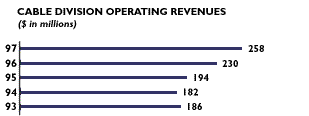
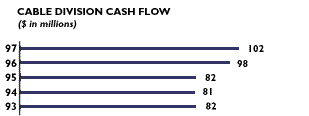
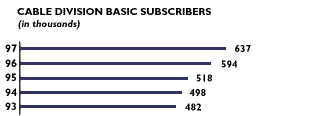
In 1997 the cable division focused intensely on making numerous changes necessary to thrive in the ever-more competitive telecommunications world of the future. Above all, the division acted to solidify its relationships with subscribers. The changes began with a new name, Cable One, that unites different system names under one uniformly promoted, customer-friendly banner. Further, the division launched over a dozen initiatives to enhance customer satisfaction. These included locating The Disney Channel on basic service everywhere, reducing pay-per-view movie prices to $2.99, and implementing a same-day service guarantee. The system upgrade effort of the last few years continued in order to provide more channels and more reliable pictures to customers, as well as to prepare the hybrid fiber-coax platform for future services. A program of daily customer research was also started. In addition, a dozen programs were launched to enhance the customer-oriented culture of the division. The initiatives ranged from a new career recognition program to an incentive program based on customer-satisfaction scores. All of this repositioning, important as it is to the future growth of the division, came at a price in 1997. Cash flow (earnings before interest, taxes, depreciation, and amortization) increased only 4 percent to $101.6 million, from $97.9 million in 1996. The acquisition of one system early in the year and the mid-year trade of three Cable One systems for a number of TCI systems were responsible for most of the growth; cash flow from existing systems was flat. Revenue rose 12 percent to $257.7 million, from $229.7 million the previous year. Existing systems accounted for slightly over half the revenue increase. Operating income declined 8 percent in 1997 due to increased depreciation and amortization charges related to the division's higher pace of capital spending. System rebuilds continued as capital spending reached $70 million in 1997, versus $37 million in 1996. This investment was already paying dividends by year end as the division's customer-satisfaction ratings rose to an all-time high. Fifty percent of the division's customers are now served by the rebuilt plant, and that will increase to 75 percent in 1998. One acquisition closed in 1997: a 16,000-subscriber group of systems around Cleveland, Mississippi. In addition, three urban Cable One systems in the San Francisco and Chicago areas were finally traded to TCI for systems in Oklahoma, Mississippi, and Minnesota. At year end, basic subscribers in the division stood at approximately 637,300, representing an increase of 7 percent, or 43,300 subscribers, from 594,000 at year-end 1996. Additional acquisitions and trades continue to be pursued. As of early 1998, the division had reached agreements in principle to acquire the cable systems serving Anniston, Alabama, and Grenada, Mississippi, and had agreed to trade various systems in Texas for systems in Oklahoma. In addition, the company was negotiating the acquisition of systems serving at least 80,000 subscribers in locations near other Cable One systems. Premium units from HBO and Showtime products rose by 15 percent in 1997. Another important Cable One initiative contributed to this growth: by the end of 1997, most systems had changed to allow customers to receive premium services without the use of a converter. In addition, the premium services are packaged to provide as many as five channels for virtually the same price as one channel--and they are available on every set in the home without the need for additional equipment. Peter Newell announced his retirement at the beginning of 1998. Pete has been a trusted and admired leader in the division since before The Washington Post Company acquired it from Capital Cities in 1986. In last year's annual report, the division stated that it was preparing to make further investments in product, people, and customers that would help sustain growth rates in a more competitive environment. Those investments have been made. As expected, cash flow growth in existing systems significantly slowed in 1997. Now it's time to start enjoying the benefits.
|
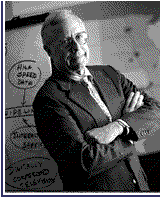
Looking Backwards Towards the Future By Peter Newell
I entered the cable business from the broadcasting business at a most propitious time. Cable was being reborn in 1980 to a second life spawned by the advent of satellite program delivery. In the late '70s it became feasible for nascent cable networks like HBO, WTBS, and CNN to gain nationwide distribution by delivering their programming to receiving dishes installed by cable operators. Simultaneous advances in cable technology created the capability to squeeze as many as 54 channels onto a cable system. What had been a pretty dull business became an exciting one! "Reborn" cable was a marketer's dream. Cable sprang up in every previously unwired city in America. This new demand was met by a plethora of new cable networks being created almost as fast as they could be imagined. Unsurpassed selling opportunities existed, and we mined them for all they were worth. We packaged programming with equipment, created optional "tiers" of service, packaged basic with premium or "pay" services, creating new and exciting ways to generate levels of subscriber revenues never before dreamed of. In some cases people were spending as much as $50.00 a month, when previously their television had been free. (Those high revenues were critical to recovering the huge capital investments we were making to get the cable to people's homes.) Cable developed advantages over traditional broadcast networks. The dual revenue stream from both advertising sales and subscriber fees, coupled with cable's multiple channel capacity, created a slow but steady erosion of broadcast audiences. The recognition of cable's inherent advantages was a major factor in The Washington Post Company's decision to enter the cable business in 1985. As the owner of network-affiliated television stations, the company engaged in a smart bit of defensive strategy. If you're going to have a competitor, it might as well be you! The excitement of helping to lead in the development of a burgeoning new business, a business premised on supplying a high-demand product through the deployment of advanced technologies, has made my second career as stimulating as anything I can imagine. For most of my cable career I have served as the operations vice president for the Nor-West region of Cable One. My region has been responsible for something less than half of the division's subscribers and associates, and something more than half of the division's operating cash flow. My job has been to make sure we didn't screw up a good thing. It would have been easy to do. We could have set prices too high in proportion to what we delivered; we could have provided shoddy service and bad pictures; we could have overspent on capital projects, or failed to be appropriately cost conscious; we could have overpaid for programming or not been so selective in what we carried; we could have failed to educate our franchising authorities as to how our business works, or worse, we could have misled them as to what we could reasonably accomplish in our communities. Unfortunately, there were cable companies that did one or more of these things, and our industry has paid a heavy price for their mistakes. The people who work for me know the importance of doing things right. Collaborating with them in the development of innovative ideas to bring Cable One to a position of preeminence in our industry has been stimulating and just plain fun! We set challenging goals, and while we occasionally fall short on some of them, we have always advanced our position. What The Post has given me, and what I try in return to give my managers, is the autonomy to find their own way to be as good as they can be. This isn't just management theory. I've had 17 managers and three staff members reporting directly to me. Some would argue that this is too great a span of control, but it accomplishes three very important things. First, it prevents me from over-managing. Second, it limits the number of levels in the chain of command to three. Third, the result encourages self-reliance, initiative, and responsibility. Of course, it only works if you have the right people. Finding those people, giving them the "benefit" of your years of experience, coaching them, and watching them develop is the most rewarding thing a senior manager can do. Planning, strategizing, and executing are fun, but as the wife of our CEO, Tom Might, said at my recent retirement dinner, "to teach is to achieve immortality." What could be better than that? It has been my great fortune to have worked for a company whose values I could embrace wholeheartedly. For better or for worse, all companies are a reflection of the values of their most senior officer. Those values have been a pleasure to live by and a pleasure to teach. As I depart, the cable television business is experiencing another rebirth. This third lifetime promises to be even more different and exciting than the second was from the first. The convergence of computers, the Internet, interactivity, high-speed digital communications, telephony, and traditional television finds cable once more uniquely positioned to be a major player in some very promising new businesses. Bandwidth will be king, and cable, with its unmatched two-way broadband pipeline to homes and businesses, can be the major beneficiary of the convergence of these technologies. As before, the mandate to management will be to not screw it up. I face retirement with deep regret. Not for mistakes made or opportunities lost, though there certainly have been some of those. My regrets are that I will be missing the opportunities yet to come, the chance to face and conquer new challenges in the company of talented and dedicated associates. For someone who has loved his business career as I have, this doesn't come to me as a great surprise. |

 At 64 years of age, and with 18 years of experience in the cable television industry, I am still considered by many to be a newcomer. (That, I hold, is at least better than being considered a novice.) The cable television industry began without me in the early 1950s. The first cable systems were designed as a substitute for outdoor antennas, in areas of the country where outdoor antennas were unable to receive television pictures. Cable's first era was begun by inventive television set dealers, who found it hard to sell sets to people who couldn't get pictures on them.