




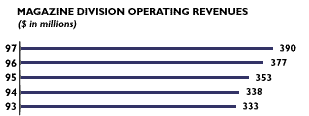
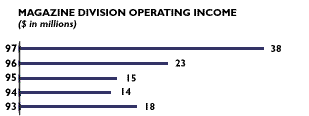
The magazine division, which now includes Newsweek, Inc., and Post-Newsweek Business Information, Inc. (formerly TechNews, Inc.), recorded operating income of $38.0 million, an increase of 67 percent from $22.8 million in 1996. Revenue totaled $389.9 million, an increase of nearly 3 percent from $377.1 million in 1996. Newsweek had its best year ever in 1997. Sustained growth in advertising sales, substantial revenue from special issues, and a boost in the company's pension credit helped produce the highest earnings in the magazine's history. Once again Newsweek distinguished itself with smart, sure-footed coverage of both breaking news and feature topics. Among the top newsstand performers were the magazine's three issues on Princess Diana. For the first of these, Newsweek stopped the presses as soon as her death was announced, producing a new 24-page cover package in just 12 hours. The Diana series culminated with a commemorative issue that sold more than 2 million copies worldwide. Other successful special issues included: "Your Child: From Birth to Three," a comprehensive guide for parents that also spawned foreign-language editions in Korea, Japan, China, and Russia, with licensees in India and Brazil; "2000: The Power of Invention," the first in a projected series on the millennium; and "Hong Kong: City of Survivors," a Newsweek International project that was accompanied by a special site on the World Wide Web. In advertising sales, Newsweek improved on an already strong performance the previous year. Advertising pages for 1997 increased by 4.5 percent, with ad revenues gaining 6.4 percent (according to PIB). Newsweek continued to emphasize marketing programs that add value to advertising pages in the magazine. Opportunities for clients include sports-event sponsorships, a variety of special advertising sections, and promotional packages. Domestic paid circulation was strong and steady at more than 3.2 million. The magazine's circulation strategy continues to yield the most long-term subscribers among the three newsweeklies, as well as the fewest subscriptions sold with premiums. U.S. readership climbed to nearly 22 million, according to the most recent MRI study. For five years running, Newsweek has led the news-magazine field in both audience growth and quality, with more readers in the key groups that advertisers most want to reach. Newsweek's overseas editions posted record circulation revenue in 1997, but advertising revenues declined in both Asia and Europe. The Pacific edition was particularly hard hit due to the regional financial crisis. However, steady circulation growth enabled Newsweek International to increase its circulation rate base guarantee in Asia to 240,000 in 1997 and in Latin America to 80,000 for 1998. The rate base for the Atlantic edition remains steady at 340,000. Newsweek remains the only news magazine with foreign-language editions--in Japanese, Korean, and Spanish. Also published in cooperation with Newsweek is Itogi, Russia's first independent news magazine. It celebrated its one-year anniversary in May with a circulation of 85,000. In October, Newsweek Productions was formed to create television programming and other media projects in conjunction with the magazine. Focusing on news, public affairs, and information programming, the unit produces the PBS series "HealthWeek." Post-Newsweek Business Information (PNBI), which publishes controlled-circulation trade periodicals for the technology industry, launched two new magazines and acquired several properties during the year. PNBI's original publication, Washington Technology, had its strongest year ever in revenues and operating income. In April, PNBI launched TechCapital, a bi-monthly magazine serving technology financiers and investors in the mid-Atlantic region. In June, PNBI launched Integration Management, a bi-weekly magazine serving the burgeoning market for systems integrators and information technology service vendors. In December, PNBI acquired Government Computer News and related publications, Contract Sourcing Guide, Reseller Management, and two trade shows, FOSE and FEDnet/FEDimaging--all from Reed Elsevier. PNBI also acquired Newsbytes News Network, a newswire service that provides technology stories to publications, online services, and Web sites worldwide.
|
A Backstage Pass to the Revolution
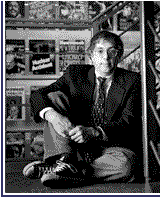
By Steven Levy
It's a story I've been covering for 16 years now, ever since I was assigned a seemingly unexceptional magazine feature about the folk who live and breathe computer programming. I was bowled over by these people, who not only envisioned a fantastic future but lived it, expressing themselves in what I learned to be a form of digital artistry. I'd like to say that right then, in 1982, I correctly guessed that these people would soon be at the center of an industry that would drive our economy and transform everything about us. But I simply wanted to write about them more. The other stuff was a bonus. Having parachuted into this revolution while its leaders were still pretty much in the jungle, I got to know the Bill Gateses, Steve Jobses, and Mitch Kapors before they became wary of my ilk. I came to know the customs and lingo of the Valley and eventually developed an armchair passion for the technology itself. But it wasn't until 1995, when I began writing for Newsweek, that I found the ideal outlet for my writings. This came as a surprise to me: as a confirmed freelancer, I had long assumed that no job would allow me the flexibility I'd been accustomed to, and I certainly didn't expect a newsweekly to give me the freedom to express my occasionally iconoclastic views in the, um, informal style that I favor. If I'd known more about Newsweek, I needn't have worried: the essence of this magazine is informed writers who know their subjects well enough to use solid reporting on the week's events to form quick, informed judgments on what those events mean--and then to express those thoughts forcefully and eloquently. It's a continual challenge to attempt this feat on a subject as impenetrable as technology, but it's a delight, too. (It's also a challenge more easily mounted with the help of first-rate editors and wonderful reporting from the bureaus. And no one made me say that.) My work may appear in various formats in the magazine--column, news story, feature, and, when the stars are properly aligned, cover package--but my mission is consistent. To report upon and illuminate the potentially baffling explosion in information technology. The best thing about my post? Maybe it's the impact that comes with appearing in such a venerable and ever-popular journalistic institution. With Newsweek I can help define what stories burst out of nerd-dom and into the national, and even global, agenda. Our cover on the IBM-Kasparov chess match helped alert the world to a potential turning point in the relationship between human and machine. People noticed when Newsweek became the first major magazine to highlight the upcoming Millennium Bug debacle on the cover. (Are we really in trouble? Let's just say I'm not planning any plane trips on December 31, 1999.) I'd like to think my early columns about the misbegotten Communications Decency Act offered our readers a thoughtful alternative to the knee-jerk sexual panic found elsewhere in the general-interest media. And Bill Gates seems to have forgiven me for helping to bury Microsoft's hapless experiment in cartoon interfaces, an annoying program called Bob. On the other hand, my job can make me as much victim of the information revolution as chronicler. My voice mail is constantly jammed with P.R. pitches for products that, every one of them, will establish new industries, solve centuries-old problems, and finally make my computer easy to use. My e-mail inbox is in the low four figures, not including the increasingly strident pleas from our network people urging me to purge messages. My office is notorious as a mad storeroom--treacherous towers of trade magazines, boxes of software, stacks of books (an alarming number of which are labeled "For Idiots"), and piles of absurd promotional items. Yes, our high-speed Internet connection provides me a powerful information-gathering tool. But virtuality has its limits. To really plumb the psyches of the gods of the digital revolution, one has to look them in the (all too often beady) eye. That's why several times a year I find myself forced--forced, I insist!--to sit poolside at posh Arizona resorts, cosseted with polo-shirted venture capitalists, grunge-bedecked geeks from start-up companies, and the genuinely awesome innovators whose thought processes continually expand my own mind. I'm often asked if I'm myself a programmer, if not a failed hacker. No way. But fortunately, there is a very elegant correspondence between the severe limits of my engineering knowledge and the necessity to convey the technicalities of such knowledge to our readers. I do make the effort to understand technical issues--despite the strain to my neurons, I will try the patience of wireheads from Redmond to Yorktown Heights so I can distinguish between flavors of Java, or comprehend what enables Deep Blue to move its bishops so devastatingly. But the stories I want to write aren't really centered on code or technical arcana: they focus on the people who create the technology, the people who get it into the world, and the people whose lives are increasingly altered by it. My subject is not machines, but how machines are affecting the next chapter of human civilization, in ways big and small, grim and absurd, sweeping and specific. And what better place to tackle this story than Newsweek? |

 Here's a prediction that seems obvious from where I sit: if civilization persists without some apocalypse throwing us back to the stone age, the closing decades of this action-packed century will be recalled primarily for the computer revolution and its consequences. When people look back on the good old 1900s, they won't be talking about Clinton peccadilloes, royal funerals, or even Seinfeld. They'll be obsessing on Gordon Moore's law, Bill Gates's strategies, and the first time people started buying books on the Internet. (There might be some explaining necessary to get across what a book used to be.) They'll consider these times as the kickoff to a transformation that drastically changed the way human beings live, and maybe even came to change what human beings are--all the stuff, happily, that falls into my beat as Newsweek's senior technology writer. It's a job with a massive built-in perk: backstage access to the big story of our time.