




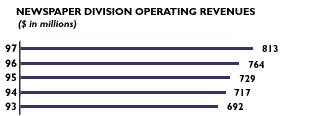
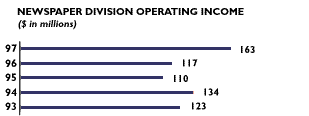
Newspaper divisionoperating income increased 39 percent in 1997 to $162.7 million, from $116.8 million in 1996. Operating revenue totaled $812.9 million, an increase of 6 percent over revenue of $763.9 million the previous year. (Operating losses from our investments in Internet-related activities are included in Other Businesses.) At The Washington Post, a thriving national and local economy, along with favorable newsprint pricing, fueled a strong performance. Advertising revenue grew 8 percent to $604.1 million, due largely to the continuing surge of the recruitment category. Low unemployment and the people needs of the burgeoning technology industry in the region contributed to recruitment revenue growth of 22 percent, to $137.9 million. That was the major factor in a classified volume increase of 6 percent. Department store advertisers, led by Hecht's and J.C. Penney, helped retail advertising volume grow for the first time in years. It was up almost 1 percent. General advertising volume rose more than 6 percent as large corporate advertisers, especially the telecommunications giants, ran extensive branding and imaging campaigns. While readership and household penetration have remained very high, circulation declined again. Average daily circulation fell 1.5 percent, while Sunday circulation was off 1.3 percent. Among the factors involved is that more city residents are moving to the outlying suburbs and becoming occasional readers. In order to become more competitive beyond its primary circulation area, where population is growing, The Post launched the first of its new outer-county sections in Prince William County in late 1996. Another was started in Loudoun County in 1997, and a third debuted in southern Maryland early this year. These bi- and tri-weekly sections have generated encouraging results. The Post's project to completely recapitalize its production operations made significant progress in 1997. Renovation of the Virginia plant was almost completed, and two of the four new presses for the plant were installed. Construction of the new Maryland plant and the installation of presses there also proceeded on schedule. By the end of 1998, all of the newspaper's production will be converted to the new presses at the new and renovated plants. Bob Kaiser announced that he is stepping down as managing editor of The Post to return to writing and reporting. He has been a wise and effective leader. He will be succeeded in June by Steve Coll, a Pulitzer Prize-winning journalist who is currently editor and publisher of The Washington Post Magazine. The National Weekly Edition of The Post, with a circulation of approximately 92,000, continues to serve a national readership with a strong interest in news about politics, foreign affairs, and public policy. The Washington Post Writers Group expanded its international sales staff in 1997 to sell material from Newsweek to print media around the world. About 100 newspapers and magazines publish Newsweek's syndicated material. In addition, the Writers Group represents 28 columnists and cartoonists and conducts a worldwide reprint business with photos and text from The Washington Post. The Herald capitalized on a strong local economy and posted a gain of 36 percent in operating income over 1996. Spurred by increased production at Boeing's Everett plant and by the arrival of the carrier Abraham Lincoln at Naval Station Everett, jobs grew at a furious pace that produced a favorable retail climate throughout the year. Herald advertising rebounded from a soft 1996 to finish 7 percent ahead in ROP revenues and 11 percent ahead in preprint volume. Despite a mid-year subscription price increase, Herald daily circulation registered its 38th consecutive month of year-over-year increases. The Herald Weeklies increased their distribution to 85,000 copies, while advertising revenue rose 16 percent. The Herald's commercial printing operations grew revenues by 14 percent. Gazette Newspapers was named one of the best community newspapers in the nation by Suburban Newspapers of America. The company's operating income grew 40 percent. Three new publications were launched: TechGazette, which covers technology businesses throughout Maryland, and two new weekly Gazettes, in College Park/Greenbelt and Beltsville--the first editions in Prince George's County, Maryland. Five military newspaper and base-guide contracts were renewed during the year. An 11,000-square-foot post-press addition to the company's commercial printing business also was completed.
|
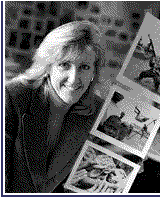
By Carol Guzy
At times I reflect on just why we do this. There's certainly an emotional toll from witnessing man's inhumanity, especially covering stories in places like Haiti and Rwanda. There, I've seen wretched poverty, men beaten to death by mobs. Refugee children watching their parents die on the side of a road, their raspy moans giving way to an eternal silence. The child suffering for politics and ethnic hatreds that he does not yet even comprehend. In my life I've seen the eyes of evil, the hands of injustice, the face of repression. I hear people say, "Oh no, not another story on Haiti." Or, "We've seen enough of refugees. Cliché, been there, done that." But it's hard to tell that desperate woman holding her starving child she's merely a cliché. These people can't turn the page when they don't like the story, they can't change channels. They're stuck in reality long after the headlines are gone. There's guilt, knowing you can simply get on a plane and fly home to comfort while others are trapped in their own personal hell. You wonder just how many pictures can you take until someone really sees. How many times can your own heart break? Are there ever any lasting answers to the suffering and turmoil our species inflicts on its own and the environment? But then you glimpse a resilience and beauty in the human spirit, even in the most desolate of times, which is deeply moving, and you continue to record their plight. It is haunting to voyage into so many different souls. We see people's most intimate moments--their joys and sorrows, their triumphs and tragedies. Always, trying to translate what you experience becomes a challenge. It's never, ever the same as being there, walking in another's shoes. But if we capture those moments and communicate them successfully, it can provide a greater knowledge and enrichment of spirit, strengthen a sense of purpose, and give us a deeper compassion and respect for all life. Lately the new technology has grabbed our attention. Digital cameras, faster computers. But it's important to remember they are merely tools. It's eyes and minds and hearts, passion and commitment, that make the most compelling images or recognize a quote that will take your breath away. Remembering also that as journalists we are merely a link. It's the people in the pictures and those who view them who are the important ones. Photographs can be an important tool in these times of increasing divisiveness and separatism, to build a bridge of empathy. To show not only our diversities, but also the qualities that make us all part of the human family. Our communities are not simply just beyond the front door any longer. The world is our backyard with an intricately intertwined existence. Some say readers are no longer interested in world affairs. But we may play a role in that. Katharine Graham said in a speech last year that she believes there is a vicious circle occurring. The less foreign news, the less public interest and vice versa. She said, "All Americans deserve excellent foreign news in their daily paper, no matter where they live. This means that owners must put public service ahead of maximum profits. It means foreign news editors must fight for their stories, and executive editors must not pander to readers' apparent lack of interest in them." Publications should pay heed to her words and put foreign news back on the front burner next to those equally important school board meetings. It is critically important now more than ever for Americans to be engaged in foreign affairs and U.S. policy. There does seem to be an increasing "shoot the messenger" mentality towards the media, however. Editors have a term called the cereal factor--what folks can bear to look at over their breakfast cereal. Certainly there needs to be a balance and sensitivity to news coverage. Not all is bleak and violent. Seeing too much death and destruction can generate a helplessness that numbs or angers readers, and fingers start pointing at the media for running those disturbing images. It's easier to criticize a photographer or editor than to address the root of the problem. But there is a great danger in censoring reality. Yes, those photos are uncomfortable to look at, but for many in this world there is no breakfast cereal or freedom from fear. And perhaps that's what society should find most intolerable, not the pictures that remind us of it. As long as abuse and conflict and inequality remain, it is our responsibility to have a social conscience and bring these issues to light, for others to judge and make educated choices. As Eugene Smith once said, "Let truth be the prejudice." A photograph can be a powerful witness and an eloquent voice for those who have none. Pictures inform, educate, enlighten, captivate, spur governments into action. They are historical documents and poignant reminders of our human frailties. Sometimes they touch our very souls. And, yes, at times they can make a difference. Perhaps a small difference to one person on one day, but meaningful nonetheless. Our stories allow readers to embrace the families of refugees whose last steps did not reach home. We all know what grief feels like--it has no cultural barriers. Sometimes on the pages of a newspaper we see things that tear at the very fiber of civilization. We are repulsed at the sight of a man's brutal death at the hands of a vigilante mob in Port-au-Prince, desperate for revenge after the killing of their beloved community leader. We taste his fear, hear his last heartbeat, and mourn the loss of hope in a land where the only justice is that of the streets. We join in the revelry of a political convention, in all its pomp and circumstance--and journey into the world of nomads, living with a certain grace and elegance on the harsh desert sands of Africa. And we smile at the tender innocence of a baby's bare bottom wrapped in the warmth of family. With pictures we can weep for Rwanda and rage at injustice everywhere. And also celebrate the daily life around us, its mystery and magic--its poetry and wonder. At The Washington Post, photo editors Joe Elbert and Michel duCille have molded what is considered for many years now to be the most talented photography staff in the country, one I'm so very proud to be a part of. With the invaluable support of editors Len Downie and Bob Kaiser, photography has gained a tremendous amount of respect in the newsroom. There is a romance of words and pictures taking place that is refreshing. I long for the day when staff photographers working side by side with staff correspondents on major stories becomes the rule and not the exception. We are leading the way to that day and are an encouraging example to other papers as we place more value on the visual image. |

 Photographers and reporters are not very different. We are all communicators. Photojournalists simply "write" with light.