David Durack, M.D., Vice President–Corporate Medical Affairs,
sums up the Company's HIV/AIDS efforts when he says, "We are
involved in the battle against HIV/AIDS at every level, from high-tech
monitoring systems to reuse prevention syringes for developing
countries that cost just pennies each." His perspective highlights the
fact that BD possesses broad-based expertise that enables it to make
contributions across the continuum of HIV/AIDS care. BD works to:
prevent the spread of the disease through needle reuse prevention
and improved healthcare worker safety; diagnose infections, such as
tuberculosis, which is the number one infectious killer of people
with HIV/AIDS; monitor the efficacy of antiretroviral treatments with
high-quality CD4 counts; provide tools that enable research of the
disease, and support those who seek to develop a vaccine against it.
The establishment of a coordinated HIV/AIDS strategy two years
ago leverages capabilities resident in each of BD's three worldwide
business segments, making BD's ongoing efforts more effective
and uncovering additional opportunities for the Company to contribute.
"Coordinating our strategy has enabled us to articulate
all that we can do and, seeing this, BD associates are very pleased
that the Company has made such a major commitment," says
Krista Thompson, Vice President and General Manager, HIV/AIDS.
BD also works toward better relationships with governments,
nongovernmental organizations and nonprofits–and with positive
results. Since 1996, for example, BD has collaborated with the
Brazilian government to create a monitoring protocol for HIVpositive
patients. When the program started, the average life
expectancy for an infected patient was 14 months. Today, with
regular CD4 testing and the proper drug therapy, the 180,000
patients in the program are experiencing dramatically improved
life expectancies.
Relationships lead to progress
BD's long-term relationship with Dr. Robert Rennie, whose work
is highlighted here, enables a leading microbiologist (a former
president of the Canadian Association for Clinical Microbiology and
Infectious Diseases with a worldwide reputation) to make inroads
in the battle against bacterial infections, particularly healthcare–associated
infections (HAI).
BD's leading-edge capabilities in the diagnosis of these infections
are also reflected in work with the National Public Health Service for
Wales to create a network to detect incidents of HAI and the emergence
of microorganisms resistant to antibiotics, with the goal of
preventing serious complications in hospitalized patients. John
Hanson, President, BD-Europe, says BD set up a system to analyze
individual patients' bacterial infections using BD Phoenix
systems situated in 12 clinical laboratories across Wales. Then,
to enable broad-based monitoring, BD linked the instruments to a
BD EpiCenter Microbiology Data Management System. The networked
system made Wales, a country of just three million people,
the first in Europe to have a nationwide monitoring capability and
to serve as a model for other countries, including England,
Scotland and Germany, that are investigating their own systems.
|
 |
Robert Rennie, Ph.D., one of Canada's senior clinical microbiologists, wanted to equip
his laboratory at the University of Alberta Hospital in Edmonton with the most advanced
technology for Identification and Antimicrobial Susceptibility Testing (ID/AST). Dr.
Rennie compared three competing automated microbiology systems to investigate which
system would enable him to provide physicians with the fastest, most reliable diagnoses
of patients' bacterial infections and help to direct effective drug therapy. Dr. Rennie
concluded that the BD Phoenix Automated Microbiology System offered an opportunity
for a new technology that would rapidly identify pathogens and give rapid and accurate
identification of the most important antimicrobial resistance markers. Dr. Rennie placed
a BD Phoenix system in his laboratory–the first BD Phoenix system to be installed in a
North American hospital. Says Dr. Rennie: "I measure ID/AST systems by their ability
to accurately identify bacteria causing infections and detect emerging antimicrobial resistance,
the time it takes to obtain that information, and then assist in directing optimal
antimicrobial treatment. Early institution of appropriate therapy leads to improved
patient outcomes."
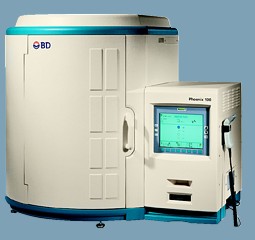
The BD Phoenix Automated Microbiology System detects
bacterial resistance rapidly and assists with optimal
patient therapy. The BD Phoenix system can perform up
to 200 simultaneous identification and susceptibility
tests, and can deliver accurate results in 4-16 hours–
rapid for the microbial world. Among its competitive
advantages, the BD Phoenix system identifies more
than 300 organisms–significantly more than that of
the nearest competitor. When certain organisms unique
to Canada proved difficult to identify, BD worked with
Dr. Rennie to design tests that provided the solution.
|
|
 |