| | 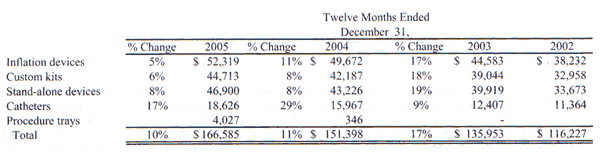
Our
revenues increased notwithstanding the fact that the markets for many of our products
are experiencing slight pricing declines as our customers try to reduce costs.
Substantially all of the increase in our revenues was attributable to increased
unit sales, except for a slight increase in the exchange rate between the Euro
and the U.S. Dollar which increased sales by .09% in 2005 compared to 2004, 1.2%
in 2004 compared to 2003, 1.8% in 2003 compared to 2002. Unit growth for 2005,
2004, and 2003 resulted primarily from a procedural growth rate of approximately
6-8%. In addition, unit growth in 2005, 2004 and 2003 was attributable, in part,
to our introduction of new products which accounted for approximately 4%, 4% and
5%, respectively, for total sales for such periods, with the remainder of unit
growth coming from market share gains. International sales in 2005 were approximately
$45.3 million, or 27% of total sales; international sales in 2004 were approximately
$37.5 million, or 25% of total sales; and international sales in 2003 were approximately
$34.3 million, or 25% of total sales. These increases were primarily a result
of greater acceptance of our products in international markets, ongoing growth
in our European direct sales, and increased sales related to improvement in the
exchange rate between the Euro and the U.S. Dollar, as discussed above. Our total
direct sales in France, Germany, the U.K., Belgium, The Netherlands and Ireland
were $20.0 million, $18.9 million and $15.6 million in 2005, 2004, and 2003, respectively.
Our gross profit as a percentage of sales was 41.5%,
44.6% and 44.7%, in 2005, 2004, and 2003, respectively. The decline in gross margins
in 2005 resulted primarily from new facilities and equipment, increased cost of
direct labor, higher overhead expenses (i.e. utilities, maintenance, cleaning
and taxes) and new product launches. The decline in gross margins for 2005 was
also affected by negative margins in the new procedure tray business we acquired
from MedSource during the fourth quarter of 2004. The effect was a reduction of
gross margins by 1.4% for 2005. Sales of procedure trays contributed 2.4% to the
Company’s total sales for 2005. The slight decrease in gross margin percentage
in 2004, compared to 2003, was the result of a slight increase in the standard
costs per unit as the result of increased manufacturing costs. The increase in
the gross margin percentage for 2003 over 2002 was primarily effected by an increase
in efficiency and productivity gains achieved primarily our operations groups.
These productivity gains have been achieved primarily by enhanced employee productivity,
which we believe was encouraged by our bonus program, streamlined production layouts
and investments in manufacturing equipment. With these improved efficiencies,
our cost per unit for many of our products has decreased as unit sales have grown,
notwithstanding slight increases in fixed overhead costs. Gross profit was also
favorable for 2003 over 2002 by an increase in the exchange rate of the Euro against
the U.S. Dollar, resulting in an increase in gross profit of 0.3 and 0.4, respectively.
During 2003, we reduced the material costs from some of its principal vendors.
We are operating in a gradually declining price market. During 2006, we expect
gross margins to decline as a result of higher overhead expenses attributable
to absorbing the new buildings and associated overhead costs; growth of lower-margin
pack sales of MedSource; and bringing on several new products until sales volumes
increase to cover overhead costs. We believe, however, that if we are successful
in increasing production volumes according to current sales plans, the increased
production will offset some of the effect of the lower margins. Our
selling, general and administrative expenses increased $3.5 million, or 10% in
2005 over 2004; $4.6 million, or 15.1% in 2004 over 2003; $2.7 million, or 9.9%
in 2003 over 2002. The increase in selling, general and administrative expenses
in 2005 was due primarily to costs associated with severance for employees ($493,000),
the buy-out of a distribution agreement ($200,000), the hiring of 17 additional
sales people, and the sample expense related to new product introductions. The
increase in selling, general and administrative costs for 2004, compared to 2003,
was primarily the result of approximately $674,000 in costs associated with our
efforts to comply with the requirements of Section 404 of the Sarbanes-Oxley Act
of 2002 and severance costs of approximately $663,000 related to the termination
of certain employees. The additional expenditures for 2003 over 2002 were related
to increases in commissions paid commensurate with sales growth, costs of expanding
our direct sales force in the United States and Europe, and an increased exchange
rate of the Euro against the U.S. Dollar compared to the same period in 2002,
resulting in an increase in selling expenses for our direct sales force in Europe. | |

