Earnings
per Common Share—Net income per common share is computed by both the
basic method, which uses the weighted average number of the Company’s common shares
outstanding, and the diluted method, which includes the dilutive common shares
from stock options and warrants, as calculated using the treasury stock method.
Financial Instruments—The
Company’s financial instruments, when valued using market interest rates, would
not be materially different from the amounts presented in the consolidated financial
statements. Stock-Based Compensation—The
Company accounts for its stock-based compensation under the intrinsic value outlined
in Accounting Principles Board Opinion No. 25, Accounting for Stock Issued
to Employees (“APB 25”). Accordingly, no compensation cost has been recognized
for its stock compensation arrangements. If the compensation cost for the Company’s
compensation plans had been determined consistent with SFAS No. 123, Accounting
for Stock-Based Compensation, the Company’s net income and net income per
common and common share equivalent would have changed to the pro forma amounts
indicated below (in thousands, except per share data): 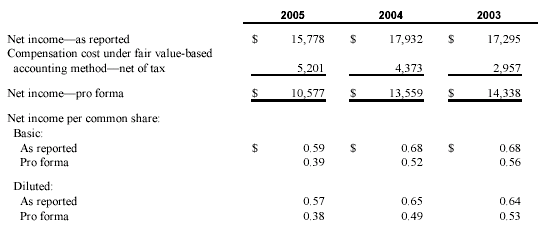
In
applying the Black-Scholes methodology to the option grants, the Company used
the following assumptions:  For
options with a vesting period, compensation expense is recognized on a ratable
basis over the service period which corresponds to the vesting period. Compensation
expense is recognized immediately for options that are fully vested on the date
of grant. On February 3, 2005, we accelerated the vesting of 427,448 options with
an exercise price of $21.67, which was in excess of the current market price.
The acceleration of these options increased the pro-forma compensation cost for
the twelve months ended December 31, 2005 by approximately $3.2 million, net of
tax. Statements of Cash Flows—For
purposes of the statements of cash flows, the Company considers interest bearing
deposits with an original maturity date of three months or less to be cash equivalents.
Concentration of Credit Risk—Financial
instruments that potentially subject the Company to concentrations of credit risk
consist primarily of temporary cash and cash equivalents and accounts receivable.
The Company provides credit, in the normal course of business, primarily to hospitals
and independent third-party packers and distributors. The Company performs ongoing
credit evaluations of its customers and maintains allowances for potential credit
losses. Sales to the Company’s single largest customer approximated 6% of total
sales for the year ended December 31, 2005, and approximately 7% of sales for
the years ended December 31, 2004 and 2003. Foreign
Currency—The financial statements of the Company’s foreign subsidiaries
are measured using local currencies as the functional currency, with the exception
of Ireland, which uses the U.S. Dollars as its functional currency. Assets and
liabilities are translated into United States Dollars at year-end rates of exchange
and results of operations are translated at average rates for the year. Gains
and losses resulting from these translations are included in accumulated other
comprehensive loss as a separate component of stockholders’ equity. | 
