Work Force
Reductions
During 2002,
we reduced our utility work force by
approximately 400 employees through
a voluntary separation program. We recorded
a net charge of approximately $21.7
million in 2002 related to this program.
We have replaced and may continue to
replace some of these employees. For
additional information, see Note 29
of the Notes to Consolidated Financial
Statements, “Work Force Reductions.”
Ice Storm
In late January 2002, a severe ice
storm swept through our utility service area causing extensive damage
and loss of power to numerous customers. Through December 31, 2002,
we incurred $19.3 million for restoration costs, a portion of which
was capitalized. We have deferred and recorded as a regulatory asset
on our December 31, 2002 consolidated balance sheet restoration
costs of approximately $15.0 million. We have received an accounting
authority order from the KCC that allows us to accumulate and defer
for potential future recovery all operating and carrying costs related
to storm restoration.
ELECTRIC UTILITY OPERATIONS
General
We supply electric energy at retail
to approximately 647,000 customers in Kansas including the communities
of Wichita, Topeka, Lawrence, Manhattan, Salina and Hutchinson.
We classify our customers as residential, commercial and industrial
as defined in our tariffs. We also supply electric energy at wholesale
to the electric distribution systems of 62 Kansas cities and four
rural electric cooperatives. We have contracts for the sale, purchase
or exchange of wholesale electricity with other utilities. In addition,
we have power marketing operations that purchase and sell electricity
in areas outside our historical service territory.
Our electric sales for the three years
ended December 31 were as follows:
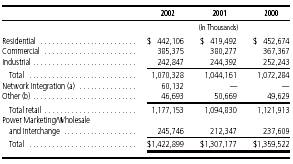
(a)Network Integration:
Reflects a new network transmission
tariff that requires us to pay to the Southwest Power Pool ( SPP)
all expenses associated with transporting power from our generating
stations. The SPP then pays us for transmitting power to the point
of delivery into our retail distribution system. These receipts
from the SPP are reflected in revenues under the network integration
classification. For further information see “— Network Integration
Transmission Service” below.
(b)Other:
Includes public street and highway lighting
and miscellaneous electric revenues.
|
|
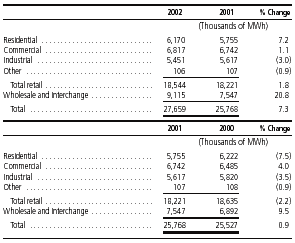
The following tables show changes
in electric sales volumes, as measured by thousands of megawatt
hours (MWh) of electricity we generate, for the three years ended
December 31. No sales volumes are shown for network integration
or power marketing because these activities are not related to electricity
we generate.
Generation Capacity
We have 5,929 megawatts (MW) of generating
capacity. See “Item 2. Properties” for additional information on
our generating units. The capacity by fuel type is summarized below.
 Our aggregate 2002 peak system net load
of 4,469 MW occurred on July 26, 2002. Our net generating capacity
combined with firm capacity purchases and sales provided a capacity
margin of approximately 24% above system peak responsibility at
the time of the peak. Our all-time peak system net load of 4,528
MW occurred on September 11, 2000. We do not anticipate needing
additional generating capacity through 2005.
We have agreed to provide generating capacity
to other utilities for certain periods as set forth below:
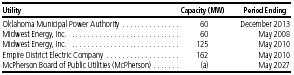
(a)We provide base capacity to McPherson. McPherson
provides peaking capacity to us. During 2002, we provided approximately
75 MW to and received approximately 181 MW from McPherson. The amount
of base capacity provided to McPherson is based on a fixed percentage
of McPherson’s annual peak system load.
|


