| Attrition
Customer
attrition has a direct impact on the
results of our monitored services operations
since it affects its revenues, amortization
expense and cash flow. Attrition is
defined as a ratio, the numerator of
which is the gross number of lost customer
accounts for a given period, net of
the adjustments described below, and
the denominator of which is the average
number of accounts for a given period.
In some instances, estimates are used
to derive attrition data. Adjustments
are made to lost accounts primarily
for the net change, either positive
or negative, in the wholesale base and
for accounts that are covered under
a purchase price holdback and are “put”
back to the seller. The gross accounts
lost during a period are reduced by
the amount of the guarantee provided
for in the purchase agreements with
sellers. In some cases, the amount of
the purchase holdback may be less than
actual attrition experience. Adjustments
to lost accounts for purchase holdbacks
is expected to be lower in the future
because Protection One is purchasing
fewer accounts in the types of transactions
that create holdbacks and it has extinguished
a substantial portion of its purchase
holdback reserve. The gross accounts
lost during a period are not reduced
by “move in” accounts, which are accounts
where a new customer moves into the
premises equipped with a Protection
One security system and vacated by a
prior customer, or “competitive takeover”
accounts, which are accounts where the
owner of a premise monitored by a competitor
requests that we provide monitoring
services.
Actual attrition
experience shows that the relationship
period with any individual customer
can vary significantly. Customers’ service
can be discontinued for a variety of
reasons, including relocation, non-payment,
customers’ perception of value and competition.
A portion of the acquired customer base
can be expected to discontinue service
every year. Any significant change in
the pattern of historical attrition
experience would have a material effect
on our results of operations from monitored
services.
Attrition
is monitored each quarter based on an
annualized and trailing twelve-month
basis. This method utilizes the average
customer account base for the applicable
period in measuring attrition. Therefore,
in periods of customer account growth,
customer attrition may be understated
and in periods of customer account decline,
customer attrition may be overstated.
Customer attrition for the years
ended December 31, 2002, 2001 and 2000 is summarized below:
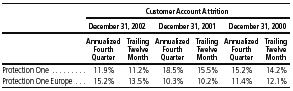
Our monitored services segment had a net decrease of 62,656
customers from December 31, 2001 to December 31, 2002. Attrition
decreased at Protection One in 2002 compared to 2001 for a variety
of reasons, including:
- An aggressive campaign dubbed “Save
Our Subscribers,” designed to retain existing customers.
- An emphasis on customer service and
attrition reduction by branch and monitoring center personnel.
- Legal action taken against competitors
who illegally solicit our customers.
|
|
Related Party Transactions
Below, we describe
significant transactions between us
and Westar Industries and some of our
other subsidiaries and related parties.
We have disclosed these significant
transactions even if they have been
eliminated in the preparation of our
consolidated results and financial position.
ONEOK
Shared Services Agreement
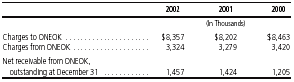
We and ONEOK have shared services agreements
in which we provide and bill one another for facilities, utility
field work, information technology, customer support, meter reading
and bill processing. Payments for these services are based on various
hourly charges, negotiated fees and out-of-pocket expenses:
 ONEOK gave us
notice of termination effective December
2003 of this shared services agreement.
We expect termination of this agreement
will increase our annual costs to provide
these services by approximately $11
million to $13 million.
Protection
One Shared Services Agreement
We provide administrative
services to Protection One pursuant
to services agreements, including accounting,
tax, audit, human resources, legal,
purchasing, facilities and technology
services. Fees for these services are
based upon various hourly charges, negotiated
fees and out-of-pocket expenses. Protection
One incurred charges of $3.9 million
in 2002, $8.1 million in 2001 and $7.3
million in 2000. These intercompany
charges have been eliminated in consolidation.
Westar Energy
and Protection One have entered into
an amended service agreement that stipulates
that if Westar Energy sells its interest
in Protection One, Westar Energy and
Protection One will negotiate, in good-faith,
the terms and conditions for continuation
of the services during an agreed-upon
transition period. This agreement is
subject to KCC approval, which has not
yet been received.
Transactions
Between Westar Industries
and Subsidiaries
Protection
One Credit Facility
Westar Industries
is the lender under Protection One’s
senior credit facility. The senior credit
facility was amended to increase the
capacity from $155 million to $280 million
during the year ended December 31, 2002.
On August 26, 2002, the senior credit
facility was further amended to extend
the maturity date to January 5, 2004.
On March 11, 2003, the KCC limited the
amount of the credit facility to $228.4
million, authorized us to fund the facility
and extend the term of the facility
to January 5, 2005 and required the
facility to be paid in full and terminated
upon the disposition of all or part
of our investment in Protection One.
We are in discussions with Protection
One about the extension of the facility
and we intend to renew the facility
through January 5, 2005, should such
renewal be necessary to provide Protection
One with continued liquidity. For further
information, see Note 34 of the Notes
to Consolidated Financial Statements,
“Subsequent Events.”
|


