|
6. FINANCIAL INSTRUMENTS, ENERGY TRADING
AND
RISK MANAGEMENT
Values of Financial Instruments
The carrying values and estimated
fair values of our financial instruments are as follows:
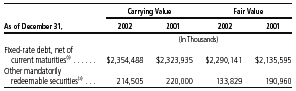 (a)Fair value is estimated based on quoted market
prices for the same or similar issues or on the current rates offered
for instruments of the same remaining maturities and redemption
provisions.
(a)Fair value is estimated based on quoted market
prices for the same or similar issues or on the current rates offered
for instruments of the same remaining maturities and redemption
provisions.
The recorded amounts of accounts receivable
and other current financial instruments approximate fair value.
Cash and cash equivalents, short-term borrowings and variable-rate
debt are carried at cost, which approximates fair value and are
not included in the table above.
The fair value estimates presented herein
are based on information available at December 31, 2002 and 2001.
These fair value estimates have not been comprehensively revalued
for the purpose of these consolidated financial statements since
that date and current estimates of fair value may differ significantly
from the amounts presented herein.
Derivative Instruments and Hedge Accounting
Our operations are exposed to market
risks from changes in commodity prices, foreign currency exchange
rates, interest rates and equity prices that could affect our results
of operations and financial condition. We manage our exposure to
these market risks through our regular operating and financing activities
and, when deemed appropriate, hedge a portion of these risks through
the use of derivative financial instruments. We use the term hedge
to mean a strategy designed to manage risks of volatility in prices
or rate movements on some assets, liabilities or anticipated transactions
by creating a relationship in which gains or losses on derivative
instruments are expected to counterbalance the losses or gains on
the assets, liabilities or anticipated transactions exposed to such
market risks. We use derivative instruments as risk management tools
consistent with our business plans and prudent business practices
and for energy trading purposes.
We
use derivative financial and physical instruments primarily to manage
risk as it relates to changes in the prices of commodities including
natural gas, oil, coal and electricity and changes in interest rates.
We also use derivative instruments for trading purposes in order
to take advantage of favorable price movements and market timing
activities in the wholesale power and fossil fuel markets. Derivative
instruments used to manage commodity price risk inherent in fossil
fuel and electricity purchases and sales are classified as energy
trading contracts on our consolidated balance sheets. Energy trading
contracts representing unrealized
gain positions are reported as assets; energy trading contracts
representing unrealized loss positions are reported
as liabilities.
|
|
Energy
Trading Activities
We engage in both financial and physical
trading to manage our commodity price risk. We trade electricity,
coal, natural gas and oil. We use a variety of financial instruments,
including forward contracts, options and swaps and trade energy
commodity contracts daily. We also use hedging techniques to manage
overall fuel expenditures. We procure physical product under fixed
price agreements and spot market transactions.
Within the trading portfolio, we take
certain positions to hedge a portion of physical sale or purchase
contracts and we take certain positions to take advantage of market
trends and conditions. Changes in value are reflected in our consolidated
statements of income. We believe financial instruments help us manage
our contractual commitments, reduce our exposure to changes in cash
market prices and take advantage of selected market opportunities.
We refer to these transactions as energy trading activities.
We are involved in trading activities
primarily to reduce risk from market fluctuations, capitalize on
our market knowledge and enhance system reliability. Net open positions
exist, or are established, due to the origination of new transactions
and our assessment of, and response to, changing market conditions.
To the extent we have open positions, we are exposed to the risk
that changing market prices could have a material, adverse impact
on our financial position or results of operations.
We have considered a number of risks and
costs associated with the future contractual commitments included
in our energy portfolio. These risks include credit risks associated
with the financial condition of counterparties, product location
(basis) differentials and other risks. Declines in the creditworthiness
of our counterparties could have a material adverse impact on our
overall exposure to credit risk. We maintain credit policies with
regard to our counterparties that, in management’s view, reduce
overall credit risk.
We are also exposed to commodity price
changes outside of trading activities. We use derivatives for non-trading
purposes and a mix of various fuel types primarily to reduce exposure
relative to the volatility of market and commodity prices. The wholesale
power market is extremely volatile in price and supply. This volatility
impacts our costs of power purchased and our participation in power
trades. If we were unable to generate an adequate supply of electricity
for our native load customers, we would purchase power in the wholesale
market to the extent it is available or economically feasible to
do so and/or implement curtailment or interruption procedures as
allowed for in our tariffs and terms and conditions of service.
To the extent open positions exist in our power marketing portfolio,
we are exposed to changing market prices that may adversely impact
our financial position and results of operations. The increased
expenses or loss of revenues associated with this could be material
and adverse to our consolidated results of operations and financial
condition. Due to the volatility of power market and gas prices,
past prices cannot be used to predict future prices.
|


