|
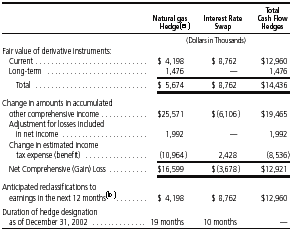
The following table summarizes the
effects our natural gas hedge and our interest rate swap had on
our financial position and results of operations for the year ended
December 31, 2002:
(a)
Natural gas hedge assets and liabilities are classified in the balance
sheet as energy trading contracts. Due to the volatility of gas commodity
prices, it is probable that gas prices will increase and decrease
over the remaining 19 months that these relationships are in place.
(b)The actual amounts that will be reclassified to earnings could
vary materially from this estimated amount due to changes in market
conditions.
Fair Value of Energy Trading Contracts
The tables below show fair value of energy
trading contracts outstanding for the year ended December 31, 2002,
their sources and maturity periods:
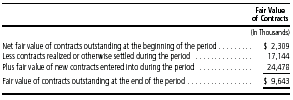 These contracts were valued through market
exchanges and, where necessary, broker quotes and industry publications.
The sources of the fair values of the financial instruments related
to these contracts are summarized in the following table:
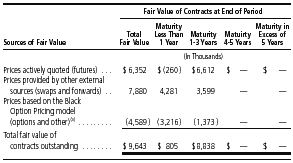
(a)The Black Option Pricing model is a variant of
the Black-Scholes Option Pricing model.
|
|
Effects of Accounting Changes — Accounting
for Energy Trading Contracts
In October 2002, the FASB, through the
EITF, issued Issue No. 02-03, which rescinded Issue No. 98-10, “Accounting
for Contracts Involved in Energy Trading and Risk Management Activities.”
As a result, all new contracts that would otherwise have been accounted
for under Issue No. 98-10 and that do not fall within the scope
of SFAS No. 133 can no longer be marked-to-market and recorded in
earnings as of October 25, 2002. We are not affected by this change
in accounting principle and are not required to reclassify any of
our contracts. EITF Issue No. 02-03 also requires that energy trading
contracts and derivatives, whether settled financially or physically,
be reported in the income statement on a net basis effective January
1, 2003. We began to classify our energy trading contracts on a
net basis during the third quarter of 2002.
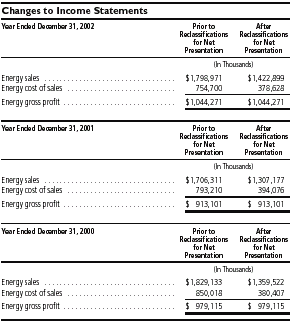
On July 1, 2002, we began reporting mark-to-market
gains and losses on energy trading contracts on a net basis, whether
realized or unrealized, in our consolidated income statements. Prior
to July 1, 2002, we reported gains on these contracts in sales and
losses in cost of sales in our consolidated income statements. The
changes are reflected in our consolidated financial statements for
the year ended December 31, 2002. Prior periods shown in our consolidated
financial statements have been reclassified to reflect the effect
of this change and to be comparable as required by GAAP. As a result
of the net presentation, we expect significant reductions in our
energy revenues and expenses from those reported in prior periods,
which will not affect gross profit or net income. A summary of the
effects of this change for the years ended December 31, 2002, 2001
and 2000 is as follows:
|


