21. MARKETABLE SECURITIES
During the last three years, we sold
substantially all of our investments in marketable securities. These
securities were classified as available-for-sale. Realized gains
and losses are included in earnings and were derived using the specific
identification method. The following table summarizes our marketable
security sales for the years ended December 31, 2002, 2001 and 2000:
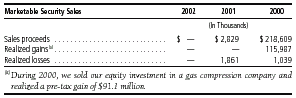 In February 2000, one of the paging
companies we held an interest in made an announcement that significantly
increased the market value of paging company securities in general.
During the first quarter of 2000, we sold the remainder of these
securities for a gain of $24.9 million.
During 2001, we wrote down the cost
basis of certain securities to their estimated fair value. The fair
value of these equity securities had declined below our cost basis,
and we determined that the decline was other than temporary. The
amount of the write down totaled $11.1 million, of which $9.6 million
related to an investment. The write down is included in other income
(expense).
See Note 4 for information regarding
the classification of our ONEOK investment.
22. MONITORED SERVICES DISPOSITIONS
In 2001, Protection One and Protection
One Europe disposed of certain monitored security operations for
approximately $48.0 million and we recorded a pre-tax loss of $13.1
million.
|
|
23. IMPAIRMENT CHARGES
Effective January 1, 2002, we adopted
SFAS No. 142 and SFAS No. 144. SFAS No. 142 establishes new standards
for accounting for goodwill. SFAS No. 142 continues to require the
recognition of goodwill as an asset, but discontinues amortization
of goodwill. In addition, annual impairment tests must be performed
using a fairvalue based approach as opposed to an undiscounted cash
flow approach required under prior standards. The completion of
the impairment tests, based upon a valuation performed by an independent
appraisal firm, as of January 1, 2002, indicated that the carrying
values of goodwill at Protection One and Protection One Europe had
been impaired and impairment charges were recorded as discussed
below.
Another impairment test of Protection
One’s goodwill and customer accounts was completed as of July 1,
2002 (the date selected for Protection One’s annual impairment test),
with the independent appraisal firm providing the valuation of the
estimated fair value of Protection One’s reporting units, and no
impairment was indicated. Protection One’s stock price declined
after regulatory orders were issued (see Note 3 ), including the
KCC’s December 23, 2002, order. As a result, Protection One retained
the independent appraisal firm to perform an additional valuation
of Protection One’s reporting units so it could perform an impairment
test as of December 31, 2002, which resulted in the additional impairment
charge discussed below.
SFAS No. 144 established a new approach
to determining whether our customer account asset is impaired. The
approach no longer permits us to evaluate our customer account asset
for impairment based on the net undiscounted cash flow stream obtained
over the remaining life of goodwill associated with the customer
accounts being evaluated. Rather, the cash flow stream used under
SFAS No. 144 is limited to future estimated undiscounted cash flows
from assets in the asset group, which include customer accounts,
the primary asset of the reporting unit, plus an estimated amount
for the sale of the remaining assets within the asset group (including
goodwill). If the undiscounted cash flow stream from the asset group
is less than the combined book value of the asset group, then we
are required to mark the customer account asset down to fair value,
by recording an impairment, to the extent fair value is less than
our book value. To the extent net book value is less than fair value,
no impairment would be recorded.
The new rule substantially reduces the net undiscounted cash flows
for customer account impairment evaluation purposes as compared
to the previous accounting rules. The undiscounted cash flow stream
has been reduced from the 16 year remaining life of the goodwill to
the nine year remaining life of customer accounts for impairment
evaluation purposes. Using these new guidelines, we determined that
there was an indication of impairment of the carrying value of the
customer accounts and an impairment charge was recorded as
discussed below.
|


