|
In June
1997 and again in September 1997, the Company approved plans
to restructure its operations in order to bring expenses in
line with forecasted revenues. In connection with these restructurings,
the Company substantially reduced its worldwide headcount
and consolidated facilities and operations to improve efficiency.
The following analysis sets forth the significant components
of the restructuring expense charge and adjustments to restructuring
expense included in the Company’s consolidated statements
of operations for the years ended December 31, 1999, 1998
and 1997 as well as the significant components of the restructuring
reserve at December 31, 1999 (in millions):
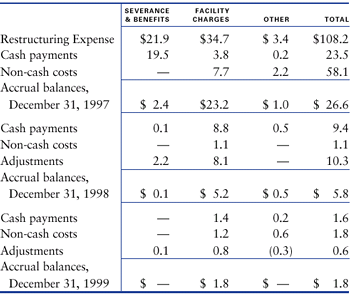
Severance
and benefits represent the reduction of approximately 670
employees, primarily sales and marketing personnel, on a worldwide
basis. Temporary employees and contractors were also reduced.
Write-off of assets include the write-off or write-down in
carrying value of equipment as a result of the Company’s decision
to reduce the number of Information Superstores throughout
the world, as well as the write-off of equipment associated
with headcount reductions. The equipment subject to the write-offs
and write-downs consisted primarily of computer servers, workstations,
and personal computers that are no longer utilized in the
Company’s operations. Facility charges include early termination
costs associated with the closing of certain domestic and
international sales offices.
For
the years ended December 31, 1999 and 1998, the Company recorded
restructuring-related adjustments to decrease restructuring
expense by $0.6 million and $10.3 million, respectively, primarily
due to adjusting the estimated severance and facility charges
to actual costs incurred. The Company has substantially completed
actions associated with its restructuring except for subleasing
or settling its remaining long-term operating leases related
to vacated properties. The terms of such operating leases
expire at various dates through 2003.

On January
1, 1998, the Company adopted Statement of Financial Accounting
Standards No. 130 (SFAS 130), “Reporting Comprehensive Income,”
which establishes standards for displaying comprehensive income
and its components.
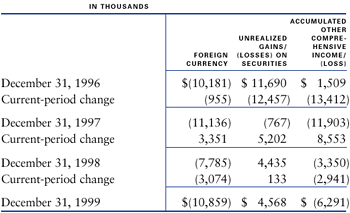
The
components of accumulated other comprehensive income (loss)
consist of the following items:
The
tax effect on components of comprehensive income (loss) is
not significant.

In June
1998, the Financial Accounting Standards Board issued Statement
No. 133 (SFAS 133), “Accounting for Derivative Instruments
and Hedging Activities,” which establishes standards for derivative
instruments, including certain derivative instruments embedded
in other contracts, and for hedging activities. It requires
an entity to recognize all derivatives as either assets or
liabilities in the statement of financial position and measure
those instruments at fair value. SFAS 133 is effective for
fiscal years beginning after June 15, 2000. Earlier application
of SFAS 133 is encouraged but should not be applied retroactively
to financial statements of prior periods. The Company is currently
evaluating the requirements and impact of SFAS 133.
|







