|
|
DEAR FELLOW KNIGHT SHAREHOLDER,
We refer to 2001 as the dark days for Knight. We experienced our first-ever
quarterly loss. We were forced to right-size with our first-ever staff
reduction. After growing at a furious pace — a compound annual
growth rate of more than 50% a year for four years — suddenly
we had to shift our primary business objective from success to survival.
This past year’s financial performance was, indeed, a bitter
pill to swallow. We need to understand every aspect of it to make
sure history does not repeat itself. To make sure we survive these
dark days and have progress to report next year.
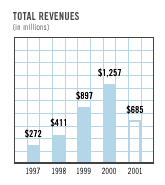
Financially, 2001 was Knight's most difficult year. Our 2001 revenues
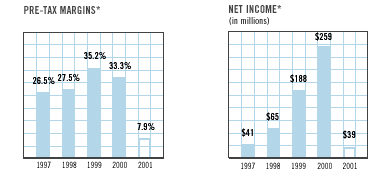
decreased 46% to $684.7 million from $1,257.3 million in 2000. Pre-tax
income decreased to $54.3 million, an 87% decline from 2000 pre-tax
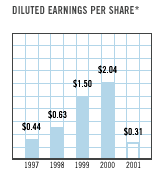
income of $418.5 million. Net income was $38.5 million, down from
2000 net income of $259.9 million. EPS for the full year was $0.31.
International expansion efforts resulted in an approximate $0.30 charge
to 2001 EPS. On an annualized basis, our return on equity was 4.7%
for the full year 2001.
KNIGHT: HIT HARD
After years of rapid acceleration — technological innovations,
growth in trading volumes, the Nasdaq topping the 5000 mark —
the bull market of the century came to an abrupt end. We witnessed
the greatest top-to-bottom decline the markets have ever known. Market
indices fluctuated, with the Nasdaq Composite Index down 21%, DJIA
down 7%, S&P 500 down 13%, and international market indices from
Europe to Japan weakened. Retail broker-dealer participation in the
equity markets evaporated. Institutions traded cautiously. A new breed
of active traders exploited marketplace inefficiencies. Simply, the
markets declined and Knight’s profitability followed. The roar
we heard a short 18 months ago was silenced, leaving all investors
with a feeling of uncertainty and doubt.
Even more than the market decline, decimalization with one-penny minimum
price variation (MPV) had the greatest impact on the industry last
year. According to Nasdaq's Economic Research Study, effective spread
contracted by 46% in the first full month of decimalized trading,
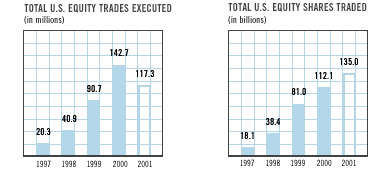
greater than the projected decline of 10%. Historically, Knight made
money through a combination of the revenue captured by the number
of shares traded, disciplined inventory management, spread retention,
market volume and volatility, and principal amount traded. How did
the market structure changes of 2001 affect Knight? We experienced
a dramatic reduction in one element of our profitability mix —
spread retention. Knight is working through these changes, putting
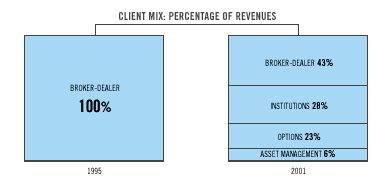
the pieces together to reclaim profitability. When
Knight was founded in 1995, we latched on for the heady ride of
the on-line trading boom. As we benefited from this trend in self-directed
investing in the U.S. and rode to the top of the bull market, we
scrambled to pull together the resources necessary to keep pace
with demand. We prepared for the same investing trend to take hold
overseas. Our rapid growth put us at a disadvantage when the market
cycle headed downward. Our infrastructure remained. As did the costs
associated with maintaining it. What are we going to do to get back
on top of our game?
KNIGHT:
A SURVIVOR
Knight is reexamining its market-making approach and making adjustments
to both technology and human capital to address these changing market
dynamics. We are exploring new trading methodologies and developing
sophisticated routing algorithms to identify the profit opportunities
in each trade. Our trading systems can’t be entirely rule-based
when releasing liquidity into the marketplace. After all, we are
deploying capital to smooth the gaps where no natural liquidity
exists. This capital commitment has value, which must reflect the
diversity of individual stocks, market situations and client demands.
We are charging commissions on certain transactions, albeit a very
small percentage of them. We are watching as the industry begins
to rationalize the costs associated with order execution.
Relative risk-adjusted
performance is creating a fundamental shift on the buy-side. Portfolio
Managers are developing new strategies around order executions,
rationalizing implicit and explicit costs. Inefficient order execution
can raise their cost basis. It can also decrease the eventual yield
of portfolio holdings. Institutional trading desks are seeking service
providers with the technology and expertise to help them create
alpha for their Portfolio Managers. So, where does Knight fit in?
Optimal execution service is the heart and soul of our value-added
proposition. Knight offers solutions that afford our clients timely,
superior executions. We provide price improvement, liquidity, speed
of executions for market orders and high fulfillment rates coupled
with rapidity for limit orders. The challenge we must overcome is
how we can recover the revenue lost and, ultimately, improve profitability.
KNIGHT: THE FUTURE
Knight is evolving at a critical time, and in the right place to
capitalize on the changes in our industry. In the U.S. equity markets,
implementation of SEC Rules 11Ac1-5 and 11Ac1-6 brought enhanced
disclosure of execution quality and order routing practices to the
marketplace. Statistics indicate that Knight’s execution quality
is highly competitive. Our value-added proposition remains valid
and relevant. We maintain a strong balance sheet. We are debt-free.
However, there is work to be done before we will see significant
steps towards profitability.
During 2002, Knight will hire
a new CEO to manage our progress as we rethink the way we do business.
However, that does not mean we will wait a single minute to start
our work. We are reviewing costs. We are deploying our human capital
wisely. We are reevaluating investments both abroad and domestically.
We are adjusting our trading methodologies in our equities businesses.
We are preparing for the introduction of Nasdaq’s SuperMontage.
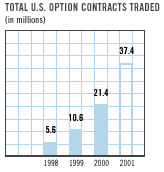
We are focusing our options business on increasing margins in an
environment where revenue per option contract continues to decline
due to lower underlying prices of equities and increased competition.
We are emphasizing fund returns over pure asset gathering in our
asset management business.
Looking at Knight today, we
are working together to transition the company to the next chapter
of its story. If ways exist to create more value around the execution
process, we will find them. If ways exist to better service our
clients and help them succeed, we will find them. We will turn the
challenges we face into opportunities. This past year knocked us
down, but not out. We are still the market leader and understand
our space better than any of our competitors. We will leverage our
knowledge. We will survive. We are Knight.
Sincerely,
 |
 |
| Kenny Pasternak
|
Tony Sanfilippo |
|
|