|
|
  |
Historically, the Company’s growth has been primarily from acquisitions. This trend began to change in late fiscal year 1999. As industry conditions reduced the number of major consolidators participating in the acquisition market, those that remained generally applied significantly tighter pricing criteria, and many potential sellers withdrew their businesses from the market rather than pursuing transactions at lower prices. As the business model shifted, death care consolidators experienced diminishing access to capital. In response to these changes, the Company ceased its acquisition activity and developed strategies for improving cash flow and reducing and restructuring debt. Throughout fiscal years 2000 and 2001, the Company has focused on debt reduction and cash flow. During fiscal year 2002, the Company plans to continue its focus on debt reduction and to position itself for business expansion in fiscal year 2003.
The Company believes that once its debt targets are achieved, it will be in a position to consider purchasing high-quality firms with free cash flow.
As described in Note 14 to the Company’s consolidated financial statements, on June 29, 2001, the Company completed several transactions that refinanced substantially all of its long-term debt. In addition, in the third quarter of fiscal year 2001, the Company decided to pursue the sale of its foreign operations in order to generate cash to reduce debt and to allow the Company to focus on its core businesses. In the fourth quarter of fiscal year 2001, the Company sold all of its foreign operations other than those in Southern Europe (France, Spain and Portugal), Canada and Argentina and subsequently entered into a binding contract to sell its Southern European operations. In total, these transactions have generated or will generate proceeds, including future tax benefits, of $150 million to $160 million of the $200 million to $250 million in total proceeds the Company expects to receive from the sale of all foreign operations. The net proceeds related to the sale of foreign operations received thus far have been used to repay debt, and net proceeds from future foreign asset sales will be used to repay debt. The Company continues to have active discussions for the sale of its remaining foreign operations and expects to complete these sales during 2002. For additional information, see Note 13 to the consolidated financial statements. Additionally, the Company has realized $21 million in proceeds for the sale of certain domestic properties, with $13.5 million from the sale of excess cemetery property and approximately $7.5 million from the sale of funeral home real estate and small domestic operations. Those proceeds were also used to reduce debt. The Company anticipates that it will realize an additional $5 million to $10 million in fiscal year 2002 from similar sales.
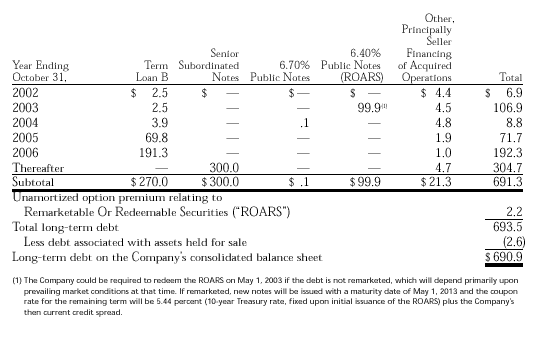
As a result of these transactions and the additional application of cash flow to reduce debt, the Company has reduced its debt from $950.5 million at the beginning of fiscal year 2001 to $692.2 million as of January 9, 2002. Long-term debt as of October 31, 2001, which includes $2.6 million of debt associated with assets held for sale, was $693.5 million. The following table reflects future scheduled principal payments and maturities of the Company’s long-term debt (in millions) as of October 31, 2001. Additional information about the Company’s long-term debt is contained in Note 14 to the consolidated financial statements.
Although the implementation of SAB No. 101 did not have an impact on the Company’s consolidated cash flows, it did have an impact on the components of the operating section of the consolidated statement of cash flows. In the following table, cash flows from operating activities for fiscal year 2001 are presented as reported after the implementation of SAB No. 101. Cash flows from operating activities for fiscal year 2000 are presented as adjusted on a pro forma basis to show the effects of SAB No. 101 and are also presented as reported, not reflecting the implementation of SAB No. 101.
|
|
|
|