|
|
  |
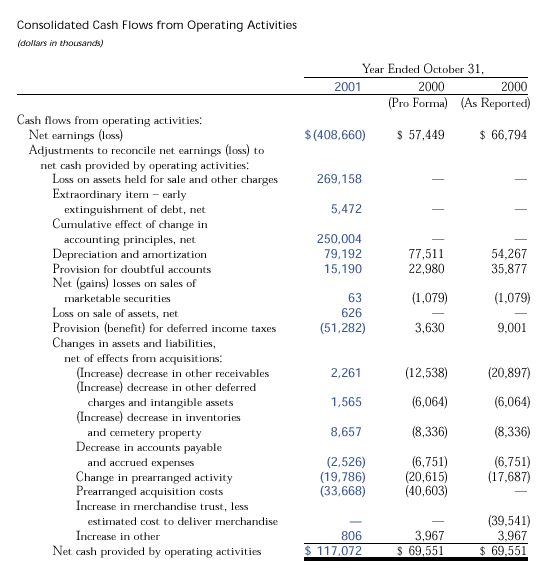
The Company’s operations provided cash of $117.1 million for the year ended October 31, 2001, compared to $69.6 million for fiscal year 2000. The increase in operating cash flow is due to improvements in operations and several working capital changes, including a decrease in other receivables and a reduction in prearranged acquisition costs due to moderation in the Company’s preneed sales and changes in preneed sales terms and conditions. Additionally, operating cash flow increased due to (1) $13.5 million in proceeds from the sale of excess undeveloped cemetery property, (2) a $7.0 million tax refund and (3) $11.0 million in tax benefits.
The Company’s investing activities resulted in a net cash inflow of $58.6 million for the year ended October 31, 2001, compared to a net cash inflow of $15.8 million for fiscal year 2000. The increase was due primarily to $74.0 million in proceeds from the sale of foreign operations and $7.5 million in proceeds from the sale of domestic funeral home real estate and small domestic operations received by the Company from the asset sales described above under “Debt Restructuring and Reduction; Asset Sales,” net of expenses and cash balances of the operations sold. The cash inflow from investing activities in 2000 was a result of converting certain voluntary escrow funds to cash for general operating purposes.
The Company’s financing activities resulted in a cash outflow of $246.3 million for the year ended October 31, 2001, compared to a cash outflow of $18.8 million for the comparable period in 2000. This is due principally to repayments of long-term debt of $978.0 million during the year ended October 31, 2001 and debt issue costs of $34.3 million associated with the Company’s June 2001 debt refinancing, partially offset by proceeds from long-term debt of $725.0 million from the debt refinancing. Also offsetting this cash outflow was $40.0 million that the Company withdrew from its trust funds in Florida in the first quarter of 2001, whereby the Company substituted a bond to guarantee performance under certain preneed funeral contracts and agreed to maintain unused credit facilities in an amount that will equal or exceed the bond amount. As of November 2001, the balance of the Florida bond was $33.1 million. Management believes that cash flow from operations will be sufficient to cover its estimated cost of providing the related prearranged services and products in the future.
As part of its strategy to increase cash flow and reduce debt, in fiscal year 2001 the Company limited its capital expenditures primarily to maintenance capital expenditures and the construction of funeral homes in connection with its operating partnership with the Archdiocese of Los Angeles, and expects to do the same in fiscal year 2002. For fiscal year 2001, capital expenditures amounted to $26.0 million, which included $17.3 million for maintenance capital expenditures and $8.7 for new growth initiatives, primarily the construction of the Archdiocese of Los Angeles funeral homes. For fiscal year 2002, the Company anticipates capital expenditures of $20.0 million to $27.0 million, which includes maintenance capital expenditures and new growth initiatives, including the construction of the Los Angeles funeral homes. The Company has no material commitments for capital expenditures in fiscal year 2002 other than approximately $3.0 million related to the Archdiocese of Los Angeles funeral homes.
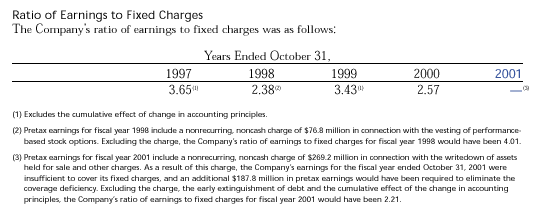
For purposes of computing the ratio of earnings to fixed charges, earnings consist of pretax earnings plus fixed charges (excluding interest capitalized during the period). Fixed charges consist of gross interest expense, capitalized interest, amortization of debt expense and discount or premium relating to any indebtedness and the portion of rental expense that management believes to be representative of the interest component of rental expense. The ratio of earnings to fixed charges for the year ended October 31, 2001 reflects the 2001 change in accounting principles; fiscal years 2000 and 1999 reflect the 1999 change in accounting principle; and fiscal years 1998 and 1997 reflect the 1997 change in accounting principles.
|
|
|
|