|
(dollars in thousands, except per share amounts.)
|
  |
During the third quarter of fiscal year 2001, the Company adopted a formal plan to sell its foreign operations and certain domestic assets, primarily funeral home real estate and excess cemetery property. In addition, it reviewed noncompetition agreements that it had entered into with sellers, key employees and others in connection with previous acquisitions, and it decided to relieve some of these individuals from the obligations not to compete, although it will continue to make the payments in accordance with the contract terms.
SFAS No. 121, “Accounting for the Impairment of Long-Lived Assets and Long-Lived Assets to be Disposed of,” applies to long-lived assets, certain identifiable intangibles, and goodwill related to those assets to be held and used and to long-lived assets and certain identifiable intangibles to be disposed of. An entity must review for impairment long-lived assets and certain identifiable intangibles to be held and used whenever events or changes in circumstances indicate that the carrying amount of an asset may not be recoverable. All long-lived assets to be disposed of that are not covered by APB Opinion No. 30, “Reporting the Results of Operations — Reporting the Effects of Disposal of a Segment of a Business, and Extraordinary, Unusual and Infrequently Occurring Events and Transactions,” and for which management, having the authority to approve the action, has committed to a plan to dispose of the assets, must be reported at the lower of carrying amount or fair value less cost to sell.
Based on its progress at that time and management’s and the Board of Directors’ decision to proceed with the sales of its foreign operations and certain domestic assets if acceptable prices and terms could be obtained, in the third quarter of 2001 the Company wrote down the aggregate value of these assets to their estimated fair value, which was based upon current offers from interested parties or market prices of comparable properties, less cost to sell. As a result, the Company incurred an aggregate pre-tax noncash charge to earnings of $269,158 ($205,089 after-tax, of which $187,329 related to foreign operations).
The portion of the charge to equity in the third quarter of fiscal year 2001 that related to foreign operations was equal to the entire foreign-related after-tax charge to earnings of $187,329. However, the Company has already reduced equity for the cumulative foreign translation adjustment incurred in each period that it has owned these businesses. Therefore, in the periods in which the sale of each of the foreign operations is consummated, the cumulative foreign translation adjustment relating to the operation sold will be reversed and included in comprehensive income, resulting in a corresponding increase in equity. The Company sold its Mexican, Australian, New Zealand, Belgian and Dutch operations in the fourth quarter of fiscal year 2001. As such, in the fourth fiscal quarter, the Company realized comprehensive income and an increase to equity for the cumulative foreign currency translation related to these operations, which equals $74,754. The remainder of the approximately $26,957 cumulative foreign translation adjustment would be reversed upon completion of the sale of the Company’s French, Spanish, Portuguese and Canadian operations.
The related assets and liabilities associated with assets held for sale are shown in separate line items in the consolidated balance sheet titled “assets held for sale” and “liabilities associated with assets held for sale.” In the consolidated statement of earnings, the impairment charges related to these writedowns and the writedowns of the noncompetition agreements are reflected in the “loss on assets held for sale and other charges” line item.
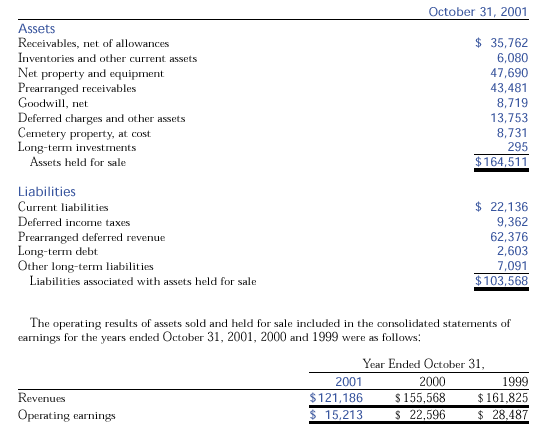
At October 31, 2001, the assets held for sale (excluding $5,072 of cash and cash equivalent investments of the operations held for sale) and the liabilities associated with assets held for sale line items in the balance sheet represent the assets and liabilities, respectively, of all of the Company’s foreign operations and certain domestic assets, primarily funeral home real estate and excess cemetery property. A summary of the assets and liabilities included in these line items is as follows:
|
|
|
|