|
|
|


|
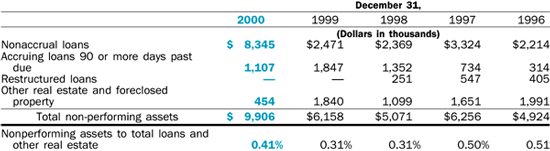
The following table presents information regarding nonperforming assets as of the dates indicated:
The Company regularly updates appraisals on loans collateralized by real estate, particularly those categorized as nonperforming loans and potential problem loans. In instances where updated appraisals reflect reduced collateral values, an evaluation of the borrower’ overall financial condition is made to determine the need, if any, for possible writedowns or appropriate additions to the allowance for loan losses. A loan is considered impaired when, based upon current information and events, it is probable that the Company will be unable to collect the scheduled payments of principal and interest when due according to the contractual terms of the loan agreement. The Company’s impaired loans were approximately $10.8 million and $13.7 million at December 31, 2000 and 1999, respectively. At December 31, 1999, the largest component of impaired loans was a commercial energy related loan of approximately $10.8 million. This loan was not considered impaired at December 31, 2000 as a result of payments in accordance with terms for a period of at least twelve months. The decrease in the impaired loan balance associated with this loan was partially offset by the addition of two loans with a principal balance of $6.2 million included in nonaccrual loans and discussed above. The average recorded investment in impaired loans during 2000, 1999 and 1998 was $9.3 million, $13.9 million and $6.3 million, respectively. The total required allowance for loan losses related to these loans was $1.0 million for 2000 and $0 for 1999. Interest income on impaired loans of $1.1 million, $1.5 million and $415,000 was recognized for cash payments received in 2000, 1999 and 1998, respectively. The Bank is not committed to lend additional funds to debtors whose loans have been modified. Securities At the date of purchase, the Company classifies debt and equity securities into one of three categories: held to maturity, trading or available for sale. At each reporting date, the appropriateness of the classification is reassessed. Investments in debt securities classified as held to maturity are stated at cost, increased by accretion of discounts and reduced by amortization of premiums, both computed by the interest method. Management has the positive intent and ability to hold those securities to maturity. Securities that are bought and held principally for the purpose of selling them in the near term are classified as trading and measured at fair value in the financial statements with unrealized gains and losses included in earnings. Securities not classified as either held to maturity or trading are classified as available for sale and measured at fair value in the financial statements with unrealized gains and losses reported, net of tax, as a component of accumulated other comprehensive income (loss) until realized. Gains and losses on sales of securities are determined using the specific-identification method. The Company has classified all securities as available for sale at December 31, 2000. This allows the Company to manage its investment portfolio more effectively and to enhance the average yield on the portfolio. |