|
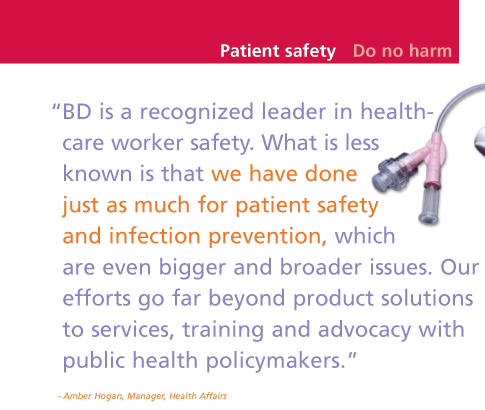 |
The BD Nexiva Closed IV
Catheter System helps
lower the risk of patient
infection by reducing the
potential for fluid pathway
contamination.
|
 Patient safety has been a focus of BD's innovation for years,
not only in the U.S. but around the world. For example,
BD in China launched an integrated catheter design that for the
last several years has been one of the Company's most successful
products in the Asia-Pacific region. The product signifi-cantly improved medical practice in China. Additional features
have now been added and the product has evolved into the
BD Nexiva Closed IV Catheter System (CIVCS). Great ideas
can–and do–come from everywhere. Patient safety has been a focus of BD's innovation for years,
not only in the U.S. but around the world. For example,
BD in China launched an integrated catheter design that for the
last several years has been one of the Company's most successful
products in the Asia-Pacific region. The product signifi-cantly improved medical practice in China. Additional features
have now been added and the product has evolved into the
BD Nexiva Closed IV Catheter System (CIVCS). Great ideas
can–and do–come from everywhere.
BD is enhancing its leadership in patient safety with several
current initiatives. Patient safety is a growing concern throughout
the European community and most major world markets.
Many quality-based standards organizations are adding patient
safety to healthcare performance measures.
Bloodstream contamination introduced through IV therapy
is of particular concern. IV lines must be constantly maintained
to guard against bacteria and viruses when administering a
drug, cleaning the system or withdrawing blood. Open IV
systems can temporarily expose the patient to airborne contaminants.
In Europe and Japan, many systems are permanently
open, putting patients at greater risk. In addition to
closing the fluid path, the BD Nexiva CIVCS incorporates
BD sharp needle technology and a patented cannula tipping
process to help reduce the pain of insertion. The risk of other
patient complications–vein irritation and phlebitis–may be
lowered because design features reduce the need for manipulation
at the insertion site. Breakthrough products such as the
BD Nexiva CIVCS help to improve healthcare worker safety
through integrated sharps safety features.
The BD PosiFlush prefilled syringe is another significant
innovation in IV therapy. The BD PosiFlush saline syringe is
the first syringe specifically designed with unique features to
enhance catheter maintenance protocols. Available with normal
saline and heparin lock solutions, all BD PosiFlush prefilled
syringes are latex and preservative-free, color-coded for easy
identification, and designed to significantly reduce blood reflux
and its associated complications.
In another major area of patient safety–reducing errors
in specimen collection and management–the BD.id Patient
Identification System has been implemented by Norwalk
Hospital in Connecticut. The hospital chose the BD.id system
based on its simplicity and its ability to minimize medical risk
and address all potential failure points. The other two hospitals
that have implemented the BD.id system–The Valley Hospital
in Ridgewood, New Jersey and South Georgia Medical Center
in Valdosta, Georgia–achieved close to a 100 percent reduction
in specimen collection errors.
Recognizing the importance of hand hygiene, BD plays
another role in patient safety by being the largest single-source
provider of surgical hand antiseptic products, including
BD E-Z Care Rinseless, Brushless Antiseptic.
 |
The BD Q-Syte Closed
Luer Access device is an
IV access site that eliminates
the need for needles
and can also help
prevent bloodstream
infections through contamination
of IV lines. |
|
BD PosiFlush Prefilled Saline and Heparin
Lock Flush syringes help protect both patient
and healthcare worker and are the first delivery
devices that BD is both manufacturing
and filling.
 |
The BD.id Patient Identification
System–the first to fully integrate bar-coding
technology with specimen collection standards–
is in its first in-hospital applications. |
 |
Each year, nearly 2 million
patients in the U.S. contract
an infection while
in a hospital. Of these,
nearly 90,000 die as a
result of their infections.
BD seeks to reduce
risks to patients and
ensure that more
people are sent home
healthy. Unlike anything
else on the market,
the BD Nexiva Closed IV
Catheter System (CIVCS)
has the potential to
change the way infusion
therapy is delivered
and to improve safety
for patients as well
as healthcare workers
in hospital and nonacute
care settings. The
BD Nexiva CIVCS helps
lower the risk of patient
infection by reducing
the potential for fluid
pathway contamination.
For healthcare workers,
it reduces exposure
to blood. It also provides
them greater convenience
and efficiency
because it is the first
system to integrate three
separate IV components
into a single,
preassembled device. |
|
|
|
|