This discussion summarizes the significant factors that affected the consolidated operating results and financial condition of Deluxe Corporation during the three years ended December 31, 1996. Over this period, the Company has engaged in a strategic reor ganization process, the goal of which is to improve profitability and provide the financial institution and retail communities an even broader range of products and services. During this process, the Company has recorded significant consolidation, restruc turing, and other reorganization costs, as well as gains and losses on sales of businesses
Although these charges have had a significant impact on the operating results and cash position of the Company, the following discussion considers them separately when analyzing the Company's financial and operational progress. The following analysis is b ased on the organization of the Company's businesses into three operating segments (described in note 12 to the Consolidated Financial Statements)
Overall Summary
In 1996, the Company achieved higher sales for the 58th consecutive year. The sales
increase of 2% was the result of growth in the Deluxe Financial Services and Deluxe
Electronic Payment Systems segments, partially offset by a planned decline in the Delux e
Direct segment. 1996 income from continuing operations was $65.5 million, compared to
$94.4 million and $144.3 million in 1995 and 1994, respectively. Earnings per share from
continuing operations were $.80 in 1996, compared to $1.15 in 1995 and $1.75 i n 1994.
Return on average assets was 5.3% for 1996, compared to 7.4% and 11.5% in 1995 and 1994,
respectively. Return on average shareholders' equity was 8.8% in 1996, compared to 11.8%
in 1995 and 17.9% in 1994. These results include pretax strategic reo rganization charges
of $142.3 million in 1996 and $62.5 million in 1995. The results for 1994 include a $10
million pretax credit to a 1993 restructuring charge
Strategic Reorganization Charges
Over the last few years, the Company has engaged in a strategic reorganization process.
This process involved a thorough examination of the Company's various lines of business,
including an examination of each business' product offerings, short-term and l ong-term
profitability, and strategic fit within the Company's long-term plans. This effort has
resulted in the consolidation of operating and administrative facilities, the elimination
of products and businesses, and the restructuring of the Company's ma nagement and
operating structure. These events have led to improved operating profitability and should
continue to result in cost reductions, which will be reflected primarily in the form of
reduced facility, materials, and employee expenses in the Compan y's operating results. It
is expected that competitive pricing measures, increased expenses, and other factors will
offset a portion of the savings expected to be achieved through the Company's cost
reduction efforts
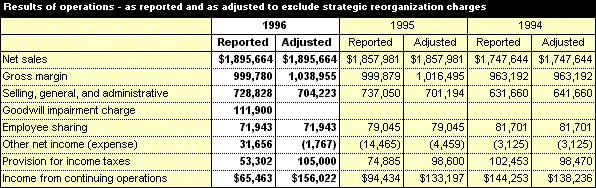
During 1996, the Company sold a total of six businesses in the Deluxe Direct segment and announced its plans to divest three others. As a result of management's decision to hold these three businesses for sale, and in accordance with generally accepted ac counting principles, the Company recorded a pre tax goodwill impairment charge of $111.9 million to write the businesses down to their estimated fair values less costs to sell. Additionally, the Company recorded net pretax charges of $30.4 million during 1996 for restructuring, gains and losses on sales of businesses, and other reorganization costs. These charges are reflected through out the consolidated statement of income according to the nature of the charge, with $39.2 million in cost of sales expens e, $24.6 million in selling, general, and administrative expense and a $33.4 million gain in other income. The December 31, 1996, balance sheet reflects a restructuring accrual of $29.1 million for employee severance costs and $3.8 million for estimated l osses on asset dispositions. The majority of these severance costs are expected to be paid out in 1997 from cash generated from the Company's operations
During the fourth quarter of 1995, the Company announced that it was exiting its Printwise ink business, which is treated as discontinued operations in the financial statements presented in this report. Also during 1995, the Company recorded pretax charge s of $62.5 million primarily related to exiting unprofitable businesses, eliminating certain products, and write-offs of non-performing assets. These costs are spread throughout the 1995 consolidated statement of income. Of the $62.5 million in charges, $ 16.6 million is included in cost of sales, $35.9 million in selling, general, and administrative expense, and $10 million in other expense
In 1994, a $10 million credit to a 1993 restructuring charge was recorded to selling, general, and administrative expense
The following table displays the Company's results of operations as reported, compared to results with the above mentioned charges excluded
Results of Operations
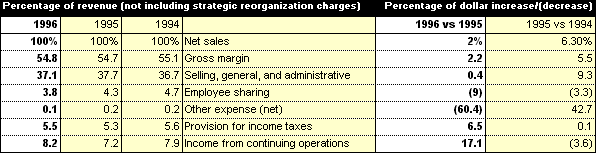
The table above sets forth, for the years indicated, the percentage relationship to
revenue of certain items in the Company's consolidated statements of operations and the
percentage dollar changes of such items in comparison to the prior year. This table does
not include the strategic reorganization charges discussed above
For discussion purposes, segment results discussed below reflect results from continuing operations, excluding the above mentioned strategic reorganization charges
NET SALES - Net sales for the Company increased 2% over 1995. Net sales for the Deluxe Financial Services segment increased 7.3% to $1,390.3 million in 1996
The majority of the increase came from increased sales of higher priced products in the financial institution check printing business and increased volume from direct mail offerings. Additionally, collection service revenue continued to increase due to ac quisitions and management efforts to increase sales volume. The Deluxe Electronic Payment Systems segment experienced a sales increase of 4.3% to $129.9 million in 1996, mostly due to increased volumes in financial institution ATM processing. These sales increases were partially offset by a 14.2% decrease to $375.5 million for the Deluxe Direct segment. This decrease was the result of actions taken to increase the profitability of the segment, including sales of businesses within the segment, reduced cata log circulation, and the elimination of unprofitable product lines
In 1995, net sales for the Company increased 6.3% over 1994. Net sales for the Deluxe Financial Services segment increased 4% from 1994 to $1,295.7 million. Order counts for the financial institution check printing business remained flat, but continued co mpetitive discounting resulted in a slight reduction of revenues. This decline was more than offset by growth in the segment's collection service business. Additionally, the Deluxe Electronic Payment Systems segment experienced a revenue increase of 25.8% to $124.5 million. Most of this growth was attributable to an international acquisition in August 1994. Finally, the Deluxe Direct segment recorded a revenue increase of 8.6% to $437.8 million in 1995. The majority of this growth was also the result of a cquisitions. The growth was partially offset by lower catalog response rates for products in the segment's social expressions business
GROSS MARGIN - Consolidated gross margin for the Company was 52.7% in 1996, compared to 53.8% and 55.1% in 1995 and 1994, respectively. The fluctuation over the three-year period was primarily due to the strategic reorganization charges discussed a bove. With the strategic reorganization charges excluded from the results, consolidated gross margin for the Company was 54.8% in 1996, compared to 54.7% and 55.1% in 1995 and 1994, respectively. The Deluxe Financial Services segment's gross margin increa sed to 60% in 1996 from 59.5% in 1995. Margin improvement from the financial institution check printing business was partially offset by declines in the collections business as a result of growth related costs. Margins for the Deluxe Electronic Payment Sy stems segment decreased to 15.9% in 1996 from 36% in 1995, due primarily to higher computer equipment rent expense, costs of infrastructure upgrades and software re-engineering, and higher telecommunication expense. Margins for the Deluxe Direct segment i ncreased to 49% from 45.9% in 1995, due primarily to the sale of businesses with poorer margins, better cost containment and inventory management, and consolidation of products within the direct mail businesses
The Deluxe Financial Services segment's gross margin was 59.5% in 1995 and 1994. Margin improvements from the financial institution check printing business were offset by a decrease from the payment protection business, due to higher processing costs and expenditures related to database enhancements. Margin percentages for the Deluxe Electronic Payment Systems segment increased to 36% from 32.2%, due primarily to higher sales volume and acquisitions. Margins for the Deluxe Direct segment decreased to 45.9 % from 47.2%, due to higher postage and paper costs and acquisitions of businesses that experienced lower margins than average for the segment
SELLING, GENERAL, AND ADMINISTRATIVE - Selling, general, and administrative expenses for the Company decreased $8.2 million, or 1.1%, in 1996, primarily as a result of the 1995 strategic reorganization charges discussed above. With the strategic re organization charges excluded, selling, general, and administrative expenses increased $3 million, or .4%, in 1996. The Deluxe Financial Services segment's expenses increased 8.6%, primarily in the financial institution check printing business,15 due to increased customer service call center volume and higher marketing expenditures for new products. The Deluxe Electronic Payment Systems segment's expenses decreased 4.6%, due to lower consulting expenses. The Deluxe Direct segment's expenses decreased 15 %, mainly due to planned catalog circulation decreases by the segment's direct mail businesses
In 1995, selling, general, and administrative expenses for the Company increased $105.4 million, or 16.7%, in part as a result of the strategic reorganization charges discussed above. With these charges excluded, selling, general, and administrative expen ses increased $59.5 million, or 9.3% from 1994
The Deluxe Financial Services segment's expenses increased 6%, due to growth in the segment's collection businesses. The Deluxe Electronic Payment Systems segment's expenses increased by 51.2%, due mainly to an international acquisition in August 1994 and increased salaries and consultant costs. The Deluxe Direct segment's expenses increased 10.5%, primarily due to acquisitions and costs associated with product development
EMPLOYEE SHARING - A portion of employee sharing includes benefits paid to employees that are based on the Company's profitability. Other components fluctuate with the number of Company employees. The decrease to $71.9 million in 1996 from $79 mill ion in 1995 and $81.7 million in 1994 resulted from a decrease in the Company's net income over this period
OTHER INCOME (EXPENSE) - Other income for the Company was $31.7 million in 1996, compared to other expense of $14.5mil lion in 1995 and $3.1 million in 1994
These changes were primarily due to the strategic reorganization charges discussed above. With these charges removed, other expense was $1.8 million in 1996, compared to $4.5 million in 1995. The decrease is due primarily to lower interest expense as a re sult of decreased borrowings. In 1995, other net expense was $4.5 million, compared to $3.1 million in 1994. The increase is due primarily to higher interest expense from increased borrowings and decreases in interest income
PROVISION FOR INCOME TAXES - The Company's effective tax rate in creased to 44.9% in 1996 and 44.2% in 1995 from 41.5% in 1994, due primarily to lower pretax income combined with an increasing base of non-deductible expenses consisting primarily of intangible amortization. Additionally, the 1996 rate increased due to the non-deductible goodwill impairment charge recorded by the Company. This was offset by tax benefits recognized for the sales of businesses and businesses held for sale
NET INCOME - 1996 net income decreased to $65.5 million from $87 million in 1995. The primary reason for the decrease was the additional strategic reorganization charges discussed above. With the charges and their related tax effects removed, the C ompany had income from continuing operations of $156 million and $133.2 million in 1996 and 1995, respectively. This increase resulted from increased sales, lower interest expense, and cost savings gained from production efficiencies and the elimination o f unprofitable product lines
1995 net income decreased to $87 million from $140.9 million in 1994, resulting primarily from the strategic reorganization charges of $62.5 million and increased losses from discontinued operations. With these charges removed from the results, income fro m continuing operations in 1995 was $133.2 million, compared to $138.2 million in 1994
Financial Condition
LIQUIDITY - Cash provided by continuing operations was $290.6 million, compared to
$214.6 million in 1995 and $199 million in 1994. Funds provided by operations are the
Company's primary source of working capital for financing capital expenditures and paying
dividends. The increase in 1996 over 1995 is due to better cash management and operating
cost reductions. 1994 cash provided by operations was lower than 1996 and 1995, due
primarily to cash expenditures related to the restructuring of the chec k printing
business. Working capital was $108.1 million as of December 31, 1996, compared to $12.3
million and $130.4 million on that date in 1995 and 1994, respectively. The year-end
current ratio for 1996 was 1.3 to 1, compared to 1 to 1 and 1.4 to 1 fo r 1995 and 1994,
respectively. The increase over 1995 is primarily the result of cost savings and cash
proceeds from the Company's strategic reorganization initiatives and from lower capital
expenditures. 1995's working capital and current ratio decline f rom 1994 resulted
primarily from acquisitions and lower profits. The Company anticipates that approximately
$24.2 million of cash will be paid out in 1997 on 1996 restructuring accruals
CAPITAL RESOURCES - In 1996, the Company made numerous business acquisitions and divestitures from which the Company derived $98.1 million in net cash proceeds
In 1995, the Company made one acquisition at a cost of $38.8 million. In 1994, the Company made several acquisitions at an aggregate cost of $53.8 million
Purchases of property, plant, and equipment required cash outlays of $92 million in 1996, compared to $125.1 million in 1995 and $126.2 million in 1994
The Company anticipates capital expenditures of approximately $130 million in 1997 for information technology upgrades and replacement and for expansion of the Company's capabilities to provide enhanced product offerings to its customers
The Company has uncommitted bank lines of credit of $190.3 million. At December 31, 1996, $17 million was outstanding at an interest rate of 6.5%. At December 31, 1995, $14.2 million was outstanding at an interest rate of 6.6%
The average amount drawn from these lines in 1996 was $14.5 million at a weighted average interest rate of 6.29%. Also, the Company has in place a $150 million committed line of credit as support for commercial paper and as a source of cash. The average a mount of commercial16 paper outstanding in 1996 was $13.3 million at a weighted average interest rate of 5.63%. No commercial paper was outstanding as of December 31, 1996. As of December 31, 1995, $34.7 million of commercial paper was issued and outsta nding at a weighted average interest rate of 6.09%. During the third quarter of 1995, the Company filed a shelf registration for a $300 million medium-term note program to be used for general corporate purposes, including working capital, repayment or rep urchase of outstanding indebtedness and securities of the Company, capital expenditures, and possible acquisitions. As of December 31, 1996 and 1995, no such notes were issued or outstanding
Cash dividends totaled $122 million in 1996, compared to $122.1 million in 1995 and $120.5 million in 1994. The payout of earnings was 186.3% in 1996, 140.4% in 1995, and 85.5% in 1994. In December 1996, the Company's board of directors amended the Compan y's stock purchase plan to permit the repurchase of up to 10 million shares of Deluxe common stock. The board authorized the repurchase of up to 5 million shares under this plan
OUTLOOK - The Company's declining profits over the past few years have required management to re-evaluate all aspects of the Company's business. The results of operations over these years and in the immediate future include significant actions inte nded to position the Company for profitable growth. In 1997, the Company expects to complete a program of divesting businesses that do not focus on providing products and services to the financial institution and retail markets. Additionally, the Company will continue its re-engineering efforts throughout the organization. This is expected to result in reduced costs and improved profitability. These changes have required, and may continue to require, charges to earnings as evidenced by the 1996 and 1995 p retax charges to continuing operations and the discontinuation of the Printwise ink business in 1995. While the Company may be required to record additional charges in the future, the Company expects the amount and degree of these charges to lessen as it completes its reorganization and begins to reap the financial and operational benefits of its efforts