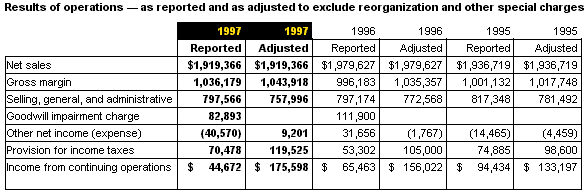
| Introduction This discussion summarizes the significant factors that affected the consolidated operating results and financial condition of Deluxe Corporation during the three years ended December 31, 1997. During this period, the Company has undergone a significant transformation. It has reorganized to improve its profitability in its core and ongoing businesses and redefined its strategy to focus on information-based growth opportunities in the payment process. As part of its strategy, the Company is creating and providing its financial institution and retail customers with integrated products and services that can help them maximize their profit opportunities and manage their risks. As a result of its transformation, the Company has recorded significant consolidation, restructuring, and reorganization costs as well as gains and losses on sales of businesses, which together, have had a significant impact on the operating results and cash position of the Company. The following discussion considers these items separately when analyzing the Company’s financial and operational progress and is based on the organization of the Company’s businesses into three operating segments: Deluxe Financial Services, Deluxe Electronic Payment Systems, and Deluxe Direct. Deluxe Financial Services provides check printing, direct marketing, customer database management, and related services to financial institutions; checks directly to households and small businesses; and payment protection and collections services to financial institutions and the retail market primarily in the United States. Deluxe Electronic Payment Systems provides debit transaction processing and other electronic banking functions in the United States and internationally. Deluxe Direct primarily sells greeting cards, stationery, and specialty paper products through direct mail to customers principally in the United States. Overall Summary Reorganization and other special charges During 1996, the Company announced its plans to divest three businesses within its Deluxe Direct segment. One of these businesses was sold in 1997. The remaining two are expected to be sold in 1998. Additionally, in 1997, the Company determined that it will divest the international unit of its Deluxe Electronic Payment Systems segment. In 1997, the Company recorded a pretax impairment charge of $99 million to write these businesses down to their estimated fair values less costs to sell. Additionally, the Company recorded pretax charges of $81 million mostly related to production consolidation, legal proceedings, and other asset impairments. These charges are reflected throughout the 1997 consolidated statement of income according to the nature of the charge, with $82.9 million identified separately as goodwill impairment charge, $7.7 million in cost of sales expense, $39.6 million in selling, general, and administrative expense, and $49.8 million in other expense. As a result of these charges and previous consolidation charges, the December 31, 1997, consolidated balance sheet includes a restructuring accrual of $39.5 million for employee severance costs and $3.7 million for estimated losses on asset dispositions. The majority of these severance costs are expected to be paid out in 1998 and early 1999 from cash generated from the Company’s operations. The December 31, 1997, consolidated balance sheet also reflects a long-term liability of $40 million for legal proceedings. During 1997, a judgment was entered against Deluxe Electronic Payment Systems, Inc. (DEPS), in U.S. District Court in Pittsburgh. The case was brought against DEPS by Mellon Bank in connection with a potential bid to provide electronic benefit transfer services for the Southern Alliance of States. The majority of this amount is expected to be paid in 1999 if the Company is unsuccessful in its attempt to seek reversal of this judgment. During 1996, as a result of the initial decision to sell the three businesses within the Deluxe Direct segment, the Company recorded a pretax goodwill impairment charge of $111.9 million to write them down to their estimated fair values less costs to sell at the time. Additionally, the Company recorded net pretax charges of $30.4 million during 1996 for restructuring, gains and losses on sales of businesses, and other reorganization costs. These charges are reflected throughout the 1996 consolidated statement of income according to the nature of the charge, with $39.2 million in cost of sales expense, $24.6 million in selling, general, and administrative expense, and a $33.4 million gain in other income. During the fourth quarter of 1995, the Company announced that it was exiting its Printwise ink business, which is treated as discontinued operations in the consolidated financial statements presented in this report. Also during 1995, the Company recorded pretax charges of $62.5 million for production consolidation and process improvements, exiting unprofitable businesses, eliminating certain products, and write-offs of non-performing assets. These costs are spread throughout the 1995 consolidated statement of income. Of the $62.5 million in charges, $16.6 million is included in cost of sales, $35.9 million in selling, general, and administrative expense, and $10 million in other expense. The following table displays the Company’s results of operations as reported, compared to results with the above mentioned charges excluded (dollars in thousands).
Results of Operations
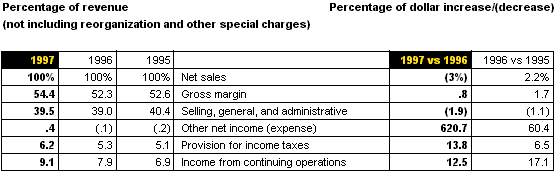
The segment results discussed below reflect results from continuing operations, excluding the above mentioned reorganization and other special charges. Net sales - Net sales for the Company in 1997 decreased 3.0% from 1996. Net sales for the Deluxe Financial Services segment increased 4.7% to $1,543.3 million in 1997. The majority of the increase came from higher collection service volume. Additionally, volume from both financial institution and direct mail check offerings increased. These increases were partially offset by competitive pricing pressures on financial institution check printing products. The Deluxe Electronic Payment Systems segment experienced a sales increase of 10.5% to $143.6 million in 1997, mostly due to increased volumes in financial institution ATM processing and electronic benefits transfer. These sales increases at the Deluxe Electronic Payment Systems and the Deluxe Financial Services segments were offset by a 38.1% decrease to $232.5 million at the Deluxe Direct segment. This decrease was the result of the continuation of actions initiated in 1996 to increase the profitability of the segment. Such actions included sales of businesses within the segment, reduced catalog circulation, and the elimination of unprofitable product lines. Additionally, response rates for the direct mail businesses declined from 1996. Excluding the impact of the lost revenues from divestitures, the Company’s consolidated net sales increased 3.5% from 1996. In 1996, net sales for the Company increased 2.2% over 1995. Net sales for the Deluxe Financial Services segment increased 7.3% to $1,474.2 million. The majority of the increase came from increased sales of higher priced products in the financial institution check printing business and increased volume from direct mail checks. Additionally, collection service revenue increased due to acquisitions and increased sales volume. The Deluxe Electronic Payment Systems segment experienced a sales increase of 4.3% to $129.9 million in 1996, primarily due to increased volume in financial institution ATM processing. These sales increases were partially offset by a 14.2% decrease to $375.5 million for the Deluxe Direct segment. This decrease was the result of actions taken to increase the profitability of the segment, including sales of businesses, reduced catalog circulation, and the elimination of unprofitable product lines. Gross margin - Consolidated gross margin for the Company was 54.0% in 1997, compared to 50.3% and 51.7% in 1996 and 1995, respectively. With the reorganization and other special charges excluded, consolidated gross margin for the Company was 54.4% in 1997, compared to 52.3% and 52.6% in 1996 and 1995, respectively. The Deluxe Financial Services segment’s gross margin increased to 58.1% in 1997 from 56.7% in 1996. The competitive pricing pressures experienced by the financial institution check printing business were more than offset by improved product mix and production efficiencies within this business, as well as reduced employee benefits costs due to a revision of the employee benefits program. Gross margin for the Deluxe Electronic Payment Systems segment increased to 19.0% in 1997 from 15.2% in 1996, due primarily to decreased consulting expenses and other cost containment initiatives. The Deluxe Direct segment’s gross margin increased to 51.8% from 48.0% in 1996, due to better cost control and inventory management within the direct mail businesses and the sale of businesses with poorer margins. The Deluxe Financial Services segment’s gross margin was flat at 56.7% in 1996 and 56.8% in 1995. The gross margin for the Deluxe Electronic Payment Systems segment decreased to 15.2% in 1996 from 34.6% in 1995, due primarily to higher computer equipment rent expense, costs of infrastructure upgrades and software re-engineering, and higher telecommunication expense. Gross margin for the Deluxe Direct segment increased to 48.0% from 44.3% in 1995, due primarily to the sale of businesses with poorer margins, better cost containment and inventory management, and consolidation of products within the direct mail businesses. Selling, general, and administrative - Selling, general, and administrative (SG&A) expenses for the Company were flat in 1997 compared to 1996. With the reorganization and other special charges discussed above excluded, SG&A expenses decreased $14.6 million, or 1.9%, in 1997. The Deluxe Financial Services segment’s SG&A expenses increased 8.7% due primarily to financial institution check printing SG&A, which increased due to higher customer service call center volume and duplicate costs from maintaining an old customer service system as a new system was implemented. Although customer service call volume increased on an annual basis, call volume did decrease in the fourth quarter of 1997 as compared to the fourth quarter of 1996. During this time, the Company began charging customers for orders placed via telephone as opposed to electronic channels. Additionally, SG&A expenses increased within the collections, direct marketing and customer database management businesses as a result of growth. The Deluxe Electronic Payment Systems segment’s SG&A expenses increased 10.4% due to legal expenses and human resources initiatives. The Deluxe Direct segment’s SG&A expenses decreased 34.2% mainly due to the cessation of depreciation and amortization of the assets of the businesses held for sale, as well as reduced catalog costs due to simplified catalog designs and lower paper costs. In 1996, SG&A expenses for the Company decreased $20.2 million, or 2.5%. With the reorganization and other special charges discussed above excluded, SG&A expenses decreased $8.9 million, or 1.1%, in 1996. The Deluxe Financial Services segment’s SG&A expenses increased 5.4%, primarily in the financial institution check printing business, due to increased customer service call center volume and higher marketing expenditures for new products. The Deluxe Electronic Payment Systems segment’s SG&A expenses decreased 8.0% due to lower consulting expenses. The Deluxe Direct segment’s SG&A expenses decreased 14.8%, mainly due to planned catalog circulation decreases by the segment’s direct mail businesses. Other income (expense) - Other expense for the Company was $40.6 million in 1997, compared to other income of $31.7 million in 1996 and other expense of $14.5 million in 1995. These changes were primarily due to the reorganization and other special charges discussed above. With these charges removed, other income was $9.2 million in 1997, compared to other expense of $1.8 million and $4.5 million in 1996 and 1995, respectively. The improvement in 1997 is due to gains realized from the sale of check printing facilities and increased investment earnings resulting from the investment of cash obtained through divestitures. The decrease in expense from 1995 to 1996 is due primarily to lower interest expense as a result of decreased borrowings. Provision for income taxes - The Company’s effective tax rate increased to 61.2% in 1997 from 44.9% in 1996 and 44.2% in 1995, due primarily to lower pretax income combined with an increasing base of non-deductible expenses consisting primarily of the non-deductible goodwill impairment charge recorded by the Company. In 1996, the effect of the goodwill impairment charge was offset by tax benefits recognized for the sales of businesses and businesses held for sale. With the effect of the reorganization and other special charges removed in each year, the Company’s tax rate was 40.5%, 40.2%, and 42.5% in 1997, 1996, and 1995, respectively. The decrease in the 1996 rate from 1995 is due to an increase in adjusted pretax income, while the base of non-deductible expenses remained constant. Net income - 1997 net income decreased to $44.7 million from $65.5 million in 1996. The primary reason for the decrease was the higher amount of reorganization and other special charges discussed above. With the charges and their related tax effects removed, the Company’s net income was $175.6 million and $156 million in 1997 and 1996, respectively. 1996 net income decreased to $65.5 million from $87 million in 1995. The primary reason for the decrease was the higher amount of reorganization and other special charges discussed above. With the charges and their related tax effects removed, the Company had income from continuing operations of $156 million and $133.2 million in 1996 and 1995, respectively. Financial Condition Capital resources - In 1997, the Company made one business acquisition and several divestitures from which the Company derived $1.1 million in net cash proceeds. In 1996, the Company made numerous business acquisitions and divestitures from which the Company derived $98.1 million in net cash proceeds. In 1995, the Company made one acquisition at a cost of $38.8 million. Cash purchases of capital assets were $109.5 million in 1997, compared to $92 million in 1996 and $125.1 million in 1995. The Company anticipates capital expenditures of approximately $150 million in 1998 mainly for information technology systems upgrades and replacement as well as for productivity improvements. The Company has uncommitted bank lines of credit for $170 million. The average amount drawn on those lines during 1997 was $3.1 million at a weighted average interest rate of 6.47%. There was no outstanding balance at December 31, 1997. At December 31, 1996, $17 million was outstanding at an interest rate of 6.5%. The Company also has in place a $150 million committed line of credit as support for commercial paper and as a source of cash. No commercial paper was outstanding at December 31, 1997 and 1996. Additionally, the Company has a shelf registration in place for the issuance of up to $300 million in medium-term notes. Such notes could be used for general corporate purposes, including working capital, capital expenditures, acquisitions, and repayment or repurchase of outstanding indebtedness and other securities of the Company. As of December 31, 1997 and 1996, no such notes were issued or outstanding. Cash dividends totaled $121.3 million in 1997, compared to $122 million in 1996 and $122.1 million in 1995. Dividend payments were 271.6% of earnings in 1997, 186.3% in 1996, and 140.4% in 1995. In December 1996, the Company’s board of directors amended the Company’s stock repurchase plan to permit the repurchase of up to 10 million shares of Deluxe common stock. The board also approved the repurchase of up to 5 million of the 10 million approved shares under this plan. The Company repurchased 1.7 million shares in 1997. Year 2000 - In 1996, the Company initiated a companywide program to prepare its computer systems and applications for the year 2000. During 1997, the Company identified the systems affected, determined a resolution strategy for each affected system, and began executing these resolution strategies. The Company expects either to modify or upgrade existing systems or replace some systems through other development projects. The Company expects to incur expense of $17 million over the next two years, consisting of both internal staff costs and consulting expenses, as it continues to implement its resolution strategy. Because of the nature of the Company’s business, the year 2000 issue would, if unaddressed, pose a significant business risk for the Company. The Company presently believes that with the planned modifications to existing systems and the replacement of other systems, the year 2000 compliance issue will be resolved in a timely manner and will not pose significant operational problems for the Company. Additionally, the Company has communicated with its suppliers and customers to determine their year 2000 readiness and the extent to which the Company is vulnerable to any third party year 2000 issues. However, there can be no guarantee that the systems of other companies upon which the Company’s systems rely will be converted timely, or that a failure to convert by another company, or a conversion that is incompatible with the Company’s systems, would not have a material adverse effect on the Company. Outlook - In 1998, the Company will continue its efforts to reduce costs and improve productivity throughout the organization. At the same time, the Company will continue to invest in major infrastructure improvements. The Company also expects to complete a divestiture program by selling the two remaining non-strategic businesses in the Deluxe Direct segment and the international operations of the Deluxe Electronic Payment Systems segment. With the major components of its reorganization nearing completion, the Company is now better positioned for growth. Its improved cash position, low debt, and available financing create the opportunity for the Company to enhance its products and services through internal developments and external alliances, partnerships, and acquisitions that are within its strategic focus. The Company’s ongoing changes related to organizational improvements and growth opportunities may require additional charges to earnings. These charges, however, should lessen as the Company completes its reorganization and focuses on its growth opportunities. |