|
|
 |
|
Page 24 of 56 < Previous Next > |
|
|
|||
|
OPERATING SEGMENT PERFORMANCE Our operating segments have similar products and services and we are organized to manage our operations geographically. Our operating segments have been aggregated into three reportable segments: United States Cleaning & Sanitizing, United States Other Services and International. We evaluate the performance of our International operations based on fixed management rates of currency exchange. Therefore, International sales and operating income totals, as well as the International financial information included in this financial discussion, are based on translation into U.S. dollars at the fixed currency exchange rates used by management for 2004. All other accounting policies of the reportable segments are consistent with accounting principles generally accepted in the United States of America and the accounting policies of the company described in Note 2 of the notes to consolidated financial statements. Additional information about our reportable segments is included in Note 16 of the notes to consolidated financial statements. Sales by Operating Segment
The following chart presents the comparative percentage change in net sales for each of our operating segments for 2004 and 2003. Sales Growth Information
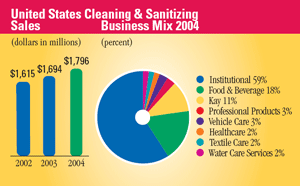
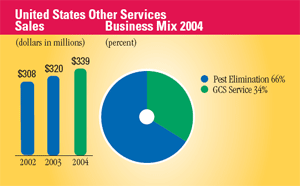
Sales of our United States Cleaning & Sanitizing operations were $1.8 billion in 2004 and increased 6 percent over net sales of $1.7 billion in 2003. Excluding acquisitions and divestitures, sales increased 5 percent in 2004. Sales benefited from double-digit growth in our Kay division, along with good growth in our Institutional division. This sales performance reflects increased account retention through enhanced service, new product and program initiatives and aggressive new account sales efforts. Institutional results include sales increases in all end markets, including restaurant, lodging, healthcare, travel and government markets. Kay's double-digit sales increase over 2003 was led by strong gains in sales to its core quickservice customers and in its food retail services business. New customers, better account penetration, new products and programs and more effective field sales coverage contributed to this sales increase. Textile Care sales increased this year, driven by a significant corporate account gain made early in the year and improved account retention. Professional Products sales, excluding the VIC acquisition, decreased 18 percent as sales growth in corporate accounts was more than offset by the planned phase down of the janitorial equipment distribution business and weak distributor sales. Sales in our Healthcare division were driven by strong growth in instrument care solids and skincare products which were partially offset by the exit of a private label product line. Food & Beverage sales, excluding the benefits of the Alcide acquisition, increased 5 percent primarily due to improved retention and corporate account growth in sales to the dairy, soft drink and agri markets. Water Care had good sales growth in the dairy, canning, meat and food processing markets. Our "Circle the Customer" strategy continues to produce new account gains as our Water Care division works with our Food & Beverage and Healthcare divisions to drive its sales growth. Vehicle Care sales declined due to bad weather, the impact of higher fuel prices on customer purchase decisions and the sale of retail gas stations by major oil companies to smaller franchises, which correspondingly affects distributor sales. Sales of our United States Other Services operations increased 6 percent to $339 million in 2004, from $320 million in 2003. Pest Elimination sales increased with good growth in both core pest elimination contract and noncontract services, such as bird work, the Stealth fly program, one-shot services and its food safety audit business. GCS Service sales decreased slightly in 2004, however, sales grew in the second half of the year as a result of an increase in direct parts revenue.
Operating Income by Operating Segment
Operating income of our United States Cleaning & Sanitizing operations was $290 million in 2004, an increase of 2 percent from operating income of $285 million in 2003. As a percentage of net sales, operating income decreased from 16.8 percent in 2003 to 16.2 percent in 2004. Excluding acquisitions and divestitures, operating income declined 1 percent from 2003 and the operating income margin also declined from 17.2 percent in 2003 to 16.2 percent in 2004. This decline is primarily due to investments in the sales-and-service force, research and development, information technology, higher incentive-based compensation costs and higher delivered product cost. This was partially offset by favorable business mix and cost efficiency improvements. The number of sales-and service associates in our United States Cleaning & Sanitizing operations declined by 60 people in 2004, as the addition of 190 new associates was offset by a decrease of 250 people due to the divestiture of our grease management product line. Operating income of United States Other Services operations increased 16 percent to $24 million in 2004. The operating income margin for United States Other Services increased to 7.2 percent in 2004 from 6.6 percent in 2003. Pest Elimination had strong operating income growth, while GCS Service results reflected a slightly higher operating loss. The increase in operating income for Pest Elimination was driven by increased sales volume, lower product cost and general expense controls. GCS Service results reflected an operating loss due to a decline in sales, increased marketing expenses and higher than expected costs resulting from centralizing the parts and administration activities. During 2004, we added 15 sales-and-service associates to our United States Other Services operations. This is net of a decrease in GCS Service technicians. Management-rate based operating income of International operations rose 12 percent to $211 million in 2004 from operating income of $188 million in 2003. The International operating income margin increased from 10.5 percent in 2003 to 10.9 percent in 2004. Excluding the impact of acquisitions and divestitures occurring in 2004 and 2003, operating income increased 8 percent over 2003, and the International operating income margin increased from 10.4 percent in 2003 to 10.8 percent in 2004. This result was due to good operating income growth and margin improvement across all of our international regions. Both higher sales and careful cost management drove this achievement. We added 640 sales-and-service associates to our International operations during 2004, reflecting our investment in our core business and the impact of acquisitions. Operating income margins of our International operations are less than those realized for our U.S. operations. The lower International margins are due to (i) the additional costs caused by the difference in scale of International operations where many operating locations are smaller in size, (ii) the additional cost of operating in numerous and diverse foreign jurisdictions and (iii) higher costs of importing raw materials and finished goods. Proportionately larger investments in sales, technical support and administrative personnel are also necessary in order to facilitate the growth of our International operations. 2003 compared with 2002 Sales of our United States Cleaning & Sanitizing operations were $1.7 billion in 2003 and increased 5 percent over net sales of $1.6 billion in 2002. Business acquisitions had no effect on the growth in sales for 2003. Sales benefited from good growth in our Kay and Professional Products operations, partially offset by lower sales in Textile Care. The increase in our Institutional division reflected our continued efforts to generate new accounts, the successful introduction of new products and improved customer service. Trends in the foodservice, hospitality and healthcare industries were challenging in early 2003 but showed signs of improvement late in the year. Kay's sales increase reflected solid growth in its food retail services business and to quickservice restaurants as well as through the introduction of new products and programs. Textile Care sales decreased, particularly to distributors, due to soft industry demand and strong competition within the industry. Textile Care focused on improving its service and reestablishing its relationships with distributors in an effort to increase sales growth. Textile Care also continued to take a selective approach to new business to ensure it meets our profit guidelines. Sales of Professional Products increased due to strong gains in the healthcare market offsetting the continuing phase-out of the specialty business. Our introduction of the first solid-based product offering to the acute care market in the second quarter of 2003 helped drive the sales growth in the healthcare market. Professional Products' janitorial sales were also positively impacted in 2003 by a long-term supply agreement that began in December 2002. Effective January 2004, our Professional Products division was reorganized to better serve janitorial and healthcare customers by splitting the Professional Products division into two divisions, Professional Products and Healthcare. Our Food & Beverage sales were driven by improved retention and corporate account growth in the dairy, soft drink, meat and poultry and food markets. This increase was partially offset by a decrease in agricultural sales due to overall market weakness. Water Care Services had good growth in sales to the food and beverage, hospitality, healthcare and commercial accounts due to solid gains in new customer accounts. Vehicle Care sales were driven by new business with major oil companies and successful new product introductions. Sales of our United States Other Services operations increased 4 percent to $320 million in 2003, from $308 million in 2002. Business acquisitions had no effect on the growth in sales for 2003. Pest Elimination's sales in 2003 reflected strong growth in both contract sales, due to the addition of new large accounts, and non-contract services, due to the aggressive efforts of the sales force. GCS Service sales decreased in 2003 due to service interruptions caused by the restructuring of field operations and the transition to a new centralized administration center, which began operation in 2003. In an effort to increase sales going forward, GCS Service implemented productivity improvement measures in the fourth quarter of 2003. Management rate sales for our International segment were $1.8 billion for 2003, an increase of 2 percent over sales in 2002. Excluding the effects of acquisitions and divestitures, sales increased 1 percent. Sales in Europe, excluding the effects of acquisitions and divestitures, decreased 1 percent. Successful new housekeeping and Ecotemp programs were offset by a weak European economy and strong competition. We focused on expanding our Pest Elimination business in Europe through acquisitions such as the Terminix operations in the United Kingdom, which was purchased in December 2002, and Nigiko with operations in France, acquired in January 2004. We expect to leverage the success of this business in the United States to become a global provider of pest elimination services. The increase in Asia Pacific was driven by Japan, New Zealand and Northeast Asia. In Japan, sales to chain restaurants and resort hotel customers improved and New Zealand showed strong growth in its pest elimination services business. In Northeast Asia, Korea's growth was propelled by strong Institutional sales while China experienced excellent growth in its Food & Beverage sales. Good growth in these areas was partially offset by a sales decline in Australia due to soft Food & Beverage and Water Care business. Sales in Latin America, excluding acquisitions, grew 6 percent in 2003 and most Latin America countries experienced good growth except Venezuela, where a country-wide strike at the beginning of 2003 resulted in virtually no sales for the first two fiscal months of 2003. Mexico, the Caribbean and Central America all had double-digit sales growth in 2003. Growth in Latin America was fueled by good growth in food retail programs, a demand for improved sanitation and expansion of pest elimination services. Sales in Canada increased due to continued focus on obtaining new customers and selling additional solutions to existing customers, partially offset by the impact of the Severe Acute Respiratory Syndrome (SARS) outbreak in Canada. Operating income of our United States Cleaning & Sanitizing operations increased 5 percent in 2003. Operating income as a percent of sales remained the same in 2003 as 2002 due to the investments in developing the sales force and higher operating costs being offset by cost savings initiatives. We added 100 sales-and-service associates to our United States Cleaning & Sanitizing operations during 2003. Operating income of United States Other Services operations decreased 36 percent. As a percentage of net sales, operating income decreased significantly as well. Pest Elimination had strong operating income growth, while GCS Service results reflected an operating loss. Strong growth in both contract and non-contract services, coupled with tight expense control, has helped fuel Pest Elimination's growth. GCS Service results reflected an operating loss due to a decrease in sales resulting from operational issues encountered with a transition to a centralized administration center and the related costs invested in this initiative. This lost revenue adversely impacted operating income due to the relatively fixed nature of GCS Service's expenses. During 2003, we added 95 sales-and-service associates to our United States Other Services operations. Operating income of our International operations rose 14 percent in 2003 at management rates. Excluding the effects of acquisitions and divestitures, operating income increased 12 percent. Our International operating income margin also increased in 2003 over 2002. Operating income as a percent of net sales excluding acquisitions and divestitures that occurred in 2003 and 2002 was 10.8 in 2003 versus 9.8 in 2002. This result was due to good operating income growth and margin improvement in our European, Asia Pacific and Canadian businesses. Operating income growth was also good in Latin America. The primary reason for these significant improvements was the successful introduction of new products and programs as well as careful cost management. We added 80 sales-and-service associates to our International operations during 2003. Corporate Our corporate operating expenses totaled $4.4 million in 2004, compared with $4.8 million in 2003 and $46.0 million in 2002. In 2004, corporate operating expense included a charge of $1.6 million for in-process research and development as part of the acquisition of Alcide Corporation and a charge of $4.0 million related to the disposal of a grease management product line, which were partially offset by $0.9 million of income for reductions in restructuring accruals and a $0.3 million gain on the sale of a small international business. Corporate operating expense in 2003 included a writeoff of $1.7 million of goodwill related to an international business sold in 2003, $1.4 million of income for reductions in restructuring accruals and $4.5 million of expense for postretirement death benefits for retired executives. In 2002, corporate operating expense included restructuring and merger integration costs of $51.8 million, which were partially offset by a curtailment gain of $5.8 million related to benefit plan changes. Interest and Income Taxes Net interest expense of $45 million was flat when compared to interest expense in 2003 with a slight decrease in interest expense being offset by a similar decrease in interest income. Higher interest expense on our euro denominated debt due to the stronger euro was offset by lower interest expense on other notes payable. Net interest expense for 2003 was $45 million, an increase of 3 percent over net interest expense of $44 million in 2002. The increase was primarily due to our euro-denominated debt and the strength of the euro against the U.S. dollar partially offset by lower debt levels. Our effective income tax rate was 36.5 percent for 2004, compared with effective income tax rates of 38.1 percent and 39.8 percent in 2003 and 2002, respectively. Excluding the effects of special charges mentioned above in the corporate section and a $1.9 million tax benefit related to prior years, the estimated annual effective income tax rate was 36.8 percent for 2004. Excluding the effects of the gain on the sale of an equity investment and the effect of special charges, the effective income tax rate was 38.0 percent for 2003. Excluding the effects of special charges in 2002, the estimated annual effective income tax rate was 39.5 percent. Reductions in our effective income tax rates over the last two years have primarily been due to a lower overall international rate, favorable international mix and tax savings efforts. The company's acquisition of its European operations at the end of 2001 resulted in additional tax saving opportunities. |
||||||||||||||||||||||||||||||||||||||||||||||||||||||||||||||||||||||||||||||||||||||||||||||||||||||||||||||||||||||||||||||||||||||||||||||||||||||||||||||||||||||||||||||||||||||||||||||||||||||||||||||||||||||||||||||||||||||||||||||||||||||

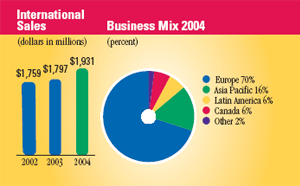 Management rate sales of our International operations reached $1.9
billion in 2004, an increase of 7 percent over sales of $1.8 billion in 2003.
Excluding acquisitions and divestitures, sales increased 4 percent for 2004.
Sales in Europe, excluding acquisitions and divestitures, were up 3 percent
primarily due to successful new product launches, increased marketing and
added sales-and-service headcount that was partially offset by the effects of a
weak European economy. Europe's Institutional division made significant
improvement over their 2003 trend, and strength in their Healthcare and Textile
Care businesses helped overcome Germany's poor economic climate and
reduced European tourism and beverage consumption. Sales in Asia Pacific,
excluding divestitures, increased 5 percent, led by good results in East Asia and
New Zealand. In Northeast Asia, China and Hong Kong led the sales increase
with strong results in both Institutional and Food & Beverage. New Zealand
sales increased over last year primarily due to growth in the Food & Beverage
business. Sales in Japan and Australia were flat versus 2003. Sales growth in
Latin America reflected good growth in all countries and was driven by the
success in new business gains in global/regional accounts, continuing to
implement the Circle the Customer growth strategy and the successful launch
of new programs such as MarketGuard and LaunderCare. Sales in Canada
increased, reflecting an improved hospitality industry and recovery from the
impact of the Severe Acute Respiratory Syndrome (SARS) outbreak in Canada in
2003.
Management rate sales of our International operations reached $1.9
billion in 2004, an increase of 7 percent over sales of $1.8 billion in 2003.
Excluding acquisitions and divestitures, sales increased 4 percent for 2004.
Sales in Europe, excluding acquisitions and divestitures, were up 3 percent
primarily due to successful new product launches, increased marketing and
added sales-and-service headcount that was partially offset by the effects of a
weak European economy. Europe's Institutional division made significant
improvement over their 2003 trend, and strength in their Healthcare and Textile
Care businesses helped overcome Germany's poor economic climate and
reduced European tourism and beverage consumption. Sales in Asia Pacific,
excluding divestitures, increased 5 percent, led by good results in East Asia and
New Zealand. In Northeast Asia, China and Hong Kong led the sales increase
with strong results in both Institutional and Food & Beverage. New Zealand
sales increased over last year primarily due to growth in the Food & Beverage
business. Sales in Japan and Australia were flat versus 2003. Sales growth in
Latin America reflected good growth in all countries and was driven by the
success in new business gains in global/regional accounts, continuing to
implement the Circle the Customer growth strategy and the successful launch
of new programs such as MarketGuard and LaunderCare. Sales in Canada
increased, reflecting an improved hospitality industry and recovery from the
impact of the Severe Acute Respiratory Syndrome (SARS) outbreak in Canada in
2003.