|
|
|
May 1, 2002
Dear Shareholder,
2001 was a disappointing year because of
extraordinary events which negatively impacted
our key businesses. We entered the year with the
British rail system in disarray due to failure of the
track provider to meet its maintenance
obligations. This was followed by a serious
accident near Selby on February 28th when an
irresponsible motorist fell asleep at the wheel and
drove off the motorway on to the East Coast Main
Line and into the path of one of our GNER high
speed trains (the driver is now serving a jail
sentence). Then came the U.K. foot-and-mouth
disease epidemic which caused the Isle of Man to
close to tourist events and seriously
reduced the number of visitors to the U.K. from
the Continent, badly affecting our ferry business
in both the Irish Sea and English Channel. The
U.K. Customs and Excise exacerbated the
problem by acting outside the law of the
European Union in harassing our ferry passengers
arriving in Dover, England when they were
exercising their legal rights to import tax paid
goods on our ferries from the Continent. We have
sued Customs & Excise for our estimated losses
arising from their actions. (They have now
'backed off ' from their most egregious behavior.)
Finally, there was September 11th which caused a
reduction in leisure profits from 2000 when we
had instead been expecting higher income. In
mid-2000 our marine container leasing business
softened in the sector of re-lease of existing units
because of the slow-down in the global economy
and this continued through the first three quarters
of 2001.
The impact of all these events was a reduction
in earnings per share compared with our 2001
budget of approximately $2.50 ($46 million less
than budget). The poor results created concerns
on the part of our banks and bondholders so they
asked us to defer the proposed spin-off of shares
in Orient-Express Hotels Ltd. to the Sea Containers
shareholders until the company restores profits
and cash flows. The price of common shares of
both Sea Containers and Orient-Express Hotels
sharply declined in the wake of September 11th,
as investors over-reacted to the situation. I'm
happy to report that the shares of both companies
have returned to pre-September 11th levels but
Sea Containers is selling at less than the value of
our shareholding in Orient-Express Hotels on its
own, which is a serious anomaly.
Sea Containers ended the year with net income
of $4.5 million or $0.24 per common share, a pale
shadow of the $44.9 million ($2.42 per common
share) reported in 2000. Revenue in 2001 was
$1.27 billion, down 7% from 2000.
Enough of 'singing the blues'. It is time we
focussed on 2002 and future years. The fourth
quarter of 2001 signalled a strong improvement in
earnings from passenger transport with operating
profits (before corporate overheads) rising 312%
over 2000's fourth quarter to $9.3 million.
Container leasing also registered its first
improvement for many quarters, showing a 253% rise after
interest to $4.6 million. Leisure is now
recovering to pre-September 11th profit levels.
|
|
|
James B. Sherwood
President and Founder |
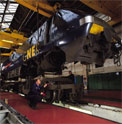
Left to right: GNER's electric
locomotive fleet is being given
a major overhaul in order to
reduce failures in service.
GNER operates 31 locomotives
on the electrified London-Leeds
and London-Newcastle-Edinburgh-
Glasgow lines.
Service extending north of
Edinburgh is provided by nine
diesel locomotive train sets. In
2001, GNER carried 13.8
million passengers compared
with 14.3 million in 2000. The
decline was due to major
network disruption in the U.K.
caused by the track provider,
Railtrack plc. GNER has a large
claim against Railtrack resulting.
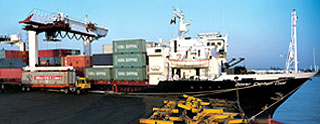
MV Boxer Captain Cook, one of the company's two container ships,
discharging in Chittagong, Bangladesh.These ships are based in Singapore
and are time chartered out for service in Asia. The charter
market declined in step with the world economy in 2001 but is
expected to improve in 2002.
|
The Swedish and Finnish governments have
passed legislation which cuts Silja's wages bill by
50% in Sweden and 25% in Finland (a majority of
Silja's ships fly the Swedish flag). We have retired
$31 million of our public debt and if we retire the
balance due in 2003 with equity raised from the
planned sale of Orient-Express Hotels common
shares our annual interest costs will drop
$16 million p.a. Approximately $200 million of
fixed rate debt will convert to floating rate in May
2002, bringing annual savings of $11 million
(assuming floating interest rates remain at current
levels). Additionally, $250 million of Euro debt
swaps mature in September 2002, saving $5 million
in a full year. We intend to increase our
shareholding in Silja in 2002 in time for the peak
season so we will consolidate more of its profits
than in 2001. Demand for new containers for long
lease at satisfactory lease rates is rising. Demand
for containers in the Sea Containers/GE Capital
pooled existing fleet has increased in Asia,
Australasia and the Middle East. SeaStreak
introduced two large passenger vessels into its
New York City ferry services in the second half of
2001 and it will be generating increased profits for
the full year 2002, as will the new containers
acquired by GE SeaCo and Sea Containers
throughout 2001. The Corinth Canal, acquired in
September 2001, has been generating above-forecast
profits since coming under our control.
The 'banana wars' caused by Chiquita Brands
have now stopped, possibly because of a change of
politics in the White House. We expect greatly
improved earnings in 2002 from our Ivory Coast
banana plantation. Profits are also rising from our
publishing business and table grape plantation in
Brazil. Taken together, all these factors are
good news for our shareholders.
Marine container leasing
In 2001 GE SeaCo purchased $81 million of new
containers and Sea Containers bought $21 million.
In 2002 I expect GE SeaCo or Sea Containers will
buy about $125 million. Sea Containers has
adopted a program of disposing of all units of
20 years of age or older not on lease.
Demand for 20ft standard height and 40ft high
cube dry cargo units is exceptionally strong at the
moment in most regions except the United States
where there is a severe trade imbalance.
GE SeaCo's refrigerated container fleet, the largest
in the world, is enjoying effective full utilization
for the 40ft high cube units and 70% for the older 20ft
and 8ft 6in height 40ft. serviceable units. Demand
for SeaCells, open tops and tanks is healthy.
Our depots and factories are all operating
profitably. One of our two containerships is
temporarily unemployed.
Passenger transport
In early 2002 we purchased a half interest in a fast
ferry for operation in our joint venture on the
Ancona-Split route and have bought the m.v. Oresund,
a large ro-pax ship, for long-term bareboat charter
to Silja. These two investments total $31 million.
An order has been placed for two more fast ferries
for SeaStreak at a cost of $12 million but delivery
will only occur in 2003. Silja is investing $6 million
in the upgrade of its m.v. Silja Opera which will
start cruises within the Baltic in June.
Leisure
Strong recovery is taking place in Orient-Express
Hotels. Other hotel operators slashed rates in the
wake of September 11th but Orient-Express
Hotels did not, at the cost of some occupancy.
The Israeli/Palestinian conflict and other terrorist
concerns may deter some U.S. resident's traveling
abroad this year, but this should benefit our North
American occupancies and since Europe is
prospering it is hoped that travel by Europeans
will replace any lost Americans.
Already this year Orient-Express Hotels has
invested $47.5 million in three acquisitions and is
spending $30 million in enlargement of existing
properties.
|
|
|
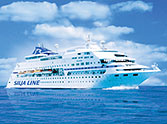
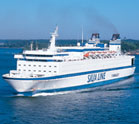
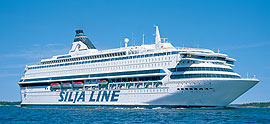
From left to right: Silja
Opera, Silja Finnjet and Silja
Europa. Silja Opera terminated
her charter in Asia early in
2002 and will commence
cruising in the Baltic in June
2002 following refit.
Silja Finnjet operates between
Helsinki, Finland, Tallinn, Estonia
and Rostock, Germany and will
be refurbished in the winter of
2002/2003.
Silja Europa
operates in winter on the Turku,
Finland-Kappelskar, Sweden
route and on the Turku-Stockholm
route in summer.
The Kappelskar service was
started in 2001 and provides a
better cruise experience than
Stockholm in the winter.
|
We need to be thinking of Sea Containers
without Orient-Express Hotels as the complete
separation of the two companies, including
spin-off of a percentage of the shares owned by
Sea Containers, is a commitment of your board.
Of the 19.3 million shares in Orient-Express Hotels
owned by Sea Containers at the end of 2001,
Sea Containers intends to sell enough to redeem
its senior notes amounting to $159.5 million falling
due in mid-2003. No further public debt falls
due until the end of 2004 and the company would
expect to refinance this debt in the public markets.
Because of the poor earnings performance of
Sea Containers in 2001, some note and debenture
holders opposed the spin-off, fearing that the
company would be unable to redeem its public
debt. Because of the poor earnings the company's
corporate credit rating was downgraded by Standard
& Poors on December 3, 2001 from BB+ to BB.
Although clearly the company had the right to
complete the spin-off, your board felt it was unwise
to proceed until solid earnings were re-established.
Thus, we announced that the spin-off would be
reconsidered late in 2002 when our current year's
performance was an accomplished fact.
One of the bizarre anomalies of the market
in your company's shares is that the value of
the Orient-Express Hotels shares is alone
more than the current market capitalization
of Sea Containers, giving in effect negative
value to Silja, GNER, Steam Packet,
Hoverspeed, SeaStreak, GE SeaCo, Corinth
Canal, plantations and the company's
valuable property holdings in the Isle of Man,
Newhaven and elsewhere, net of outstanding
debt. The current market value of our Orient-Express
Hotels shareholding is $384 million
or $21 per Sea Containers common share.
At December 31, 2001 the book value of
Sea Containers excluding our shareholding in
Orient-Express Hotels was $234 million or
$13 per common share. These amounts total
$34 per common share compared with a
current market price of $18. We would argue
that book value seriously understates fair
market value.
|
|
|
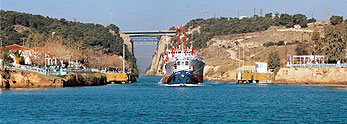
From left to right: The company acquired a 40-year
concession in September, 2001 to operate and
develop the Corinth Canal in Greece along
with adjacent property. Shown here is a cargo
ship exiting the northern end of the canal on
its way to Piraeus, Greece’s main seaport a
short distance away. At the top of the photo
can be seen the motorway and railway
bridges that cross the canal, constituting the
only land bridge between mainland Greece
and the Peloponnisos. The company plans to
build a mixed-use leisure facility on the land
shown left, including a marina.
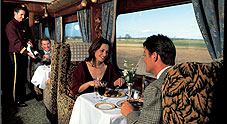
Orient-Express Hotels
introduced a second tourist
train in the U.K. to meet
frustrated demand. This train is
called the Northern Belle and
provides charter and
excursion trips north of London,
while the other U.K. tourist
train, the British Pullman,
operates south and west of
London. Shown here is a typical
car of the new train. Chatsworth,
the stately home of the Dukes
of Devonshire in Derbyshire, is
a frequent day trip excursion
destination for the Northern
Belle.
|
Property, plantations and publishing
The company is moving ahead with its plans to
build the largest office building in the Isle of Man
on Steam Packet owned property. Its marina and
bulk handling facilities in Newhaven are highly
profitable, particularly since the less profitable
part of the Port of Newhaven was sold in 2001.
The banana wars seem to be over and the
company's Ivory Coast plantation is once again
achieving high profitability. Seedless grape
production from the plantation in Brazil should
ensure excellent profitability from that activity in
2002. The Corinth Canal has consistently
exceeded its profit forecast and should be
contributing more than $1 million to net income
in 2002. Publishing was profitable in 2001 and is
expected to be more so in 2002.
Finance
The company refinanced the Isle of Man Steam
Packet Company in April 2002 through a
securitization costing 8.3% p.a., releasing $45 million
of funds which will be used for debt retirement
and additional investment in Silja. At December
31, 2001 the company had cash and unused credit
lines (excluding those of Orient-Express Hotels)
of $202 million. Cash flow from operations, net new
borrowing and asset sales in 2001 was $76 million
(excluding Orient-Express Hotels). Cash flow in
2002 should be particularly strong from the
planned sale of shares in Orient-Express Hotels
combined with higher net income from container
leasing and passenger transport.
The company has a large claim against Railtrack
plc for revenue and other losses due to gauge
corner cracking, flooding, delay in reopening of
Leeds Station, the Selby rail accident, and other
matters. We have provided for less than the full
claim in our accounts but we think it is valid for
the entire amount. We have withheld the entire
amount from track access and other charges
payable to Railtrack. GNER will seek an out-of-court
settlement with Railtrack but not at less
than the amount provided. We express our sorrow
to the relatives of the ten persons killed in the
Selby rail accident, including three GNER staff, as
well as to those injured.
Brian Bennett retired in 2001 from the position
of Vice President - Sales and Marketing of GE SeaCo
and was replaced by Ian Routledge, formerly
Regional Manager, Australasia. Robert Alagna
replaced Ian. Luis Freitas replaced Toby Grey as
Regional Manager, South America. Adrian Constant
replaced Jean Foerster as Vice President - Europe
and Asia of Orient-Express Hotels. Steven
Robson was appointed Chief Financial Officer of
Silja. Duncan Scott was appointed deputy to
Stephen O. Whittam, Vice President,
Management Information Systems who retired
early in 2002 and Angus Frew was appointed
deputy to Robert S. Ward, Senior Vice President,
Containers, who also retires in 2002. Guy N. Sanders
joined as Vice President - Funding, North America
during 2001.
We thank all those who have left and welcome
those who have joined. Our management team is
stronger than ever.
I hope I have passed on to you my optimism for
your company's 2002 and future years' prospects.
I feel that the adversities of 2001 were mostly
extraordinary in nature and hopefully will not be
repeated.
Sincerely,

James B. Sherwood President and Founder
|
|
|
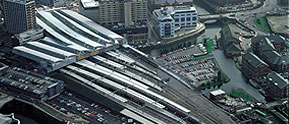
From left to right:A GNER train leaves Leeds station for
London. This station has been rebuilt by the
rail infrastructure provider, Railtrack plc, which
unfortunately has gone into a form of
bankruptcy due to overspends on this and
other projects. The U.K. government plans to
re-nationalize Railtrack sometime in 2002.
GNER will introduce new train sets on the
London-Leeds route in 2002, which have been
leased from Eurostar U.K. Ltd., bringing
departures to half-hourly in both directions
through most of the day.
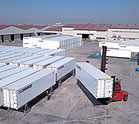
40ft high cube refrigerated containers at
the Maersk Container Industri Qingdao Ltd. factory
in Qingdao, China. Demand for new containers of
this type exceeded GE SeaCo’s purchases in 2001
and is expected to be strong again in 2002.
Many lessees are phasing out their old, central
plant, blown-air containers and replacing them with
integral refrigeration machine units such as those
shown here. Furthermore, there is a trend away
from carriage of perishable cargoes in pallet ships
in favor of integral refrigerated containers. Many
of the company’s lessees have introduced much
larger vessels with increased installed electric power
able to accommodate the containers.
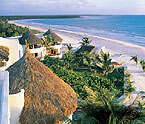
Orient-Express Hotels
acquired a 75% shareholding
in the Maroma Resort & Spa
on Mexico's Mayan Riviera
early in 2002. Maroma Bay is
about a 30-minute drive south
of Cancún Airport on the
Yucatán Peninsula. It faces the
island of Cozumel. The
Cozumel Reef is considered
one of the best diving and
snorkelling areas in the world.
The sand on the hotel's beach
is like white talcum powder.
The ruins of ancient Tulum are
a short distance away.
Orient-Express Hotels has also
acquired La Residencia in
Mallorca, Spain and Le Manoir
aux Quat'Saisons in
Oxfordshire, England at the
beginning of 2002, bringing its
portfolio to 41 properties in 16
countries.
|
|