Management’s Discussion and
Analysis of Financial Condition

Overview

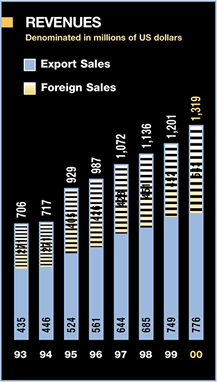
Vitro S.A. de C.V. is a diversified glass and household products manufacturer with a leading share in Mexico’s flat glass, glass containers, glassware and household appliance markets. It has a strong international presence through exports to approximately 70 countries and sales from operating subsidiaries in North, Central and South America. In 2000, 46% of the company’s consolidated revenues were generated outside of Mexico. Close to 70% of Vitro’s 2000 net sales were either denominated in or linked to the U.S. dollar. Eleven long-standing joint ventures with world-class partners and industry leaders, such as Pilkington, Ford, Solutia, Whirlpool, Libbey, Kimble Glass and Rexam, give the company access to state-of-the-art technology and important international distribution channels.

Financial Position

To strengthen our financial structure we look to: (1) Expand our average debt life and continue to improve our liquidity to support the growth of our three core strategic businesses, and (2) Reduce debt through the divestiture of non-strategic and non-operating assets. Nevertheless, we recognize that our debt levels may rise as a result of the timing of specific asset sales, investments in our core businesses and cash flow generation. With this in mind, our debt management objectives are to:

Keep the ratio of long-term debt to total debt above 70%
Maintain our diversified funding sources
Constantly pursue a reduction in our weighted average cost of debt
Incur debt mainly at our operating companies (with holding company debt linked to specific operating company projects)

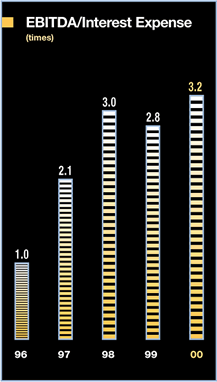
In 2000 management reduced interest expenses by a total of Ps. 515 million (US$31 million), bringing the average cost of Vitro’s debt to 10.3%. Seventy-four percent of the company’s debt is long-term. The average life of Vitro’s debt is 3.1 years and no debt in the international public markets matures until year 2002. The company’s debt-to-EBITDA ratio was 2.9 times, versus 2.6 times in 1999, while the EBITDA to interest expense ratio, was 3.2 times, an improvement from 2.8 times in 1999.
2000 Consolidated Results

Increased sales in Vitro’s three strategic core businesses, Flat Glass, Acros Whirlpool and Glassware, partially countered the effect of the strong peso (year-over-year depreciation of 1.2% versus inflation of 9%), increased domestic price competition in certain business units and product substitution. EBITDA decreased 13.3% in constant pesos, 4.8% in U.S. dollars, as a result of price increases in natural gas and certain packaging materials, continued price competition, the impact of a strong Mexican peso on export sales margins and the consolidated sales of the most dollar exposed business units (Flat Glass and Diverse Industries), and additional SG&A expenses mainly from the consolidation of Harding Glass. For the year, non-cash items countered Vitro’s lower net financial expenses and taxes, ultimately producing net income of Ps. 813 million (US$85 million).

Sales

Additional sales from the Harding Glass acquisition, strong demand in the household appliances industry, and increased revenue from Libbey’s 1999 transfer of part of its Canadian glassware production drove increased sales at our core Flat Glass, Acros Whirlpool and Glassware businesses. The Glass Container unit remained relatively stable year-over-year despite lost sales from a vertically integrated customer and a slowdown at its Central American subsidiary. Overall, 2000 consolidated sales were Ps. 28 billion (US$2.9 billion), a 0.3% year-over-year increase in constant pesos and an 8.7% rise in dollar terms.

EBITDA

For the year, Vitro’s subsidiaries generated total EBITDA of Ps. 5.5 billion (US$558 million), a 13.3% year-over-year drop in constant pesos and a 4.8% decline in dollar terms. This decrease resulted from increased prices of natural gas and certain packaging materials, continued price competition, the impact of the strong Mexican peso on export sales (approximately 70% of Vitro’s sales are directly or indirectly linked to the U.S. dollar, with Flat Glass and Diverse Industries having the largest exposures of 87% and 85%, respectively) and higher SG&A expenses primarily due to the consolidation of Harding Glass.

Financial Expenses

The decrease in financial expenses was due to lower interest rates on Vitro’s peso denominated debt. The company’s weighted average interest cost declined to 10.3%, versus 11.5% for 1999. Because of the Mexican peso’s depreciation and lower inflation, Vitro recorded an exchange loss and lower gain from monetary position that resulted in a total financing cost of Ps. 1,153 million (US$114 million), compared to Ps. 319 million (US$30 million) a year ago, mainly due to non-cash items.

Capital Expenditures

Capital expenditures amounted to Ps. 1.4 billion (US$141 million), including the Harding Glass acquisition in April 2000, versus Ps. 1.8 billion (US$167 million) in 1999.

Taxes

Taxes declined year-over-year as a result of the pension plan funding, the corporate reorganization of the Glass Containers
and Flat Glass business units (to improve costumer service and reduce administrative cost), and the implementation of the provisions from new Bulletin D-4.

Earnings

Net majority income was Ps. 339 million (US$36 million), mainly as a result of higher financing costs due to an
(non-cash) exchange loss. Earnings per share on a weighted average basis were Ps. 1.22 or US$0.39 per ADR, versus earnings per share of Ps. 2.25
or US$0.70 per ADR in 1999.

Key Developments

Planned Divestitures

During 2000, the company sold an injection molded plastic production line for US$7.1 million. Additionally, Vitro sold real estate for US$16 million. This brings the total amount of management’s planned divestitures (announced in 1999) to US$39.6 million, including the sale of the silicates operation (US$9.9 million) and COMADEVI (US$6.6 million) at the end
of 1999.

Enron Supply Agreement

Vitro signed an electrical supply agreement with Enron de México, a subsidiary of Enron Corporation. Under this agreement, Enron will own, develop and operate a 245-megawatt power plant in the Monterrey, Mexico metropolitan area. The plant, the first large-scale cogeneration plant of its kind in Mexico, will supply power to at least 12 of Vitro’s plants throughout the country and provide steam to Industria del Álcali, S.A. de C.V., a Vitro subsidiary. The plant will begin operations during the first half of 2002.

Harding Glass Acquisition

On April 14, 2000, Vitro announced that its U.S. subsidiary, VVP America, Inc., signed a definitive agreement with SunSource Inc. to purchase its Harding Glass, Inc. subsidiary. Consistent with Vitro’s strategy to grow its core strategic businesses, the Harding Glass acquisition complements Vitro’s successful VVP America subsidiary.

IBM Framework Agreement

On February 11, 2000, Vitro signed a framework agreement with IBM, setting forth the guidelines that both companies will follow to enhance Vitro’s business platform through greater use of electronic commerce and Internet applications. The implementation of the principles set forth in the framework agreement has partially allowed Vitro to align its businesses with the Internet’s new global trends.

Share Repurchase Program

During 2000 Vitro undertook a share repurchase program that was authorized by the Board of Directors on March 31, 2000. As of December 31, 2000 the balance of repurchased shares held in Treasury was approximately 25.6 million. Additionally and pursuant to the Board’s resolution, approximately 8.8 million shares were transferred during the fourth quarter from Treasury to the newly created pension plan trust.

Employees’ Stock Option Trust

To fund the employees’ pension plan, the employees’ Stock Option Trust sold 30.5 million shares to the pension trust. At year-end, the Stock Option Trust held approximately 1.8 million shares.

Pension Plan Funding

Pursuant to a resolution by the Board on August 2000, the company started funding the employees’ pension plan, creating a trust for that effect. On December 31, 2000, the trust had 39.2 million Vitro shares with a market value of Ps. 294 million and Ps. 144 million in cash, which is invested in Mexican government bonds in accordance with Mexican law.