|
|

|
Notes to Consolidated Financial Statements
Yellow Corporation and Subsidiaries |
|
|
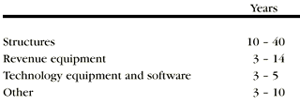
Principles of Consolidation and Summary of Accounting Policies The accompanying consolidated financial statements include the accounts of Yellow Corporation and its wholly-owned subsidiaries (the company). All significant intercompany accounts and transactions have been eliminated in consolidation. Management makes estimates and assumptions which affect the amounts reported in the financial statements and footnotes. Actual results could differ from those estimates. The company provides transportation services primarily to the less-than-truckload (LTL) market throughout North America. Principal operating subsidiaries are Yellow Freight System, Inc. (Yellow Freight), Saia Motor Freight Line, Inc. (Saia), Jevic Transportation, Inc. (Jevic), WestEx, Inc. (WestEx), and Action Express, Inc. (Action Express). Major accounting policies and practices used in the preparation of the accompanying financial statements not covered in other notes to consolidated financial statements are as follows: • Cash includes demand deposits and highly liquid investments purchased with original maturities of three months or less. All other investments, with maturities less than one year, are classified as short-term investments and are stated at cost which approximates market. • Fuel is carried at average cost. The company primarily uses heating oil financial instruments to manage a portion of its exposure to fluctuating diesel prices. Under the agreements the company receives or makes payments based on the difference between a fixed and a variable price for heating oil. These agreements provide protection from rising fuel prices, but limit the ability to benefit from price decreases below the purchase price of the agreements. At December 31, 1999, the company had agreements for 40.7 million gallons at a cost averaging $.46 per gallon over the next 7 months, representing 44 percent of total anticipated fuel usage over the contract period. At December 31, 1998, the company had agreements on 163.8 million gallons at a cost averaging $.47 per gallon representing 75 percent of total anticipated fuel usage over the contract period. Based on quoted market prices, the fair value of the swaps and fixed purchase contracts was $6.7 million above and $14.1 million below its purchase price at December 31, 1999 and 1998. Gains and losses on the agreements are recognized as a component of fuel expense when the corresponding fuel is purchased. Hedge instruments are recorded at cost in fuel and operating supplies. This accounting is used for instruments designated as a hedge of anticipated fuel transactions. The effectiveness of the hedge is periodically evaluated. If the hedge is not highly effective or if the anticipated transaction is subsequently determined unlikely to occur, the unrealized gains and or losses accumulated are recognized immediately in earnings. • The company has interest rate contracts with notional amounts totaling $13.7 million at December 31, 1999 to hedge a portion of its exposure to variable rate debt. There were no material unrealized gains or losses at December 31, 1999. These interest rate contracts were acquired in connection with the Jevic acquisition. The company had no interest rate contracts at December 31, 1998. The differentials to be received or paid under contracts designated as hedges are recognized as adjustments to interest expense over the life of the contract. • The Financial Accounting Standards Board (FASB) issued Statement No. 133, Accounting For Derivative Instruments and Hedging Activities subsequently amended by FASB Statement No. 137 that will be effective for the company’s fiscal year ended December 31,2001. This statement establishes accounting and reporting standards requiring all derivative instruments to be recorded in the balance sheet at their fair value. The statement requires changes in a derivatives fair value to be recognized currently in earnings, except for special qualifying hedges for which gains and losses may offset the hedged item in the income statement. The company does not believe the impact of adoption of statement No. 133 will be material to results of operations or financial position. • Property and equipment are carried at cost less accumulated depreciation. Depreciation is computed using the straight-line method based on the following service lives:
|
|
 |
|