 |
 |

|
|
Debt
and Financing |
|
At December
31, debt consisted of the following in (thousands):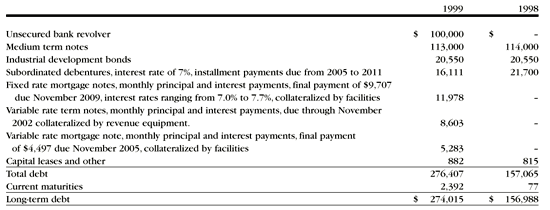
The company has a $300 million unsecured credit agreement with a group of banks which expires September 24, 2001. At December 31, 1999, $100 million in borrowings were outstanding, and $79 million of letters of credit had been issued under the agreement. There were no borrowings at December 31, 1998, but $49 million of letters of credit had been issued under the agreement. The agreement may be used for additional short-term borrowings and for the issuance of standby letters of credit. Interest on borrowings is based, at the company’s option, at a fixed increment over the London interbank offered rate or the agent bank’s base rate. Under the terms of the agreement among other restrictions, the company must maintain a minimum consolidated net worth and total debt must be no greater than a specified ratio of earnings before interest, income taxes, depreciation and amortization, as defined. At December 31, 1999 and 1998, the company was in compliance with all terms of this credit agreement. In 1999, the company renewed a $175 million, three year accounts receivables sales agreement with a bank, an increase from $150 million under the old agreement. The agreement involves the sale of accounts receivable to the company’s wholly owned, special purpose corporation (SPC).The SPC in turn sells an undivided interest in a revolving pool of eligible receivable as funding is required. Under terms of the agreement, the SPC’s assets are available to satisfy its obligations prior to any distribution to its shareholders. The company maintains responsibility for processing and collecting all receivables. Accounts receivable at December 31, 1999 and 1998, are net of $135 million and $43 million of receivables sold. Other, net nonoperating expense includes costs in lieu of interest of $6.1 million, $2.9 million and $2.5 million associated with this agreement in 1999, 1998 and 1997. The company maintains financing flexibility under the credit agreement and the accounts receivable sales agreement. Medium term notes maturing within one year, and intended to be refinanced, are classified as long-term. Medium term notes have scheduled maturities through 2008 with interest rates ranging from 5.7 percent to 8.8 percent. The company has loan guarantees, mortgages and lease contracts in connection with the issuance of industrial development bonds used to acquire, construct or expand terminal facilities. Interest rates on some issues are variable. Rates on these bonds and other debt currently range from 3.9 percent to 7.7 percent, with principal payments due through 2020. The company has interest rate swap agreements with two separate banks for the variable rate term notes and the variable rate mortgage note presented in the above table. The swaps coincide with the principle payment schedules on these obligations and are designed to hedge against future changes in interest rates. The principal maturities of long-term debt for the next five years (in thousands) are as follows: 2000 - $2,392, 2001 - $136,800, 2002 - $28,051, 2003 - $24,626, 2004 - $16,406, thereafter $68,132. Based on the borrowing rates currently available to the company for debt with similar terms and remaining maturities, the fair value of total debt at December 31, 1999 and 1998, was approximately $277 million and $167 million. |
|
|
 |
|