




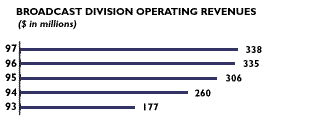
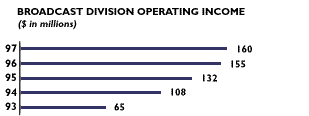
The broadcast division had another strong year. Operating income rose 3 percent to $159.6 million, from $155.0 million in 1996. Excluding the effects of the WFSB/WKMG trade in September, division operating income rose approximately 5 percent. Revenue was flat in 1997 due to the absence of $30 million of Olympics-related and political advertising that Post-Newsweek Stations obtained in 1996. WDIV-Detroit continued to lead the market as Detroit's number-one station and maintained the important distinction of having the most-watched news. In February the station introduced an innovative new environment for its newscast that incorporates the latest technology in news and weather in a state-of-the-art, two-level, fully operational setting. WDIV's unique commitment to explore local history continued. "The Rouge," a primetime documentary on the life of the remarkable Ford auto plant, received a national IRIS award. KPRC-Houston followed its game plan of emphasizing local news as a means of establishing itself as the city's leading television station. In the November 1997 ratings, KPRC tied for second place, sign-on to sign-off, in what is now a tighter-than-ever battle for audience. The station's 4 p.m. newscast, a market innovation begun in August 1996, has far exceeded initial ratings expectations. In the last major ratings sweeps, it finished just one point behind "Oprah" on a competing station and was the second-highest rated 4 p.m. news in the country. WPLG-Miami-Ft. Lauderdale maintained its dominance as South Florida's first choice for news and programming for the 13th consecutive year despite a fiercely competitive market environment. WPLG finished in the number-one spot in virtually every daypart. The station won every major newscast and improved its delivery of young adults in the critical 6 p.m. and 11 p.m. news shows. The station's series of live "Town Hall Meetings" focusing on children's and family issues generated enormous public response and was instrumental in forcing the governor to call a special session of the state legislature to deal with the crisis in school overcrowding. As a result of several trips to Cuba by the station's news management, WPLG is well positioned to become the first South Florida station to establish full-time news operations on the island. WKMG-Orlando was acquired in September 1997 from Meredith Broadcasting in a trade for WFSB in Hartford. A strategy was immediately developed to completely overhaul the look, feel, pace, and energy of the station's existing third-place news product. This effort is part of a larger project to remake the entire on-air image of the station. This is a work in progress, but in the November ratings, WKMG won second place in early and late news. The call letters of the station were changed from WCPX to WKMG in honor of Katharine Meyer Graham on January 30, 1998. KSAT-San Antonio is the most-watched station in South Texas and dominates the market in local news and local programming. The positioning of the station among younger key demographic groups continues to be strong. KSAT's commitment to live, local, and late-breaking coverage was enhanced by a fresh new logo presentation, improved graphics, and state-of-the-art digital disk technology, which enables the station's live broadcasters to present news and information faster and better. WJXT-Jacksonville enjoyed another year of dominance in the market. The station ranked number one in all newscasts, as well as sign-on to sign-off. WJXT successfully launched weekend editions of "Eyewitness News This Morning," which debuted with strong ratings in November. As a result, WJXT now leads the market in total hours of local news while maintaining top quality. In 1997, WJXT's newscasts earned national recognition from the Radio-Television News Directors Association, winning the prestigious Edward R. Murrow Award for Overall Excellence.
|
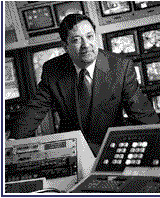
Television, America, & Me By J. Henry Maldonado
You see, television creates a unique and emotional bond with the viewer that must be understood, and respected, if one is to fully appreciate this contraption. "It ain't brain surgery" is usually the way some people excuse the triviality of television. Well, I am here to tell you, with tremendous respect and admiration for the medical profession, that when it goes right television does save lives, and when it goes awry, well, blame us for everything from El Niño to the downfall of western civilization. I am in charge of programming and promotion at WDIV-TV in Detroit. It is my office that purchases programs and promotes them. It is my office that is praised when a documentary plays in prime time, or run out of town when a soap opera is preempted by a special report. And it is my office that has to make decisions based on the instrument of the devil himself--"RATINGS." And, yes, we do make decisions based on ratings. Television is perhaps the most democratic of industries because ratings represent people who tell us every day how we are doing and what they want. There are not many businesses that poll all of their customers on a daily basis and eventually act on their response. A rating is my neighbor devoted to a soap opera, a rating is the local team seeing their touchdown, bad weather for school, good news for my kid. Ratings are real living people who invite us into their home. A rating is a little boy learning the language. A rating is someone I know, someone who lives in my town. I am a local broadcaster and I love it, because I love Detroit. I love its people. My heart breaks for its problems, but it's my town and nobody knows it better. My television station is a part of this town. We stuck with it while others left for the suburbs. We wrote songs about it as our station theme. We firmly believe in the greatness of Detroit, and we always reflect that pride on our air. Did you know that Detroit has the largest fireworks display in North America every summer? Well, they are gorgeous and exciting, and a two-hour show. And we have a wonderful history that sometimes is lost in tough times. Do you know that Detroit was the last stop to freedom on the Underground Railroad; or that Abraham Lincoln once declared to the nation, "Thank God for Michigan"? A year-long history series made our story the talk of the town. And our station theme does not end in blatant self promotion, but in a very personal message that became a battle cry during the really bad years--"What do you have to show if you don't try, why don't you go for it." And when we tell our viewers, "Local news comes first," we mean it. A television station is not just a reflection of the community, it is a part of it. It is this feeling of community, of local broadcasting, that is the driving force behind our company. While very powerful as a group, the individuality of each of our markets and our emotional connection to each of our communities determine who we are as stations. It is this mandate from Bill Ryan and each of our general managers that makes Post-Newsweek stations leaders in their markets. And it is tradition, deeply rooted in The Washington Post Company's courage and absolute commitment to the truth, that continues to impress this immigrant, now middle-aged broadcaster. It is a source of all things important when it's time for the tough decisions. So, while it may not be brain surgery, we at Post-Newsweek Stations certainly do very well for those under our care. Like all immigrants, I am lucky and grateful to have landed in your midst. I am spending wonderful times with the loves of my life, America and television, and like all immigrants before me, I look to my son, American born, to do great things. |

 I am an immigrant from Venezuela. My father, my mother, my brother, my two sisters, and I entered the U.S. in 1959 at a place called Idlewild. Together we stepped into the insensible cold of that American January. Each one of us carried a big
envelope that contained everything we were, from birth certificates to x-rays, and in a blatant act of symbolism, a sudden gust of wind lifted my papers and blew my 11-year-old past into the night. And so as all immigrants, the parents went about the business of survival, and we, the children, went about the business of devouring everything American. Our constant companion was the television. Through it we learned the language, customs, rock and roll, and eventually many of the skills we would need to get along. My parents had no time for television, never really learned the language, and eventually the cold winters chased them back to Venezuela. I fell in love with democracy and all the other imperfections that make America real and wonderful, and, of course, I developed an eternal attachment to and affection for television.
I am an immigrant from Venezuela. My father, my mother, my brother, my two sisters, and I entered the U.S. in 1959 at a place called Idlewild. Together we stepped into the insensible cold of that American January. Each one of us carried a big
envelope that contained everything we were, from birth certificates to x-rays, and in a blatant act of symbolism, a sudden gust of wind lifted my papers and blew my 11-year-old past into the night. And so as all immigrants, the parents went about the business of survival, and we, the children, went about the business of devouring everything American. Our constant companion was the television. Through it we learned the language, customs, rock and roll, and eventually many of the skills we would need to get along. My parents had no time for television, never really learned the language, and eventually the cold winters chased them back to Venezuela. I fell in love with democracy and all the other imperfections that make America real and wonderful, and, of course, I developed an eternal attachment to and affection for television.