
HOUSING MARKET
The market for manufactured housing currently appears to have stabilized, albeit at a low level, and is
showing some signs of recovery. Industry shipments in both calendar years 2003 and 2004 were
approximately 131,000, but Fleetwood shipped 3,400 more homes in calendar 2004 than it did in 2003.
This translated into a significant wholesale market share gain, moving to 17.6 percent in 2004 from 15.0
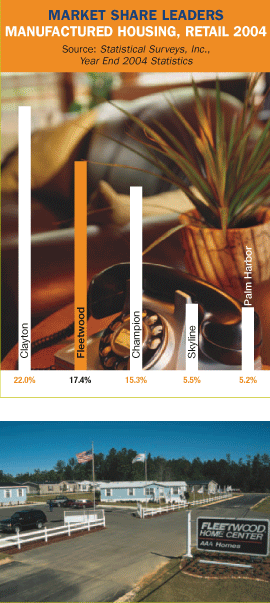
percent in the prior year. Retail market share was also up considerably to 17.4 percent from 15.7 percent
in calendar 2003. About half of the unit gain is estimated to be from sales to government agencies for
disaster relief, with the remainder sold through traditional channels
and manufactured housing communities.
The market for manufactured housing is stabilizing due to
improvements in some of our nation's regions. |
Back in 1991, the industry shipped 171,000 homes. As the 1990s
progressed, the popularity of manufactured housing began to grow
rapidly. Several factors contributed, including the improved quality
and aesthetics of the homes, the limited availability of apartments,
and readily available wholesale and retail financing for manufactured
housing. In fact, it is widely accepted that financing became too
easy to obtain, which led to an abundance of home purchases by
less creditworthy buyers. This contributed to an expansion in the
number of retail dealerships and the level of retail inventories, which
in turn led to increased manufacturing capacity and wholesale
shipments. At the peak of the market in 1998, the industry shipped
373,000 homes.
Unfortunately, the quality of many loans written during this time was
poor, and as consumer lenders faced elevated default rates and
significant repossessions, they began to tighten underwriting
standards and limit their exposure to the industry. A number of
finance companies exited the chattel (home-only or personal
property) lending business altogether, while those that remained
increased their interest rates significantly. Although some of the
chattel loans have been replaced by land-home financing, the time
and expense necessary to generate these loans, which require land
to be included as collateral, is greater. While this additional expense
is somewhat offset by increased availability and lower interest rates,
the net effect has been fewer sales of new homes. In addition,
competition from an excessive number of repossessed homes has
further challenged a difficult market. At the same time, site-built
housing loans have become easier to obtain, with low down payment
requirements and historically low interest rates. Combined, these
issues have resulted in a prolonged recession in the industry.
We believe a reversal of one or more of these factors will rejuvenate
the market and there are some positive signs on the horizon. Sales
have improved dramatically in Florida and California and a few
neighboring states where lending underwriting appears to have
remained more disciplined and therefore the downturn was less
severe. This recent surge in buying, however, is being offset by
continued declines in the mid-South and Midwest. Both the rate
of repossessions and the inventory of repossessed homes appear
to be improving throughout the country. Estimates of repossessed
houses being liquidated, which peaked at more than 100,000 in
2003 and 2004, have now fallen to less than 70,000 in the current
calendar year. Also encouraging is a heightened interest in the
sector on the part of midsized local and regional lenders.
|
|
