Yes, we can...
Speed the diagnosis of deadly infections that
take a heavy human and economic toll
Patients who come to hospitals with the expectation of leaving
with their health restored too often contract something they
never anticipated: healthcare–associated infections (HAIs).
Today, nearly six million HAIs occur annually across the United
States, Europe and Japan, and, according to the Centers for
Disease Control and Prevention, are implicated in an estimated
90,000 deaths per year in the United States alone. The main
culprits are deadly, antibiotic-resistant bacteria, such as
MRSA (methicillin-resistant Staphylococcus aureus) and VRE
(vancomycin-resistant Enterococcus). The mortality rate for
patients infected by these organisms is alarmingly high–a one
in five chance of death associated with an MRSA infection.
BD is moving to the forefront in the battle against HAIs.
The Company now offers a range of instruments and assays
designed to deliver fast, accurate information to aid in
diagnosing a patient infection. Looking to take the next step
in rapid diagnostics, BD acquired GeneOhm Sciences, the
pioneer in molecular diagnostic testing for the rapid detection of healthcare-associated bacterial organisms, in February 2006.
Now integrated into the BD Diagnostics segment, BD GeneOhm
offers two FDA-cleared nucleic acid-based assay systems:
BD GeneOhm MRSA and
BD GeneOhm Strep B tests. These
tests offer the potential for improved patient outcomes and
lower cost of care by delivering results within two hours instead
of days, using highly accurate gene identification methods.
Another key category of HAIs–with a mortality rate of
18 percent–is catheter-related bloodstream infections (CRBSIs).
BD innovations such as the BD Nexiva Closed IV Catheter
System, the BD Q-Syte luer access split-septum device and the
BD E-Z Scrub surgical scrub brush are designed to help reduce
the potential for bloodstream infection that can be introduced
through intravenous therapy. Through the use of innovative
products such as these, HAIs are largely preventable. BD will
work closely with hospitals, major quality organizations, infection
control agencies and others to focus on the eradication of this
serious threat to healthcare.
|
|

|
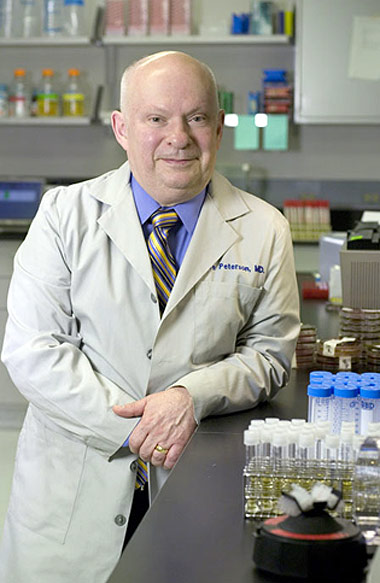
In the United States... Lance Peterson, MD,
led Evanston Northwestern Healthcare in the northern
suburbs of Chicago to become the first hospital system
in North America to screen 100 percent of incoming
patients for MRSA. BD’s new rapid molecular test, the
The BD GeneOhm MRSA test, delivers results in less than
two hours. Patients testing positive–generally, six to
eight percent of those being admitted to Evanston–are
put into isolation to prevent subsequent MRSA infections
among the patient population. Results in the first nine
months at Evanston Northwestern showed a 60 percent
reduction in MRSA infections and a net financial benefit
by the end of the first year, exceeding Dr. Peterson’s
original target of reaching these benchmarks in two years.
|
The BD GeneOhm MRSA assay is a
qualitative in vitro diagnostic test
for the direct detection of nasal
colonization by methicillin-resistant
Staphylococcus aureus (MRSA)
to aid in the prevention
and control of healthcare-associated
infections.
|
|
|
|
The BD Directigen EZ
Flu A+B test takes just
15 minutes and aids
healthcare providers
in flu diagnosis–
enabling doctors
to tailor treatment
to their patients.
In China... BD is building a new facility in Suzhou to
produce robust, easy-to-use tests to aid in diagnosing flu and
viral infections, in response to growing demands for clinical
testing and rapid diagnosis. Accurate diagnosis can result in
rapid, approproiate treatment and prevent unnecessary use of
potentially scarce therapeutics.
|
|
|
|