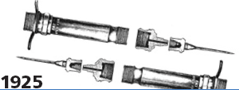
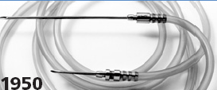
Over its first four decades, BD made tremendous strides in the art of injection. In the 1940s, the Company began its focus on improving the quality of specimen collection, and in doing so laid the foundation for today’s BD Vacutainer family of products.
The idea of drawing blood by vacuum through a double-ended needle into a test tube was pioneered by Joseph J. Kleiner, who came to BD in 1943. He recognized that when multiple samples of a patient’s blood were needed, a separate puncture was required for each. Samples were then emptied into test tubes for laboratory analysis. Minimizing patient discomfort and ensuring sample integrity were Kleiner’s challenges.
His solution was a stoppered vacuum container about the size of a test tube, a holder and a double-ended needle. Kleiner’s “Evacutainer” not only solved the immediate problems, it also advanced diagnostic practice. Today, the BD Vacutainer family of products covers a wide range of tubes, needles and needle holders, sharps collectors, and safety-engineered devices that are optimally designed for controlling preanalytical variability throughout the specimen collection process. BD’s diagnostics business is far broader, as well, and–true to Kleiner’s legacy–the Company is continuing to innovate.
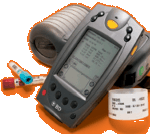
| The BD.id Patient
Identification System
features a handheld
computer with
built-in scanner
and employs
sophisticated
software to collect
and sort information. |
|
One of today’s most significant challenges is errors in specimen management, which cost U.S. hospitals an estimated $200 to $400 million a year. BD focused on the problem, calling on years of experience in the hospital environment. After extensive field testing, the Company developed the BD.id Patient Identification System and brought it to market in mid-2003. The BD.id system is the first to address every step in the specimen collection process and is the only completely integrated solution, as it includes hardware, software, management reports and BD Vacutainer Plus tubes used to gather specimens.
The system is built around a handheld computer with builtin scanner. Prior to collecting a specimen, the BD.id system identifies the healthcare professional by scanning a user ID badge. The patient’s barcoded wristband is also scanned to confirm that the right patient is receiving the right tests. Once the specimen is collected, the system verifies the correct specimen container for each test, captures the date and time of collection, prints barcode labels at bedside and, once replaced in its cradle, synchronizes with the laboratory information system.
Extensive testing at two hospitals makes BD the only company with proprietary, published results. Along with productivity benefits, the system delivered a 99.95 percent reduction in specimen errors at one hospital and a 100 percent reduction in errors at the other.
|