
1201 Third Avenue, Suite 1601
March 17, 2004
Dear Shareholder:
You are cordially invited to attend the Annual Meeting of Washington Mutual, Inc. shareholders that will be held in the S. Mark Taper Foundation Auditorium on Tuesday, April 20, 2004, at 10:00 a.m., local time, at Benaroya Hall, 200 University Street, Seattle, Washington 98101. The meeting will be webcast on the Washington Mutual website at www.wamu.com/ir. I look forward to greeting as many of our shareholders as possible at the Annual Meeting.
As set forth in the attached Proxy Statement, the meeting will be held to consider the following matters:
| Ø | the election of four directors; | |
| Ø | the ratification of the appointment of Washington Mutual’s independent auditors for 2004; and | |
| Ø | one shareholder proposal that is expected to be called at the meeting. |
Please read the attached Proxy Statement carefully for information about the matters upon which shareholders are being asked to consider and vote. In addition to these specific matters, there will be a report on the progress of Washington Mutual and an opportunity to ask questions of general interest to shareholders.
Your vote is important. Whether or not you attend the meeting in person, I urge you to promptly vote your proxy as soon as possible via the Internet, by telephone or by mail using the enclosed postage-paid reply envelope. If you decide to attend the meeting and vote in person, you will, of course, have that opportunity.
Thank you for your continued support of Washington Mutual, and again, I look forward to seeing you at the Annual Meeting.
| Sincerely, | |
 | |
| Kerry K. Killinger | |
| Chairman, President and | |
| Chief Executive Officer |
WASHINGTON MUTUAL, INC.
1201 Third Avenue, Suite 1601
NOTICE OF ANNUAL MEETING OF SHAREHOLDERS
To Be Held April 20, 2004
|
Meeting
Date: |
Tuesday, April 20, 2004 | |
|
Meeting
Time: |
10:00 a.m. (local time) | |
|
Location: |
S. Mark Taper Foundation
Auditorium Benaroya Hall 200 University Street Seattle, Washington 98101 | |
|
Record
Date: |
February 27, 2004 |
Agenda:
| 1. | To elect four directors, each for a term of three years; | |
| 2. | To ratify the appointment of Deloitte & Touche LLP as the Company’s independent auditors for 2004; | |
| 3. | To consider a shareholder proposal, if it is properly presented by the shareholder proponent at the meeting; and | |
| 4. | To transact such other business as may properly come before the meeting or any adjournments thereof. |
The Board of Directors urges shareholders to vote FOR Items 1 and 2 and AGAINST Item 3.
All of these items are more fully described in the Proxy Statement that follows. Shareholders of record at the close of business on the Record Date will be entitled to vote at the Annual Meeting and any adjournments thereof.
| By order of the Board of Directors, | |
 | |
| William L. Lynch | |
| Secretary |
Seattle, Washington
IMPORTANT
Whether or not you expect to attend the Annual Meeting in person, we urge you to vote your proxy at your earliest convenience via the Internet, by telephone or by mail using the enclosed postage-paid reply envelope. This will ensure the presence of a quorum at the Annual Meeting and will save Washington Mutual the expense of additional solicitation. Sending in your proxy will not prevent you from voting your shares in person at the Annual Meeting if you desire to do so. Your proxy is revocable at your option in the manner described in the Proxy Statement.
Table of Contents
| Page | ||||
|
| ||||
| 1 | ||||
|
Item 1.
Election of Directors |
3 | |||
| 3 | ||||
| 6 | ||||
| 12 | ||||
| 13 | ||||
| 14 | ||||
| 16 | ||||
| 19 | ||||
| 22 | ||||
| 24 | ||||
| 27 | ||||
| 28 | ||||
| 29 | ||||
|
Item 2.
Ratification of the Appointment of Independent
Auditors |
30 | |||
| 30 | ||||
|
Item 3.
Shareholder Proposal Relating to a Specific
Compensation Program |
32 | |||
| 34 | ||||
| 34 | ||||
| 34 | ||||
| Appendix A | ||||
i
WASHINGTON MUTUAL, INC.
1201 Third Avenue, Suite 1601
The board of directors (the “Board of Directors” or the “Board”) of Washington Mutual, Inc. (“Washington Mutual” or the “Company”) is soliciting proxies to be voted at the Annual Meeting of Shareholders on April 20, 2004, at 10:00 a.m. (the “Annual Meeting”), and at any adjournments thereof, for the purposes set forth in the attached Notice of Annual Meeting of Shareholders. The Notice, this Proxy Statement and the form of proxy enclosed are first being sent to shareholders on or about March 17, 2004.
Questions and Answers about these Proxy Materials and the Annual Meeting:
Question: Why am I receiving these materials?
Answer: The Board of Directors is providing these proxy materials to you in connection with Washington Mutual’s annual meeting of shareholders, to be held on April 20, 2004. As a shareholder, you are invited to attend the Annual Meeting and are entitled to and requested to vote on the items of business described in this Proxy Statement.
Question: What information is contained in this Proxy Statement?
Answer: This information relates to the proposals to be voted on at the Annual Meeting, the voting process, compensation of the Company’s directors and most highly paid executives, and certain other required information.
Question: Who is soliciting my vote pursuant to this Proxy Statement?
Answer: The Board of Directors is soliciting your vote at the 2004 Annual Meeting.
Question: Who is entitled to vote?
Answer: Only shareholders of record at the close of business on February 27, 2004 will be entitled to vote at the Annual Meeting.
Question: How many shares are eligible to be voted?
Answer: As of the record date of February 27, 2004, the Company had 868,397,759 shares of common stock (“Common Stock”) outstanding (including 6,000,000 shares of Common Stock held in escrow). Each outstanding share of Common Stock will entitle its holder to one vote on each matter to be voted on at the Annual Meeting.
Question: What am I voting on?
Answer: You are voting on the following matters:
| Ø | The election of four directors, each for a term of three years. The Company’s nominees are Anne V. Farrell, Stephen E. Frank, Margaret Osmer McQuade and William D. Schulte. All are current Company directors. | |
| Ø | Ratification of the appointment by the Audit Committee of the Board of Directors of Deloitte & Touche LLP as the Company’s independent auditors for 2004. | |
| Ø | A shareholder proposal, if it is presented at the Annual Meeting. |
Question: How does the Board recommend that I vote?
Answer: The Board recommends that you vote “FOR” each director nominee, “FOR” the ratification of the Audit Committee’s appointment of Deloitte & Touche as independent auditors, and “AGAINST” the shareholder proposal, if it is presented at the Annual Meeting.
Question: How many votes are required to hold the Annual Meeting and what are the voting procedures?
Answer: Quorum Requirement: Washington law provides that any shareholder action at a meeting requires that a quorum exist with respect to that action. A quorum for the actions to be taken at the Annual Meeting will consist of a majority of all of the outstanding shares of Common Stock that are entitled to vote at the Annual Meeting. Therefore, at the Annual Meeting, the presence, in person or by proxy, of the holders of at least 434,198,880 shares of Common
| Required Votes: Each outstanding share of Common Stock is entitled to one vote on each proposal at the Annual Meeting. |
| Ø | Election of Directors: If a there is quorum at the Annual Meeting, the four nominees who receive the greatest number of votes cast for directors will be elected. There is no cumulative voting for Company directors. | |
| Ø | Ratification of Independent Auditors and Shareholder Proposal: If there is a quorum, each action will be approved if the number of votes cast in favor of the proposed action exceeds the number of votes cast against it. |
Abstentions and broker non-votes will have no impact on the election of directors or the approval of either of the other proposals set forth in the Notice of Annual Meeting of Shareholders.
Question: How may I cast my vote?
Answer: If you are the shareholder of record: You may vote by one of the following four methods (as instructed on the enclosed proxy card):
| Ø | in person at the Annual Meeting, | |
| Ø | via the Internet, | |
| Ø | by telephone, or | |
| Ø | by mail. |
Whichever method you use, the proxies identified on the back of the proxy card will vote the shares of which you are the shareholder of record in accordance with your instructions. If you submit a proxy card without giving specific voting instructions, the proxies will vote the shares as recommended by the Board of Directors.
If you own your shares in “street name,” that is, through a brokerage account or in another nominee form: You must provide instructions to the broker or nominee as to how your shares should be voted. Your broker or nominee will usually provide you with the appropriate instruction forms at the time you receive this Proxy Statement and the Company’s Summary Annual Report. If you own your shares in this manner, you cannot vote in person at the Annual Meeting unless you receive a proxy to do so from the broker or the nominee, and you bring the proxy to the Annual Meeting.
Question: How may I revoke or change my vote?
Answer: If you are the record owner of your shares, you may revoke your proxy at any time before it is voted at the Annual Meeting by:
| Ø | submitting a new proxy card, | |
| Ø | delivering written notice to the Corporate Secretary of the Company prior to April 20, 2004, stating that you are revoking your proxy, or | |
| Ø | attending the Annual Meeting and voting your shares in person. |
Please note that attendance at the Annual Meeting will not, in itself, constitute revocation of your proxy.
Question: Who is paying for the costs of this proxy solicitation?
Answer: The Company will bear the cost of preparing, printing and mailing the materials in connection with this solicitation of proxies. In addition to mailing these materials, officers and regular employees of the Company may, without being additionally compensated, solicit proxies personally and by mail, telephone, facsimile or electronic communication. The Company will reimburse banks and brokers for their reasonable out-of-pocket expenses related to forwarding proxy materials to beneficial owners of stock or otherwise in connection with this solicitation. The Company has retained Georgeson Shareholder Communications Inc. to assist in the solicitation at a cost of approximately $10,000, plus payment of reasonable out-of-pocket expenses incurred by Georgeson.
Question: Who will count the votes?
Answer: Automated Data Processing, Inc., the Company’s inspector of elections for the Annual Meeting, will receive and tabulate the ballots and voting instruction forms.
Question: What happens if the Annual Meeting is postponed or adjourned?
Answer: Your proxy will still be effective and may be voted at the rescheduled meeting. You will still be able to change or revoke your proxy until it is voted.
2
INFORMATION ABOUT THE MEETING
The Annual Meeting will be held at 10:00 a.m. (local time) on Tuesday, April 20, 2004, at the S. Mark Taper Foundation Auditorium at Benaroya Hall, 200 University Street, Seattle, Washington 98101. Listening devices will be available at the Annual Meeting for shareholders with impaired hearing.
The Company plans to webcast the Annual Meeting. The webcast may be accessed on the Washington Mutual website at www.wamu.com/ir during the Annual Meeting and for thirty days after the meeting.
ITEM 1. ELECTION OF DIRECTORS
Board Nominees
The Board of Directors has nominated each of the following persons for election as a Company director. Each of the nominees is currently a director of the Company and each has indicated that he or she is willing and able to continue to serve as a director.
Anne V. Farrell
The Company’s Articles of Incorporation provide that the number of directors will be fixed by the Company’s Bylaws and divided into three classes. The Bylaws of the Company currently fix the size of the Board of Directors at thirteen directors. At the Annual Meeting, four nominees will be elected to serve three-year terms to expire at the 2007 Annual Meeting and until their successors are elected and qualified.
If any nominee becomes unable or unwilling to serve, which is not anticipated, the accompanying proxy may be voted for the election of such other person as shall be designated by the Governance Committee of the Board of Directors. Proxies granted may not be voted for a greater number of nominees than the four named above. Unless instructions to the contrary are specified in a proxy properly voted and returned through available channels, the proxies will be voted FOR each of the nominees listed above.
THE BOARD OF DIRECTORS UNANIMOUSLY RECOMMENDS THAT SHAREHOLDERS
Current Directors
Below is information regarding each of the Company’s directors, including the four nominees, as of March 17, 2004. Except as otherwise indicated, each director has been engaged in the principal occupation described below for at least five years.
Douglas P. Beighle
Mr. Beighle, age 71, is Chairman of the Board of Directors of Puget Energy, Inc. and its subsidiary, Puget Sound Energy, Inc., and a director of Simpson Investment Company. Mr. Beighle retired as Senior Vice President and Chief Administrative Officer of The Boeing Company in May 1997. From 1980 through 1997, he held various senior executive positions at Boeing, including Senior Vice President from 1986 through 1997. He has been a consultant to Boeing since 1997.
3
Anne V. Farrell
Mrs. Farrell, age 68, served as President and Chief Executive Officer of The Seattle Foundation, a charitable and educational corporate foundation, from 1984 until 2003, and currently serves as its President Emeritus. Mrs. Farrell also serves as a trustee of the registered investment companies that comprise the WM Group of Funds. The investment advisor to the funds is an indirect wholly owned subsidiary of Washington Mutual. She also serves as a director of Recreational Equipment, Inc. (R.E.I.).
Stephen E. Frank
Mr. Frank, age 62, is a director of Aegis Insurance Services, Inc., LNR Property Corporation, Puget Energy, Inc. and UNOVA, Inc. On January 1, 2002, Mr. Frank retired as Chairman, President and Chief Executive Officer of Southern California Edison, the largest subsidiary of Edison International, where he had served since June 1995. From 1990 until 1995, Mr. Frank served as the President, Chief Operating Officer and a director of Florida Power & Light Company. Prior to that, he served as an Executive Vice President and Chief Financial Officer of TRW, Inc. and the Vice President, Controller and Treasurer of GTE Corporation.
Kerry K. Killinger
Mr. Killinger, age 54, has been Chairman, President and Chief Executive Officer of Washington Mutual since 1991. Mr. Killinger became President and a director in 1988, Chief Executive Officer in 1990 and Chairman of the Board of Directors in 1991. Mr. Killinger also serves as a director of Safeco Corporation and Simpson Resource Company and as a trustee of The Seattle Foundation.
Phillip D. Matthews
Mr. Matthews, age 65, is Chairman of the Executive Committee and Lead Director of Wolverine World Wide, Inc. and served as its Chairman from 1993 through 1996. He is also Chairman of the Board of Worldwide Restaurant Concepts, Inc. Mr. Matthews was Chairman and Chief Executive Officer of The Reliable Company from 1992 to 1997.
Michael K. Murphy
Mr. Murphy, age 67, is Chairman of CPM Development Corporation, the parent company of Central Pre-Mix Concrete Company and Inland Asphalt Company. Mr. Murphy also serves as a trustee of the registered investment companies that comprise the WM Group of Funds. The investment advisor to the funds is an indirect wholly owned subsidiary of Washington Mutual.
Margaret Osmer McQuade
Ms. Osmer McQuade, age 65, has been President of Qualitas International, an international consulting firm, since 1993. She also serves as a director of River Capital International LLC.
4
Mary E. Pugh
Ms. Pugh, age 44, is founder, President and Chief Executive Officer of Pugh Capital Management, Inc., a fixed income money management company. Ms. Pugh is a director of the Seattle branch of the Federal Reserve Bank of San Francisco and a director of Cascade Natural Gas Corporation. She is a member of the Washington Roundtable.
William G. Reed, Jr.
Mr. Reed, age 65, is lead independent director of Safeco Corporation and a director of Simpson Resource Company. He was Chairman of Simpson Investment Company from 1971 to 1996. Mr. Reed also serves as a director of Microsoft Corporation, PACCAR, Inc. and The Seattle Times.
Elizabeth A. Sanders
Ms. Sanders, age 58, is founder and Principal of The Sanders Partnership, an executive management and leadership consulting firm. Prior to 1990, she served as a Vice President and General Manager of Nordstrom, Inc. She is also a director of Denny’s Corporation (formerly Advantica Restaurant Group, Inc.), WellPoint Health Networks Inc. and Wolverine World Wide, Inc.
William D. Schulte
Mr. Schulte, age 71, served in various positions with KPMG from 1961 until his retirement in 1990, including Managing Partner of the Los Angeles office and member of the firm’s management committee from 1979 to 1986 and Vice Chairman and member of the board of directors from 1986 until 1990. Mr. Schulte is also the Chairman and CEO of the Weingart Foundation.
James H. Stever
Mr. Stever, age 60, retired as Executive Vice President — Public Policy of US WEST, Inc. on December 31, 1996, a position he had held since January 1996. He was Executive Vice President — Public Policy and Human Resources of US WEST, Inc. from November 1994 to January 1996, and Executive Vice President — Public Policy of US WEST, Inc. and US WEST Communications, Inc. from 1993 until 1994. He was President — Public Policy of US WEST Communications, Inc. from 1990 until 1993, and President — Business Division from 1988 until 1990.
Willis B. Wood, Jr.
Mr. Wood, age 69, retired as Chairman, Chief Executive Officer and director of Pacific Enterprises, the holding company of Southern California Gas Company, in 1998. Mr. Wood had served in various positions, including as executive officer of Pacific Enterprises’ subsidiaries, since 1960. Mr. Wood is chairman of the American Automobile Association (AAA) and a director of the Automobile Club of Southern California.
5
Corporate Governance
Washington Mutual values strong corporate governance principles and adheres to the highest ethical standards. These principles and standards, along with Washington Mutual’s corporate values of ethics, respect, teamwork, innovation and excellence, assist the Company in achieving its corporate mission. To foster strong corporate governance and business ethics, the Board of Directors continues to take many steps to strengthen and enhance the Company’s corporate governance practices and principles. The Company has adopted Corporate Governance Guidelines to achieve the following goals:
| - | to promote the effective functioning of the Board; | |
| - | to ensure that the Company conducts its business in accordance with the highest legal and ethical standards; and | |
| - | to enhance shareholder value. |
The following is a summary of some of the most significant governance principles as embodied in the Company’s Corporate Governance Guidelines, and the Company’s current practices with respect to many other aspects of strong corporate governance. The full text of the Company’s Corporate Governance Guidelines is available on the Company’s website at www.wamu.com/ir. Shareholders may also obtain a written copy of the guidelines at no cost by writing the Company at 1201 Third Avenue, Seattle, Washington, 98101, Attention: Investor Relations Department, WMT 2140, or by calling (206) 461-3187.
The Governance Committee of the Board of Directors administers the Corporate Governance Guidelines, reviews performance under the guidelines and the content of the guidelines annually and, when appropriate, recommends updates and revisions to the Board of Directors.
| Board of Directors Independence |
The Company currently has thirteen directors. The Corporate Governance Guidelines require that the Board consist predominantly of non-management directors. This means directors who are not currently, and have not been, employees of the Company during the most recent three years. Currently, the Chief Executive Officer is the only director who is a member of the Company’s management.
The Corporate Governance Guidelines also require that a substantial majority of the Board consist of independent directors. A director is independent for this purpose when the Board affirmatively determines that he or she has no material relationship with the Company, other than as a director. This determination is made in accordance with the Corporate Governance Guidelines, which are consistent with the applicable rules of the New York Stock Exchange (“NYSE”) and federal securities laws.
The Governance Committee is responsible for reviewing with the Board annually the appropriate criteria and standards for determining director independence consistent with all applicable legal requirements, including the NYSE rules and federal securities laws. In accordance with applicable NYSE and Securities and Exchange Commission (“SEC”) rules, the Company has established categories of immaterial relationships that are deemed not to have any bearing on a director’s independence. Accordingly, the Corporate Governance Guidelines provide that no Company director will be considered non-independent solely as a result of any of the following relationships:
| - | if the director is an employee or executive officer of, or a member of his or her immediate family is an employee or an executive officer of another company that makes payments to or receives payments from the Company for property or services in an amount which is less than $1 million and two percent (2%) of the annual consolidated gross revenues of the other company, determined for the most recent fiscal year; | |
| - | if the director is a director of another company that makes payments to or receives payments from the Company for property or services in an amount which is less than the greater of $1 million and two percent (2%) of the annual consolidated gross revenues of the other company, determined for the most recent fiscal year; | |
| - | if the director is an executive officer of another company which is indebted to the Company, or to which the Company is indebted, and the total amount of indebtedness either of them owes to the other is less than one percent (1%) of the total consolidated assets of the other company; |
6
| - | if the director serves as an officer, director or trustee of a charitable organization, and the Company’s discretionary charitable contributions to the organization are no greater than the greater of $250,000 or one percent (1%) of that organization’s total annual charitable receipts. The Company’s automatic matching of employee charitable contributions will not be included in the amount of the Company’s contributions for this purpose; | |
| - | if the director serves as a non-employee director of another company (and has not been determined by such other company to be non-independent), on whose board one or more other WMI directors sit as non-employee directors; or | |
| - | if the director maintains one or more deposit accounts with the Company, provided that there is no obligation or requirement to maintain the existence of such accounts and such accounts exist on terms and conditions that are no more favorable than those offered to the general public. |
In February 2004, the Board determined that all of its current directors are independent in accordance with the Corporate Governance Guidelines, other than Mr. Killinger, Mrs. Farrell and Ms. Pugh. Mr. Killinger, Mrs. Farrell and Ms. Pugh are not independent because of the following:
| - | Mr. Killinger is an executive officer of the Company. | |
| - | Mrs. Farrell was the President and Chief Executive Officer of The Seattle Foundation at a time when Mr. Killinger was a member of its executive committee, the committee that determined Mrs. Farrell’s compensation. | |
| - | Ms. Pugh is the founder and President of Pugh Capital Management, a company with which Washington Mutual transacted business in 2003. This relationship is more fully discussed in “Certain Relationships and Related Transactions” on page 22 of this Proxy Statement. |
The Board also determined in February 2004 that all of the members of the Company’s Audit Committee are independent in accordance with the Corporate Governance Guidelines.
Responsibilities of the Board of Directors
In addition to each director’s basic duties of care and loyalty, the Board of Directors has separate and specific obligations enumerated in the Corporate Governance Guidelines. Among other things, these obligations require directors to effectively monitor management’s capabilities, compensation, leadership and performance, without undermining management’s ability to successfully operate the business. In addition, the Board has the authority to retain and establish the fees of outside legal, accounting or other advisors, as necessary, to carry out its responsibilities.
Directors are expected to avoid any action, position or interest that conflicts with an interest of the Company, or gives the appearance of a conflict. As a result, directors must disclose all business relationships with the Company and with any other person doing business with the Company to the entire Board and to recuse themselves from discussions and decisions affecting those relationships. The Company periodically solicits information from directors in order to monitor potential conflicts of interest and to confirm director independence.
Communication With Directors
Individuals may submit communications to the Board, the Board’s executive session presiding director, or to the non-management directors as a group by sending the communications in writing to the following address: Washington Mutual, Inc., 1201 Third Avenue, WMT 1706, Seattle, Washington 98101. All correspondence should note whether it is addressed to the “Board of Directors,” the “Presiding Director,” or the “Non-Management Directors.”
Director Education and Evaluation
All directors are expected to be knowledgeable about the Company and its industry and to understand their duties and responsibilities as directors. This knowledge may be gained from attendance at Board meetings; periodic director training sessions; regular meetings with Company management; reading of appropriate industry, corporate governance and directorship literature; and attendance at educational seminars. The Company frequently conducts in-house director education programs on relevant topics. In addition, directors are encouraged to attend education sessions provided by third
7
All new directors are required to attend orientation sessions conducted by management and educational programs intended to satisfy the special qualification requirements for membership on committees of the Board.
The Board, acting through the Governance Committee, annually evaluates the effectiveness of the Board collectively, and the performance of each standing Board committee. The Governance Committee determines the appropriate means for this evaluation, which may include surveying the Board and committee membership.
Director Nomination Process
The Governance Committee is responsible for reviewing with the Board annually the appropriate skills and characteristics required of Board members, and for selecting, evaluating and recommending nominees for election by the Company’s shareholders. The Governance Committee may use one or more third party search firms to assist in this purpose. The following are the General Criteria for Nomination to the Board, as adopted by the Governance Committee. These General Criteria set forth the traits, abilities and experience that, at a minimum, the Board looks for in determining candidates for election to the Board:
| - | Directors should possess personal and professional ethics, integrity and values, and be committed to representing the long-term interests of the Company’s shareholders and other constituencies. | |
| - | Directors should have reputations, both personal and professional, consistent with the image and reputation of Washington Mutual. | |
| - | Each director should have relevant experience and expertise and be able to add value and offer advice and guidance to the Chief Executive Officer based on that experience and expertise. | |
| - | Other important factors to be considered in seeking directors include current knowledge and contacts in the Company’s industry and other industries relevant to the Company’s business, ability to work with others as an effective group and ability to commit adequate time as a director. | |
| - | A substantial majority of directors on the Board should be “independent,” not only as that term may be legally defined, but also without the appearance of any conflict in serving as a director. In addition, directors should be independent of any particular constituency and be able to represent the interests of the Company’s shareholders and other constituencies. | |
| - | Each director should have the ability to exercise sound business judgment. | |
| - | Directors should be selected so that the Board of Directors is a diverse body reflecting gender, ethnic background, professional experience, current responsibilities and community involvement. |
The Chair of the Governance Committee may authorize the Chief Executive Officer or any other representative of the Board, speaking on behalf of the Board, to extend invitations to join the Board to new director candidates. The Board is responsible for making interim appointments of directors in accordance with the Company’s Bylaws.
Company shareholders may propose nominees for Board membership for consideration by the Governance Committee by submitting the nominee’s name and qualifications to the Secretary of the Company at 1201 Third Avenue, WMT 1706, Seattle, WA 98101. Shareholders who wish to nominate candidates for election to the Board at the Annual Meeting of Shareholders must follow the procedures outlined in “Shareholder Proposals for the 2005 Annual Meeting” set forth on page 34. The Governance Committee will consider all director candidates properly submitted by Company shareholders in accordance with the Company’s Bylaws and Corporate Governance Guidelines.
Director Rotation and Retirement
The Board of Directors does not favor a formal rotation process or term limits for non-management directors. A director must retire at the Company’s Annual Meeting of Shareholders immediately following his or her seventy-second birthday. The vacancy created by the retirement will be filled by a majority of the remaining directors in accordance with the Company’s Bylaws. A director so appointed to fill the vacancy will stand for re-election by the Company’s shareholders at the first annual meeting of shareholders following that director’s appointment to the Board. In addition, the Company requires that directors tender their resignation when their present position or job responsibility changes
8
Board Meetings and Executive Sessions
The Board of Directors currently plans eight full Board meetings each year. Directors are encouraged to attend each meeting in person. Management provides all directors with an agenda and appropriate written materials sufficiently in advance of the meetings to permit meaningful review. To ensure active and effective participation, directors are expected to arrive at each Board and committee meeting having reviewed and analyzed the materials for the meeting.
All Company non-management directors generally meet in executive session at every regularly scheduled Board meeting, both with and without the Chief Executive Officer present. All directors who are determined to be independent meet in executive session once per year. The non-management directors will annually select one of their own to be the presiding director at executive sessions. In February 2004, Douglas P. Beighle was selected as the presiding director at all executive sessions.
Director Attendance at Company Annual Meetings
All directors are encouraged to attend every Company annual meeting of shareholders. To facilitate availability at the time of the annual meeting, the Company typically schedules Board and Board committee meetings on the day of and the day before the annual meeting. Twelve out of the thirteen Washington Mutual directors attended the annual meeting of shareholders held on April 15, 2003.
Director Contact with Management
All directors are invited to contact the Chief Executive Officer at any time to discuss any aspect of the Company’s business. There generally are frequent opportunities for directors to meet with other members of the management team.
Investment Expectations of Directors
Directors are expected to own a meaningful number of shares of Company Common Stock, which should not be less than 1,000 shares.
Code of Conduct and Code of Ethics for Senior Financial Officers
The Company has implemented a Code of Ethics applicable to senior financial officers of the Company and a revised Company Code of Conduct applicable to all Company officers, employees and directors. The Code of Ethics provides fundamental ethical principles to which Company senior financial officers are expected to adhere. The Code of Conduct operates as a tool to help Washington Mutual officers, employees and directors understand and adhere to the high ethical standards required for employment by, or association with, the Company. Both the Code of Ethics and the Code of Conduct are available on the Company’s website at www.wamu.com/ir. Shareholders may also obtain written copies at no cost by writing the Company at 1201 Third Avenue, Seattle, Washington 98101, Attention: Investor Relations Department, WMT 2140, or by calling (206) 461-3187.
Board Meetings and Attendance
During 2003, the Company’s Board of Directors met nine times. Each director attended at least 75% of the aggregate of the total number of meetings of the Board and the total number of all meetings held by committees on which he or she served.
9
Committees of the Board of Directors
|
| ||
| Committees | 2003 Meetings and General Committee Functions | |
|
| ||
|
AUDIT |
Meetings in 2003: 10 | |
| Douglas P. Beighle
(Chair)* Stephen E. Frank (Vice Chair)* Phillip D. Matthews William G. Reed, Jr. William D. Schulte Willis B. Wood, Jr. *Beginning with the committee meetings in April 2004, Mr. Beighle will become Vice Chair and Mr. Frank will become Chair. |
- Oversees
the integrity of the Company’s financial reporting process and financial
statements and systems of internal
controls; - Oversees the Company’s compliance with legal and regulatory requirements; - Appoints and retains the independent auditor, and reviews its qualifications, independence and performance; and - Selects general auditor, and oversees and monitors the performance of the Company’s internal audit function. | |
|
| ||
|
HUMAN
RESOURCES |
Meetings in 2003: 5 | |
| James H. Stever (Chair) Douglas P. Beighle Stephen E. Frank Willis B. Wood, Jr. Elizabeth A. Sanders |
- Develops
and administers the Company’s executive and senior officer compensation
programs; - Establishes and administers annual and long-term incentive compensation plans for executive and senior management; - Oversees the administration of the Company’s officer and employee benefit plans and any associated plan trust funds; and - Annually evaluates the Chief Executive Officer’s performance and sets the Chief Executive Officer’s compensation level based on such evaluation. | |
|
| ||
|
GOVERNANCE |
Meetings in 2003: 3 | |
| William G. Reed, Jr.
(Chair) Phillip D. Matthews James H. Stever Anne V. Farrell* Margaret Osmer McQuade Elizabeth A. Sanders * Beginning with the committee meetings in April 2004, Mr. Wood will become a member of this committee and Mrs. Farrell will no longer be a member. |
- Develops
and recommends to the Board of Directors governance principles for the
Company and takes a leadership role in shaping the corporate governance of
the Company; - Identifies individuals qualified to become directors and recommends to the Board candidates for directorship; and - Reviews and makes recommendations to the Board concerning the strategic plans of the Company developed by management. | |
|
| ||
10
|
| ||
| Committees | 2003 Meetings and General Committee Functions | |
|
| ||
|
FINANCE* |
Meetings in 2003: 6 | |
| Michael K. Murphy
(Chair) Phillip D. Matthews Stephen E. Frank William D. Schulte Margaret Osmer McQuade Mary E. Pugh *Beginning with the committee meetings in April 2004, Mr. Reed will become a member of this committee. |
- Monitors
investments and dispositions of loans and financial instruments, and
significant purchases and dispositions of real property acquired by
Washington Mutual (excluding the Company’s premises or other real property
acquired for use by the Company); and - Monitors the development and administration of policies that govern the Company’s acquisition, retention and disposition of investments, and makes recommendations with respect to such policies. | |
|
| ||
|
CORPORATE DEVELOPMENT |
Meetings in 2003: 1 | |
| Kerry K. Killinger
(Chair) Douglas P. Beighle Stephen E. Frank Willis B. Wood, Jr. James H. Stever |
- Reviews,
on a case-by-case basis, with Washington Mutual’s management, all
transactions not in the ordinary course of business;
and - Oversees stock issuances by the Company. | |
|
| ||
|
CORPORATE RELATIONS |
Meetings in 2003: 2 | |
| Anne V. Farrell (Chair) Margaret Osmer McQuade Mary E. Pugh Elizabeth A. Sanders Michael K. Murphy Willis B. Wood, Jr.* *Beginning with the committee meetings in April 2004, Mr. Stever will become a member of this committee and Mr. Wood will no longer be a member. |
Monitors the Company’s charitable giving and community service activities, including implementation of its ten-year $375 billion Community Commitment initiated in 2001. | |
|
| ||
| Committee Independence and Additional Information |
The Audit Committee and the Human Resources Committee are currently composed entirely of “independent” directors, as defined by the Company’s Corporate Governance Guidelines and applicable NYSE and SEC rules and regulations. The Governance Committee will be composed entirely of independent directors as of and after the Annual Meeting. Each of the Company’s committees has a written charter, which may be obtained on Washington Mutual’s website at www.wamu.com/ir. A copy of the current Audit Committee charter is attached as Appendix A to this Proxy Statement.
The chair of each committee is responsible for establishing committee agendas. The agenda, meeting materials and the minutes of each committee meeting are furnished in advance to all directors, and each committee chair reports on his or her committee’s activities to the full Board.
| Audit Committee Financial Expertise |
The Board has determined that each of Messrs. Beighle and Frank qualifies as a Company “audit committee financial expert,” as defined by the rules and regulations of the SEC. The Board further determined that each member of the Audit Committee is financially literate and has accounting or related financial management expertise, as such qualifications are defined pursuant to the rules of the NYSE.
11
Compensation of Directors
In establishing the compensation of its non-employee directors, Washington Mutual seeks to provide total compensation that is competitive, fair, aligned with shareholder return and business results, and likely to facilitate long-term ownership of Washington Mutual stock. Washington Mutual does not pay director compensation to its directors who are also employees of the Company.
| Cash Compensation |
Non-employee directors receive the following compensation for their service on the Board of Directors and its committees:
| - | an annual cash retainer of $35,000; | |
| - | an annual deferred retainer of $35,000; | |
| - | $750 for attendance at each purely telephonic Board meeting or committee meeting; | |
| - | $1,500 for attendance in person or by telephone at each other Board meeting or committee meeting; | |
| - | an annual retainer of $5,000 to the chairperson of each of the following standing Board committees: Human Resources, Finance, Corporate Relations, and Governance; and | |
| - | annual retainers of $10,000 and $5,000 respectively to the chairperson and vice chairperson of the Audit Committee. | |
| - | The Corporate Development Committee members receive an annual cash retainer of $6,000 in lieu of any fees for committee meeting attendance. |
As of April 1, 2004, the annual cash retainers paid to the chairperson of the Audit Committee and the Human Resources Committee will increase to $15,000 and $10,000, respectively, and the annual retainer to the vice chairperson of the Audit Committee will increase to $7,500. These changes are intended to reflect the increase in the responsibilities of those committees. Also, the non-management director who is selected to be the presiding director at executive sessions of the Board will receive an annual cash retainer of $5,000. All directors are reimbursed for travel and accommodation expenses in connection with attendance at Board and committee meetings.
| Stock Compensation |
Each non-employee director is eligible for an annual grant of either options to purchase Common Stock or shares of restricted stock issued from the Washington Mutual 2003 Equity Incentive Plan, as determined by the Governance Committee. The Governance Committee has determined that each non-employee director will receive an option to purchase 5,000 shares of Common Stock in December 2004. Director annual option grants generally have an exercise price equal to the fair market value of one share of Common Stock on the date of grant and vest on the first anniversary of the date of grant.
| Director Compensation Pursuant to Assumed Plans |
Messrs. Frank and Wood are entitled to certain retirement benefits under an unfunded directors’ retirement plan for which Washington Mutual has assumed responsibility as successor to Great Western Financial Corporation (“GWFC”). Upon termination of service on GWFC’s board of directors, each eligible director became entitled under the plan to an annual retirement benefit equal to the sum of the annual retainer previously paid to members of the GWFC board plus twelve times the monthly meeting fee, both as in effect at the time of the director’s termination. Benefits are payable for a period equal to the number of years that the eligible director served as a GWFC director and will be provided to the surviving spouse or other designated beneficiary following an eligible director’s death. Washington Mutual has purchased company-owned cost-recovery life insurance on the lives of the participants in the plan. Pursuant to the plan, Messrs. Frank and Wood are each entitled to receive quarterly payments of $11,650. Mr. Frank is entitled to receive these payments until October 2008 and Mr. Wood’s payments end in October 2011. Accordingly, in 2003 each of these directors received payments aggregating $46,600 pursuant to the plan.
Messrs. Frank and Wood also have vested balances in an unfunded deferred compensation plan for certain former directors of GWFC for which Washington Mutual has assumed responsibility as successor to GWFC. No additional compensation may be deferred under this plan. Washington Mutual has purchased company-owned cost-recovery life
12
Mr. Schulte is entitled to certain retirement benefits under an unfunded directors’ retirement plan for which Washington Mutual has assumed responsibility as successor to H.F. Ahmanson & Company (“Ahmanson”). Upon termination of service on Ahmanson’s board of directors, each eligible director became entitled under the plan to an annual retirement benefit equal to the director’s pay during the twelve-month period immediately preceding retirement from such board. Benefits are payable for a period equal to the number of years that the eligible director served as an Ahmanson director and will be provided to the surviving spouse or other designated beneficiary following an eligible director’s death. Washington Mutual has purchased company-owned cost-recovery life insurance on the lives of the participants in the plan. Mr. Schulte began receiving monthly payments of $2,000 under the plan on April 1, 1999, and is entitled to receive this benefit through September 2006.
PRINCIPAL HOLDERS OF COMMON STOCK
This table shows information regarding beneficial ownership of Common Stock by the only entity known by the Company to have owned more than 5% of the outstanding shares of Common Stock on December 31, 2003.
| Shares of Common | ||||||||
| Name and Address of | Stock Beneficially | |||||||
| Beneficial Owner | Owned | Percent of Class(1) | ||||||
|
|
|
| ||||||
| Harris Associates, L.P. Harris Associates Inc. (General Partner) Two North LaSalle Street, Suite 500 Chicago, IL 60602-3790 |
48,754,766(2 | ) | 5.5% | |||||
| (1) | Based on 880,985,764 shares outstanding (including 6,000,000 shares of Common Stock held in escrow) as of December 31, 2003. |
| (2) | Based solely on a review of the Schedule 13G filed by Harris Associates, L.P. with the SEC on February 13, 2004. As reported in the Schedule 13G, Harris Associates, L.P. has shared voting power with respect to 48,754,766 shares (including 28,453,700 shares owned by the Harris Associates Investment Trust), sole dispositive power with respect to 20,301,066 shares, and shared dispositive power with respect to 28,453,700 shares, all of which are owned by the Harris Associates Investment Trust. |
13
SECURITY OWNERSHIP OF DIRECTORS
This table and the accompanying footnotes provide a summary of the beneficial ownership of the Common Stock as of February 27, 2004, by (i) directors, (ii) the Company’s Chief Executive Officer, (iii) the other current and former executive officers named in the executive compensation table set forth herein, and (iv) all current directors and executive officers as a group. The following summary is based on information furnished by the respective directors and officers.
Each listed person owns less than 1% of the outstanding shares and voting power of the Common Stock of the Company, except that the Company’s directors and executive officers as a group hold approximately 1.3%. In most cases, each person has sole voting and investment power with respect to the shares he or she beneficially owns. Where that is not the case, voting and investment power is specified in a footnote.
| Shares of | Options | |||||||||||
| Name | Common Stock(1) | Exercisable(2) | Total | |||||||||
|
|
|
|
| |||||||||
|
Douglas P.
Beighle |
37,131 | (3) | 39,750 | 76,881 | ||||||||
|
Thomas W.
Casey |
14,655 | (4) | 99,999 | 114,654 | ||||||||
|
Craig S.
Davis(5) |
85,251 | (6) | 0 | 85,251 | ||||||||
|
Anne V.
Farrell |
10,463 | (7) | 39,750 | 50,213 | ||||||||
|
Stephen E.
Frank |
15,789 | (8) | 48,189 | 63,978 | ||||||||
|
Kerry K.
Killinger |
725,058 | (9) | 4,280,251 | 5,005,309 | ||||||||
|
William A.
Longbrake |
1,045,152 | (10) | 598,359 | 1,643,511 | ||||||||
|
Phillip D.
Matthews |
8,633 | (11) | 40,415 | 49,048 | ||||||||
|
Michael K.
Murphy |
25,913 | (12) | 39,750 | 65,663 | ||||||||
|
Deanna W.
Oppenheimer |
112,219 | (13) | 742,750 | 854,969 | ||||||||
|
Margaret
Osmer McQuade |
22,488 | 7,685 | 30,173 | |||||||||
|
Mary E.
Pugh |
4,018 | (14) | 24,000 | 28,018 | ||||||||
|
William G.
Reed, Jr. |
128,555 | (15) | 39,750 | 168,305 | ||||||||
|
Elizabeth
A. Sanders |
18,638 | (16) | 36,060 | 54,698 | ||||||||
|
William D.
Schulte |
18,243 | (17) | 48,660 | 66,903 | ||||||||
|
James H.
Stever |
28,263 | (18) | 39,750 | 68,013 | ||||||||
|
Craig E.
Tall |
206,584 | (19) | 798,894 | 1,005,478 | ||||||||
|
Willis B.
Wood, Jr. |
21,899 | (20) | 48,189 | 70,088 | ||||||||
|
All
directors and executive officers as a group (23 persons)(21)
|
2,572,128 | 8,608,617 | 11,180,745 | (22) | ||||||||
| (1) | All fractional shares have been rounded up to the next highest share. |
| (2) | In accordance with applicable SEC rules, only options that are exercisable within 60 days after February 27, 2004 are included in this column. |
| (3) | Includes 1,463 shares of restricted stock. |
| (4) | Includes 11,921 shares of restricted stock. |
| (5) | Mr. Davis’ employment with the Company terminated effective September 30, 2003. The information regarding Mr. Davis contained in this table was provided to the Company by Mr. Davis as of February 27, 2004. |
| (6) | Includes 75,085 shares held in the Davis Family Trust and 9,421 shares held in an individual retirement account. |
| (7) | All shares are held jointly with Mrs. Farrell’s spouse; includes 1,463 shares of restricted stock. |
| (8) | Includes 1,462 shares of restricted stock. |
| (9) | Includes 4,000 shares held in trust for the benefit of Mr. Killinger’s sons. |
| (10) | Includes 14,860 shares held directly by Mr. Longbrake’s spouse and 123,525 shares held by a family foundation of which Mr. Longbrake is a trustee. |
14
| (11) | Includes 7,500 shares held in the Matthews’ Family Trust and 1,133 shares of restricted stock. |
| (12) | Includes 6,000 shares held jointly with Mr. Murphy’s spouse and 1,463 shares of restricted stock. |
| (13) | Includes 9,207 shares held in the WaMu Savings Plan (the “401(k) Plan”). |
| (14) | Includes 500 shares held jointly with Ms. Pugh’s spouse and 909 shares of restricted stock. |
| (15) | All shares are held jointly with Mr. Reed’s spouse; includes 1,463 shares of restricted stock. |
| (16) | Includes 2,520 shares held jointly with Ms. Sanders’ spouse and 1,133 shares of restricted stock. |
| (17) | Includes 1,133 shares of restricted stock. |
| (18) | Includes 1,800 shares held in the Stever Family Foundation, of which Mr. Stever is the President; 13,500 shares held jointly with Mr. Stever’s spouse; and 1,463 shares of restricted stock. |
| (19) | Includes 1,500 shares held directly by Mr. Tall’s spouse and 2,069 shares held in the 401(k) Plan. |
| (20) | Includes 1,463 shares of restricted stock. |
| (21) | Includes 14,679 shares held in the 401(k) Plan, 3,272 shares in personal retirement accounts and 39,973 shares of restricted stock. |
| (22) | Does not include shares owned or options held by Mr. Davis. |
15
EXECUTIVE COMPENSATION
Summary Compensation Table
This table shows all compensation paid by the Company to its Chief Executive Officer and its four most highly paid executive officers (other than the Chief Executive Officer) for 2003, plus a former executive officer who would have been one of the four most highly paid executive officers for 2003 had he remained employed by the Company (collectively, the “Named Executive Officers”), for the three years ended December 31, 2003. Annual Compensation includes amounts deferred at the Named Executive Officer’s election.
| Annual Compensation | Long-Term Compensation | ||||||||||||||||||||||||||||||||
|
|
|
||||||||||||||||||||||||||||||||
| Number of | |||||||||||||||||||||||||||||||||
| Securities | |||||||||||||||||||||||||||||||||
| Restricted | Underlying | ||||||||||||||||||||||||||||||||
| Other Annual | Stock | Options | LTIP | All Other | |||||||||||||||||||||||||||||
| Name and Principal Position | Year | Salary($) | Bonus($) | Compensation($)(1) | Awards($) | Granted(2) | Payouts($)(3)(4) | Compensation($)(5) | |||||||||||||||||||||||||
|
|
|
|
|
|
|
|
|
| |||||||||||||||||||||||||
|
Kerry K.
Killinger |
2003 | $ | 1,000,000 | $ | 2,943,000 | $ | 76,025 | (6) | — | 760,000 | — | $ | 825,520 | ||||||||||||||||||||
| Chairman, President and Chief | 2002 | 1,000,000 | 3,009,000 | 12,498 | — | 900,000 | $ | 2,118,143 | 661,013 | ||||||||||||||||||||||||
| Executive Officer | 2001 | 1,000,000 | 2,486,835 | — | — | 1,200,000 | 2,358,667 | 567,174 | |||||||||||||||||||||||||
|
Deanna W.
Oppenheimer |
2003 | 600,023 | 981,000 | — | — | 300,000 | — | $ | 148,508 | ||||||||||||||||||||||||
| President, Consumer Group | 2002 | 323,128 | 513,035 | — | — | 325,000 | 564,143 | 95,603 | |||||||||||||||||||||||||
| 2001 | 326,682 | 500,251 | — | 46,000 | 626,815 | 100,867 | |||||||||||||||||||||||||||
|
Thomas W.
Casey |
2003 | 550,021 | 1,387,650 | (8) | 1,200,640 | (9) | — | 230,000 | 101,414 | 2,750 | |||||||||||||||||||||||
| Executive Vice President and | 2002 | 98,721 | 700,000 | (10) | 54,289 | 500,000 | (11) | 300,000 | — | — | |||||||||||||||||||||||
| Chief Financial Officer(7) | |||||||||||||||||||||||||||||||||
|
Craig E.
Tall |
2003 | 525,020 | 833,850 | — | — | 150,000 | — | $ | 212,361 | ||||||||||||||||||||||||
| Vice Chair, Corporate | 2002 | 525,020 | 852,550 | — | — | 230,000 | 589,262 | 201,440 | |||||||||||||||||||||||||
| Development | 2001 | 500,023 | 750,375 | — | — | 230,000 | 657,256 | 149,237 | |||||||||||||||||||||||||
|
William A.
Longbrake |
2003 | 475,026 | 735,750 | — | — | 140,000 | — | $ | 188,810 | ||||||||||||||||||||||||
| Vice Chair | 2002 | 475,026 | 752,764 | — | — | 210,000 | 589,262 | 193,377 | |||||||||||||||||||||||||
| 2001 | 450,158 | 750,375 | — | — | 210,000 | 633,604 | 133,319 | ||||||||||||||||||||||||||
|
Craig S.
Davis(12) |
2003 | 450,017 | 981,000 | 1,202 | (13) | — | — | — | $ | 3,745,928 | (14) | ||||||||||||||||||||||
| Former President, Home Loans and | 2002 | 550,029 | 855,070 | — | — | 325,000 | 526,361 | 117,881 | |||||||||||||||||||||||||
| Insurance Services Group | 2001 | 490,027 | 750,375 | — | — | 230,000 | 565,969 | 82,460 | |||||||||||||||||||||||||
| (1) | In accordance with applicable SEC rules, this column excludes perquisites and other personal benefits if such amounts, in the aggregate, do not exceed $50,000 for any one year. |
| (2) | The options shown in this column for 2003 were granted on December 16, 2003. The options shown for 2002 were granted on December 17, 2002 and the options shown for 2001 were granted on December 18, 2001. In proxy statements for previous years, the Company reported options as compensation for the year after the year of grant. |
| (3) | During 2004, the Company expects to issue shares of Common Stock to the Named Executive Officers in satisfaction of performance share awards made for the 2001-2003 performance period (the “2003 Performance Stock”). Performance share awards are contingent performance awards paid out in cash or Common Stock at the end of a three-year period based upon the Company’s performance on key financial metrics over the three-year period compared to the performance of a peer group in the S&P Financial Index. This program is more fully discussed in “Long Term Incentive Plan Awards in 2003” on page 18 of this Proxy Statement. Based on preliminary calculations, it is expected that Washington Mutual’s performance during the 2001-2003 period will be in the top 10% of the applicable peer group. The 2003 Performance Stock will be issued after the number of shares of 2003 Performance Stock earned is calculated and approved by the Human Resources Committee of the Board of Directors in accordance with the terms of the Performance Share Awards program. Based on preliminary calculations, the number of shares of 2003 Performance Stock that are likely to be issued to the Named Executive Officers are as follows: Mr. Killinger: 198,750, Ms. Oppenheimer: 52,500, and Messrs. Casey, Tall, Longbrake and Davis: 16,250, 52,500, 52,500 and 52,500, respectively. These amounts do not include any dividend shares that have accrued on the 2003 Performance Stock. |
| (4) | The amounts shown in this column represent the value, as of the vesting date of March 31 of the applicable year of shares of restricted stock on which restrictions based on achievement of performance-based criteria or length of service have lapsed. |
| (5) | The amounts shown in this column include the following: |
| (a) | Profit sharing and Company matching contributions under the Company’s 401(k) Plan during 2003 of: $11,200 for each of Messrs. Killinger, Tall and Longbrake and Ms. Oppenheimer, $2,750 for Mr. Casey, and $6,000 for Mr. Davis. | |
| (b) | Allocations under the Company’s Supplemental Employee Retirement Plan (the “SERP”) during 2003 of $333,241, $70,525, $90,956, $79,387, and $312,020 to the accounts of Mr. Killinger, Ms. Oppenheimer, and Messrs. Tall, Longbrake and Davis, respectively. Mr. Casey did not receive a 2003 SERP allocation. The SERP is a nonqualified, noncontributory deferred compensation plan designed to provide certain executives with benefits they would have otherwise received under |
16
| the Company’s Cash Balance Pension Plan and the Retirement Savings Investment Plan but for certain limits set forth in the Internal Revenue Code. | ||
| (c) | Allocations under the Supplemental Executive Retirement Accumulation Plan (the “SERAP”) during 2003 of $481,079, $66,783, $110,206, $98,223, and $137,854 to the accounts of Mr. Killinger and Ms. Oppenheimer, and Messrs. Tall, Longbrake and Davis, respectively. Mr. Casey did not receive a 2003 SERAP allocation. The SERAP is an unfunded plan of deferred compensation to provide retirement benefits for certain executive employees of the Company and its affiliates. The Human Resources Committee determines the level of benefits under the SERAP. |
| (6) | Includes $41,702 in incremental cost to the Company for Mr. Killinger’s personal use of Company transportation and $13,363 for payment of certain taxes related to imputed income. |
| (7) | Mr. Casey became an employee of the Company in October 2002 |
| (8) | This amount includes a $750,000 signing bonus paid to Mr. Casey in 2003. |
| (9) | This amount was related to Mr. Casey’s relocation to Seattle and included the following: a payment for certain taxes in the amount of $381,228, $169,412 in moving and relocation expenses, and a $650,000 supplemental relocation assistance cash payment. For 2002, the amount related to miscellaneous relocation expenses, including a cash allowance of $41,667. |
| (10) | This amount includes an employment relocation bonus of $350,000. |
| (11) | On October 21, 2002, Mr. Casey was granted 14,148 shares of restricted stock with a value on such date calculated in accordance with applicable SEC rules of $500,000. The restricted stock vests annually in five equal amounts beginning on March 31, 2003. As of December 31, 2003, Mr. Casey held 11,811 shares of such restricted stock including accrued dividend shares with a value on such date calculated in accordance with applicable SEC rules of $473,857. Regular Company dividends are paid on the shares of restricted stock in the form of additional shares of Common Stock. |
| (12) | Mr. Davis’ employment with the Company ended effective September 30, 2003. |
| (13) | This payment was for certain taxes related to an amount of imputed income. |
| (14) | The following amounts related to Mr. Davis’ termination of his employment with the Company: $3,200,000 as a severance payment and a $90,054 payment for accrued vacation. |
Grants of Stock Options in 2003
This table shows all stock option grants during 2003 to the Named Executive Officers. All of the options listed below were granted on December 16, 2003.
| Potential Realizable | ||||||||||||||||||||||||
| Value at Assumed | ||||||||||||||||||||||||
| Number of | Percent of | Annual Rates of Stock | ||||||||||||||||||||||
| Securities | Total Options | Price Appreciation for | ||||||||||||||||||||||
| Underlying | Granted to | Exercise | Ten- Year Option Term(2) | |||||||||||||||||||||
| Options | Employees in | Price Per | Expiration |
| ||||||||||||||||||||
| Name | Granted(1) | Fiscal Year(%) | Share($) | Date | 5%($) | 10%($) | ||||||||||||||||||
|
|
|
|
|
|
|
| ||||||||||||||||||
|
Kerry K.
Killinger |
760,000 | 7.56 | % | $ | 39.53 | 12/16/13 | $ | 18,893,755 | $ | 47,880,486 | ||||||||||||||
|
Deanna W.
Oppenheimer |
300,000 | 2.99 | 39.53 | 12/16/13 | 7,458,061 | 18,900,192 | ||||||||||||||||||
|
Thomas W.
Casey |
230,000 | 2.29 | 39.53 | 12/16/13 | 5,717,847 | 14,490,147 | ||||||||||||||||||
|
Craig E.
Tall |
150,000 | 1.49 | 39.53 | 12/16/13 | 3,729,031 | 9,450,096 | ||||||||||||||||||
|
William A.
Longbrake |
140,000 | 1.39 | 39.53 | 12/16/13 | 3,480,429 | 8,820,090 | ||||||||||||||||||
|
Craig S.
Davis |
- | - | - | - | - | - | ||||||||||||||||||
| (1) | All options reflected in this table were granted to the respective Named Executive Officer pursuant to the 2003 Equity Incentive Plan. These options have terms of ten years, subject to earlier termination upon termination of employment. These options vest over three years in equal annual installments beginning one year after the date of the grant. |
| (2) | These assumed rates of appreciation are provided in order to comply with the requirements of the Securities and Exchange Commission and do not represent the Company’s expectation as to the actual rate of appreciation of the Common Stock. These gains are based on assumed rates of annual compound stock price appreciation of 5% and 10% from the date the options were granted over the full option term. The actual value of the options will depend on the performance of the Common Stock and may be greater or less than the amounts shown. |
17
Aggregated Option Exercises in 2003 and Year-End Option Values
This table shows stock option exercises during 2003 by each of the Named Executive Officers and the value of their unexercised options at December 31, 2003.
| Number of Securities | ||||||||||||||||||||||||
| Underlying Unexercised | Value of Unexercised | |||||||||||||||||||||||
| Shares | Options at | In-the-Money Options | ||||||||||||||||||||||
| Acquired | Value | Fiscal Year-End(#) | Fiscal Year-End($)(2) | |||||||||||||||||||||
| on | Realized |
|
| |||||||||||||||||||||
| Name | Exercise(#) | ($)(1) | Exercisable | Unexercisable | Exercisable | Unexercisable | ||||||||||||||||||
|
|
|
|
|
|
|
| ||||||||||||||||||
|
Kerry K.
Killinger |
108,000 | $ | 2,686,899 | 4,371,612 | 1,760,000 | $ | 66,410,621 | $ | 6,334,394 | |||||||||||||||
|
Deanna W.
Oppenheimer |
- | - | 866,609 | 601,999 | 13,278,331 | 1,567,116 | ||||||||||||||||||
|
Thomas W.
Casey |
- | - | 99,999 | 430,001 | 418,496 | 972,704 | ||||||||||||||||||
|
Craig E.
Tall |
189,405 | 4,437,359 | 798,894 | 380,000 | 9,456,072 | 1,354,263 | ||||||||||||||||||
|
William A.
Longbrake |
151,430 | 3,095,583 | 602,918 | 350,000 | 5,508,848 | 1,238,294 | ||||||||||||||||||
|
Craig S.
Davis |
931,607 | 14,860,172 | 325,000 | - | 1,166,750 | - | ||||||||||||||||||
| (1) | The value realized is the difference between the fair market value of the underlying stock at the time of exercise and the exercise price. |
| (2) | Amounts are calculated using as the stock price the closing price of the Common Stock on the last trading day of the year, December 31, 2003, which was $40.12. There is no guarantee that, if and when these options are exercised, they will have this value. |
Long-Term Incentive Plan Awards in 2003
This table shows all performance share awards granted by the Company to the Named Executive Officers in 2003.
| Contingent Future Payouts | ||||||||||||||||||||
| Performance |
| |||||||||||||||||||
| Number of | or Other | |||||||||||||||||||
| Shares, Units | Period Until | |||||||||||||||||||
| or Other | Maturation or | |||||||||||||||||||
| Name | Rights(#) | Payout | Threshold(#) | Target(#) | Maximum(#) | |||||||||||||||
|
|
|
|
|
|
| |||||||||||||||
|
Kerry K.
Killinger |
114,000 | 2004-2006 | 28,500 | 114,000 | 285,000 | |||||||||||||||
|
Deanna W.
Oppenheimer |
45,000 | 2004-2006 | 11,250 | 45,000 | 112,500 | |||||||||||||||
|
Thomas W.
Casey |
34,500 | 2004-2006 | 8,625 | 34,500 | 86,250 | |||||||||||||||
|
Craig E.
Tall |
22,500 | 2004-2006 | 5,625 | 22,500 | 56,250 | |||||||||||||||
|
William A.
Longbrake |
21,000 | 2004-2006 | 5,250 | 21,000 | 52,500 | |||||||||||||||
|
Craig S.
Davis |
- | - | - | - | - | |||||||||||||||
Performance share awards are contingent performance awards paid out at the Company’s discretion in cash or shares of Washington Mutual Common Stock at the end of a three-year period only if the Company achieves specified performance goals. For the 2004-2006 cycle, the performance share program will measure three-year:
| - | total shareholder return versus peers, | |
| - | return on common equity versus peers and | |
| - | earnings per share growth versus peers. |
Each metric is equally weighted. The peer group consists of financial services companies that comprise the S&P Financial Index. This is the same group that the Company uses for its total shareholder return Performance Graph on page 28 of this Proxy Statement. The awards, which may be paid in cash or Common Stock at the end of the three-year cycle, will range from zero to 250% of the contingent award. The target payout is at the 60th percentile of the peer group companies, and is payable at 100% of the contingent award. The threshold payout is at the 30th percentile of the peer group companies, and payable at 25% of the contingent award. There is no payout for performance below the 30th percentile of peer group companies. If the performance share awards are paid in Common Stock, they will earn dividend equivalents, that will be accrued in the form of additional performance shares paid in Common Stock when and to the extent the related performance shares are paid. The value of the performance share awards may be deferred under the Company’s Deferred Compensation Plan.
18
PENSION PLANS AND AGREEMENTS
Cash Balance Pension Plan
Pursuant to the terms of the WaMu Pension Plan (the “Pension Plan”), participants receive benefit credit accruals as a percentage of eligible compensation and interest accruals on current and prior benefit accruals. The current benefit accrual rate is based on years of service as follows:
| - | for service up to four years, the benefit credit is 4.0%; | |
| - | for service from five to nine years, the benefit credit is 5.0%; | |
| - | for service from ten to fourteen years, the benefit credit is 6.0%; | |
| - | for service from fifteen to nineteen years, the benefit credit is 7.0%; and | |
| - | for twenty years or more of service, the benefit credit is 8.0%. |
Eligible compensation includes base salary, incentive payments, bonuses and overtime. The Pension Plan annually credits interest on all benefit accruals at the rate quoted at the beginning of each year for the yield on U.S. government securities adjusted to a constant maturity of 30 years. The Pension Plan credits benefit accruals each pay period and interest on a daily basis. The interest credit rate for 2003 was 4.96%.
Upon termination, participants may elect to receive a lump-sum distribution of their vested balances or an annuitized payment from the Pension Plan’s trust fund. The Pension Plan complies with the Employee Retirement Income Security Act of 1974, as amended (ERISA).
In general, all employees become eligible to participate in the Pension Plan beginning with the quarter following completion of one year of service with Washington Mutual during which they work a minimum of 1,000 hours. An employee’s balance in the Pension Plan becomes vested at a graduated rate after two years of service, with full vesting after five years of active service. There are no employee contributions to the Pension Plan.
The following is an estimate of annual benefits payable upon retirement at normal retirement age to each of the Named Executive Officers in accordance with the Pension Plan. These projections are based on an interest crediting rate of 6.5% and are not subject to any deduction for Social Security or other offset amounts.
| Estimated Annual | ||||
| Benefits at 65 Years | ||||
| Name | of Age | |||
|
|
| |||
|
Kerry K.
Killinger |
$ | 64,213 | ||
|
Deanna W.
Oppenheimer |
102,374 | |||
|
Thomas W.
Casey |
61,308 | |||
|
Craig E.
Tall |
41,839 | |||
|
William A.
Longbrake |
17,648 | |||
|
Craig S.
Davis |
23,402 | |||
Stock Option Expensing and Re-Pricings
Effective January 1, 2003, and in accordance with the transitional guidance of the Financial Accounting Standards Board, Washington Mutual elected to prospectively apply the fair value method of accounting for stock-based awards granted after December 31, 2002.
The Company did not reduce the exercise price of any outstanding stock options during 2003. The Washington Mutual 2003 Equity Incentive Plan expressly prohibits such stock option re-pricings under any circumstances.
19
Employment, Termination and Change in Control Agreements
Agreements
Washington Mutual has entered into a separate agreement with each of the Named Executive Officers for a term that continues until either the Board of Directors in its sole discretion or the Named Executive Officer in his or her sole discretion terminates the respective agreement in accordance with its terms. Each agreement provides the following:
| - | The annual salary of the Named Executive Officer is determined by the Board of Directors’ Human Resources Committee. | |
| - | Upon termination for any reason upon or within three years after a Change in Control, or upon resignation for Good Cause upon or within three years after a Change in Control (as Change in Control and Good Cause are defined in the individual agreements), the Named Executive Officer will be paid: |
| • | Three times his or her total annual compensation, including the greater of: |
| - | salary and target bonus for the calendar year in which the termination occurs (if established before the termination) or | |
| - | an amount equal to his or her salary and actual bonus for the prior calendar year (annualized if the Named Executive Officer was not employed by the Company for the entire calendar year). |
| • | In either case, the amount paid will exclude the value of grants of stock options and restricted stock. | |
| • | All the Named Executive Officer’s outstanding, unvested options will immediately vest and become exercisable. | |
| • | Subject to prior approval of the Human Resources Committee, restrictions on all or certain grants of the Named Executive Officer’s restricted stock will immediately lapse. | |
| • | If the Severance Payment constitutes a “parachute payment” under Section 280G of the Internal Revenue Code of 1986, as amended (the “Code”), the Company will pay an additional amount (the “Gross-Up Payment”) to the Named Executive Officer within a specified period of time. |
| - | The Gross-Up Payment would be equal to the amount necessary to cause the net amount retained by the Named Executive Officer, after subtracting the parachute excise tax imposed by Section 4999 of the Code (the “Excise Tax”) and any federal, state and local income taxes, FICA tax and Excise Tax on the Gross-Up Payment, to be equal to the net amount the Named Executive Officer would have retained had no Excise Tax been imposed and no Gross-Up Payment been paid. |
Mr. Killinger’s agreement provides that he also will be entitled to cash payments and equity vesting acceleration if he is terminated other than for Cause (as defined in Mr. Killinger’s agreement), whether or not a Change in Control has occurred.
Pursuant to his 1982 employment agreement, Mr. Killinger entered into a deferred bonus arrangement with the Company pursuant to which certain deferred bonus amounts and accrued interest thereon are payable to Mr. Killinger upon death, resignation or retirement. As of December 31, 2003, the accrued benefits under such arrangement totaled $219,820.
The Company and Craig Davis entered into an Executive Separation and Release Agreement, effective September 30, 2003 (the “Separation Agreement”), regarding the termination of Mr. Davis employment with the Company. Pursuant to the Separation Agreement:
| - | the Company paid Mr. Davis a severance payment in the amount of $3,200,000 (which will be included in the calculation of the Company’s SERP and SERAP allocations), plus the cash bonus for 2003 that he would have received had he remained employed at the end of 2003, and will continue his medical and life insurance benefits until May 31, 2006; | |
| - | the Company will pay Mr. Davis a consulting fee of $1,500,000 on October 1, 2005 if Mr. Davis complies with certain non-competition and non-solicitation provisions until such date; |
20
| - | all of Mr. Davis’ unvested stock options immediately vested and will remain exercisable until the later of May 31, 2006 or the end of the applicable option term, and restrictions on his performance shares awarded before September 30, 2003 lapsed as if he were employed through May 31, 2006; and | |
| - | Mr. Davis released and discharged the Company from any and all existing or potential claims, and agreed to certain non-competition, non-solicitation, cooperation, confidentiality and non-disparagement provisions. |
Change in Control Provisions Contained in Company Equity Compensation Plans
2003 Equity Incentive Plan
Unless otherwise specified in an employment agreement or by the Human Resources Committee in establishing an award, in the event of a merger, consolidation, acquisition of property or stock, separation, reorganization or liquidation of the Company as a result of which the Company’s shareholders receive cash, stock or other property in exchange for their stock: (i) all options will vest, unless the Company elects to convert the options into options to purchase stock of an acquiring company; and (ii) the restrictions and forfeiture provisions on all outstanding shares of Company restricted stock will lapse to the same extent that vesting of outstanding options accelerates.
Equity Incentive Plan
Unless otherwise specified in an employment agreement or by the Human Resources Committee in establishing an award, in the event of a merger, consolidation, acquisition of property or stock, separation, reorganization or liquidation of the Company as a result of which the Company’s shareholders receive cash, stock or other property in exchange for their stock, all awards will vest, except that an award of restricted stock based on length of service with the Company will not vest if the award is converted into restricted stock of the acquiring company.
Leadership Bonus Plan
Unless otherwise specified by the Human Resources Committee in its establishment of bonus criteria for a given bonus measurement period, if the Company or its affiliates consummates one or more acquisitions that, individually or in the aggregate, constitute a Triggering Acquisition, as defined below, the bonus measurement period will be terminated early and prorated bonuses will be paid based on the degree of attainment of the performance goals during the shortened bonus measurement period. A “Triggering Acquisition” is an acquisition in which the acquired entity’s operating earnings for the four calendar quarters before the acquisition are equal to 10% or more of the pro forma operating earnings for the combined entities for the same period.
1994 Stock Option Plan
Unless otherwise specified in an employment agreement or by the Human Resources Committee in establishing an award, in the event of a merger, consolidation, acquisition of property or stock, separation, reorganization or liquidation of the Company as a result of which the Company’s shareholders receive cash, stock or other property in exchange for their stock, all options will vest, unless the Company elects to convert the options into options to purchase stock of an acquiring company.
Performance Share Award Program
If a participant in the Performance Shares Award Program voluntarily terminates his or her employment with the Company during a performance period, the entire performance share award for that period is forfeited. If employment ends due to an approved retirement, the participant continues to participate in all in-progress performance cycles and receives the award at the end of each cycle based on full-cycle performance. If a participant moves to a non-eligible position during an in-progress performance cycle the award will be calculated based on full-cycle performance and the final payment prorated to the job change date. Upon the occurrence of a change in control of the Company, the participant will receive a pro rata award payment as soon as reasonably possible following the date of the change in control based on performance measured as close as practical to the date of the change in control.
21
CERTAIN RELATIONSHIPS AND RELATED TRANSACTIONS
Transactions With Management
| - | In 2003, the Company paid $229,632.42 to Pugh Capital Management, Inc. for investment advisory services. Mary E. Pugh, a director of the Company, is the founder and President of Pugh Capital Management, Inc., a Seattle-based fixed income money management company. The Human Resources Committee, on behalf of the Board, reviews the performance of her firm, with respect to the provided services. | |
| - | The Company and Columbia Hospitality, Inc. (“CHI”), a property management company, are parties to a management agreement whereby CHI provides property management services to Washington Mutual. John Oppenheimer, the husband of Deanna W. Oppenheimer, President, Consumer Group, is the owner of CHI. During 2003, Washington Mutual paid CHI $49,264 for project management services that were completed in 2002 related to the development of Cedarbrook, the Washington Mutual Leadership Center (“Cedarbrook”). In addition, CHI serves as the sole and exclusive manager of Cedarbrook. Washington Mutual has agreed to pay CHI a monthly management fee of $20,000 until expiration of the agreement in December 2007. The Company also pays CHI an Incentive Satisfaction Fee once every six months commencing January 2003 up to a maximum of $20,000 semi-annually and an Outside Revenue Fee equal to 5% of gross revenues attributable to renting the facility to outside groups. Washington Mutual also reimburses CHI for all facility operating expenses directly paid by CHI. During 2003, the total amount paid by Washington Mutual to CHI as payment for services rendered by CHI pursuant to this arrangement was approximately $276,671. | |
| - | During 2003, Washington Mutual and CHI amended the management agreement to provide that CHI would perform a feasibility study related to a proposed Company office tower. For the study, the Company agreed to pay CHI a fee not to exceed $40,000 plus reimbursement of expenses. | |
| - | In 2003, the Company paid approximately $474,518 to Columbia Resource Group, LLC, an event management and planning group (“CRG”), for services rendered in coordinating Company conferences plus reimbursement of related expenses. Mr. Oppenheimer holds a minority ownership interest in CRG. Washington Mutual is currently negotiating the terms of a Master Event Agreement with CRG to establish certain general terms applicable to future event planning services that may be provided to the Company by CRG. |
Indebtedness of Management
No Company executive officer or director was indebted to the Company or its subsidiaries in an amount greater than $60,000 at any time since the beginning of 2003, except as set forth below. In each exception below, Washington Mutual or one of its subsidiaries is the lender for a residential loan secured by a deed of trust or mortgage on the respective residence of the executive officer or director.
| Largest | ||||||||||||||||
| Amount of | Indebtedness | Current | ||||||||||||||
| Indebtedness | Nature of | Outstanding at | Interest | |||||||||||||
| Name and Position | During 2003 | Indebtedness | February 28, 2004 | Rate (%) | ||||||||||||
|
|
|
|
|
| ||||||||||||
|
Stephen E.
Frank |
$ | 892,341.96 | Residential (1 | ) | $0 | N/A | ||||||||||
|
Director
|
||||||||||||||||
|
Willis B.
Wood, Jr. |
598,084.81 | Residential (1 | ) | 569,087.04 | 2.0549 | % | ||||||||||
|
Director
|
||||||||||||||||
| (1) | Interest on the loans is payable at monthly adjustable rates equal to WMBFA’s cost of funds plus 0.25%. The rates were approximately 2.398% below similar loans to the public during 2003. The loans were made by GWFC under a GWFC home loan program (the “GW Program”), to Messrs. Frank and Wood, who were directors of GWFC. Under the GW Home Loan Program, employees, officers and directors of GWFC and its affiliates were able to obtain loans in amounts up to 90% of the appraised value of their primary and secondary residences. Washington Mutual had no control over GWFC when the loans were made prior to the merger of GWFC into a subsidiary of the Company on July 1, 1997 (the “GW Merger”). Executive officers and directors that had loans outstanding under the GW Program at the time of the GW Merger were entitled to continue their participation because all participants were protected |
22
| against adverse amendments to the terms of existing loans or suspensions of the GW Program following a change in control. Washington Mutual has not made any loans under the GW Program since the GW Merger, and currently does not make any loans to directors. |
Each of Fay L. Chapman and Robert H. Miles, executive officers of the Company, also had Washington Mutual home loans outstanding in 2003. Each of these loans (i) were made in the ordinary course of business, (ii) on substantially the same terms, including interest rates and collateral, as those prevailing at the time for comparable transactions with other Washington Mutual customers, and (iii) did not involve more than the normal risk of collectability or present other unfavorable features. Ms. Chapman and Mr. Miles obtained their loans prior to becoming executive officers of the Company. Mr. Miles paid the remaining outstanding balance of his loan in full during 2003.
23
REPORT OF THE HUMAN RESOURCES COMMITTEE
Overview
As part of its duties, the Human Resources Committee of the Board of Directors develops and administers Washington Mutual’s compensation programs and annual and long-term incentive compensation plans for executive and senior management. As part of the Human Resources Committee’s long-term incentive compensation strategy, it establishes specific grants of stock options and performance shares for executive and senior officers. The Human Resources Committee also established the 2003 compensation program for the Company’s Chief Executive Officer, including annual and long-term incentive compensation awards.
The compensation program for Washington Mutual’s executive and senior officers for 2003 consisted of a combination of the following components:
| - | base salary; | |
| - | cash bonus awards primarily under the Company’s Leadership Bonus Plan; | |
| - | option grants under the Company’s 2003 Equity Incentive Plan; | |
| - | awards of performance shares; | |
| - | awards under the Company’s Supplemental Executive Retirement Accumulation Plan; | |
| - | participation in investment, retirement and other benefit programs generally available to employees; and | |
| - | certain additional perquisites that vary with the level of responsibility. |
The Human Resources Committee is comprised solely of independent directors, none of whom has been an employee of Washington Mutual. The Human Resources Committee utilized an outside compensation consultant to assist it in its deliberations.
Compensation Policy
In determining the compensation for a particular executive or senior officer, the Human Resources Committee was guided by the following objectives:
| - | Attracting and retaining highly qualified officers by maintaining competitive compensation packages for officers; | |
| - | Motivating those officers to achieve and maintain superior performance levels; | |
| - | Maintaining compensation packages that are equitable relative to efforts, skills and responsibilities of the officer when compared to other positions in Washington Mutual; and | |
| - | Making a significant portion of each officer’s total compensation package at risk and dependent on Company performance and creation of long-term shareholder value. |
The Human Resources Committee believes that total compensation for executive and senior officers should be sufficiently competitive with compensation paid by financial institutions of similar size, with lines of business, geographic dispersion and marketplace positions similar to Washington Mutual, so that the Company can attract and retain qualified officers who will contribute to Washington Mutual’s long-term success. An outside compensation consultant provided relevant information and market survey data for use by the Human Resources Committee in its deliberations.
Compensation payments in excess of $1 million to the Company’s five most highly compensated executive officers may be subject to a limitation on deductibility under Section 162(m) of the Code. Certain performance-based compensation is not subject to the limitation on deductibility. All of the compensation in excess of $1 million paid to the Company’s five most highly compensated executive officers in 2003 was performance-based, and therefore, was deductible under Section 162(m) of the Code. Stock option grants under the 2003 Equity Incentive Plan, cash bonuses granted under the Leadership Bonus Plan and performance share awards are intended to qualify for the performance-based exception to the $1 million limitation on deductibility of compensation payments. The Human Resources Committee nevertheless
24
Salaries
The Human Resources Committee evaluated the individual performance of the executive officers based on performance reviews conducted by the Chief Executive Officer. In evaluating each executive officer, the Human Resources Committee qualitatively reviewed the significance of the position held by the officer and the officer’s experience and performance on the job, which is based on an assessment of the officer’s management skills, judgment, application of knowledge and information, and support of corporate values and priorities.
The Human Resources Committee set base salary levels for the executive officers and the 2003 base salary level for the Chief Executive Officer. The approved 2003 base salary levels for the executive officers were based primarily on the market data provided by the outside compensation consultant and the performance of each executive officer during the previous year. The Human Resources Committee determined the closest comparable position in the market data and then adjusted the recommended target based on specific job responsibilities within the Company and the individual performance review. The market data included a portion of the companies included in the Performance Graph included on page 28 of this Proxy Statement, as well as certain other financial services companies. The base salary component was intended to be at the median of the applicable market salaries.
Annual Cash Bonus Awards
Each year, in determining target bonuses for executive officers, the Human Resources Committee first identifies a target bonus based on the market survey data provided by the outside consultant. The target bonus is positioned at the median of market salary levels for each position. Where no equivalent market data is available, the target bonus opportunity is set by considering the significance of the position to the Company.
Pursuant to the bonus plan, executive officers receive a percentage of their target bonuses based on the Company’s achievement of established business goals that are long-term determinants of shareholder value. For 2003, 70% of the target bonus depended on Washington Mutual’s achieving its goal for Earnings Per Share (“EPS”), 15% on achievement of customer service goals, and 15% on achievement of regulatory compliance goals. No bonuses would have been paid if the established thresholds were not met. Executive officers could have received up to 150% of their target bonus if Washington Mutual exceeded its business targets. For 2003, the bonus component achievements fell slightly short of the targets resulting in a payout at 98.1% of target.
Stock Options
Awards of stock options under the 2003 Equity Incentive Plan were intended to provide long-term incentives that are directly linked to the enhancement of long-term shareholder value. The Human Resources Committee selected the executive officers who received stock options and determined the number of shares subject to each option. The size of the individual option grant was generally intended to reflect the officer’s position within Washington Mutual, his or her performance and contributions to the Company, and an evaluation of competitive market data.
In addition to such grants, and to further encourage and facilitate stock ownership by executives, the Company offered executive officers a program whereby they may exchange a portion of the upcoming year’s target cash bonus award for a grant of stock options. To partially compensate for the additional risk of stock options, the executives were offered a stock option grant with a Black-Scholes value equal to 1.5 times the dollar amount of the foregone bonus opportunity. For 2003 performance, several executive officers accepted this offer.
Performance Shares
In 2003, the Committee made performance share awards designed to focus executives on and reward them for attaining specified long-term performance goals aligned with increasing shareholder value. Performance share awards are contingent awards of Washington Mutual common stock paid out at the end of a three-year period only if the Company achieves specified performance goals. The awards may be paid in cash, at the discretion of the Company.
25
For the 2003-2005 performance cycle, the program will measure three-year total shareholder return versus peers (one-third of the award); return on common equity versus peers (one-third of the award); and EPS growth versus peers (one-third of the award). The peer group consists of financial services companies that comprise the S&P Financial Index. This is the same group that the Company uses for its total shareholder return Performance Graph on page 28 of this Proxy Statement.
CEO Compensation
Compensation for Washington Mutual’s Chief Executive Officer, Mr. Killinger, was determined based on the same general policies and criteria as the compensation for other executive officers. Mr. Killinger’s base salary and target bonus for 2003 were approved by the Human Resources Committee at its December 2002 meeting. In making its determination, the Human Resources Committee reviewed the outside compensation consultant’s market survey data and considered the financial and operating results of Washington Mutual in 2002 and the Company’s 2003 financial and business plans. Based on the factors set out in “Annual Cash Bonus Awards,” Mr. Killinger’s bonus for 2003 was calculated in the same manner as described above for the other executive officers.
In evaluating Mr. Killinger’s 2003 performance, the Human Resources Committee used both quantitative and qualitative criteria. They included earnings of $3.88 billion, which is indicative of creation of shareholder value; capital strength, as evidenced by the continued qualification of all the Company’s banking subsidiaries as “well capitalized”; strong asset quality; improvements in customer service and compliance; growth in assets to $275.18 billion; and the quantity and quality of leadership talent throughout the organization. The Committee also considered the previously reported operational issues in the Company’s mortgage business and the measures implemented to address them. The Human Resources Committee’s assessment of Mr. Killinger’s performance was reviewed with the Board of Directors.
In determining the size of Mr. Killinger’s option and performance share grants, the Human Resources Committee reviewed the market survey data and other information provided by the outside consultant. Based on these considerations, as compensation for 2003, Mr. Killinger was awarded an option to purchase 760,000 shares and was awarded 114,000 target performance shares for the 2003-2005 performance cycle. The Human Resources Committee concluded that Mr. Killinger’s performance in 2003 fully supported the total compensation awarded.
| HUMAN RESOURCES COMMITTEE | |
| James H. Stever, Chair | |
| Douglas P. Beighle | |
| Stephen E. Frank | |
| Elizabeth A. Sanders | |
| Willis B. Wood, Jr. |
26
REPORT OF THE AUDIT COMMITTEE
The Company’s Audit Committee is composed of six directors who have been found by the Board of Directors to be both independent and financially literate as required by the listing standards of the NYSE. In addition, the Board has determined that Messrs. Beighle and Frank are Audit Committee Financial Experts under the rules of the SEC. The Audit Committee operates under a written charter adopted by the Board of Directors. A copy of the charter is attached as Appendix A.
The purpose of the Audit Committee is to assist the Board of Directors in its general oversight of the Company. The primary responsibilities of the Audit Committee are to oversee and monitor the integrity of the Company’s financial reporting process, financial statements and systems of internal controls; the Company’s compliance with legal and regulatory requirements; the independent auditor’s qualifications, independence and performance; and the performance of the Company’s internal audit function. The Audit Committee is responsible for the retention, supervision and termination of the independent auditor and for resolving disagreements between management and the independent auditors. The independent auditors report directly to the Audit Committee. The Audit Committee is also responsible for the selection and employment of the Company’s general auditor and for reviewing the adequacy of the authority, responsibilities and functions of the Company’s internal audit department.
The Audit Committee is not responsible for conducting reviews of auditing or accounting procedures. Management has primary responsibility for preparing the Company’s financial statements and for the Company’s financial reporting process. The Company’s independent auditors are responsible for performing an independent audit of the consolidated financial statements in accordance with generally accepted auditing standards. The Audit Committee serves a board-level oversight role in which it provides advice, counsel and direction to management and the independent auditors on the basis of the information it receives, discussions with the independent auditors and the experience of the Audit Committee’s members in business, financial and accounting matters.
In this context, the Audit Committee hereby reports as follows:
1. The Audit Committee has reviewed and discussed the consolidated financial statements with management;
2. The Audit Committee has discussed with the independent auditors the matters required to be discussed by SAS 61 (Codification of Statements on Auditing Standard, AU 380) as modified or supplemented;
3. The Audit Committee has received the written disclosures from the Company’s independent auditors required by Independence Standards Board Standard No. 1 (Independence Discussions with Audit Committees), as modified or supplemented, and has discussed with the independent auditors that firm’s independence; and
4. Based upon the review and discussions referred to in paragraphs 1 through 3 above, the Audit Committee recommended to the Board of Directors that the audited consolidated financial statements be included in the Company’s Annual Report on Form 10-K for the year ended December 31, 2003 for filing with the SEC.
| AUDIT COMMITTEE | |
| Douglas P. Beighle, Chair | |
| Stephen E. Frank, Vice Chair | |
| Phillip D. Matthews | |
| William G. Reed, Jr. | |
| William D. Schulte | |
| Willis B. Wood, Jr. |
27
PERFORMANCE GRAPH
The following two graphs compare the cumulative total shareholder return (stock price appreciation plus reinvested dividends) on Washington Mutual Common Stock against the cumulative total shareholder return of the S&P 500 Composite Index and the S&P Financial Index since December 31, 1998 and since Washington Mutual first became a publicly traded company on March 11, 1983, respectively. The graphs assume that $100 was invested on December 31, 1998 and March 11, 1983, respectively in each of the Company’s Common Stock, the S&P 500 Composite Index and the S&P Financial Index and that all dividends were reinvested. Management of Washington Mutual cautions that the stock price performance shown in the graphs below should not be considered indicative of potential future stock price performance.
Comparison of Cumulative Total Return
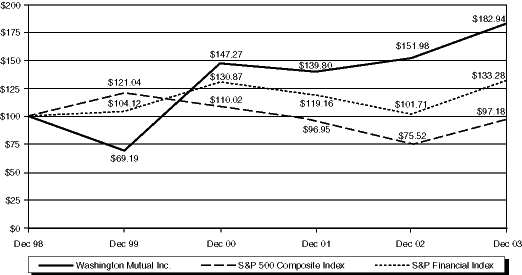
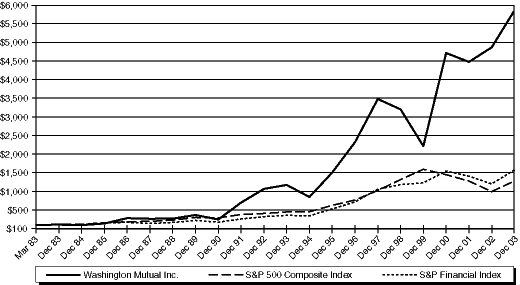
28
SECTION 16(a) BENEFICIAL OWNERSHIP
Under Section 16(a) of the Securities Exchange Act of 1934, as amended, and the rules and regulations thereunder, Washington Mutual’s directors and executive officers and beneficial owners of more than 10% of any registered class of Washington Mutual equity securities, if any, are required to file reports of their ownership, and any changes in that ownership, with the SEC. Based solely on its review of copies of these reports and on written representations from such reporting persons, Washington Mutual believes that during 2003, all such persons filed all ownership reports and reported all transactions on a timely basis, except as otherwise noted below:
| Ø | A Form 5 for the year-ended December 31, 2002 was filed late for the following reporting persons: Douglas P. Beighle, Willis B. Wood, Jr., Craig J. Chapman, Daryl D. David, Robert H. Miles, Craig E. Tall and J. Taylor Crandall (a former director). This Form 5 disclosed compensation deferments into Company phantom stock units during the period of January 1, 2002 through August 29, 2002, pursuant to the Company’s Deferred Compensation Plan for Directors and Certain Highly Compensated Employees. As of August 29, 2002, these transactions became reportable within two business days on Form 4, which is the Company’s practice. Prior to August 29, 2002, these transactions were reportable on Form 5 at the end of the applicable year. |
| Ø | A Form 5 for the year ended December 31, 2003 reporting a gift of 576 shares of Company Common Stock by Craig J. Chapman was filed late. |
29
ITEM 2. RATIFICATION OF THE APPOINTMENT
Deloitte & Touche LLP currently serves as the Company’s independent auditors and has conducted the audit of the Company’s accounts for 2003. The Sarbanes-Oxley Act of 2002 requires the Audit Committee to be directly responsible for the appointment, compensation and oversight of the audit work of the independent auditors. In February 2004, the Audit Committee appointed Deloitte & Touche LLP to serve as independent auditors to conduct an audit of the Company’s accounts for 2004.
PRINCIPAL ACCOUNTANT’S FEES
For the years ended December 31, 2003 and 2002, professional services were performed for the Company by Deloitte & Touche LLP, the member firms of Deloitte Touche Tohmatsu and their respective affiliates (collectively, the “Deloitte Entities”). Aggregate fees billed to the Company by the Deloitte Entities for 2003 and 2002 were as follows:
| Year Ended | |||||||||
|
| |||||||||
| 2003 | 2002 | ||||||||
|
|
| ||||||||
|
Audit Fees
|
$6,089,000 | $ | 5,300,000 | ||||||
|
Audit-Related Fees |
1,440,000 | 2,000,000 | |||||||
|
Tax Fees
|
1,198,000 | 426,000 | |||||||
|
All Other
Fees |
6,525,000 | 10,300,000 | |||||||
|
|
|
||||||||
|
Total Fees
|
$ | 15,252,000 | $ | 18,026,000 | |||||
Audit Fees
Audit Fees related to the audit of the Company’s annual financial statements for the years ended December 31, 2003 and 2002, and for the reviews of the financial statements included in the Company’s Quarterly Reports on Form 10-Q for those years.
Audit-Related Fees
Audit-Related Fees for each of 2003 and 2002 included fees for:
| Ø | audits of employee benefit plans and trust entities, | |
| Ø | assistance related to mortgage securitizations and other securities offerings, | |
| Ø | assistance in applying financial accounting principles, | |
| Ø | internal control related services, and | |
| Ø | loan related due diligence procedures. |
Tax Fees
Tax Fees in both 2003 and 2002 consisted of tax compliance services including preparation of original and amended tax returns, assistance with Internal Revenue Service exams and appeals and supervisory goodwill claims. Tax compliance fees were $713,000 in 2003 and $328,000 in 2002. Tax Fees in both 2003 and 2002 also included tax consulting fees for tax advice relating to acquired companies, discontinued operations, tax credits and a proposed business structure. Tax consulting fees were $485,000 in 2003 and $98,000 in 2002.
All Other Fees
All Other Fees for 2003 included fees for:
| Ø | consulting related to non-financial software selection projects, | |
| Ø | strategic sourcing of key vendor relationships consulting, | |
| Ø | vendor management consulting, | |
| Ø | consulting related to a non-financial system design, and | |
| Ø | cost reduction advisory services. |
All Other Fees related to 2002 included fees for:
| Ø | co-sourced internal audit activities (effective January 1, 2003, such activities were discontinued), | |
| Ø | cost reduction advisory services, | |
| Ø | vendor management consulting, |
30
| Ø | advisory services on compliance matters, consulting related to a non-financial software selection project, and | |
| Ø | consulting related to a non-financial system design and implementation project. |
Audit Committee Pre-Approval Policy
The Company’s Audit Committee believes that maintaining the independence of the Company from its independent auditors is critical to the integrity of the Company’s financial statements. The Audit Committee has adopted a Policy Regarding the Approval of Audit and Non-Audit Services Provided by the Independent Auditor (the “Pre-Approval Policy”), which requires that services performed for the Company by the independent auditor must be pre-approved by the Audit Committee, or a designated member thereof. The Pre-Approved Policy, among other things, also contains a list of non-audit services that the Company’s independent auditor is prohibited from providing. In determining whether to approve services to be performed by the independent auditor, the Audit Committee considers the independent auditor’s knowledge of the Company and whether another firm can provide similar services to the Company.
In 2003 100% of Audit-Related Fees, Tax Fees and All Other Fees were approved by the Audit Committee.
To further the independence of the Company from its independent auditor the Audit Committee adopted a policy in February 2003 requiring that fees paid by the Company to its independent auditor that are considered All Other Fees (i.e. fees for services that are not Audit, Audit-Related or Tax-Related) shall be less than the aggregate amount of Audit Fees, Audit-Related Fees and Tax Fees paid to its independent auditor. This policy also strongly discourages the Company’s use of its independent auditor for non-audit services, and is intended to limit the amount of non-audit services performed by the independent auditor. On a quarterly basis, the Audit Committee reviews summaries of previously approved services or categories of services performed by the independent auditor and the fees therefor, a list of non-audit services to be approved by the Audit Committee, and a current projection, presented in a manner consistent with the proxy statement disclosure requirements, of the estimated annual fees to be paid to the independent auditor. The ratio of fees for Audit, Audit-Related and Tax-Related Services to the amount of All Other Fees paid by the Company to its independent auditor was 1.34:1.00 in 2003 and 0.75:1.00 in 2002.
Ratification of Independent Auditors
Selection of the Company’s independent auditor is not required to be submitted to a vote of the shareholders of the Company for ratification. However, the Board of Directors is submitting this matter to the shareholders as a matter of good corporate practice. If the shareholders fail to ratify the selection, the Audit Committee will reconsider whether to retain Deloitte & Touche LLP. After doing so, it may retain that firm or another without re-submitting the matter to the Company’s shareholders. Even if the shareholders ratify the appointment of Deloitte & Touche LLP, the Audit Committee may, in its discretion, direct the appointment of different independent auditors at any time during the year if it determines that such a change would be in the best interests of the Company and the shareholders.
Representatives of Deloitte & Touche LLP will be present at the Annual Meeting of Shareholders, with the opportunity to make a statement if so desired, and will be available to respond to appropriate questions submitted to the Secretary of Washington Mutual in advance of the Annual Meeting.
THE BOARD OF DIRECTORS UNANIMOUSLY RECOMMENDS THAT
31
ITEM 3. SHAREHOLDER PROPOSAL RELATING TO
The Sheet Metal Workers’ National Pension Fund of 601 N. Fairfax Street, Suite 500, Alexandria, Virginia 22314, submitted the following shareholder proposal and supporting statement. The Fund is the beneficial owner of approximately 28,095 shares of Company Common Stock. The proposal and supporting statement are quoted verbatim below.
Shareholder Resolution
Resolved, that the shareholders of Washington Mutual (“Company”) request that the Company’s Board of Directors and its Executive Compensation Committee replace the current system of compensation for senior executives with the following “Commonsense Executive Compensation” program including the following features:
| (1) | Salary – The chief executive officer’s salary should be targeted at the mean of salaries paid at peer group companies, not to exceed $1,000,000 annually. No senior executive should be paid more than the CEO. | |
| (2) | Annual Bonus – The annual bonus paid to senior executives should be based on well-defined quantitative (financial) and qualitative (non-financial) performance measures. The maximum level of annual bonus should be a percentage of the executive’s salary level, capped at 100% of salary. | |
| (3) | Long-Term Equity Compensation – Long term equity compensation to senior executives should be in the form of restricted shares, not stock options. The restricted share program should utilize justifiable performance criteria and challenging performance benchmarks. It should contain a vesting requirement of at least three years. Executives should be required to hold all shares awarded under the program for the duration of their employment. The value of the restricted share grant should not exceed $1,000,000 on the date of the grant. | |
| (4) | Severance – The maximum severance payment to a senior executive should be no more than one year’s salary and bonus. | |
| (5) | Disclosure – Key components of the executive compensation plan should be outlined in the Compensation Committee’s report to shareholders, with variances from the Commonsense program explained in detail. |
The Commonsense compensation program should be implemented in a manner that does not violate any existing employment agreement or equity compensation plans.
Supporting Statement
We believe that compensation paid to senior executives at most companies, including ours, is excessive, unjustified, and contrary to the interests of the Company, its shareholders, and other important corporate constituents. CEO pay has been described as a “wasteland that has not been reformed” (Institutional Shareholder Services senior vice-president, Wall Street Journal, “Executive Pay Keeps Rising, Despite Outcry,” October 3, 2003). As of 2002, the CEO-worker pay gap of 282-1 was nearly seven times as large as the 1982 ratio of 42-1 according to the United for a Fair Economy’s Tenth Annual CEO Compensation Survey (“Executive Excess 2003 – CEO’s Win, Workers and Taxpayers Lose”).
We believe that it is long past time for shareholders to be proactive and provide companies clear input on the parameters of what they consider to be reasonable and fair executive compensation. We believe that executive compensation should be designed to promote the creation of long-term corporate value. The Commonsense Executive Compensation principles seek to focus senior executives, not on quarterly performance numbers, but on long-term corporate value growth, which should benefit all the important constituents of the Company. We challenge our Company’s leadership to embrace the ideas embodied in the Commonsense proposal, which still offers executives the opportunity to build personal long-term wealth but only when they generate long-term corporate value.
The Board of Directors unanimously recommends that shareholders vote against this proposal for the following reasons:
Washington Mutual’s Board of Directors and its independent Human Resources Committee endorse the goal of establishing compensation programs that reward executives only when they generate long-term corporate value. For example, bonuses for 2003 were below the prior year’s level because the Human Resources Committee determined that certain aspects of performance did not meet expectations, even though the Company’s performance under some criteria set
32
| • | the Chief Executive Officer’s salary is targeted at the median of peer companies, taking into account individual performance, and has not exceeded $1 million annually; | |
| • | annual bonuses are based on the Company’s achievement of clearly articulated business goals that are selected by the independent Human Resources Committee as long-term determinants of shareholder value; | |
| • | long-term equity compensation is provided in the form of performance shares that are contingent upon achievement of specific corporate performance goals tied to shareholder value over a three year term, and a number of the Company’s compensation programs are designed to foster stock ownership by executives; | |
| • | the Company generally does not maintain a fixed severance package for departing executives, other than with respect to the chief executive officer; and | |
| • | key components of the Company’s executive compensation program are discussed in the Human Resources Committee’s Report on Executive Compensation, including specifically identifying performance criteria established by the committee for different components of compensation. |
The main aspects of the proposal which differ from the Company’s current executive compensation philosophy is that the proposal would impose arbitrary caps on compensation and could limit the Company’s ability to implement alternative arrangements in the future. The independent Human Resources Committee and the Board believe that it is not appropriate to impose a one-size-fits-all standard for executive compensation. Instead, they believe that it is important to retain the flexibility to structure compensation programs that can allow the Company to achieve the goals of attracting, retaining and motivating highly qualified officers; maintaining competitive compensation packages; maintaining compensation packages that are equitable relative to efforts, skills and responsibilities within the Company; and making a significant portion of each officer’s total compensation package at risk and dependent on Company performance and creation of long-term shareholder value. As part of fulfilling these goals, the Company must take into account pay levels in the marketplace, and the Company utilizes bonus programs that provide superior compensation when it achieves superior results in creating and maintaining long-term shareholder value. The Board believes that it is important to maintain the ability to implement and adapt a compensation program that allows it to continue to operate under these principles.
FOR THE FOREGOING REASONS, THE BOARD OF DIRECTORS
33
ANNUAL REPORT
The Company’s Annual Report on Form 10-K for the year ended December 31, 2003, including financial statements and schedules, and the Company’s 2003 Summary Annual Report were mailed to shareholders with this Proxy Statement. Additional copies of the Annual Report on Form 10-K for the year ended December 31, 2003 and the 2003 Summary Annual Report may be obtained without charge by writing to Investor Relations, Washington Mutual, Inc., 1201 Third Avenue, Suite 2140, Seattle, Washington 98101. This Proxy Statement and the Company’s Annual Report on Form 10-K for the year ended December 31, 2003, are also available at the Company’s website, www.wamu.com/ir and from the Securities and Exchange Commission at its website, www.sec.gov.
SHAREHOLDER PROPOSALS FOR THE 2005 ANNUAL MEETING
Under the rules of the Securities and Exchange Commission and the Company’s Bylaws, shareholder proposals that meet certain conditions may be included in the Proxy Statement and Form of Proxy for a particular annual meeting if they are presented to the Company in accordance with the following:
| • | Shareholders that intend to present a proposal at the Company’s 2005 Annual Meeting of Shareholders must give notice of the proposal to the Company no later than November 17, 2004 to be considered timely under the Company’s Bylaws and for inclusion of such proposal in the Proxy Statement and Form of Proxy relating to that meeting. | |
| • | If the date of the 2005 Annual Meeting is earlier than March 21, 2005 or later than May 20, 2005, notice of a proposal must be received by Washington Mutual a reasonable time before the Company begins to print and mail its proxy materials to be considered for inclusion in the Proxy Statement and Form of Proxy relating to that meeting, otherwise such proposal must be received by Washington Mutual not less than 45 days nor more than 75 days prior to such meeting to be considered timely. | |
| • | Pursuant to Rule 14a-4(c)(1) promulgated under the Securities Exchange Act of 1934, as amended, the proxies designated by Washington Mutual for the 2005 Annual Meeting will have discretionary authority to vote with respect to any proposal that is determined to be untimely. In addition, the Company’s Bylaws provide that any matter to be presented at the 2005 Annual Meeting must be proper business to be transacted at the Annual Meeting or a proper nomination to be decided on at the Annual Meeting and must have been properly brought before such meeting pursuant to the Bylaws. | |
| • | Receipt by Washington Mutual of any proposal from a qualified shareholder in a timely manner will not guarantee its inclusion in the proxy materials or its presentation at the 2005 Annual Meeting because there are other relevant requirements in the Securities and Exchange Commission’s proxy rules. | |
| • | The Secretary of the Company must receive shareholder proposals or nominations in writing at the executive offices of the Company at 1201 Third Avenue, WMT 1706, Seattle, Washington 98101, Attention: Secretary. |
OTHER MATTERS
As of the date of this Proxy Statement, management knows of no matters that will be presented for consideration at the Annual Meeting other than the proposals set forth in this Proxy Statement. If any other matters properly come before the Annual Meeting, it is intended that the shares represented by proxies will be voted in accordance with the judgment of the persons voting such proxies.
| By Order of the Board of Directors, | |
| | |
| William L. Lynch | |
| Secretary |
34
APPENDIX A
Washington Mutual, Inc.
I. PURPOSE
The Audit Committee (the “Committee”) shall provide assistance to the Company’s Board of Directors (the “Board”) in fulfilling its responsibility to shareholders, the investment community and governmental agencies that regulate the activities of the Company with respect to oversight of:
| A. | The integrity of the Company’s financial reporting process and financial statements and systems of internal controls; |
B. The Company’s compliance with legal and regulatory requirements;
C. The independent auditor’s qualifications and independence and performance; and
D. The performance of the Company’s internal audit function.
The Committee shall prepare the report that Securities and Exchange Commission (“SEC”) rules require be included in the Company’s annual proxy statement.
II. STRUCTURE AND OPERATIONS
Composition and Qualifications
The Committee shall be composed of three or more directors, as determined by the Board, each of whom is determined by the Board to be “independent” under the rules of the New York Stock Exchange and Section 10A(m)(3) of the Securities Exchange Act of 1934, as amended (the “Exchange Act”), and the Rules and Regulations (the “Regulations”) of the SEC under the Exchange Act. All members of the Committee shall be financially literate, as the Board interprets such qualification in its business judgment, or must become financially literate within a reasonable period of time after their appointment to the Committee. In addition, at least one member shall have accounting or related financial management expertise, as the Board interprets such qualification in its business judgment, and, if required by the Board, at least one member shall be an “audit committee financial expert” as that term is defined in the Regulations.
No member of the Committee may serve on the audit committee of more than three public companies, that is, companies, the securities of which are registered under Section 12 of the Exchange Act or that are required to file reports under Section 15(d) of the Exchange Act, or that files or has filed a registration statement that has not yet become effective under the Securities Act of 1933 and that it has not withdrawn, including the Company, unless the Board (i) determines that such simultaneous service would not impair the ability of such member to effectively serve on the Committee, and (ii) discloses such determination in the annual proxy statement. Service on the Company’s audit committee and the audit committee of any of its subsidiaries shall be deemed to be service on one audit committee for purposes of this paragraph.
No member of the Committee shall receive compensation from the Company other than (i) director’s fees for service as a director of the Company, including reasonable compensation for serving on the Committee and regular benefits that other directors receive, and (ii) a pension or similar compensation for past performance, provided that such compensation is not conditioned on continued or future service to the Company.
Appointment and Removal
The members of the Committee shall be appointed annually by the Board, acting upon the recommendation of the Chair of the Board and the Governance Committee, and shall serve until the term of their appointments, so long as they remain a member of the Board.
Chair
In the absence of a member designated by the Board to serve as chair, the members of the Committee may appoint, by the majority vote of the full Committee membership, from among their number, a person to preside at their meetings.
A-1
Delegation
The Committee may delegate certain of its responsibilities and duties as it deems appropriate, to (i) subcommittees comprised of the Committee’s own members or (ii) officers of the Company; provided, however, the Committee may delegate to a “Designated Member or Members” of the Committee the authority to approve in advance non-audit services to be provided by the independent auditor so long as any such approvals are disclosed to the full Committee at its next scheduled meeting.
III. RESPONSIBILITIES AND DUTIES
The following functions shall be the common recurring activities of the Committee in carrying out its purpose outlined in Section I of this Charter. These functions should serve as a guide with the understanding that the Committee may carry out additional functions and adopt additional policies and procedures as may be appropriate in light of changing business, legislative, regulatory or other conditions. The Committee shall also carry out any other responsibilities and duties delegated to it by the Board from time to time related to the purpose of the Committee outlined in Section I of this Charter.
The Committee, in discharging its oversight role, is empowered to study or investigate any matter of interest or concern that the Committee deems appropriate. In this regard, the Committee shall have the authority to retain outside legal, accounting or other advisors for this purpose, including the authority to approve fees payable to such advisors and any other terms of retention. The Company shall provide for appropriate funding, as determined by the Audit Committee, for payment of compensation to the independent auditor for the purpose of rendering an audit report and to any advisors employed by the Audit Committee.
The Committee shall be given full access to the Company’s internal audit department, the Board, corporate executives and independent auditor as necessary to carry out these responsibilities and duties. While acting within the scope of the purpose of the Committee outlined in Section I of this Charter, the Committee shall have all the authority of the Board.
Notwithstanding the foregoing, the Committee is not responsible for certifying the Company’s financial statements or guaranteeing the independent auditor’s report nor is the Committee responsible for guaranteeing the Company’s compliance with laws, regulations or its compliance policies or programs. The fundamental responsibility for the Company’s financial statements and disclosures and its compliance with laws and regulations rests with management and the independent auditor.
Independent Auditor
With regard to the independent auditor, the Committee shall:
| • | Select and retain the independent auditor (and propose, in any proxy statement, that shareholders ratify the appointment of the independent auditor) and, where appropriate, terminate the independent auditor. At least annually, evaluate the independent auditor’s qualifications, performance and independence, including that of the lead partner. In so doing the Committee shall: |
| • | Obtain and review a report by the Company’s independent auditor describing (i) the auditing firm’s internal quality-control procedures; (ii) any material issues raised by the most recent internal quality-control review, or peer review, of the auditing firm, or by any inquiry or investigation by governmental or professional authorities, within the preceding five years, respecting one or more independent audits carried out by the auditing firm, and any steps taken to deal with any issues; and (iii) (to assess the auditor’s independence) all relationships between the independent auditor and the Company. | |
| • | Evaluate the written disclosures and the letter that the independent auditor submits to the Committee regarding the auditor’s independence in accordance with Independence Standards Board Standard No. 1 and discuss such reports with the independent auditor. |
| • | Approve the terms of the audit engagement and the fees to be paid to the independent auditor for audit services. |
| • | Inform, in writing, each registered public accounting firm currently performing audit services for the Company that such firm reports directly to the Committee. |
| • | Oversee the work of any registered public accounting firm engaged by the Company to perform audit services, including the resolution of any disagreement between management and the auditor regarding financial reporting, for the purpose of preparing and issuing an audit report or related work; any accounting adjustments that were noted or |
A-2
| proposed by the auditor but were “passed” (as immaterial or otherwise); and any communications between the audit team and the audit firm’s national office respecting auditing or accounting issues presented by the engagement. | |
| • | Review with the independent auditor the responsibilities, budget and staffing of the Company’s internal audit function. |
| • | Approve in advance any significant audit or non-audit engagement or relationship between the Company and the independent auditor, which is not prohibited by law, and approve the fees for such services. Assure the regular rotation of the lead audit partner as required by law and consider whether, in order to assure continuing auditor independence, there should be regular rotation of the audit firm itself. |
| • | Instruct the independent auditor to report to the Committee on all critical accounting policies of the Company, all alternative treatments of financial information within generally accepted accounting principles that have been discussed with management, ramifications of the use of such alternative disclosures and treatments and the treatment preferred by the independent auditor, and other material written communication between the independent auditor and management. |
| • | Discuss with the independent auditor the matters required to be discussed by SAS 61 — Communications with Audit Committee, as amended from time to time. |
Review of Company’s External Reports
With regard to the review of documents and reports, the Committee shall:
| • | Meet with management and the independent auditor to review and discuss the Company’s annual report on Form 10-K, including the Company’s disclosure under “Management’s Discussion and Analysis of Financial Condition and Results of Operations,” the annual financial statements and the report of the independent auditor thereon, and significant issues encountered in the course of the audit work, including: restrictions on the scope of activities; recommended adjustments arising from the audit; the adequacy of internal financial controls; access to required information; the adequacy of the disclosure of off-balance sheet transactions, arrangements, obligations and relationships in reports filed with the SEC; and the appropriateness of the presentation of any pro forma financial information included in any report filed with the SEC. |
| • | Following such reviews and discussions, determine whether to permit the inclusion of the annual financial statements in the Company’s annual report. |
| • | Meet quarterly with management and the independent auditor, in advance of filing the Company’s quarterly report on Form 10-Q, to review and discuss the quarterly financial statements, including the Company’s disclosures under “Management’s Discussion and Analysis of Financial Condition and Results of Operations.” |
| • | Discuss with management earnings press releases, as well as financial information and earnings guidance provided to analysts and rating agencies. The Committee’s discussion in this regard may be general in nature (i.e., discussion of the types of information to be disclosed and the type of presentation to be made) and need not take place in advance of each earnings release or each instance in which the Company may provide earnings guidance. |
| • | Review the management letter regarding the Company’s internal controls delivered by the independent auditor in connection with the audit. |
| • | Meet periodically in separate executive sessions with management, the Company’s general auditor, and the independent auditor to discuss matters that the Committee or either of these groups believes could significantly affect the financial statements and should be discussed privately. |
| • | Review significant changes to the Company’s accounting principles and practices proposed by the independent auditor, the Company’s general auditor, or management. |
Internal Audit and Its Functions
With regard to internal audit and its functions, the Committee shall:
| • | Select and employ the Company’s general auditor, and, where appropriate, direct the replacement of this officer. |
| • | Review the adequacy of the authority, responsibilities and functions of the Company’s internal audit department, including internal audit plans, budget, and the scope and results of internal audits and management’s responses thereto. |
| • | Review with the independent auditor its evaluation of the internal audit function. |
A-3
Financial Reporting Process
With regard to the financial reporting process, the Committee shall:
| • | Review with management, the internal auditors and the independent auditor the integrity of the Company’s financial reporting processes, both internal and external. In that connection the Committee shall obtain and discuss with management and the independent auditor, reports from management and the independent auditor regarding (i) all critical accounting policies and practices to be used by the Company; (ii) the effect on the Company’s financial statements of the judgments, assumptions and estimates used by management with respect to those critical accounting policies; and (iii) the potential effects of changes to or variances in those judgments, assumptions and estimates on the Company’s financial statements. |
| • | Prepare the report of the Committee required by the rules of the SEC to be included in the Company’s annual proxy statement. |
| • | Monitor management’s publication of the Committee’s charter in the Company’s proxy statement takes place at least once every three years. |
| • | In connection with each periodic report of the Company, review disclosures made to the Committee by the Company’s Chief Executive Officer and Chief Financial Officer regarding the effectiveness of, or any deficiencies in, the design or operation of internal controls and any fraud, whether or not material, that involves management or other employees who have a significant role in the Company’s internal controls. |
Legal Compliance/ Enterprise Risk Management
With regard to legal compliance/enterprise risk management, the Committee shall:
| • | Consult with the Company’s general counsel and chief risk officer concerning legal and regulatory matters that may have a significant impact on the Company’s financial statements, compliance policies or programs. |
| • | Have such meetings with management as the Committee deems appropriate to discuss significant risk exposures facing the Company and to discuss the steps that management has taken to monitor and control such exposures, including the Company’s guidelines and policies governing risk assessment and risk management. |
| • | Oversee the Company’s performance of commitments made by management in the course of regulatory examinations, make recommendations and monitor the Company’s compliance with the Committee’s recommendations. |
| • | Establish procedures for the receipt, retention and treatment of any complaints received by the Company about its accounting, internal accounting controls or auditing matters and for the confidential and anonymous submission by employees of concerns regarding questionable accounting or auditing matters. |
| • | Receive periodic reports from management as to the administration of, and compliance with, the Code of Ethics for Senior Financial Officers. Receive periodic reports from management as to the administration of, and compliance with, the Code of Conduct. |
| • | Review and act upon all requests for waivers of the Code of Conduct in favor of any executive officer or director of the Company, and any waiver of the Code of Ethics for Senior Financial Officers. |
| • | Set clear hiring policies for employees or former employees of the independent auditor. |
Reports
With regard to reports, the Committee shall:
| • | Provide minutes of Committee meetings to the Board, and report regularly to the Board on any significant matters arising from the Committee’s work. A report to the Board may take the form of an oral report by the Chair or any other member of the Committee designated by the Committee or the Chair to make such a report. |
Committee Performance Review
With regard to the Committee’s performance review, the Committee shall:
| • | Perform a review and evaluation, at least annually, of the performance of the Committee by whatever means the Committee determines appropriate, including by surveying the Committee membership. |
A-4
| • | Review and reassess, at least annually, this Charter and, if appropriate, recommend proposed changes to the Board. |
IV. MEETINGS
A majority of the number of Committee members shall constitute a quorum for the transaction of any business at any meeting of the Committee. If less than a majority shall attend a meeting, a majority of the members present may adjourn the meeting from time to time without further notice, and a quorum present at any such adjourned meeting may transact business.
If a quorum is present when a vote is taken, then the affirmative vote of a majority of Committee members present shall constitute the act of the Committee.
Any action permitted or required to be taken at a meeting of the Committee may be taken without a meeting if all the members of the Committee shall sign one or more written consents setting forth the action. Action taken by written consent is effective when the last Committee member signs the consent, unless the consent specifies an earlier or later effective date.
A Committee member who is present at a meeting of the Committee at which action is taken shall be presumed to have assented to the action taken unless such member’s dissent shall be entered in the minutes of the meeting or unless such member shall file his written dissent to such action with the person acting as secretary of the meeting before the adjournment thereof or shall forward such dissent by registered mail to the secretary of the Company immediately after adjournment of the meeting. A member who votes in favor of an action shall have no such right to dissent.
Committee members may participate in, or conduct, a meeting of the Committee through the use of any means of communication by which all Committee members participating can hear each other during the meeting and participation by such means shall constitute presence in person at the meeting.
The Committee shall meet at least four times annually as directed by the Chair of the Committee, except that the Board, the Chair of the Board or the Chair of the Committee may call special meetings of the Committee. The notice of a special meeting shall state the date and time and, if the meeting is not exclusively telephonic, the place of the meeting. Unless otherwise required by law, neither the business to be transacted at, nor the purpose of, any regular or special meeting need be specified in the notice or waiver of notice of such meeting.
Any Committee member may waive notice of any meeting of the Committee at any time. Whenever any notice is required to be given to any Committee member under this Charter or applicable law, a waiver thereof in writing signed by the member, entitled to notice shall be deemed equivalent to the giving of notice. The attendance of a member at a meeting of the Committee shall constitute a waiver of notice of the meeting except where a member attends a meeting for the express purpose of objecting to the transaction of any business because the meeting is not lawfully convened. A member waives objection to consideration of a particular matter at a meeting that is not within the purpose or purposes described in the meeting notice, unless the member objects to considering the matter when it is presented.
A-5