|
Industry shipments declined for the third straight year, ending at 193,229, down 22.9 percent from the previous year’s 250,614 and 48.2 percent from the peak in 1998. A rise in monthly shipments on a year-over-year basis in the fall of 2001 signaled a possible recovery, but it was short-lived. Several important lenders to our industry announced in late 2001 and during early 2002 their intentions to exit the business or further restrict their participation. In addition, the Texas legislature passed a bill that went into effect on January 1, 2002. The new law, in effect, While regional banks and other lenders do make loans on manufactured homes, specialized national lenders provided the bulk of the loans during the 1990s. Due to the overly competitive environment in the industry during the last half of the ’90s—as well as overly aggressive lending practices on the part of some lenders quite apart from competitive pressures—most of these lenders made a disproportionate number of bad loans. This caused traditional lenders to exit the market and potential new lenders to be discouraged by the poorly performing portfolios generated by many lenders during that period. Our estimates are that the top seven lenders funded almost $12 billion of manufactured housing in 2000. By mid-2002, four of those seven had exited the business altogether, and we believe the remaining three will provide less than $3 billion of loans for new manufactured homes during the year. Clearly, in the current situation the most creditworthy customers are still able to qualify for funding. However, significantly higher credit scores and higher down payments are now required. This creates a vacuum of financing for many potential customers who should be able to qualify for a loan—as well as an opportunity for a lender with a careful, rational approach. In particular, customers whose situation dictates a personal property (or chattel) loan, and people who are seeking a single-section home are being left out or priced out by most lenders. Just a few years ago, more than half of manufactured home borrowers utilized chattel loans, and half of all manufactured homes sold were single-sections. Recently, chattel borrowers and single-section home purchasers have each shrunk to approximately 25 percent of the total market. It appears that these trends are being driven largely by lack of financing rather than by changes in demand. The lax underwriting standards created another problem for the industry—when people can’t make their payments and lenders repossess their homes, these houses enter the market again, often at fire sale prices, competing with new homes. Furthermore, lenders are highly motivated to qualify new buyers for repossessed houses, for which the lender is responsible. Last year, approximately 90,000 homes were repossessed. This amount is almost half of the number of new homes that were manufactured last year. This calendar year we expect the percentage of repossessions to be even higher. The upshot of all of this is we now anticipate that recovery will not begin until mid-2003. The stream of repossessed houses should begin to slow by then, based on how much time will have elapsed since the bulk of the lax underwriting occurred. And we think that the lending situation will have eased through increased volume by current lenders and perhaps the entry of new lenders. We do continue to see demand for manufactured homes, as evidenced by customer traffic and applications at retail stores. Also, projections indicate that the industry’s target demographic market is expanding. There is a continuing need for affordable housing, and manufactured homes remain a great value. Obviously, many potential customers are securing alternative housing if they can’t get funding for manufactured homes—sometimes single-family site-built houses, but more often apartments. Consequently, we believe that once the financing imbalance is resolved—either by lenders entering the market or current lenders expanding their participation—we may experience some pent-up demand. It is likely, however, to be tempered by some lingering (and appropriate) conservatism in lending practices.
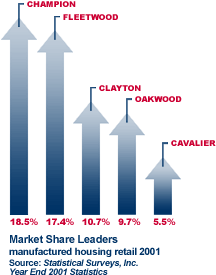
Retail sales of Fleetwood homes totaled 32,348 in calendar 2001, off 34 percent from the prior year. We ended the year with retail market share of 17.4 percent—a higher percentage than our wholesale market share, which reflects our successful actions to reduce inventory on our retailers’ lots. Fleetwood’s shipments declined 33 percent from 45,082 to 30,410 and, consequently, wholesale market share dropped from 18.0 percent in calendar 2000 to 15.7 percent in calendar 2001. Much of this market share loss was a result of the Housing Group’s The rightsizing actions of fiscal 2001 put the manufacturing segment in a good position, considering the state of the industry. A decrease of 1 percent in our material cost as a percentage of sales helped protect gross margins. Material standardization efforts yielded annualized savings of more than $4 million. Total retailer inventories have been reduced by 18 percent since the end of fiscal 2001, helping to better position retailers through lower inventory carrying costs. Average turn rates on Fleetwood homes in dealer inventories are up 32 percent, from 2.2 at the end of last year to 2.9 this year. Improvements were also made at the personnel level. The manufacturing segment successfully flattened the organization, eliminating a layer of management. A new safety program included controls and procedures that decreased job-related injuries by more than 50 percent, so workers’ compensation expenses have been significantly reduced. And turnover among hourly associates has been reduced, improving efficiencies and quality. Over the past two years, the Housing Group has successfully reorganized for a volatile down market. In addition to the 10 plants idled during fiscal 2001, we announced the closure of an additional plant in Texas in May 2002 and the consolidation of two plants in Tennessee in July 2002. Although we project that fiscal 2003 will be a difficult period for the Housing Group, it will be well positioned when the upturn in this traditionally cyclical business begins. New and improved products have been introduced. The Entertainer Home, for example, is a value-focused home offering an entertainment center and an emphasis on spacious areas for family gatherings. It has become one of our best sellers. Our two-story houses are creating a buzz wherever they’re displayed. We are using them to bring customers to our FRC stores, where traffic has increased by a multiple of three or four following each installation. And our LifeStages II Home incorporates universal design features to accommodate the changing lifestyles of homeowners. Fleetwood’s design team has introduced 135 new models so far in calendar 2002. One of the primary focuses for the design team will be to continue developing product innovations that will result in convenient and easy-to-maintain homes with high-quality features and appliances. Some of the newer floor plans include offices, workout rooms, studies, game rooms and larger second and third bathrooms, to accommodate contemporary living for families across the United States. The team also develops homes to meet the specific needs of developers and communities.
Our retailer relationships are of primary importance. Beyond providing them with products that customers want at a value-oriented price, we also strive to improve We believe our standard two-year warranty is the best in the industry. The entire home is covered for manufacturing defects. There is no small print, just coverage that’s easy to understand, with no service charge. We also offer FleetGuard, an optional three-year extended service contract on the structure as well as built-in systems and appliances. FleetGuard takes effect after the initial two-year warranty, and has a $50 deductible charge per service call. Our Pinnacle Program has been successful in encouraging our retailers to sell Fleetwood Homes exclusively. Our exclusive retailers sell about twice as many Fleetwood homes on a per-lot basis as our nonexclusive retailers. Pinnacle retailers receive valuable marketing support, as well as training and finance programs and, as a result, we now have more than 430 retailers in the program.
This year, wholesale financing has become an issue in the industry’s struggles, due largely to the withdrawal of Conseco from that business. Conseco, the industry’s largest floor plan lender with an approximate 20 percent market share, announced its action As with so many of the factors that are having a negative effect on sales and profits, we believe that the elimination of some of the industry’s marginal retailers, while unfortunate, will be beneficial in the long run. There are still more outlets than even “normal” demand can support. The trends toward higher credit standards, more land/home transactions and higher-end homes will ultimately have a positive effect on our industry and its image. While the short-term negatives create an extremely difficult environment, we will weather the storm. As we’ve been saying consistently, we believe that lending to manufactured home buyers can be a safe, profitable endeavor if managed prudently. There are a few well-respected non-industry lenders who are, or have been, evaluating this arena but the process has been much slower than anticipated. As a result, we’ve been pursuing alternative strategies to ensure that our Company-operated stores, as well as our independent retailers, have sustained access to competitive financing over the long term. To that end, we have established a finance subsidiary, HomeOne Credit Corp. (HCC). During the fiscal year, we successfully developed the HCC lending platform to provide incremental lending capacity to Company-operated stores. This strategy, to a limited degree, enables us to mitigate the impact of the restrictive financing, as well as provide us with a competitive edge. We continue to closely monitor the lending environment and consider strategic opportunities to expand lending capacity through the HCC platform.
This fiscal year was clearly a rebuilding year for Fleetwood Retail Corp. (FRC). The industry downturn allowed FRC to focus on improving financial performance, standardizing many important retail operating functions and providing key training and systems support. FRC has been reorganized and rightsized over the past two years to position itself for profitability, while still providing the improved shopping experience that we always The division’s goals in fiscal 2002 were to significantly reduce overhead expenses and inventory levels, tighten operational controls to gain efficiencies, develop and implement sales training programs, and standardize and centralize all accounting and administrative functions. We ended fiscal 2002 with 137 Company-operated stores, down from 188 at the beginning of the year. We expect to add to the store count where inadequate market penetration exists once the industry climate improves. However, due to the current industry conditions, our valuation of the division under newly adopted Statement of Financial Accounting Standards No. 142 led to an $80.6 million write-down of goodwill. In addition, we recorded $9.5 million of inventory write-downs and $8.9 million in asset impairment and restructuring charges. The division lost $65.2 million at the operating income line for the year. This was primarily a result of a 41 percent decline in sales to $328 million caused by the restrictive financing conditions and the reduced number of stores. The operating results were also negatively impacted by low gross margins stemming from competitive market conditions, the actions taken to reduce inventories and inventory write-downs. Operating expenses dropped by 32 percent, Despite the drop in the number of stores, 16 percent of Fleetwood’s production volume was sold through the sales centers during fiscal 2002. Most of our stores are exclusive Fleetwood dealers, and 95 percent of the new homes sold by FRC now are manufactured by Fleetwood. The retail division was built largely by acquisition, and integration of systems and operations has been an ongoing process. Unquestionably, substantial progress was achieved this year, as we have now centralized our accounting, payroll and financial services systems and implemented standardized policies and procedures for our associates. One key valuation is our Customer Satisfaction Index. This independently measured index is how we monitor our success in meeting and surpassing customers’ expectations. We continue to look for ways to bring value to our customers. For example, our Home Sentry Insurance Agency, Inc. provides insurance products at the time and point of sale, making these decisions more convenient for our customers and providing us with additional revenue. Certainly the ability to provide our customers with financing options through HomeOne Credit Corp. will be an increasingly important resource for us.
We believe that fiscal 2003 will bring with it a gain in our Housing Group’s market share, strengthened retailer relationships and continued improvements in our design and retail offerings. The integration of lending services, if it can be successfully developed and implemented on a meaningful scale, will only further add to our sales opportunities and create an additional profit center for our Company as we focus on our road to recovery. | ||||||