
 Year in review 2012
Chairman’s statement
BackWhat have been your main impressions of Vodafone after your first year?
The Group is well positioned. It has strong franchises in most of its markets, attractive global exposure, a core product that has become a vital part of people’s lives and a number of exciting opportunities for growth. Combined with its substantial cash flow, low leverage and management strength in depth, there are plenty of reasons for optimism.
However, throughout Vodafone I see what I would describe as a restless dissatisfaction: a sense that we are doing well and have significantly improved our commercial performance over recent years, but that we could do much better still.
People at Vodafone are their own toughest critics but this creates a highly energetic and strongly collaborative environment aiming at constant improvement.
How is the strategic focus of the company evolving?
The last two years have seen significant proceeds realised from the sale of non-controlled stakes and the income dividend from Verizon Wireless, which means that the external focus will now inevitably turn more to our operational execution. From our perspective, this is no more than business as usual and the Group’s strategy continues to be clear: to pursue our growth opportunities in data, enterprise and emerging markets in a disciplined and efficient way, and give shareholders a healthy return on their investment in the process. All of these elements are discussed in much more detail elsewhere in this report.
How is the Board currently functioning?
The Board’s primary focus is to support and advise the executive management on the delivery of the Group’s strategy within a clear and transparent governance framework, and I believe we are currently fulfilling that role. Our annual survey on Board effectiveness has prompted some minor modifications but no major overhaul.
With respect to expertise, my predecessor made excellent progress in assembling a broad diversity of talents and outlooks. The Board currently comprises business leaders from sectors as wide-ranging as financial services, retail, venture capital, accountancy, technology and regulated industries, as well as far-reaching geographical knowledge. I would be keen to build our experience of internet-based business models, as well as a detailed knowledge of Asian markets. We also aim to bring further gender balance over the coming years as we reach our goal of 25% of Board members being women by 2015.
How do you approach shareholder remuneration?
Our shareholder remuneration strategy is focused on total shareholder return, through a combination of growing the value of the Company by investing in opportunities that earn a return in excess of our cost of capital, and a consistent dividend policy. Our dividend per share growth target, put in place two years ago, sets out to give shareholders a growing dividend stream comfortably covered by expected annual free cash flow. We are also nearing the end of a £6.8 billion share buyback programme and this year paid an additional special dividend of 4.0 pence per share out of the proceeds of our income dividend from Verizon Wireless.
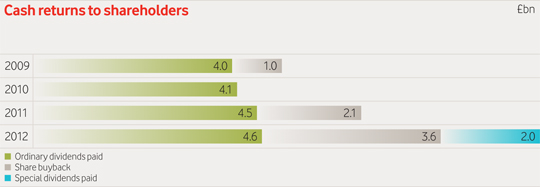
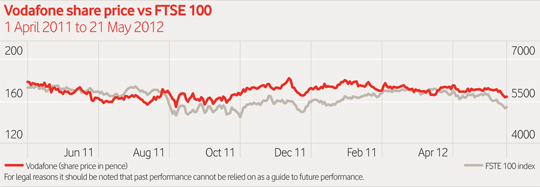
Taking ordinary dividends, this year’s special dividend and the buyback programme together, total cash returns to shareholders have been equivalent to approximately 30% of our market capitalisation over the last four years. Furthermore, in the period from 1 April 2011 to 21 May 2012, our share price has outperformed the MSCI European Telecoms index by 19.6% and the FTSE 100 by 3.7%.
And what about management remuneration?
The executive management team should be paid well to the extent that they create value for shareholders. Our incentive schemes have a bias towards long-term, share-based plans, which incentivise our leaders to prioritise multi-year investment decisions and align their interests closely with those of institutional shareholders. We have deepened this alignment this year by introducing shareholding requirements throughout the senior leadership team.
How is Vodafone addressing its broader social responsibilities?
Mobile telecommunications have played a significant role in the development of emerging market economies, not only through the investment in infrastructure but also through allowing people to connect with each other cheaply and easily for the first time. Vodafone and Vodacom have clearly played their part in this, particularly in India and southern Africa.
We are also taking a step further, introducing mobile financial services platforms across many of our markets, and developing mobile health initiatives. These, of course, stand to benefit our business through enhanced customer loyalty, but they also bring wider social benefits to the countries in which they are deployed.
Finally, we can also use the resourcefulness and dynamism of our employees to help raise funds to target specific medical issues that compromise thousands of lives in emerging markets. This year we launched our Moyo challenge, to raise £7 million through our employees for the Vodafone Foundation partner Comprehensive Community Based Rehabilitation (‘CCBRT’) to eradicate obstetric fistula (a maternal health condition) in Tanzania, which has affected 24,000 women since 2000. We are well on our way to reaching our target by June this coming year, aided by the generosity of our employees, suppliers and partners.
Gerard Kleisterlee
Chairman