|


| N O T E S T O C O N S O L I D A T E D F I N A N C I A L S T A T E M E N T S |
|
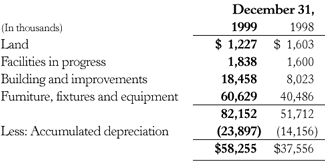
Significant Accounting Policies Fiscal Year During October 1997, the Company changed its fiscal year from a May 31 year end to a December 31 year end. Consolidation Policy The consolidated financial statements include Choice Hotels International, Inc. and its subsidiaries. All significant inter-company accounts and transactions have been eliminated in consolidation. Cash and Cash Equivalents The Company considers all highly liquid investments purchased with a maturity of three months or less at the date of purchase to be cash equivalents. Capitalization Policies Major renovations and replacements are capitalized to appropriate property and equipment accounts. Upon sale or retirement of property, the cost and related accumulated depreciation are eliminated from the accounts and the related gain or loss is taken into income. Maintenance, repairs and minor replacements are charged to expense. Impairment Policy The Company evaluates the recoverability of long lived assets, including franchise rights and goodwill, whenever events or changes in circumstances indicate that the carrying amount of an asset may not be recoverable. Recoverability is measured based on net, undiscounted expected cash flows. Assets are considered to be impaired if the net, undiscounted expected cash flows are less than the carrying amount of the assets. Impairment charges are recorded based upon the difference between the carrying value of the asset and the expected net cash flows, discounted at an appropriate interest rate. Deferred Financing Costs Debt financing costs are deferred and amortized, using the interest method, over the term of the related debt. Investment Policy The Company accounts for its investments in common stock in accordance with Statements of Financial Accounting Standards (“SFAS”) No. 115 “Accounting for Certain Investments in Debt and Equity Securities” and SFAS No. 130 “Reporting Comprehensive Income.” The Company accounts for its investment in unincorporated joint ventures in accordance with Accounting Principles Board Opinion (“APB”) No. 18 “The Equity Method of Accounting for Investments in Common Stock.” Use of Estimates The preparation of financial statements in conformity with generally accepted accounting principles requires management to make estimates and assumptions that affect the reported amounts of assets and liabilities, disclosure of contingent assets and liabilities at the date of the financial statements and the reported amounts of revenues and expenses during the reporting period. Actual results could differ from these estimates. Property and Equipment The components of property and equipment in the consolidated balance sheets are:
Depreciation has been computed for financial reporting purposes using the straight-line method. A summary of the ranges of estimated useful lives upon which depreciation rates have been based follows:
Goodwill Goodwill primarily represents an allocation of the excess purchase price of the stock of the Company over the recorded minority interest. Goodwill is amortized on a straight-line basis over 40 years. Such amortization amounted to $2.0 million, $2.0 million, $1.1 million, and $1.9 million for the years ended December 31, 1999 and 1998, the seven months ended December 31, 1997, and the fiscal year ended May 31, 1997, respectively. Goodwill is net of accumulated amortization of $10.1 million and $8.1 million at December 31, 1999 and 1998, respectively. Franchise Rights Franchise rights are intangible assets and represent an allocation in purchase accounting for the value of long-term franchise contracts. The majority of the balance results from the Econo Lodge and Rodeway acquisitions made in fiscal year 1991. Franchise rights acquired are amortized over an average life of 15 years. Amortization expense for the years ended December 31, 1999 and 1998, the seven months ended December 31, 1997 and the fiscal year ended May 31, 1997 amounted to $4.3 million, $3.8 million, $1.7 million and $2.9 million, respectively. Franchise rights are net of accumulated amortization of $23.0 million and $18.7 million at December 31, 1999 and 1998, respectively. |