Annual
Report 1999 | investor
relations | corporate
home
|
Annual
Report 1999 | investor
relations | corporate
home
|
|
MD
& A
|
|
MD
& A
|
|
MD & A One |
MANAGEMENT'S
DISCUSSION AND ANALYSIS OF This discussion contains certain forward looking statements within the meaning of Section 27A of the Securities Act of 1933, as amended, and Section 21E of the Securities Exchange Act of 1934, as amended, which are identified by the use of the words "believes," "expects," "anticipates," "will," "contemplates," "would" and similar expressions that contemplate future events. Numerous important factors, risks and uncertainties affect the Company's operating results, including without limitation those contained in this report, and could cause the Company's actual results to differ materially from the results implied by these or any other forward looking statements made by, or on behalf of, the Company. There can be no assurance that future results will meet expectations. Results
of Operations
The Company operates in two business segments in the software industry: products and professional services. Products
Revenue Professional
Services Revenue Operating
Profit Financial information for the Company's products segment is as follows (in thousands):
Products revenue by geographic location is presented in the table below (in thousands):
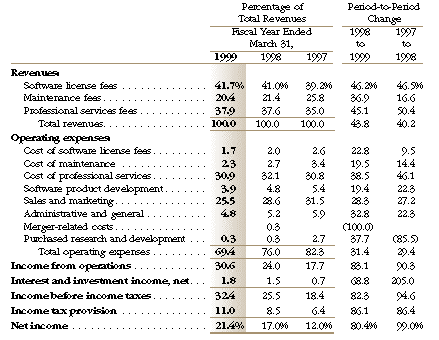
The products segment generated operating margins of 46.1%, 39.0% and 34.0% during fiscal years 1999, 1998 and 1997, respectively. Products expenses include cost of software license fees, cost of maintenance, software product development costs and sales and marketing expenses. The increase in the operating margins year over year is primarily a result of economies associated with larger transactions, more sales representatives in the field with increased sales productivity, additional product offerings including the NuMega and QA products acquired during fiscal 1998, and increased market penetration of our client/server products. Cost of software license fees includes amortization of capitalized software, the cost of preparing and disseminating products to customers and the cost of author royalties. The increase in these costs is due primarily to an increase in amortization of internally developed software products, increased author royalties and, to a lesser extent, increased packaging and distribution costs. As a percentage of software license fees, these costs were 4.1%, 4.9% and 6.5% in fiscal 1999, 1998 and 1997, respectively. Cost of maintenance consists of the cost of maintenance programmers and product support personnel and the computing, facilities and benefits costs allocated to such personnel. The increase in cost of maintenance was due primarily to the increase in maintenance and support staff in order to support the worldwide growth of the installed base. As a percentage of maintenance fees, these costs were 11.2%, 12.8% and 13.0% for fiscal years 1999, 1998 and 1997, respectively. The Company will continue to look for ways to reduce this percentage while maintaining superior service levels and high renewal rates. Software product development costs consist of the cost of programming personnel, the facilities, computing and benefits costs allocated to such personnel and the costs of preparing user and installation guides for the Company's software products, less the amount of software development costs capitalized during the fiscal year. The increase in these costs was due primarily to an increase in software development staff needed to meet the demand for new and enhanced products. While continuing to support and enhance its traditional mainframe products, the Company has significantly increased the resources allocated to developing and enhancing its client/server product lines. Before the capitalization of internally developed software products, total research and development expenditures for fiscal 1999 increased $11.8 million, or 18.2%, to $76.8 million from $65.0 million in fiscal year 1998. In fiscal 1998, total research and development costs increased $10.7 million, or 19.8%, from $54.3 million in fiscal 1997. Those major development projects that achieved technological feasibility for fiscal 1999 included two new interactive analysis and debugging products, one new fault management product, three new file and data management products, three automated testing products, seven systems management products, four new application development products, and eleven new Windows development tools. Sales and marketing costs consist of the sales and marketing expenses associated with the Company's products business, which include costs of direct sales, sales support and marketing staff, the facilities and benefits costs allocated to such personnel and the costs of marketing and sales incentive programs. The increase in sales and marketing costs was largely attributable to the expansion of the worldwide sales force, higher sales commissions associated with increased product sales, and increased advertising expenditures. The direct sales and sales support staff increased by 245 to 2,061 people at the end of fiscal 1999, as compared to 1,816 at the end of fiscal 1998 and 1,130 at the end of fiscal 1997. Financial information for the Company's professional services segment is as follows (in thousands):
Professional services revenue by geographic location is presented in the table below (in thousands):
The professional services segment generated operating margins of 18.4%, 14.5% and 12.0% during fiscal years 1999, 1998 and 1997, respectively. The increase in the professional services margin is primarily attributable to increased billable staff and a movement toward higher margin lines of business. Cost of professional services includes all costs of the Company's professional services business, including the personnel costs of the professional, management and administrative staff of the Company's services business and the facilities and benefits costs allocated to such personnel. The increase in these expenses was due primarily to an increase of 1,723 professional billable staff to 6,278 in fiscal 1999 from 4,555 people at the end of fiscal 1998. This compares to an increase of 1,033 billable people in fiscal 1998 from 3,522 people at the end of fiscal 1997. Administrative and general expenses increased 32.8% during fiscal 1999 and 22.3% during fiscal 1998. However, as a percentage of total revenue, these expenses have been steadily decreasing at 4.8%, 5.2% and 5.9% of total revenue during fiscal years 1999, 1998 and 1997, respectively. These decreases are primarily a result of increased revenues with significantly smaller increases in corporate expenditures. During fiscal year 1999, the Company recognized $4.4 million of expense for purchased research and development costs associated with the acquisition of products from Centerline Software, Inc., Vireo Software, Inc. and Cardume Software Limited. During fiscal 1998, the Company incurred special charges of $3.2 million related to purchased research and development incurred in connection with the acquisition of UnderWare, Inc. The Company also incurred $3.6 million of merger-related costs incurred in connection with the merger and integration of NuMega Technologies, Inc. During fiscal 1997, the Company incurred special charges of $21.8 million related to purchased research and development acquired in connection with the purchases of Direct Technology Limited and DRD Promark, Inc. Since the research and development in process had not reached technological feasibility, these amounts were expensed in accordance with Statement of Financial Accounting Standards No. 2. Net interest and investment income for fiscal 1999 was $29.4 million as compared to $17.4 million in fiscal 1998 and $5.7 million in fiscal 1997. This increase in income was due primarily to higher average cash and investment balances resulting from cash generated from higher operating earnings. The Company's provision for income taxes was $180.2 million in fiscal 1999, which represents an effective tax rate of 34.0%. This compares to a tax provision of $96.8 million in fiscal 1998, which represents an effective tax rate of 33.3%, and an income tax provision of $52.0 million in fiscal 1997, which represents an effective tax rate of 34.8%. The fiscal 1999 increase in the effective tax rate was due to the growth in pre-tax earnings, which dilutes the effect of the tax credits on the effective tax rates. The difference between the effective tax rate for fiscal 1998 and 1997 was due primarily to the non-deductibility of the purchased research and development costs incurred during fiscal 1997 in connection with the DRD Promark, Inc. acquisition. The effective tax rate for fiscal 1997 would have been 33.6% without this cost. Liquidity
and Capital Resources In March 1999, the Company announced that its Board of Directors had approved a stock repurchase program, pursuant to which the Company was authorized to purchase up to $500 million of outstanding Company stock. The Company purchased approximately 21.5 million shares representing the entire $500 million authorized by the Board for this program. These shares were purchased ratably from March through May 1999. Compuware believes its available cash resources, together with cash flows from operations, will be sufficient to meet its cash needs for the foreseeable future. As of March 31, 1999 the Company has no long term debt. The Company continues to evaluate business acquisition opportunities that fit the Company's strategic plans. On June 24, 1999, Compuware announced it has entered into an agreement to purchase all outstanding shares of common stock of Data Processing Resources Corporation for an aggregate purchase price of $353 million. Compuware expects to enter into a credit agreement with a financial institution for an unsecured line of credit. It is expected that this purchase will be funded by cash on hand and borrowings under the credit agreement.
|
|
|
Annual Report 1999 |
|