|



|
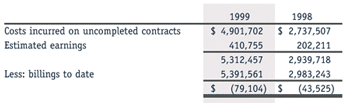
Provisions for estimated losses on uncompleted contracts are made in the period in which such losses are determined. In forecasting ultimate profitability on certain contracts, estimated recoveries are included for work performed under customer change orders to contracts for which firm prices have not yet been negotiated. Due to uncertainties inherent in the estimation process, it is reasonably possible that completion costs, including those arising from contract penalty provisions and final contract settlements, will be revised in the near-term. Such revisions to costs and income are recognized in the period in which the revisions are determined. Costs and Estimated Earnings on Uncompleted Contracts Costs and estimated earnings in excess of billings on uncompleted contracts arise when revenues have been recorded but the amounts cannot be billed under the terms of the contracts. Such amounts are recoverable from customers upon various measures of performance, including achievement of certain milestones, completion of specified units or completion of the contract. Also included in costs and estimated earnings on uncompleted contracts are amounts EMCOR seeks or will seek to collect from customers or others for errors or changes in contract specifications or design, contract change orders in dispute or unapproved as to both scope and price, or other customer-related causes of unanticipated additional contract costs (claims and unapproved change orders). These amounts are recorded at their estimated net realizable value when realization is probable and can be reasonably estimated. No profit is recognized on the construction costs incurred in connection with these amounts. Unapproved change orders involve the use of estimates, and it is reasonably possible that revisions to the estimated recoverable amounts of recorded unapproved change orders may be made in the near-term. Claims made by EMCOR involve negotiation and, in certain cases, litigation. EMCOR expenses litigation costs as incurred, although it may seek to recover these costs as part of the claim. EMCOR believes that it has established legal basis for pursuing recovery of recorded claims, and it is management’s intention to pursue and litigate these claims, if necessary, until a decision or settlement is reached. Claims also involve the use of estimates, and it is reasonably possible that revisions to the estimated recoverable amounts of recorded claims may be made in the near-term. Claims against EMCOR are recognized when a loss is considered probable and amounts are reasonably determinable. Costs and estimated earnings on uncompleted contracts and related amounts billed as of December 31, 1999 and 1998 are as follows (in thousands):
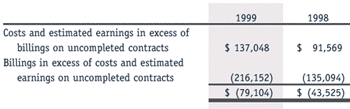
Such amounts are included in the accompanying Consolidated Balance Sheets at December 31, 1999 and 1998 under the following captions (in thousands):
As of December 31, 1999, costs and estimated earnings in excess of billings on uncompleted contracts included unbilled revenues for unapproved change orders of approximately $22.7 million and claims of approximately $17.8 million. In addition, accounts receivable as of December 31, 1999 included claims and contractually billed amounts related to such contracts of approximately $28.3 million. Claims and related amounts included in accounts receivable aggregated approximately $29.0 million as of December 31, 1998. Generally, contractually billed amounts will not be paid by the customer to EMCOR until final resolution of related claims. Classification of Contract Amounts In accordance with industry practice, EMCOR classifies as current all assets and liabilities related to the performance of long-term contracts. The contracting cycle for certain long-term contracts may extend beyond one year and, accordingly, collection or payment of amounts related to these contracts may extend beyond one year. Accounts receivable at December 31, 1999 and 1998 included $128.7 million and $91.6 million, respectively, of retainage billed under terms of the contracts. EMCOR estimates that approximately 85% of retainage recorded at December 31, 1999 will be collected during 2000. |