|



|
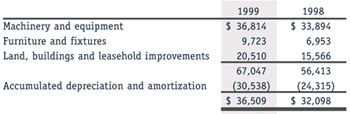
Cash and Cash Equivalents For purposes of the consolidated financial statements, EMCOR considers all highly liquid instruments with original maturities of three months or less to be cash equivalents. EMCOR maintains a centralized cash management program whereby its excess cash balances are invested in high quality, short-term money market instruments which are considered cash equivalents. At times, cash balances in EMCOR’s bank accounts may exceed federally insured limits. Inventories Inventories, which consist primarily of construction materials, are stated at the lower of cost or market. Cost is determined principally using average cost. Investments, Notes and Other Long-Term Receivables Investments, notes and other long-term receivables at December 31, 1999 was $17.4 million, representing a $10.4 million increase compared to $7.0 million at December 31, 1998, and primarily consists of investments in joint ventures accounted for using the equity method of accounting. The $10.4 million increase was primarily attributable to such investments of a company acquired by EMCOR in 1999. Property, Plant and Equipment Property, plant and equipment is stated at cost. Depreciation is recorded principally using the straight-line method over estimated useful lives ranging from 3 to 40 years. Property, plant and equipment in the accompanying Consolidated Balance Sheets consisted of the following amounts as of December 31, 1999 and 1998 (in thousands):
Goodwill Goodwill at December 31, 1999 and 1998 primarily consisted of approximately $68.0 million and $22.8 million, respectively, of the excess of cost over fair market value of net identifiable assets of companies acquired in purchase transactions. Goodwill is being amortized using the straight-line method over periods ranging from 5 to 20 years. At the end of each quarter, EMCOR reviews events and changes in circumstances to determine whether the recoverability of the carrying value of Goodwill should be reassessed. Should events or circumstances indicate that the carrying value may not be recoverable based on undiscounted future cash flows, an impairment loss measured by the difference between the discounted future cash flows (or another acceptable method for determining fair value) and the carrying value of Goodwill would be recognized by EMCOR. Through December 31, 1999, no adjustment for the impairment of Goodwill carrying value has been required. Insurance Reserves EMCOR’s insurance liability is determined actuarially based on claims filed and an estimate of claims incurred but not yet reported. At December 31, 1999 and 1998, the estimated current portion of the discounted insurance liability was included in “Other accrued expenses and liabilities” in the accompanying Consolidated Balance Sheets. The non-current portion of the discounted insurance liability was included in “Other long-term obligations.” Fair Value of Financial Instruments EMCOR’s financial instruments include accounts receivable, investments, notes and other long-term receivables, long-term debt, foreign currency contracts and other financing commitments whose carrying values approximate their fair values. At December 31, 1999, the fair value of EMCOR’s 5.75% convertible subordinated notes was $97.8 million compared to the carrying value of $115.0 million. The fair value was estimated based on quoted market prices and market interest rates as of December 31, 1999. |