|
Commitments to extend credit are agreements to lend to a customer
provided there is no violation of any condition established in
the contract. Commitments generally are extended at the then prevailing
interest rates, have fixed expiration dates or other termination
clauses and may require payment of a fee. Since many of the commitments
are expected to expire without being drawn upon, the total commitment
amounts do not necessarily represent future cash requirements.
The Corporation evaluates each customer's creditworthiness on
a case-by-case basis. The amount of collateral obtained if deemed
necessary by the Corporation upon extension of credit is based
on Management's credit evaluation of the counter party. Collateral
held varies but may include accounts receivable, inventory, property,
plant and equipment, and income-producing commercial properties.
Standby letters of credit and financial guarantees written are
conditional commitments issued by the Corporation to guarantee
the performance of a customer to a third party. Those guarantees
are primarily issued to support public and private borrowing arrangements,
including commercial paper, bond financing and similar transactions.
Except for short-term guarantees of $32.9 million and $27.6 million
at December 31, 1999 and 1998, respectively, the remaining guarantees
extend in varying amounts through 2012. The credit risk involved
in issuing letters of credit is essentially the same as that involved
in extending loan facilities to customers. Collateral held varies,
but may include marketable securities, equipment and real estate.
In recourse arrangements, the Corporation accepts 100% recourse.
By accepting 100% recourse, the Corporation is assuming the entire
risk of loss due to borrower default. The Corporation's exposure
to credit loss, if the borrower completely failed to perform and
if the collateral or other forms of credit enhancement all prove
to be of no value, is represented by the notional amount less
any allowance for possible loan losses. The Corporation uses the
same credit policies originating loans which will be sold with
recourse as it does for any other type of loan.
Derivative
financial instruments include swaps, futures, forwards and option
contracts, all of which derive their value from underlying interest
rates, commodity values or equity instruments. For most contracts,
notional amounts are used solely to determine cash flows to be exchanged.
The notional or contract amounts associated with the derivative
instruments are not recorded as assets or liabilities on the balance
sheet and do not represent the potential for gain or loss associated
with such transactions. During 1998 the Corporation entered into
swap agreements to modify the interest sensitivity of certain liability
portfolios. Specifically, the Corporation swapped $25 million fixed
rate certificate of deposits (CDs) to floating rate liabilities
and swapped $50 million of fixed rate capital securities to floating
rate liabilities. At the same time, the Corporation purchased a
$50 million interest rate cap associated with the fixed rate capital
securities. At December 31, 1999, the CD swap totaled $25 million,
the same as last year-end. The fixed rate capital securities swap
and the interest rate cap were both reduced from $50 million at
December 31, 1998 to $21.45 million at year-end 1999. The Corporation
decreased the amount of the capital securities swap and interest
rate cap by $28.55 million in connection with a corresponding decline
in the instrument being hedged by the swap and cap.
20.
Contingencies
The nature
of the Corporation’s business results in a certain amount of litigation.
Accordingly, FirstMerit Corporation and its subsidiaries are subject
to various pending and threatened lawsuits in which claims for monetary
damages are asserted. Management, after consultation with legal
counsel, is of the opinion that the ultimate liability of such pending
matters would not have a material effect on the Corporation’s financial
condition or results of operations.
21.
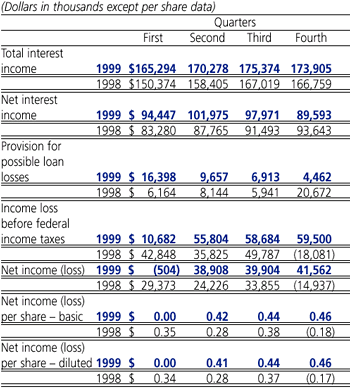
Quarterly Financial Data (Unaudited)
Quarterly financial
and per share data for the years ended 1999 and 1998 are summarized
as follows:
22.
Shareholder Rights Plan
The Corporation
has in effect a shareholder rights plan (the “Plan”). The Plan provides
that each share of Common Stock has one right attached. Under the
Plan, subject to certain conditions, the Rights would be distributed
after either of the following events: (1) a person acquires 10%
or more of the Common Stock of the Corporation, or (2) the commencement
of a tender offer that would result in a change in the ownership
of 10% or more of the Common Stock. After such an event, each Right
would entitle the holder to purchase shares of Series A Preferred
Stock of the Corporation. Subject to certain conditions, the Corporation
may redeem the Rights for $0.01 per Right.
|