18.
Fair Value Disclosure of Financial Instruments
Disclosures of fair value information about certain financial
instruments, whether or not recognized in the consolidated balance
sheets are provided as follows. Instruments for which quoted market
prices are not available are valued based on estimates using present
value or other valuation techniques whose results are significantly
affected by the assumptions used, including discount rates and
future cash flows. Accordingly, the values so derived, in many
cases,
may not be indicative of amounts that could be realized in immediate
settlement of the instrument. Also, certain financial instruments
and all non-financial instruments are excluded from these disclosure
requirements. For these and other reasons, the aggregate fair
value amounts presented below are not intended to represent the
underlying value of the Corporation.
The following methods and assumptions were used to estimate the
fair values of each class of financial instrument presented:
- Investment
securities - Fair values are based on quoted prices, or for
certain fixed maturity securities not actively traded estimated
values are obtained from independent pricing services.
- Federal
funds sold - The carrying amount is considered a reasonable
estimate of fair value.
- Net loans
- Fair values for loans with interest rates that fluctuate
as current rates change are generally valued at carrying amounts
with an appropriate discount for any credit risk. Fair values
of other types of loans are estimated by discounting the future
cash flows using the current rates for which similar loans
would be made to borrowers with similar credit ratings and
for the same remaining maturities.
- Cash
and due from banks - The carrying amount is considered a reasonable
estimate of fair value.
- Accrued
interest receivable - The carrying amount is considered a
reasonable estimate of fair value.
- Deposits
– For deposit liabilities with no defined maturities,
the fair value disclosed is the amount payable on demand as
of the dates presented. The fair values for fixed maturity
certificates of deposit and other time deposits are estimated
using the rates currently offered for deposits of similar
remaining maturities.
- Securities
sold under agreements to repurchase and other borrowings –
Fair values are estimated using rates currently available
to the Corporation for similar types of borrowing transactions.
- Derivative
financial instruments – The fair value of exchange–traded
derivative financial instruments was based on quoted market
prices or dealer quotes. These values represent the estimated
amount the Corporation would receive or pay to terminate the
agreements, considering current interest rates, as well as
the current credit–worthiness of the counterparties.
Fair value amounts consist of unrealized gains and losses,
accrued
interest receivable and payable, and premiums paid or received,
and take into account master netting agreements.
- Accrued
interest payable – The carrying amount is considered
a reasonable estimate of fair value.
- Commitments
to extend credit – The fair value of commitments to extend
credit is estimated using the fees currently charged to enter
into similar arrangements, taking into account the remaining
terms of the agreements, the creditworthiness of the counterparties,
and the difference, if any, between current interest rates
and the committed rates.
- Standby
letters of credit and financial guarantees written –
Fair
values are based on fees currently charged for similar agreements
or on the estimated cost to terminate or otherwise settle
the obligations.
- Loans
sold with recourse – Fair value is estimated based on
the present value of the estimated future liability in the
event of default.
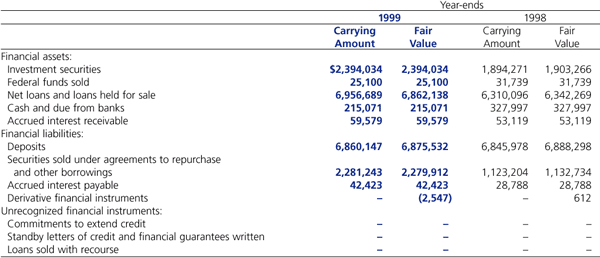
The estimated
fair values of the Corporation’s financial instruments based on
the assumptions described above are as follows:
19.
Financial Instruments with Off–Balance–Sheet Risk
The Corporation
is a party to financial instruments with offbalance-sheet risk in
the normal course of business to meet the financing needs of its
customers. These financial instruments include commitments to extend
credit, standby letters of credit, financial guarantees, and loans
sold with recourse.
These instruments
involve, to varying degrees, elements recognized in the consolidated
balance sheets. The contract or notional amount of these instruments
reflect the extent of involvement the Corporation has in particular
classes of financial instruments.
The Corporation’s
exposure to credit loss in the event of non-performance by the other
party to the financial instrument for commitments to extend credit
and standby letters of credit and financial guarantees written is
represented by the contractual notional amount of those instruments.
The Corporation uses the obligations as it does for on-balance-sheet
instruments.
Unless noted
otherwise, the Corporation does not require collateral or other
security to support financial instruments with credit risk. The
following table sets forth financial instruments whose contract
amounts represent credit risk:

|