
|
|||||||
|
 |
|
|||||


FirstMerit Corporation and Subsidiaries
Selected Financial Data (continued)
 |
|
Net interest income, on a fully tax-equivalent basis, increased $28.6 million, or 7.9%, to $388.2 million in 1999 compared to $359.7 million in 1998 and $329.3 million in 1997. The increase over 1998 occurred because the rise in interest income more than offset the increase in interest expense. Specifically, interest income rose $45.1 million while interest expense increased $14.5 million. Interest income was higher than in 1998 because average earning assets grew 11.5% or $905.5 million. The increase in average earning assets was mainly attributable to strong loan demand. Additionally, 1998’s average earning assets included the results of CoBancorp, Inc., accounted for as a purchase acquisition, from the acquisition date of May 22, 1998 through December 31, 1998, or approximately 7 months compared to a full year in 1999. Totals prior to May 22, 1998 do not include the results of CoBancorp, Inc. in accordance with purchase accounting guidelines. The overall lower interest rate environment in 1999 compared with the prior year had the following effect on interest bearing assets and liabilities. The average yield on earning assets decreased 36 basis points from 8.19% in 1998 to 7.83% for 1999. In summary, higher earning asset volumes outpaced the decline in interest income caused by lower yields on earning assets. Higher interest
expense was also volume driven as deposits and other borrowings
as well as certificates of deposits were the main funding sources
for the earning asset growth. The cost of funds for the year as
a percentage of average earning assets decreased 21 basis points
from
Changes in Net Interest Differential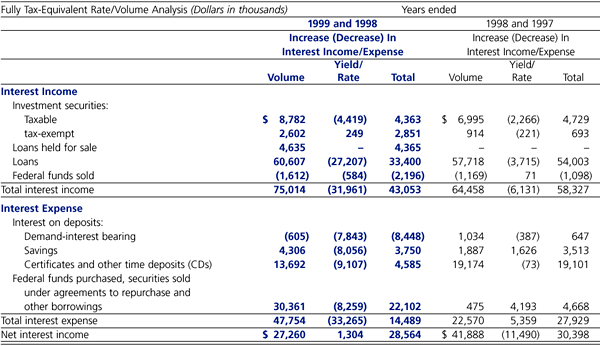
|

