|
|||||||
|
 |
|
|||||


FirstMerit Corporation and Subsidiaries
Selected Financial Data (continued)
 |
|
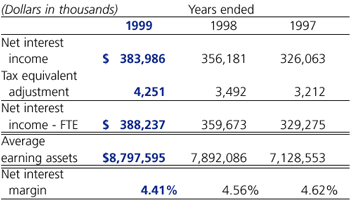
The net interest margin is calculated by dividing net interest income FTE by average earning assets. As with net interest income, the net interest margin is affected by the level and mix of earning assets, the proportion of earning assets funded by non-interest bearing liabilities, and the interest rate spread. In addition, the net interest margin is impacted by changes in federal income tax rates and regulations as they affect the tax equivalent adjustment. The net interest margin for 1999 was 4.41% compared to 4.56% in 1998 and 4.62% in 1997. As discussed previously, the decline in the net interest margin compared to last year was a result of the decline in earning asset yield outpacing the decline in earning asset funding costs.
Other Income Excluding securities
gains, other income totaled $146.2 million in 1999, an increase
of $12.8 million or
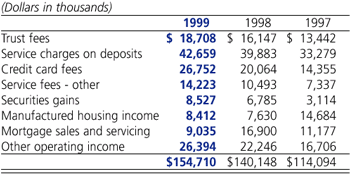
Trust fees increased $2.6 million or 15.9% to $18.7 million in 1999. The improvement is a result of market value increases in managed assets, a high commitment to quality service, our continued emphasis as being the first choice when choosing a managed asset provider, and sales volumes in excess of goals. Service charges on deposits rose $2.8 million or 7.0% compared to last year. Much of this income is based on the number of accounts and customer checking account activity. As stated throughout this Annual Report, as a general rule some portion of the increase between 1999 and prior balances is due to the May 1999 purchase accounting acquisition of CoBancorp, Inc. Credit card fees increased $6.9 million or 33.3% in 1999. A large portion of the increase was a result of increased debit card volume, much of the expansion occurring with Signal customers who did not previously have this product. The remainder of the increase was fee driven as the Corporation maintained fee structures consistent with competitors. Other service fees rose $3.7 million, or 35.5% compared to last year; major components of this category include certain ATM fees, sales commissions on personalized customer checks, and fee income from the sale of “official” bank checks. The 1999 decline in loan sales and servicing income was a result of fewer sales due to the level of interest rates in the economy. Other operating income, as presented in the table, was up $4.1 million in part because of higher letter of credit fees, introduction of our new business manager product, and higher commissions on equity and insurance sales. Excluding gains from sales of securities, other income was $146.2 million and now represents 27.4% of net revenue compared to 27.1 % last year. Net revenue is defined as net interest income, on a fully-taxable equivalent basis, plus other income, excluding securities sales gains or losses. Federal Income Tax Federal income
tax expense totaled $55.9 million in 1999, including a tax benefit
of $3.1 million associated with an extraordinary item, compared
to $37.9 million in 1998, and $56.1 in 1997. In 1999 the effective
federal income tax rate for the Corporation, excluding the extraordinary
charge, equaled Other Expenses Core other expenses excluding merger-related costs associated with the February 1999 Signal merger were $282.9 million in 1999 compared to $319.5 million in 1998 and $245.9 million in 1997. Totals for 1998 include the results of CoBancorp, Inc. for approximately 7 months and the full-year results of several smaller acquisitions that were acquired mid-year 1997. In accordance with purchase accounting rules, the results of the companies purchased are not included in results presented prior to their purchase dates. |