|
|||||||
|
 |
|
|||||


FirstMerit Corporation and Subsidiaries
Selected Financial Data (continued)
 |
|
Other
Expenses
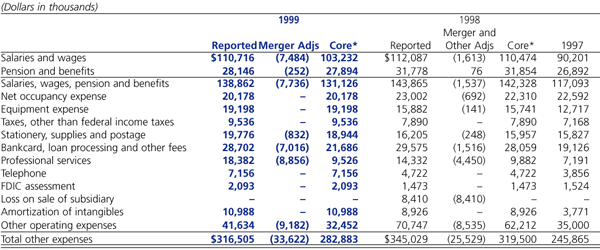
Adjusted salaries, wages, pension and benefits totaled $131.1 million in 1999, a decrease of $11.1 million or 7.0% from the corresponding adjusted 1998 costs. The decrease in salaries and wages were attributable to efficiencies gained through the Signal acquisition, lower bonus pay, and longer replacement times in filling open positions due to the low unemployment rate in our operating areas. Pension and benefit costs were also reduced by efficiencies realized in the Signal merger and longer job replacement times. Adjusted bankcard, loan processing, and other fees decreased $6.4 million to $21.7 million in 1999 as efficiencies were realized compared to pre-merger processing costs. Amortization of intangible expense during 1999 was $11.0 million compared to $9.0 million in 1998 and $3.8 million in 1997. The 1998 increase was due to the CoBancorp acquisition. The efficiency
ratio for 1999, excluding merger-related and other material unusual
costs, was 50.86% compared to 63.55% in 1998. The 1998 efficiency
ratio includes a $28.9 million pre-tax valuation charge related
to residual interest on manufactured housing asset-backed securities.
If the residual interest charge had been excluded from the 1998
efficiency ratio calculation, the resultant ratio would have been
57.69%. The “lower-is-better” efficiency ratio indicates the percentage
of operating costs that is used to generate each dollar of net revenue
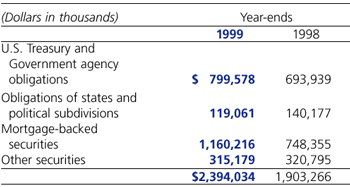
- that is, during 1999, Investment Securities The investment portfolio is maintained by the Corporation to provide liquidity, earnings, and as a means of diversifying risk. In accordance with the Financial Accounting Standards Board Statement No. 115, “Accounting for Certain Investments in Debt and Equity Securities,” securities have been classified as available-for-sale. In this classification, adjustment to fair value of the securities available-for-sale in the form of unrealized holding gains and losses, is excluded from earnings and reported net of taxes in a separate component of shareholders’ equity. The pre-tax adjustment to decrease fair value at year-end 1999 was $69.7 million and and the corresponding adjustment to increase fair value at year-end 1998 was $9.0 million. At year-end 1999, investment securities totaled $2.4 billion compared with $1.9 billion one year earlier, an increase of 27.5%. The most notable increase occurred in mortgage-backed securities which rose from $748.4 million to $1.1 billion as the Corporation securitized its own one-to-four family mortgage loans to improve liquidity and have readily available assets to pledge against potential borrowings. A summary of investment securities’ carrying value is presented below as of year-ends 1999 and 1998. Presented with the summary is a maturity distribution schedule with corresponding weighted average yields.
Carrying Value of Investment Securities
|