|
|||||||
|
 |
|
|||||


FirstMerit Corporation and Subsidiaries
Selected Financial Data (continued)
 |
|
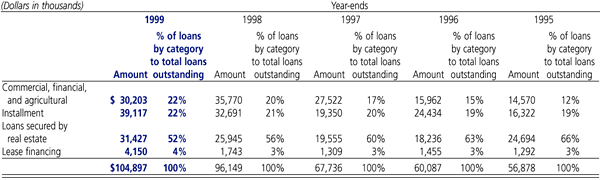
Allocation of the Allowance for Loan Losses
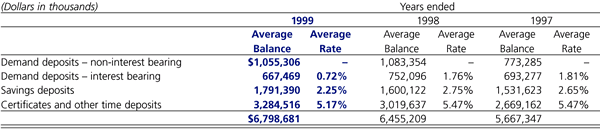
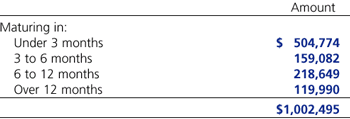
Deposits Average deposits for 1999 totaled $6.8 billion, an increase of 5.3% and 20.0% compared to 1998 and 1997 levels, respectively. Because the May 22, 1998 acquisition of CoBancorp, Inc. was accounted for as a purchase transaction, average deposits for 1998 include deposits of CoBancorp, Inc. for approximately seven months and 1997 average deposit balances do not include CoBancorp, Inc. totals at all. Savings and certificates and other time deposits (CDs) increased 12.0% and 8.8%, respectively. In addition to the impact of the CoBancorp acquisition, savings deposits rose primarily in money market type accounts. The average rate paid on all interest bearing deposits compared to the prior year reflected the overall lower interest rate environment experienced during most of 1999. Specifically, interest bearing demand deposits yields decreased considerably to 0.72%; the average yield paid on savings and money market accounts declined 50 basis points to 2.25% and the average yield paid on CDs dropped 30 basis points to 5.17%. Total demand deposits comprised 25.3% of average deposits in 1999 compared with 28.4% last year and 25.9% in 1997. Savings accounts, including money market products, made up 26.3% of average deposits in 1999 compared to 24.8% in 1998 and 27.0% in 1997. CDs accounted for 48.3% of average deposits in 1999, 46.8% in 1998 and 47.1% in 1997. The most notable shift was increased savings and money market balances, due to a broader product offering and higher rates paid on money market accounts; and higher average CD balances partially due to CD “specials” with higher rates offered at different times throughout 1999. These specials were used at various times to decrease reliance on wholesale borrowings when deemed appropriate. The average cost of deposits and other borrowings was down 39 basis points compared to one year ago, or 4.06% in 1999 compared to 4.45% last year. The following table summarizes the certificates and other time deposits in amounts of $100 or more as of year-end 1999, by time remaining until maturity.
Interest Rate Sensitivity Interest rate sensitivity measures the potential exposure of earnings and capital to changes in market interest rates. The Corporation has a policy which provides guidelines in the management of interest rate risk. This policy is reviewed periodically to ensure it complies to trends within the financial markets and within the industry. The analysis presented on the following page divides interest bearing assets and liabilities into maturity categories and measures the “GAP” between maturing assets and liabilities in each category. |