|
|||||||
|
 |
|
|||||


FirstMerit Corporation and Subsidiaries
Selected Financial Data (continued)
 |
|
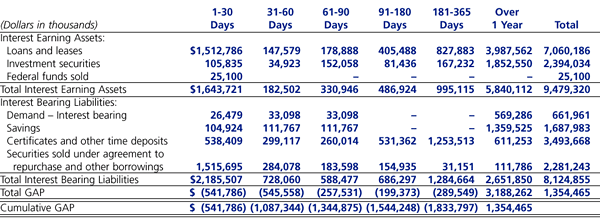
Focusing on estimated repricing activity within 90 days subsequent to year end, the Corporation was in a liability-sensitive position as illustrated in the following table:
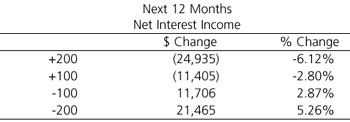
Market Risk FirstMerit is exposed to market risks in the normal course of business. Changes in market interest rates may result in changes in the fair market value of the Corporation’s financial instruments, cash flows, and net interest income. The corporation seeks to achieve consistent growth in net interest income and capital while managing volatility arising from shifts in market interest rates. The Asset and Liability Committee (ALCO) oversees financial risk management, establishing broad policies that govern a variety of financial risks inherent in the Corporation’s operations. ALCO monitors FirstMerit’s interest rates and sets limits on allowable risk annually. Market risk is the potential of loss arising from adverse changes in the fair value of financial instruments due to changes in interest rates, exchange rates, and equity prices. FirstMerit’s market risk is composed primarily of interest rate risk. Interest rate risk on FirstMerit’s balance sheet consists of mismatches of maturity gaps and indices, and options risk. Maturity gap mismatches result from differences in the maturity or repricing of asset and liability portfolios. Options risk exists in many of FirstMerit’s retail products such as prepayable mortgage loans and demand deposits. Options risk typically results in higher costs or lower revenue for FirstMerit. Index mismatches occur when asset and liability portfolios are tied to different market indices which may not move in tandem as market interest rates change. Interest rate risk is monitored using gap analysis, earnings simulation and net present value estimations. Combining the results from these separate risk measurement processes allows a reasonably comprehensive view of short-term and long-term interest rate risk in the Corporation. Gap analysis measures the amount of repricing risk in the balance sheet at a point in time. Earnings simulation involves forecasting net interest earnings under a variety of scenarios including changes in the level of interest rates, the shape of the yield curve, and spreads between market interest rates. Presented below, as of December 31, 1999, is an analysis of FirstMerit Corporation’s interest rate risk for earnings simulation for instantaneous and sustained parallel shifts in the yield curve up and down 200 basis points.
Capital Resources Shareholders’ equity at year-end 1999 totaled $833.6 million compared to $906.7 million at December 31, 1998, a decrease of 8.1%. The Federal Deposit Insurance Corporation Act of 1991 (“FDICIA”) set capital guidelines for a financial institution to be considered “well-capitalized.” These guidelines require a risk-based capital ratio of 10%, a Tier I capital ratio of 6% and a leverage ratio of 5%. At year-end 1999, the Corporation’s risk-based capital equaled 10.12% of risk-adjusted assets, its Tier I capital ratio equaled 8.81% and its leverage ratio equaled 7.47%. During 1999, the Corporation’s Directors increased the quarterly cash dividend, marking the eighteenth consecutive year of annual increases since the Corporation’s formation in 1981. The cash dividend of $0.20 paid has an indicated annual rate of $0.80 per share. Over the past five years the dividend has increased at an annual rate of approximately 9.5%. |